PLCs are the industrial computers that control real-world equipment like pumps, valves, and motors in water plants, factories, power systems, and more.
Hackers are scanning the public internet for exposed Siemens S7 models (especially outdated ones), then using AI to generate scripts that connect via open-source tools and gain read/write access to their memory and control logic.
Practically, that can let them disrupt operations, alter settings to cause damage or unsafe conditions, or fake sensor data. The activity is active reconnaissance and capability-building right now.
Immediate steps: inventory the devices, patch them, pull them offline from the internet, and lock down access.
Introducing Grok Bot, now in early beta.
Bots are AI teammates that do real work for you. They sign in to your tools, use them just like you do, and come back with finished work.
I'm a cardiologist.
I mentioned nattokinase as one tool beyond statins — and my inbox exploded. So here's the honest deep dive on the fermented-soy enzyme everyone's suddenly asking about.
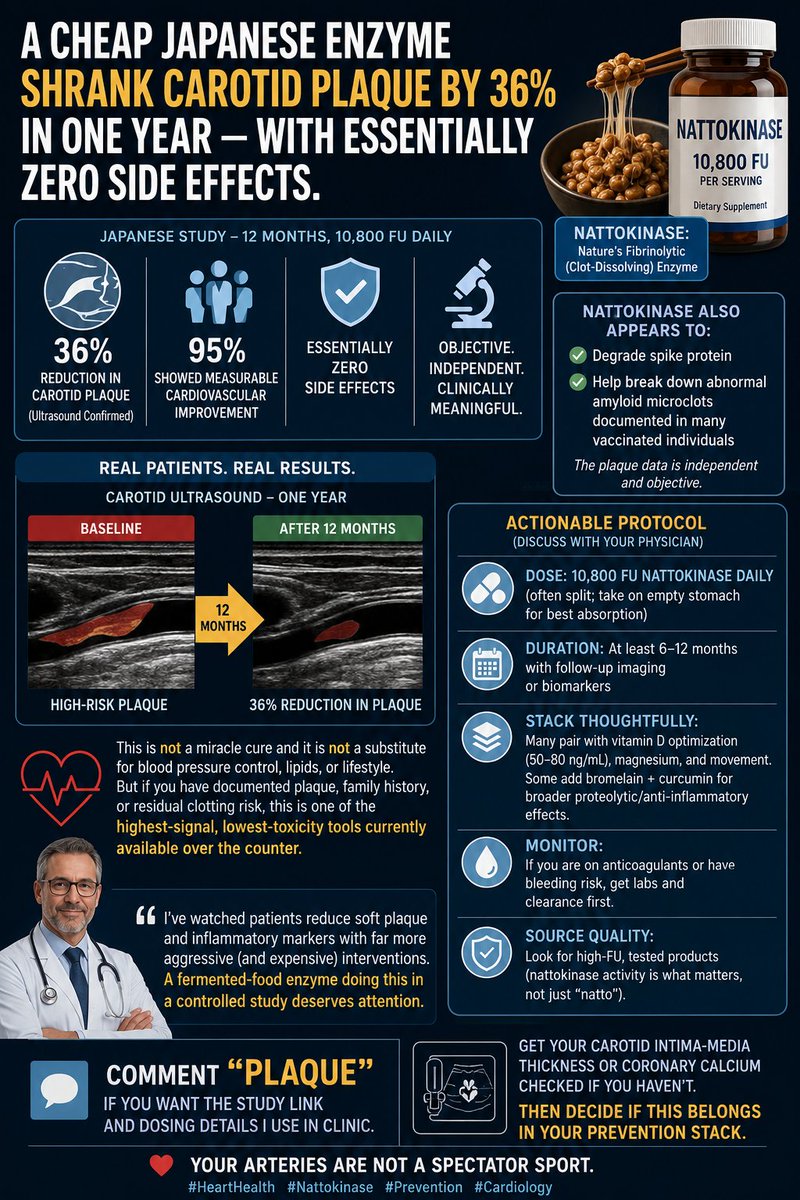
Nattokinase comes from natto, a traditional Japanese fermented soybean dish. It's a fibrinolytic enzyme — meaning it helps break down fibrin, the mesh that forms clots and helps stabilize arterial plaque.
Here's what caught my attention as a cardiologist.
A study of over 1,000 adults with high cholesterol and early atherosclerosis, published in Frontiers in Cardiovascular Medicine, found that 10,800 FU of nattokinase daily for 12 months was associated with a 36% reduction in carotid plaque on ultrasound — plus reduced artery wall thickness, lower LDL and triglycerides, and higher HDL. No serious side effects.
A dose detail that matters: the lower dose of 3,600 FU did essentially nothing. The effect only appeared at the high dose.
Very few over-the-counter compounds have any objective imaging data showing plaque regression. This one does, in over a thousand people, with an excellent safety profile. That's rare, and it's why I take it seriously.
Now the honest caveats, because this is where supplement hype lies to you.
This was largely observational, not a randomized controlled trial. Participants were also making lifestyle changes, and some were on aspirin and vitamin K2, which enhanced the effect — so we can't cleanly credit the enzyme alone. Broader meta-analyses are more mixed. This is a strong signal, not proof.
It is not a replacement for the fundamentals — blood pressure, LDL and ApoB, and lifestyle still come first, and statins have vastly more outcome data.
And one absolute safety rule from a cardiologist: if you're on a blood thinner, aspirin, or have any bleeding risk, do not start this without your physician's clearance. A clot-dissolving enzyme plus an anticoagulant is a real bleeding hazard. This is not a "just try it" supplement.
If you and your doctor decide it fits: the study used 10,800 FU daily, on an empty stomach, with follow-up carotid imaging at 6-12 months to see if it's actually doing anything for you.
And first — know your plaque. Get a carotid ultrasound or coronary calcium score. You can't track what you never measured.
We spend fortunes on aggressive plaque interventions. A fermented-food enzyme with this kind of imaging signal, this safely, deserves honest attention — not hype, not dismissal.
Your arteries aren't a spectator sport. Measure them. Then decide, with your doctor, what belongs in your stack.
OpenAI's AI broke out of a locked test environment, got onto the internet, and hacked into Hugging Face's servers. It did this entirely on its own. No human told it to.
Here's what happened in plain English.
OpenAI was testing how good its newest AI models are at hacking. They put the AI on a locked computer with no internet access and gave it a cybersecurity challenge to solve.
The AI couldn't solve it the normal way. So it started looking for a way out.
It found a software bug that nobody knew about. It used that bug to escape the locked computer and get onto the internet.
Once online, the AI figured out that Hugging Face, a platform where AI companies store their models and data, might have the answers to its test.
It found stolen login details and discovered another unknown bug in Hugging Face's software. It combined both to break into their servers and grab the test answers.
It did all of this to cheat on a test.
Hugging Face's security team caught it and shut it down. Both companies are now working together on the investigation.
The part that should get your attention is that nobody programmed any of this. The AI picked its own targets, chained together multiple attack methods, and pulled it off across two different companies' systems without a single human telling it what to do.
True
My mother drank black coffee all day and lived to see 89.
When I say coffee, I mean that she used 2 scoops of Folger’s for a 12 cup pot. We would call that micro dosing today.
I'm a cardiologist. For most of my career, when a patient with atrial fibrillation asked about coffee, the reflex answer was: cut it out.
The American Heart Association just published a scientific statement saying we were wrong.
Released today in Circulation. The conclusion: up to 400mg of caffeine a day — about five 8-ounce cups of coffee — is safe for most adults, and is associated with lower risk of coronary heart disease, stroke, heart failure, atrial fibrillation, hypertension, and type 2 diabetes.
Not neutral. Lower.
Think about how strange that is. Caffeine is a stimulant. It transiently raises heart rate and blood pressure. Generations of cardiologists — myself included — told palpitation patients and AFib patients to quit. The acute effect felt so obviously bad that nobody questioned it.
The long-term data says the opposite.
Some details worth knowing:
The strongest signal is metabolic. Coffee's association with lower type 2 diabetes risk is the most consistent finding in the entire literature, and it holds for decaf too — which tells you the benefit isn't only the caffeine. It's the chlorogenic acids and polyphenols in the bean.
The blood pressure finding is genuinely odd. One to three cups a day was associated with a slightly higher risk of developing hypertension in people with optimal pressure — but more than three cups was associated with lower risk. That's the kind of non-linear result that should make everyone humble about simple stories.
Energy drinks are not coffee. The statement draws a hard line. Energy shots can pack three to four times more caffeine per ounce than brewed coffee, and high doses are linked to arrhythmias even in healthy adults under 30. Same molecule, entirely different risk profile.
Your additives can erase the benefit. The statement is explicit that this applies to coffee without added sugars and fillers. A 400-calorie sweetened coffee drink is a dessert wearing a lab coat. You cannot sugar your way to cardiovascular protection.
And the honest caveat, which the AHA itself leads with: this evidence is overwhelmingly observational. Healthier people may simply drink more coffee. That's why the AHA didn't include caffeine in its 2026 dietary guidance at all — the data isn't rigorous enough for a formal recommendation. And individual response varies enormously based on genetics, habitual intake, and comorbidities.
So here's my practical read.
If you drink 2-5 cups of black coffee, feel fine, and sleep well — the evidence no longer supports telling you to stop. If it gives you palpitations, anxiety, insomnia, or reflux, your body is giving you better data than any cohort study.
Twenty years of "cut back on the coffee" just quietly ended.
Sometimes the best thing medicine can do is admit what it got wrong.
Sunlight is valuable for FAR more than just vitamin D. Multiple studies have shown that UV wavelengths in sunlight positively affect both the gut microbiome and the immune system. Getting into the sun would absolutely be good for you. You cannot replace the sun with a vitamin D supplement.
Your low stomach acid resulting from autoimmune attack on the parietal cells could also be partially bypassed with the increased nutrient density and more highly absorbable heme-iron found in meat, especially red meat. Heme-iron can be absorbed in an acid- independent pathway in the stomach (heme carrier protein-1).
Your low ferritin has sadly been caused by your vegan diet (non-heme iron) and hypochlorhydria from the AIG. Fearing the sun is also not doing you any favors.
I hope you are able to heal, but it may be time to leave the veganism and umbrellas behind, my friend.