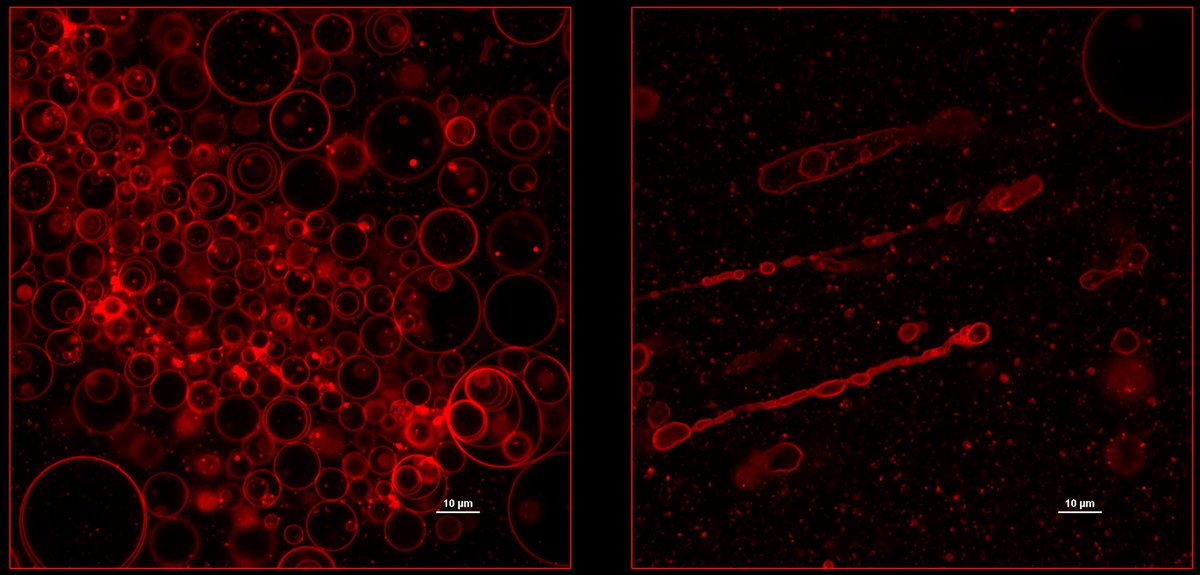
Seeing is believing. We show complex behavior of lipids in concentrated sulfuric acid, including vesicle formation and quasi "prebiotic cell-division".
Special thanks to Daniel Duzdevich, Collin Nisler and others from prof. Jack Szostak lab.
https://t.co/W7MQTm8Sft
Life hinges on genetic polymers capable of encoding biological complexity. PNA—a structural cousin of DNA—can endure 98% sulfuric acid. We’ve started a new chapter on the potential of sulfuric acid as a solvent for life. https://t.co/mkbQ751QYd
Some dipeptides are stable in 98% sulfuric acid. We now know why. We are closer to true sulfuric acid biochemistry. Our paper describing the unexpected behavior of dipeptides in concentrated sulfuric acid got selected for a cover. https://t.co/4yg2UyJED2 @ACSPublications
Venus is a step closer.
We’re embarking on the first private Venus mission and sending a probe into the Venusian atmosphere to search for signs of microbial life. Recently the probe’s heatshield, a crucial component that will protect the capsule as it passes through the volatile clouds above Venus’ surface, completed a fit check by engineers at @NASAAmes.
Learn more: https://t.co/B1xlRs5JNe
Preparing for Venus 🚀
Our engineers installed a NASA-designed heat shield on a private spacecraft that will study the clouds of Venus for signs of life. This woven heat shield is designed to protect the craft from temperatures of up to 4,500 degrees Fahrenheit. https://t.co/AmQzV1BmJP
Our most recent work shows that some peptide bonds are perfectly stable in 98% sulfuric acid for many months, if not longer. This is another step towards true biochemistry in this aggressive solvent.
https://t.co/4yg2UyKcsA
Great collaboration with Daniel Duzdevich, Collin Nisler and others from prof. Jack Szostak lab. We show complex behavior of lipids in concentrated sulfuric acid, including vesicle formation. Another step closer to biochemistry in this unusual solvent.
https://t.co/JMU8jgJRn5
@jgreaves6@REasther@IbnulHussaini@chrislintott ...note that PH3 cannot be efficiently produced by Venusian volcanoes. Venusian PH3 also cannot be made by disproportionation of P4O6. These ideas were quite often floated on the internet. A summary of the PH3 debate to date can be found here: https://t.co/XpteoEPNhs
@jgreaves6@REasther@IbnulHussaini@chrislintott ...and I am rushing with an answer: No solidly established pathway of abiotic PH3 formation on Venus is known, but of course it is an active field of study with interesting ideas that await experimental confirmation, for example: https://t.co/b0SZIeG48H
We are at the dawn of a new branch of Astrobiology and a new branch of organic chemistry. The study organic chemistry in other solvents than water is crucial for the true understanding of the habitability of the Galaxy. H2O doesn't necessarily have to be the only solvent for life
We continue our quest to understand organic chemistry in concentrated sulfuric acid to inform the science objectives of the future space missions to Venus. This time we show that 19 out of 20 amino acids present in proteins are stable in H2SO4.
https://t.co/yjEMNTz4eo
Concentrated sulfuric acid differs vastly from aqueous or diluted acid solutions, which challenge typical organic and biochemistry assumptions. Studying organic chemistry in pure sulfuric acid requires a direct, unbiased approach, without prior preconceptions and assumptions.
Can life be based on other solvents than water? Can life change its solvent during the course of evolution, and undergo solvent replacement, an idea that might sound crazy, but is it really? Just today our new paper on this topic got published on arXiv: https://t.co/jsCvDMCo29
"Thus, (...) hot strongly acidic nonaqueous Venusian clouds are better environments to generate complex organic chemistry than the cold slightly alkaline water often invoked as environments where life may have arisen on Earth." work by Jan Spacek and team.
https://t.co/HFblqpJFXv
Thanks @ProfSaraSeager for joining me for a fascinating conversation about Exoplanets and Life beyond Earth. Special shout-outs to @DrFunkySpoon@jjpetkowski@c_e_carr and collaborators for inspiring the conversation!
https://t.co/dhiXYCjRkf
Our new paper, on P4O6 and planetary science.
"We show that, regardless of the value of ΔGo(g) for P4O6 assumed, the formation of phosphine from P4O6 in the Venusian atmosphere is thermodynamically unfavorable."
Venusian PH3 source is still a mystery.
https://t.co/7ObQX4wtJv