Research Fellow @IFPRI working on governance & service delivery, political economy, and voice & inclusion. Former @OMBPress @InstituteGC. Mother of daughters.
IFPRI researchers employed WEAGov as they joined forces with @AWARDFellowship's Gender Responsive Agriculture Systems Policy (GRASP) Fellowship Program in a virtual workshop on June 21.
Learn more in this new blog: https://t.co/KIY4xRciuQ
@CGIAR@jkyleindc@crragasa@Dorinebolo
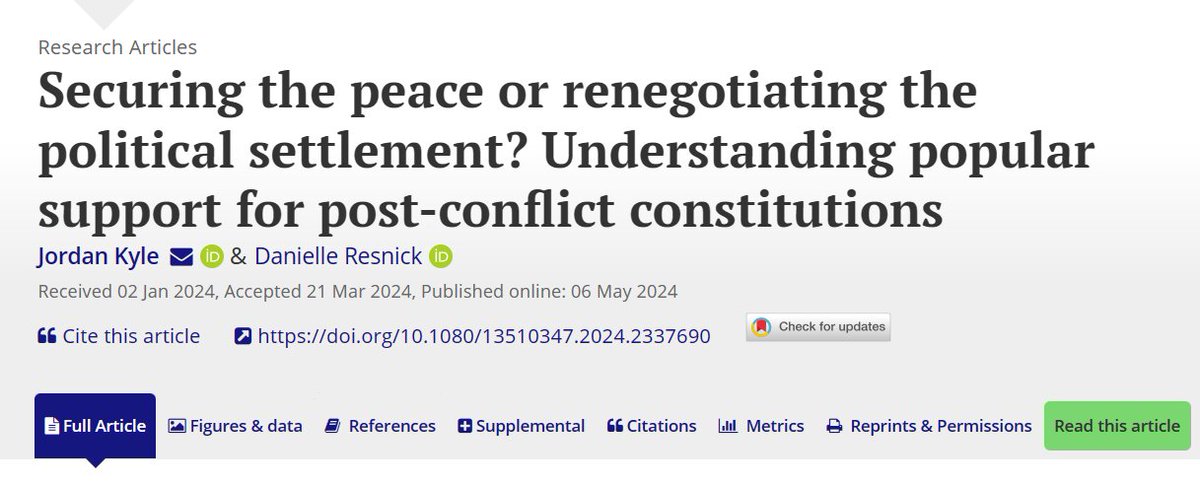
#NowReading Securing the peace or renegotiating the political settlement? Understanding popular support for post-conflict constitutions.
🖋️By Jordan Kyle and Danielle Resnick.
🔗https://t.co/vBftBFlOwF
@CGIAR@jkyleindc@D_E_Resnick
In this presentation on how researchers can help reduce administrative burden through the public comment process, I outlined 3 key ways for scholars to provide effective public comments:
Please join this afternoon for this opportunity to learn more about how to connect evidence to policy impact! One part of my job at @OMBPress was reading public comments submitted thru this process and helping agencies to meaningfully respond to evidence & public concerns
Policy impact can be non-linear and hard to see from the outside. Ideas submitted through one window can fuel more ideas in a completely different policy area where processes may be similar. A great line up of speakers at this webinar will provide 🔑insights to maximizing impact
Please join this afternoon for this opportunity to learn more about how to connect evidence to policy impact! One part of my job at @OMBPress was reading public comments submitted thru this process and helping agencies to meaningfully respond to evidence & public concerns
policy feedback effects, coalition dynamics, & influence of economic interests on policymaking that can bring a lot to this v important conversation when joined with expertise from economics on the effects of economic policies on wages, labor markets, consumption & well-being
A must-read! Important & insightful new paper from @gamblingondev on the political economy of economic policy advice, arguing that if researchers really care about impact we need to think about 2nd best solutions that are more politically feasible. A few thoughts:
Researchers love to offer '1st best' advice to policymakers & then walk away when advice is ignored due to political incentives.
If we care about impact, let's carefully look at what a 2nd best -accounting for pol. constraints- looks like.
And then give 'subversive' advice.
I would really like to see more interdisciplinary work between economists and political scientists on the 'political economy of economic reform.' There is a lot of political science lit on credible commitments, intertemporal challenges in policymaking, state capacity...