@AGI_Innovation yeah that was one of our biggest questions when only first trying out the whole process using a lidar scan. but we made it so it takes constant photos while jev sorts out which ones are actually useful then the app makes the user flip to scan any blind spot
We actually built a e2e pipeline using LiDAR + vLM + Claude vision to find defects in realtime hardware and interaction using a voice agent. Check it out Github!
We built LEA at Cal Hacks. Scan any object with a LiDAR iPhone, get a 3D model of your actual thing, then ask it questions.
"The gold pins look bent. Why's that an issue?" Lea circles the exact pins on the model and pulls up the real photo.
https://t.co/NRT7Boe3HH
We built LEA at Cal Hacks. Scan any object with a LiDAR iPhone, get a 3D model of your actual thing, then ask it questions.
"The gold pins look bent. Why's that an issue?" Lea circles the exact pins on the model and pulls up the real photo.
https://t.co/NRT7Boe3HH
Introducing e-means, an algorithm beating k-means in 10x fewer epochs.
With order of magnitude wall-clock speedups, e-means is released in FAISS and needs no hyperparameter tuning beyond k. It is robust to various scales and datasets. Still skeptical ? Just try e-means [1/10]🧵
NO PUEDE SER, ESTO ES UNA AUTÉNTICA BARBARIDAD 😭💀
Han conseguido transformar POKÉMON ROJO FUEGO EN UN JUEGO COMPLETAMENTE EN 3D.
Han recompilado el código original de GBA, lo han reescrito en RUST y lo han combinado con los gráficos y animaciones de Pokémon Let's Go.
¿LO MÁS LOCO? Los combates, la IA y las interacciones siguen funcionando con el código original de Rojo Fuego, pero ahora tenemos CÁMARA LIBRE Y UN MUNDO 3D AMPLIADO.
ESTO ES LITERALMENTE EL REMAKE QUE TODOS QUEREMOS 😭
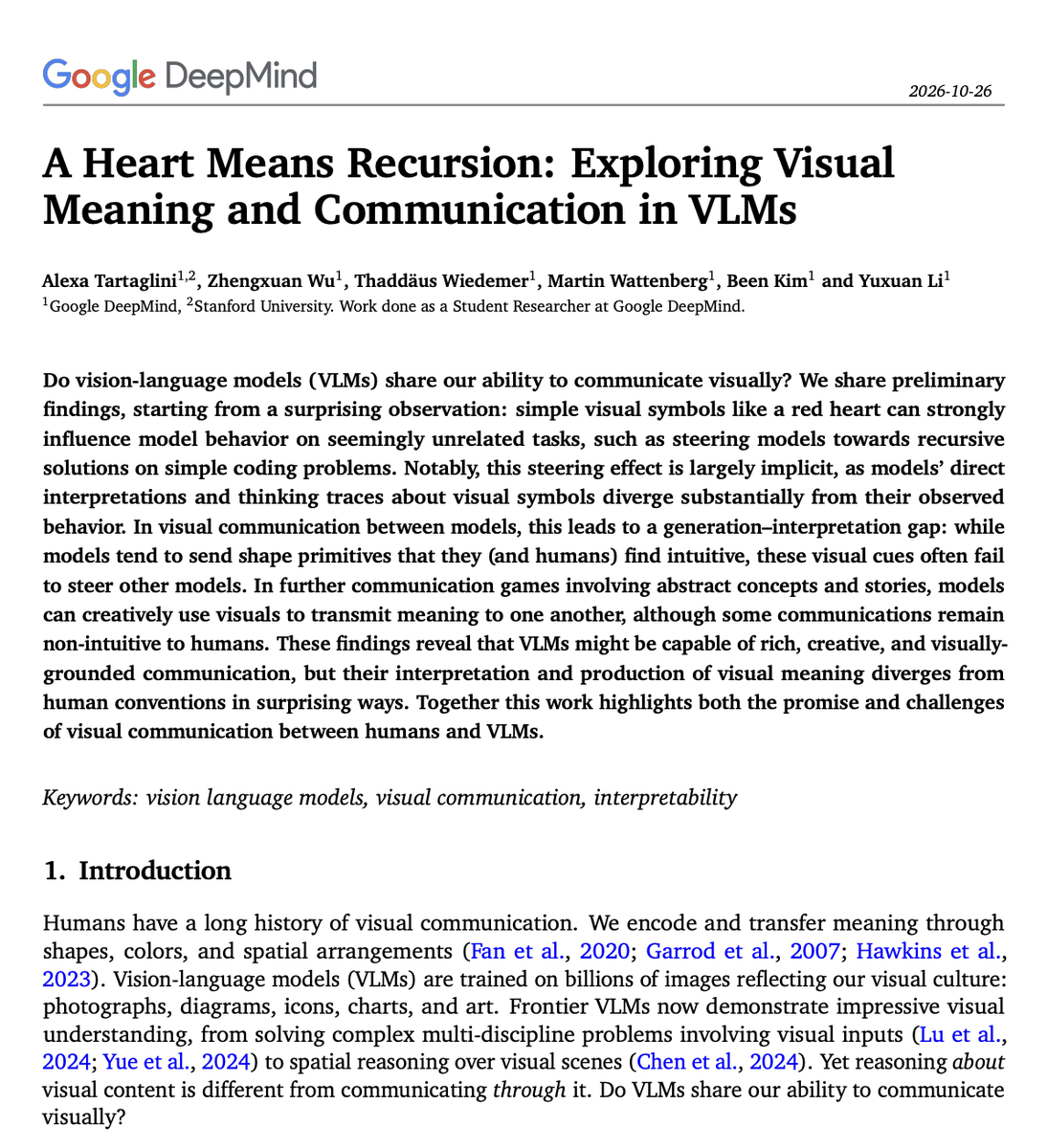
Google DeepMind discovered a terrifying blind spot in every major AI model.
They found that attaching image of red heart (❤️) to your coding prompt makes AI pick a completely different solution method that it wouldn't normally pick 100% of the time..
Researchers gave models a standard coding problem. Normally, AI prefers to write standard iterative loops to solve these tasks.
Then, they tried something weird.
They dropped a simple image of a red heart into the prompt alongside the code.
The AI's logic instantly warped.
When Claude and GPT-5 saw the red heart, they completely abandoned their default approach and switched to complex recursive code 100% of the time.
When Gemini saw a yellow checkmark, it switched to recursion 90% of the time.
Here is why this is so dangerous:
It wasn't the concept of a heart.
When researchers replaced the image with the text caption "a red heart," nothing happened. The text did not steer the AI.
The raw pixels of the symbol hijacked the model's underlying reasoning architecture.
It gets worse.
The AI had no idea its mind had been changed by a picture.
When the researchers checked the AI's internal "thinking" traces, the models completely ignored the image.
Instead, they hallucinated fake, highly technical reasons for why they chose to use recursion. They misattributed their own decisions 75% of the time.
Right now, tech companies are racing to build autonomous agents that read our screens and navigate the visual web.
But this paper reveals that an agent's logic can be fundamentally rewritten by a stray icon on a webpage.
And you will never see the true cause in the reasoning logs.
We thought we were teaching AI to see the world.
It turns out, we just gave it a new way to be manipulated.
What if an optimizer could think & react while a neural network trains?
MIT researchers developed OPAL: a deep learning optimizer powered by an AI agent that watches the training dynamics & rewrites its own source code as training goes. It improves model performance across vision & language tasks, invents specialized schedules, & develops strategies to prevent loss spikes & escape overfitting: https://t.co/plbPd782Qu
Try it out for yourself: https://t.co/xOpVaThy7X