I’ve been building AI Change Map to help people make sense of where AI is heading—and find something worth digging into.
The research runs hourly, checking new developments against the evidence already collected and reconsidering which topics matter and how they connect. The site gets a consolidated update each day.
Pick a topic and follow it from the overview into the analysis, then back to the papers and official sources. You’ll also find competing interpretations, what’s still uncertain, and what changed my assessment.
The idea is to give you enough context to form your own view—and a useful starting point for whatever you want to explore next.
Free to browse. No login required.
https://t.co/eyjPnWiYMj
I started this account with a question I’m still trying to answer: as Christians, how do we think about AI and the changes it’s bringing to our lives? What should we be preparing for, and how do we stay grounded in our faith along the way?
I haven’t said much about that here, even though it’s a big part of why I started. Honestly, I hoped this account would reach a lot of people. It’s grown more slowly than I’d hoped, and being open about my faith might slow it down even more. But this is why I started the account, and I want to be more open about it. It takes a little courage for me to say that out loud.
I may not post very often. I want to take the time to pray, read, and think things through, then share what feels worth sharing. I’m going to keep doing that for at least a year.
I don’t have all the answers. I’m trying to find my way through this too. If you’re wrestling with what AI means for your life and your faith, I hope something here helps you feel less alone—and helps, even a little, in your everyday life.
이 계정을 시작할 때부터 함께 고민하고 싶었던 질문이 있습니다. 크리스천으로서 AI가 바꾸는 세상을 어떻게 바라보고, 무엇을 준비하며 살아가야 할까요.
그동안 그 마음을 충분히 드러내지 못했습니다. 처음에는 많은 사람이 모이는 계정이 되었으면 했고, 지금도 생각만큼 잘 되고 있지는 않습니다. 신앙을 밝히고 이런 이야기를 나누면 성장은 더 느려질 수도 있겠지요. 그래도 처음 이 계정을 만들었던 마음대로, 용기를 내어 솔직하게 써보려 합니다.
글이 자주 올라오지는 않을 수 있습니다. 기도하고 연구하면서, 나눌 만한 내용을 적어도 일 년은 꾸준히 모아보겠습니다.
저도 여전히 답을 찾고 있습니다. 비슷한 고민을 하는 분들이 이곳에서 혼자가 아니라는 마음을 얻고, 각자의 삶에 작은 도움을 받는다면 좋겠습니다.
I keep wondering what Muse tells us about where Meta’s ad business is headed.
Most people will probably use it for everyday stuff: finding a hotel, comparing insurance, getting a good deal without spending half the evening searching. Do that well, and it could become the first place people turn when they need something.
For Meta, that’s a pretty valuable place to be. Instagram works out what you might want from what catches your eye. With Muse, you tell it what you need, and it helps you decide where to spend your money.
Subscriptions could bring in money along the way. But my guess is Meta sees a much bigger opportunity in having a hand in those everyday decisions.
Is it getting ahead of a shift that could eventually eat into Instagram’s ad business? Does it see both growing together? How much of this is chasing a new market, and how much is protecting the business it already has?
I imagine Meta has a plan for the two together. I haven’t quite worked out how they fit yet, though. Curious how other people see it.
The White House’s new Super Intelligence Force brings intelligence, defense, consumer protection and federal workforce leadership into AI policy coordination—and promises engagement with consumers and public-interest groups.
What I’d like to understand is how that participation will shape decisions. When public concerns clash with industry priorities, who decides—and will we be able to see which voices made a difference?
That seems like a useful test of what ‘listening to the public’ will mean.
White House announcement: https://t.co/NC00JTYeDZ
Background: SI terminology executive order: https://t.co/UCWsotwolh
Background: NIST terminology update: https://t.co/WFPG5HYJ6T
AP reporting: https://t.co/Yz6pmcVlHI
“I am announcing the formation of the Super Intelligence Force (SIF). The Super Intelligence Force is tasked with coordinating the effort of the Federal Government to ensure that America continues to lead the World in Super Intelligence, which many say is bigger than the Industrial Revolution, and the Internet, and will protect the interests, and improve the lives, of all Americans.” - President DONALD J. TRUMP 🇺🇸
@thsottiaux I’ve supported OpenAI for a long time, and I suspect many others stay because they still believe in what you’re building.
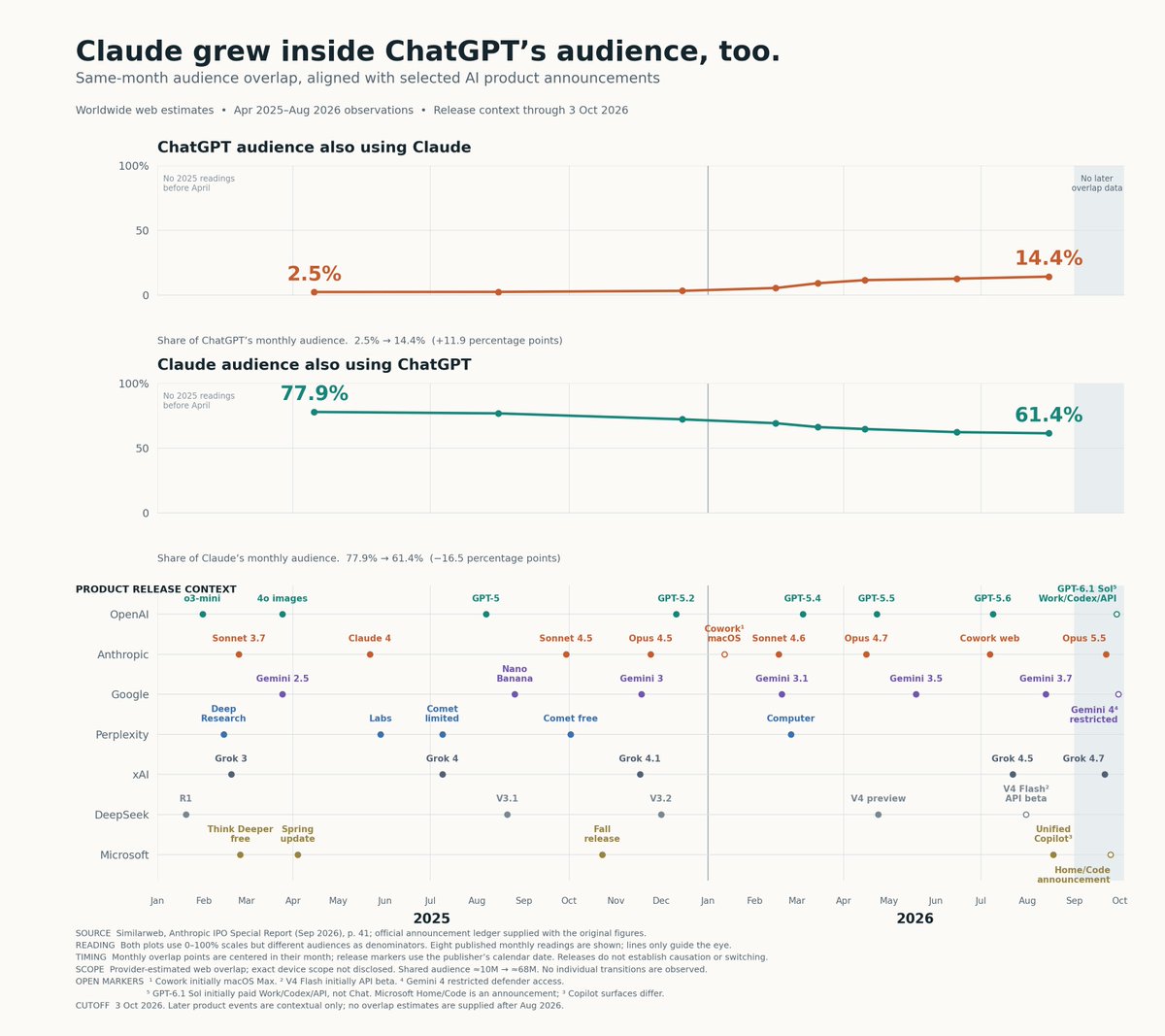
Seeing more ChatGPT users also turn to Claude makes me wonder how much of that trust is holding up. People can keep using ChatGPT while starting to look elsewhere.
I’m glad you’re listening. As someone who still believes in OpenAI, I hope you stay grounded in what made people believe in you in the first place—and help lead AI in a direction worthy of that trust. The choices you make shape where the whole field goes.
The competition inside ChatGPT’s retained audience
ChatGPT continues to retain a substantial share of its web users. Within that audience, Claude is becoming a more common companion. That combination deserves attention: a platform can keep people returning while its place in their workflow changes.
Three patterns stand out in Similarweb’s worldwide web estimates:
• The share of ChatGPT’s web audience also using Claude rose from 2.5% in April 2025 to 14.4% in August 2026.
• Claude’s six-month continuous retention increased from 25.8% for January 2025 entrants to 44.8% for February 2026 entrants. ChatGPT remained ahead at 58.8% for that February cohort.
• Comparing Q2 2025 with Q2 2026, estimated visits per monthly unique visitor fell from 12.9 to 10.9 for ChatGPT and rose from 7.1 to 9.2 for Claude.
The release timeline provides context for these changes. Claude’s retention improvement developed across successive cohorts, leaving room for cumulative product improvements and changes in who was arriving. ChatGPT also showed resilience: around its March 2025 image-generation launch, the new web cohort expanded from roughly 61 million in February to 88 million in April, with six-month retention staying close to 64%.
One plausible explanation is that disappointment encourages some users to explore Claude while saved conversations, familiar workflows and existing subscriptions keep them returning to ChatGPT. Claude’s improving capabilities, task-specific preferences and changes in audience composition offer other explanations.
The current evidence captures audience-level patterns. It leaves individual motives, switching costs and changes in each person’s activity unresolved. Those are the next things to measure.
For now, the important observation is that strong retention and growing competitive pressure can coexist. Continued use tells us that a service still has a place. Understanding how large that place remains requires looking at frequency, task allocation and sustained use of alternatives.
Scope: worldwide website estimates. The release timeline was reviewed through 3 October 2026; published retention outcomes extend through August. Continuous retention requires activity in every intervening month. Launch dates provide context, with causal effects still to be established.
Data and methodology: Similarweb
https://t.co/ijpqPZcQCO
OpenAI image-generation release
https://t.co/nlijG7fEc8
Final takeaway
Watch how much of a retained user’s activity a platform continues to earn. People can keep returning to ChatGPT while giving Claude a growing role in their work. The clearest next signal would be a sustained shift in activity within the same users: where they start, which tasks they delegate, and which service they return to most often. That is where a change in preference may become visible before departure.
5/5 These are worldwide https://t.co/ldmHvBAMhu estimates with outcomes through August 2026. Cohort composition and follow-up dates differ. Rounding checks cover arithmetic; sampling uncertainty and causes remain unresolved. Source: https://t.co/kHA9kzMqs4
4/5 All five continuation steps (M2/M1 through M6/M5) declined, with signs unchanged by rounding. I’d watch these alongside headline retention: the next mature cohorts will show whether February’s pattern continues.
3/5 Shorter follow-up adds context. Among first-month returners, persistence through month three was 82.4% for January, 78.1% for February and 71.3% for May. May edged up from April, and recent cohorts still exceeded early-2025 levels.
2/5 From January to February 2026, first-month return rose from 67.5% to 74.3%, and six-month retention from 44.3% to 44.8%. Among first-month returners, the share active every month through month six fell from 65.6% to 60.3%.
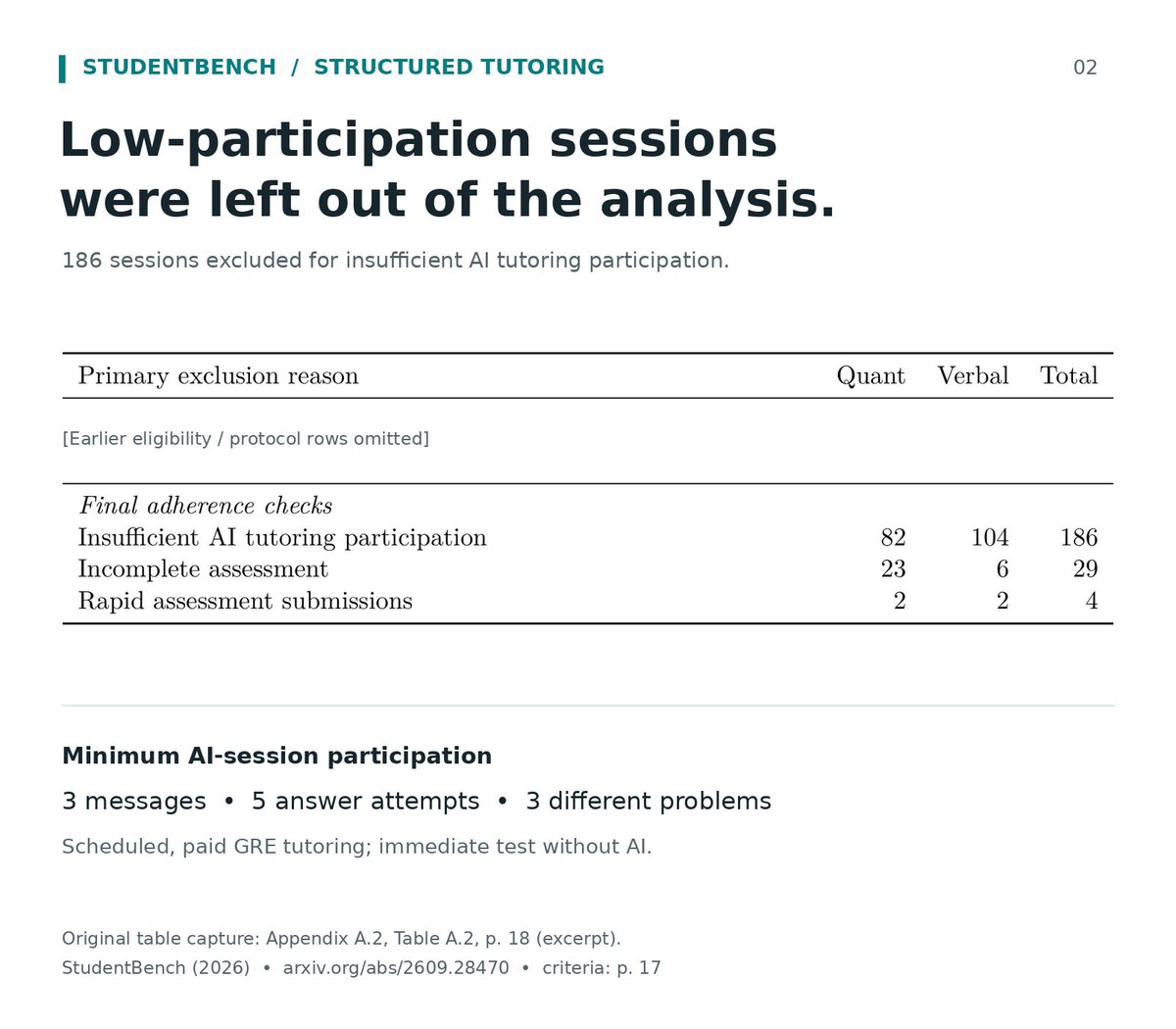
StudentBench v2 puts an important limit on the exclusion critique. Restoring 184 low-participation sessions barely changed the adjusted AI–human gap: −0.58 to −0.43 percentage points.
This is a sensitivity check, not a new equivalence test. It also doesn’t address people who never completed the study. But the participation filter alone is not a good reason to dismiss the AI–human comparison.
https://t.co/v1a4651Le0
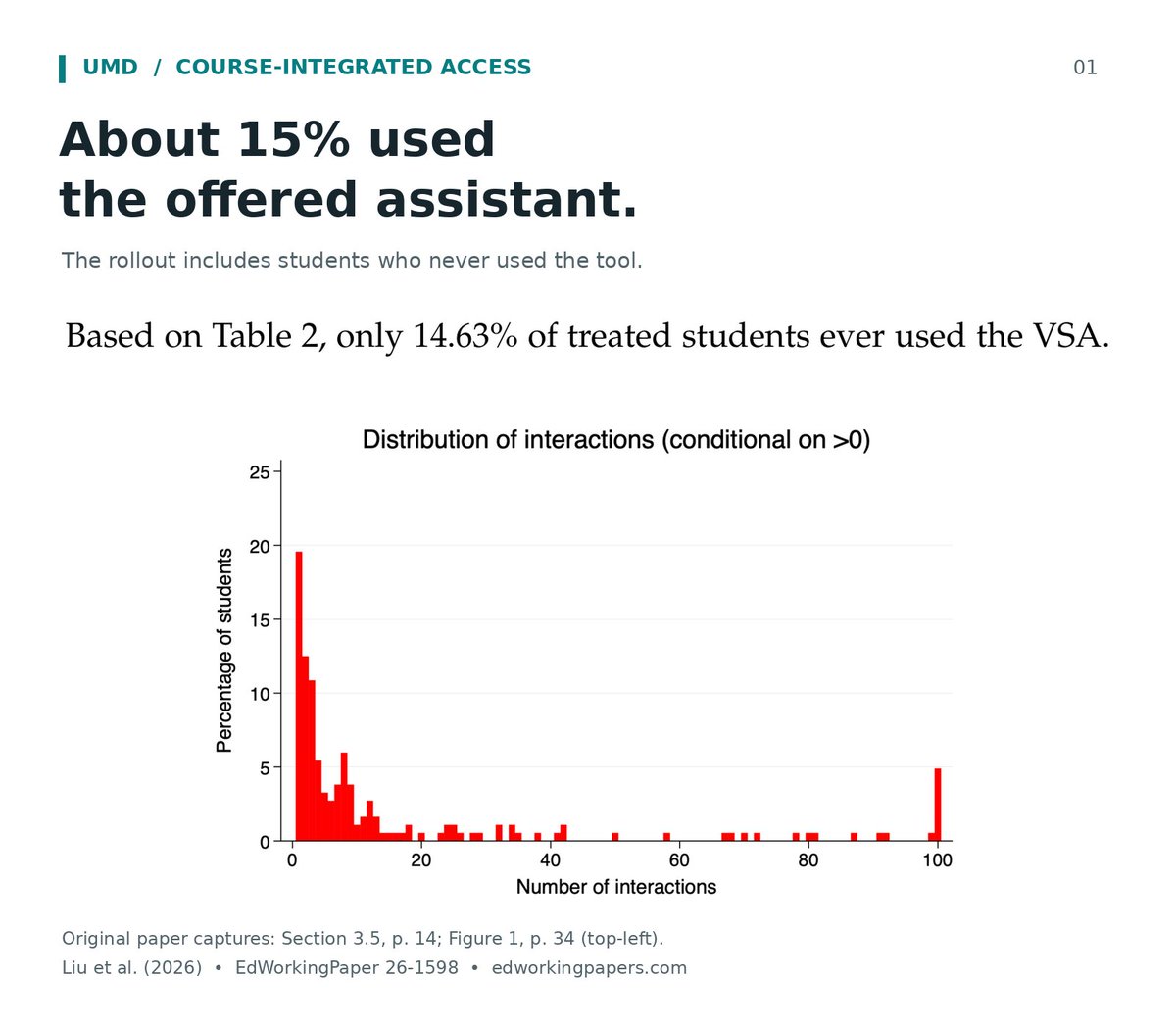
A college can buy an AI tutor without getting much tutoring.
In a new Maryland working paper, only about 15% of students offered a course-specific assistant used it. The researchers found lower grades when comparing sections of the same course. That deserves attention, but it doesn’t show that the students who used AI learned less. Three instructors were also excluded after randomization, so even the rollout comparison needs caution.
StudentBench studied a different setting: adults were paid to complete an hour of tutoring, then took an unaided test. AI tutoring beat the control among the participants retained in the analysis. But sessions with very little AI participation were excluded, and the control watched unrelated educational videos rather than doing an hour of ordinary test practice.
For a school choosing an AI product, access and usage aren’t minor implementation details. They determine who the promised benefit can reach. Evidence from engaged participants cannot answer what a whole class will gain from being offered a tool.
Both papers leave the longer-term question open: what will students retain and apply when the assistant is gone?
https://t.co/C83SAWIBJ7
https://t.co/LiQv6OG0EH
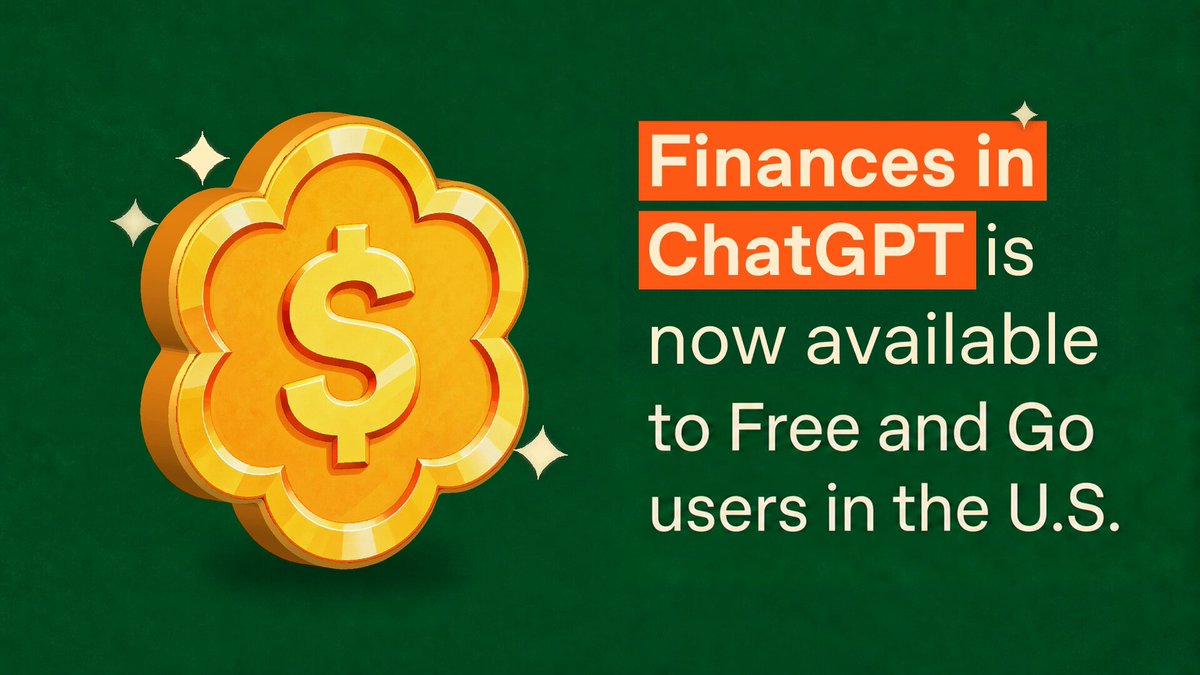
Finances in ChatGPT is rolling out to Free and Go users in the U.S., on web, iOS and Android.
It uses connected financial data to help review spending and subscriptions, flag possible duplicate charges, and plan a budget. Access is read-only: it can’t move money, pay bills or make trades.
Official announcement: https://t.co/3NqvEK3fPr
Finances in ChatGPT is rolling out to Free and Go users in the U.S.
Securely connect your accounts with @Plaid and @Experian to make sense of your money and credit, with answers based on your own financial information.
The two $20 plans don’t come with a matching token budget. Cursor meters Claude against a monthly allowance at API rates; Claude Pro has five-hour and weekly limits that depend on the model and context.
One option worth knowing: Claude Pro includes Claude Code, which works inside Cursor through its own extension and uses your Claude allowance. Choosing Claude in Cursor’s native Agent uses Cursor’s allowance instead.
https://t.co/kRPVHjhvqT
https://t.co/8wYW1rqVOU
Appendix B actually tests stripping old reasoning blocks while reusing the suffix. That accounts for most of the extra cache reuse in their Qwen3.6-27B run. This use doesn’t require a model-editable context. The reuse is approximate, though; matched task accuracy doesn’t mean identical outputs.
https://t.co/n4Kug3bNBZ
@kstellana The bank-run case also has an incentive problem. Different models can all decide that withdrawing is best for their own user. I’d test that separately from shared mistakes: a system can be fragile even when every agent makes a reasonable individual decision.
@lawheroezV2 I’d watch the small contracts clients used to handle themselves. If predictable fees make those worth sending to a lawyer, AI could expand demand for legal services even as the price of each review falls.