Since the Dartmouth workshop in 1956, which is often seen as the funding event for Artificial Intelligence as a field, 66 years have passed. How will AI evolve in the next 66 years? This is what I cover in my new blog post: https://t.co/AjlsG9I5JI #ArtificialIntelligence#humans
@GaryMarcus This indicates that adapting the reasoning process for additional external fact verification can be helpful in addressing some of the model hallucinations. (Obviously, more work is needed beyond this.)
@GaryMarcus Self-advertisement, but I think it fits here topic-wise: In a recent paper at https://t.co/nXyvxdqNXN we showed that using a more human-like retrieval process cuts GPT-4 error rate for question answering in half while standard retrieval leads to no improvement (Figure 6).
🎉We developed a prompting method for improved (and more human-like) LLM reasoning and verified it on hybrid question answering, surpassing the GPT-4 baseline. 🚀 Thanks to my co-authors!
Blog post & paper: https://t.co/gbCvq2k7na
@AmazonScience#AI#LLMs#QuestionAnswering
Congratulations to the following Amazon researchers who have been recently recognized for their contributions, innovations, and leadership to the scientific research community: Rahul Urgaonkar, @YizhouSun, @PooyanAA, @apotam, and Alexandre Belloni. #AmazonScience
Our paper “Language Models as Controlled Natural Language Semantic Parsers for Knowledge Graph Question Answering” got accepted at #ecai2023. Details on our findings are here: https://t.co/kziP3vmcbR
@AmazonScience@SaVahdati#LLM#KnowledgeGraphs
The keynote by @AlisonGopnik at #ACL2023NLP argues that we should think about LLMs differently: rather than (only) discussing about their intelligence, it is helpful to think of them as a new cultural technology that helps people accessing information.
- Environmental concerns relevant
- Malicious actors using LLMs and the need for regulations
- NLP is becoming the natural science studying how LLMs work
- Academic research and research at tech companies enabling diversity (in academia) and scale (in industry)
Some personal notes on topics raised at the #ACL2023NLP panel on LLMs:
- NLP and Computational Linguists diverging
- Vertical applications becoming horizontal layers
- Scientific processes yielding to commercial processes
- Role of open and closed source LLMs depending on usage
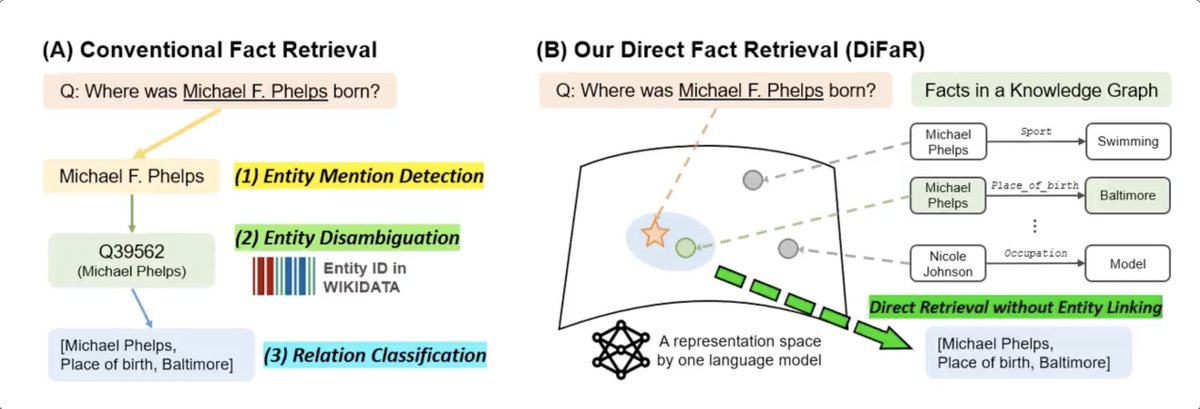
At #acl2023nlp in Toronto, we present our work on directly retrieving facts from a knowledge graph without explicit entity & relation linking. Work with Jinheon Baek, Alham Fikri and Sung Ju Hwang.
Paper link: https://t.co/HrDrNcefcT
#QuestionAnswering#LLMs#KnowledgeGraphs
The second part of the talk of Geoffrey Hinton at his keynote at #ACL2023NLP covers his recent work on analog computation and potential paths towards training capable models using less power and different ways of obtaining and sharing knowledge.
First day of #ACL2023NLP kicking off with @geoffreyhinton giving interesting perspectives about the ability of #LLMs to understand and how goalposts have shifted in NLP.
Can we directly retrieve facts from knowledge graphs with a single step, instead of using the conventional three steps?
We propose this in our #ACL2023 paper, done during my internship at @AmazonScience with @AlhamFikri@JLehmann82@SungJuHwang1.
Paper: https://t.co/zaPvPEoYPq
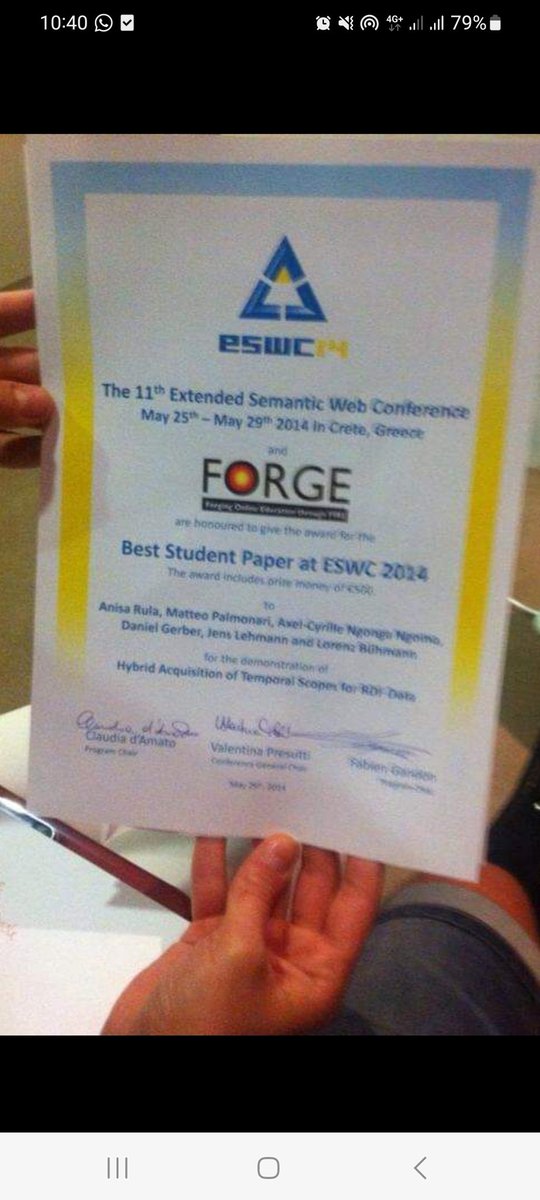
AMiner sent me congratulations that I'm the 2nd "most influential scholar" in #KnowledgeEngineering 2013 - 2022. This seems be based on citation metrics for certain venues. #knowledge#AI
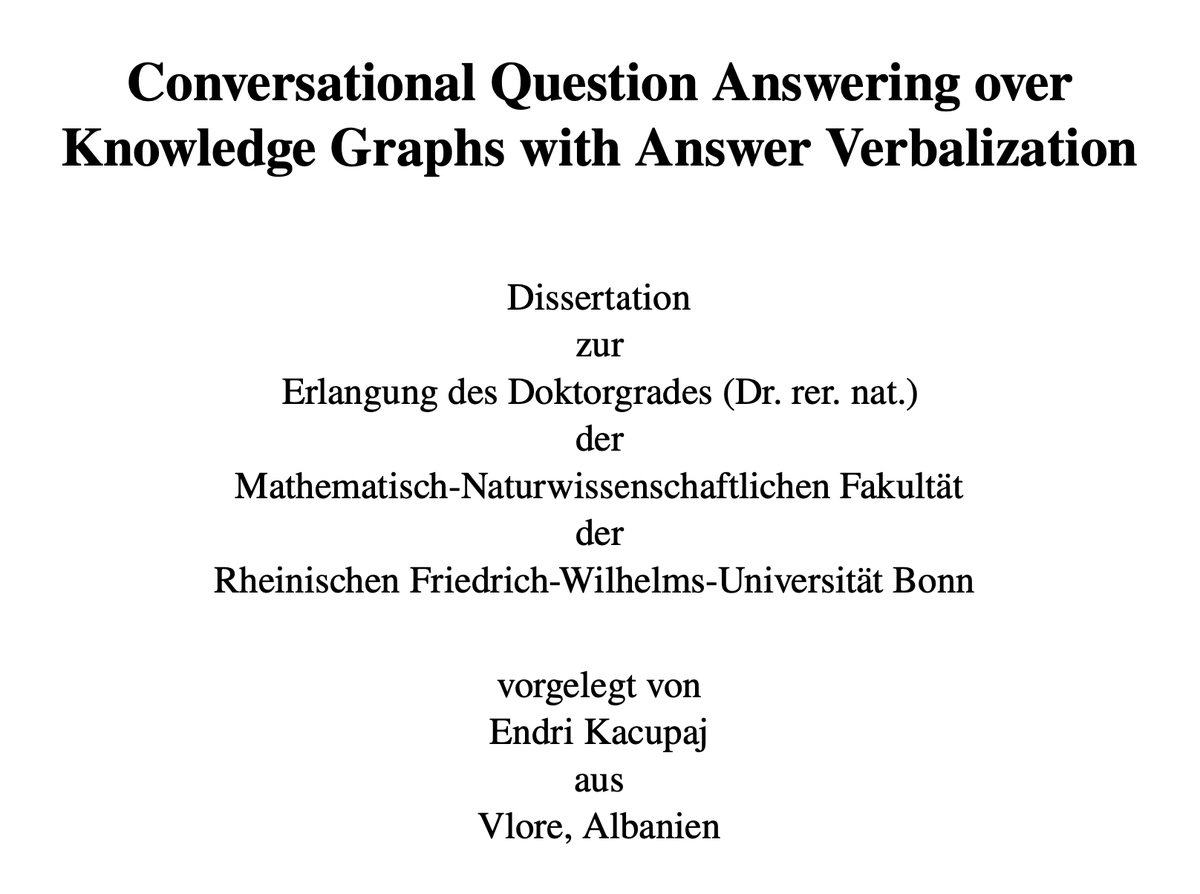
Congratulations to @EndriKacupaj for defending his thesis on "Conversational Question Answering over Knowledge Graphs with Answer Verbalization" today. Endri has shown impressive ability and results throughout his PhD journey!