As we near the end of the 2022 monkeypox PHE, it’s important to keep an eye on future orthopoxvirus outbreak risk with residual smallpox vaccine immunity waning globally. Check out our new study led by @julianactaube & @mtevarest w/@jlloydsmith https://t.co/hqmEDDCDxh
Monkeypox spread will be shaped by the global landscape of immunity left by past smallpox vaccinations. But this landscape hadn’t ever been mapped, until now. Check out our preprint, by @julianactaube and @mtevarest, led by old friend and new collaborator @bansallab. Her thread:
The ongoing monkeypox outbreak has brought to the forefront the legacy of smallpox eradication. Historical smallpox vaccination efforts were heterogenous leaving a modern patchwork of long-lasting protection. We characterize this landscape in new work: https://t.co/N60yNnhKuI. 🧵
Even a small donation helps a lot! One of the metrics that guides this funding competition is the number of supporters... so please consider chipping in a few dollars. Thanks!
Hey everyone, please consider supporting this crowd-funding effort to study urban coyotes in LA. Dr. Sarah Helman is a brilliant and determined scientist, and her work is shedding light on how coyote health is impacted by human impacts including anti-rodenticide poisoning.
Thrilled to announce that our data science (modeling/analytics) jobs are now live for the @cdcgov Center for Forecasting and Outbreak Analytics:
closing June 3 so apply now!
For people interested in this topic (tis the season!)... with a group of great grad students and postdocs a few years ago, we wrote this 'Ten Simple Rules' piece. https://t.co/5WFU82QeQM
To the majority of the worlds population that don’t fit this stereotype, please be assured that we are just as good at data crunching. https://t.co/JQcjt0K1RP
Are introduced rodents involved in disease outbreaks threatening subantarctic wildlife?
If you're attending #EAB2021 (online or in person) and if you're into disease ecology, invasive species, and/or #seabirds, don't hesitate to come by my poster!
UCLA is hiring in Quantitative Virology! We seek a dynamic faculty member who uses data-driven computational/modeling methods to study how viruses do what they do.
Superb intellectual environment, great city, beautiful state.
Diversity valued and welcomed!
https://t.co/GKljnNccbO
The product of many, many years of hard work led by the great Katie Prager, with an all-star team including @bennyborremans, @rileymummah, @anacrgomez, and many more. Manuscript is in prep, so stay tuned...
Great to see such interest at #EEID2021 in our team's work on leptospirosis in California sea lions. After 3 decades of yearly seasonal outbreaks, we documented spontaneous fadeout of the disease, driven by severe oceanographic anomalies, followed by re-emergence 4 years later.
Wonderful keynote talk by @katrina_lythgoe at @eeid2021 on levels of selection in viral evolution. Very lucid analysis and her work on SARS-CoV-2 is beautiful.
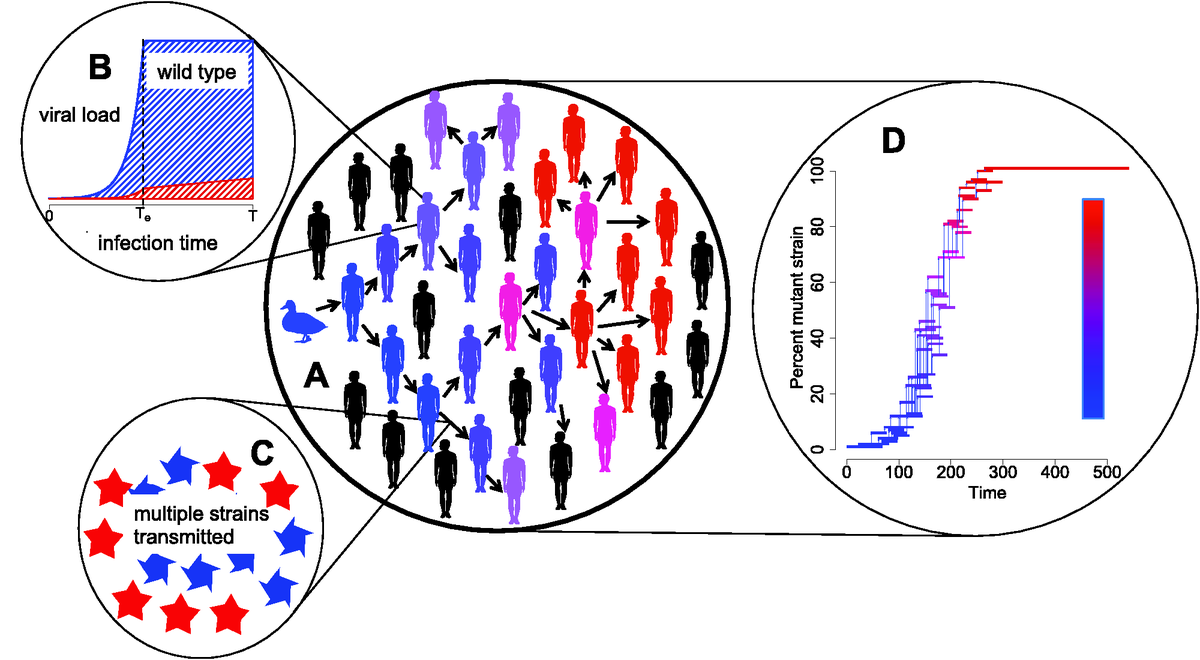
For some theory that explores related ideas, see our recent paper on cross-scale evolution of emerging viruses...
After many years of effort, it is a great feeling to see this paper with @jlloydsmith, @ke_lab, @StochasticParis@asphyxiac and Miran Park published. Examines the relative roles of within- and between-host selection on evolutionary emergence of pathogens.
https://t.co/vwlqCsrDwk
But I think we all owe a huge debt of gratitude to one scientist, in particular. @linseymarr is behind a lot of what you are reading on aerosol transmission. She has been out front since the beginning and has helped ALL of us behind the scenes, many times
https://t.co/lkylWBHxZZ
I agree strongly! Those places that are doing in-depth contact tracing could really help epidemiology by making the data available for analysis. Detailed transmission chain data are rare and valuable - esp if not subject to selection bias for unusual events.
@kakape@joshmich I don’t understand why there aren’t more reconstructions of chains of transmission. These case investigations are so important for learning about transmission.
For a TLDR: virus inactivation is slower at low temperature (nothing new) and when inactivating solutes (e.g., salts) concentration is lower, which happens in very humid (via dilution), but also very dry contexts because these solutes effloresce, forming harmless crystals.
Curious about how temperature and humidity affect infectiousness of SARS-CoV-2? And why? And a model that accurately predicts how this generalizes to other viruses?
See our new preprint, beautifully explained in this thread by @dylanhmorris