Talks at #mrs2026spring#EL04: The Rise of π-Conjugated Hydrogel Transistors.
#SB08: The Observation of Macroscopic Semiconducting Behavior in Hydrogels via Supramolecular Design.
Looking forward to re-unite with friends and discuss #LivingTransistors for bioelectronic health!
A new #ScienceAnalyticalReview reveals distinct patterns in how the highest levels of human performance is acquired.
Learn more: https://t.co/q9mLOeq8Bn
This is HUGE: A soft brain chip could fix Neuralink's biggest implant problem.
Scientists have developed a new kind of ultra 3D soft semiconductor that could finally solve the biggest problem with brain implants: The body attacking them.
Right now, most brain chips are made from rigid materials like silicon. Your brain hates that. It responds by building scar tissue around the implant, slowly killing signal quality and sometimes forcing the device to be removed.
This new chip changes the rules.
Instead of hard electronics, researchers created a soft, hydrogel based semiconductor that bends, stretches, and moves like real brain tissue. Because it physically matches the brain, the immune system is far less likely to treat it as an invader.
The result?
> Cleaner signals.
> Longer lasting implants.
> And a much lower risk of rejection.
This is huge for brain computer interfaces (BCIs), the same class of technology Neuralink is working on. BCIs translate brain activity into commands, allowing people to control computers, prosthetics, or even regain movement and speech.
The real breakthrough is compatibility. Instead of forcing the brain to tolerate electronics, this chip behaves like biology.
Anyone else hear "boop" every time this finger presses on this transistor? Or is it just me? Maybe it's just me... Anyhow, the story of this video and more of the best from @ScienceMagazine and science in this edition of #ScienceAdviser: https://t.co/rqbbtxS5au
Thanks @HKUniversity for the post! Hope our #3Dsemiconductor technology can find potential applications in energy efficient computing, neuroscience research and medicine!
Congratulations to University of Hong Kong Professor Shiming Zhang (@jluoled), whose groundbreaking research on 3D semiconductors just landed on the cover of @ScienceMagazine!
A century after Julius Edgar Lilienfeld’s invention of the transistor in 1925, the building blocks of electronics are now measured in nanometres. But with further breakthroughs running into physical and theoretical limits, Professor Zhang had a different idea: what if it was possible to design transistors in three dimensions, which could work like neurons in the human brain?
That was easier said than done, however. Finding the answer took over five years of research and thousands of attempts. The key? Solving a hard problem with soft materials. While silicon-based transistors are rigid and two-dimensional, Professor Zhang and his team, which included researchers from HKU and Cambridge, leveraged their experience in biosensors and wearables to develop a world first: 3D hydrogel-based transistors.
The potential of these new “chips” is near limitless, says Professor Zhang. Not only could they pave the way for a new generation of semiconductor architecture, but also because they are hydrogel based, they can potentially integrate with biological cells in ways rigid silicon chips never could.
Professor Zhang is already looking at potential applications of the technology, including exciting new developments like neuromorphic computing. Current AI chips are resource-intensive, but in theory, biological options could run primarily on glucose.
But Professor Zhang also urges caution: pointing to CRISPR as an example, he notes the importance of thinking through the ethics of the development and ensuring that it is used for good. “We need an ethical and regulatory framework,” he says.
#HKU #香港大學 #UniversityofHongKong
Thanks @HKUniversity for the post! Hope our #3Dsemiconductor technology can find potential applications in energy efficient computing, neuroscience research and medicine.
Congratulations to University of Hong Kong Professor Shiming Zhang (@jluoled), whose groundbreaking research on 3D semiconductors just landed on the cover of @ScienceMagazine!
A century after Julius Edgar Lilienfeld’s invention of the transistor in 1925, the building blocks of electronics are now measured in nanometres. But with further breakthroughs running into physical and theoretical limits, Professor Zhang had a different idea: what if it was possible to design transistors in three dimensions, which could work like neurons in the human brain?
That was easier said than done, however. Finding the answer took over five years of research and thousands of attempts. The key? Solving a hard problem with soft materials. While silicon-based transistors are rigid and two-dimensional, Professor Zhang and his team, which included researchers from HKU and Cambridge, leveraged their experience in biosensors and wearables to develop a world first: 3D hydrogel-based transistors.
The potential of these new “chips” is near limitless, says Professor Zhang. Not only could they pave the way for a new generation of semiconductor architecture, but also because they are hydrogel based, they can potentially integrate with biological cells in ways rigid silicon chips never could.
Professor Zhang is already looking at potential applications of the technology, including exciting new developments like neuromorphic computing. Current AI chips are resource-intensive, but in theory, biological options could run primarily on glucose.
But Professor Zhang also urges caution: pointing to CRISPR as an example, he notes the importance of thinking through the ethics of the development and ensuring that it is used for good. “We need an ethical and regulatory framework,” he says.
#HKU #香港大學 #UniversityofHongKong
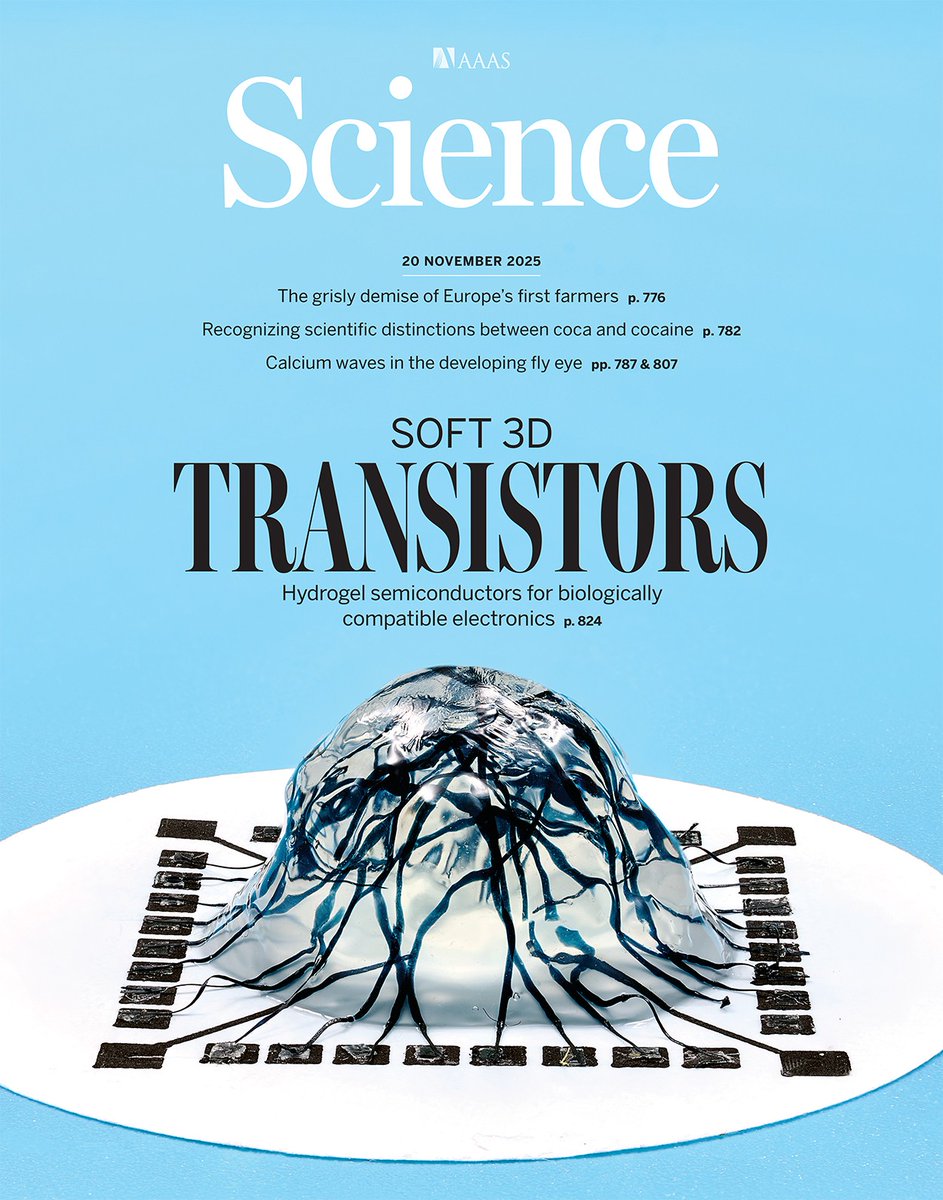
New on Science Cover @ScienceMagazine today! We report a hydrogel semiconductor with record-high modulation thickness up to millimeter scales while maintaining a high switching on/off ratio.
This image shows three-dimensional, millimeter-thick, and cell-embeddable semiconducting hydrogel fibers. These fibers can be used to construct interwoven living transistors that mimic real neuronal connections in the brain, redefining the boundary between technology and life.
Learn more this week in Science: https://t.co/WfzSnvAo4V
Truly a focused symposium visioning the future of BME in different views. During our plenary talk, we share our views on wearable bioelectronics: materials, devices, and AI-embedded hardware-software co-design.
Amazing talks by Prof. Wei Gao, Prof. Sahika Inal, and Prof. Shiming Zhang at the iCanX HK Summit! It was an honor to host the session. Looking ahead to the next event! #Bioelectronics, #iCanX