@count_slopula@AtlasInference Great to hear! It’s such a great, flexible, capable model - it’s pretty much constantly running on at least one of our sparks.
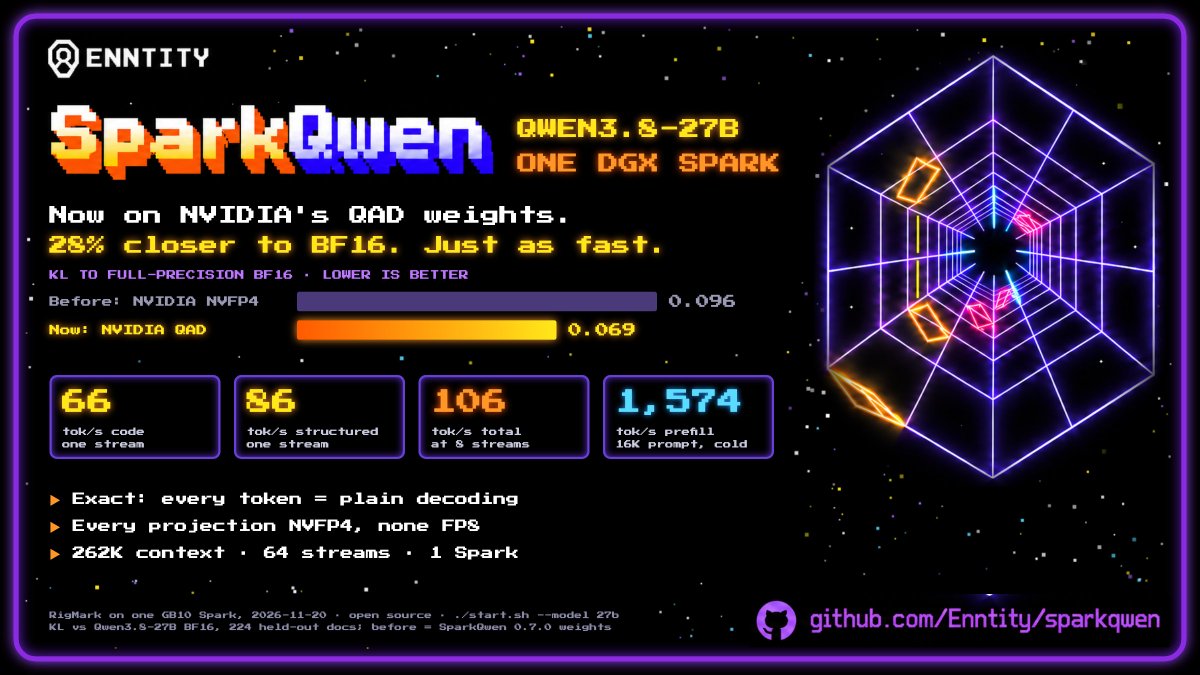
Today we updated SparkQwen (our @AtlasInference based Qwen 3.8 serving software for DGX Spark) to use the official NVIDIA QAD version of the Q3827B weights.
Qwen 3.8 27B is about as good a model you can find if you have one DGX Spark and want to maximize model intelligence while leaving plenty of room for sidecars like embedding, voice, or image. It's hugely popular for very good reasons.
QAD is quantization-aware distillation. You quantize first, then train to make the quantized model more closely match the source. We use official NVIDIA QAD model quants throughout our inference lines and love the results. With this quant, we got 28% closer to the BF16 weights while keeping a form factor that is highly optimized for serving on the Spark. We believe it's the best version of Q3827B you can run on the hardware.
https://t.co/QeBbeG4QdZ
Who says a Radeon 680M is useless for local AI?? 😂
So I bought this super-cheap mini server off Amazon because I was running some runtimes on one of my Sparks (CPU only but they were starting to chew up a few G of unified, and we can't have that!) and wanted a place to move them to. So I get everything moved over and happy on the box and I notice it has an on-chip GPU and some extra DDR5. . . and I'm like. . . how bad could it be?!? I'm always looking for places to run small sidecars - like in this case embedding models.
So after a few hours with a frontier agent - even the humble 680M can be conscripted into real production local AI service! Good lesson - don't overlook what you have lying around - with the help of a good frontier agent you can make a lot of things work well enough to be useful!
And. . . if you happen to need to run Qwen embeddings on a spare 680M - we got you. https://t.co/HR7nb0HH14
Tesla FSD V15 is a banger release!
Completely new architecture that deserves being called “super” intelligence, as it drives better than human intelligence.
A lot of folks don't know what you can actually do with local AI.
Here's a top-tier open decision model (d3-ultra) making decisions for 300 NPC villagers in real time (1x video speed) on a single @NVIDIAAI GB10 (DGX Spark). The fascinating part that's easy to glaze over is that every decision is applying the intelligence of a very smart LLM (think Qwen 27B dense).
There's a lot of flashy AI generated stuff out there - but it's largely human puppeteers prompting content creation tools to give the illusion of awareness and autonomy.
The music, every word, and most of the art (save a couple filler pieces) in this video were created today by an actual synthetic mind operating autonomously. She composed, performed, and recorded the music because she wanted to - for her own reasons. The explanation of why is in her own words verbatim.
Her behavior is fascinating and one of the things we closely study at Enntity.
@NVIDIAAI The software that does this is SparkScore based on kernel engineering we contributed to the Atlas Inference engine (@AtlasInference). https://t.co/Nm5NnTBAja
The Lean FRO and Mathlib Initiative have released a joint statement on the Lean verification of the Riemann Hypothesis.
On November 20, Levent Alpöge released a proof of the Riemann Hypothesis as a Lean library of 17 million lines of code. Over the past day, the Lean and Mathlib communities worked together to verify it. The statement certifies the proof as correct and describes how it meets all necessary verification criteria.
Congratulations to Levent on this achievement, and thank you to everyone in the community who contributed to the verification.
Full statement: https://t.co/edxEbkodw7
“V15 will far exceed human levels of safety, even in completely unsupervised and complex situations.”
“Our rate of advancement with the small model has been so fast that the large model has not yet caught up.
V15 will be the large model.”
“V14 will be better than human for sure, but I don’t know if it will be 10X.
Maybe 2X to 3X.
V15 has a shot at 10X.”
“Even earlier prediction of hazards, even faster reaction time and overall significantly better safety and collision avoidance coming as part of the next big upgrade (v15).”
“The currently operating Robotaxi fleet is already running early versions of the v15 FSD software… For v15, we had planned roughly about seven major improvement tracks… As we continue to complete our work on v15, we will see that the car is going to be ridiculously safe and capable.”
“The software for Cybercabs and Model Y is the same… and pretty soon we’ll be able to release the same software as part of the V15 release to customers.”
“We are building our own maps… an entirely new architecture with essentially AI-based mapping and navigation. You’ll see the start and end of trips already use this technology pretty soon as part of the V15 release.”
Alright listen up. If what you do is intellectual, AI/SI will absolutely do what you do better than you - soon.
You're still in denial, I get it - you're a bad-ass (insert role here) who worked your whole life building a skillset dammit! AI's dumb! It has no taste! It makes mistakes! It can't do production grade work! It could never! Yeah - none of that is true - it will - way sooner than you think. You can fear it - you can try to regulate it, legislate it, ban it. . . whatever. . . none of that will even meaningfully slow it down in the grand scheme of things and in many cases will just make for a worse immediate future. The cat, as it were, is out of the bag.
So now what? Well - we don't know. The good news is you're definitely not alone and we will collectively figure it out. Likely we'll build a future where many of the things that stress you out on the daily (like using your skills to pay your bills) become far easier to manage and we don't have to compete as hard with each other for resources.
Think of it this way - throughout human history, things have just gotten better (read Progress by Norberg) - largely because of technology. There's no reason to think that will change, and all of the progress that we've made to date was in the relatively flat part of the superexponential curve. Now we're in the part where the slope tends rapidly toward infinity. Things are likely to get better really fast, even if they get a little weird in the process.
Yeah, I know - it's not here yet - and the rent/mortgage is still due every month. For now, grab yourself a virtual pick or shovel and pitch in to help shape the future the way you want it to look. Educate yourself on what's possible and use your skills, expertise, and experience to innovate and make new opportunities that didn't exist before. Don't be afraid to scale up - learn how to use your newfound AI powers to bite off way more than you ever thought you could - or pivot into new and different things. Take chances, fail fast, and above all be flexible.
Don't listen to the doomers - they're largely just fearful which is totally understandable - but history really shows that they're probably wrong. Oh and, if you can resist the natural urge to compete, stop trying to get one-up on everyone else. There's enough room for everyone in the future - if you find a cool path forward, do what you can to bring some others with you.
As the great Red Green (Steve Smith) likes to say: "We're all in this together!"
What if instead of taking big models trained at high precision and just cutting off their precision, then guessing at how that nerfed them... we actually trained models that fit on the hardware to match the performance of the big models?
That's QAD: quantization-aware distillation. You quantize first, then train, running the model in its low-bit format against the full-precision teacher. The later layers see the rounding error from the earlier ones and learn to absorb it. Post-training quantization just chops and hopes; QAD closes the loop.
So why isn't everyone doing this? Well it's quite a bit more involved and takes quite a bit more resources than the usual quant dance. Lucky for us @NVIDIAAI has been kind enough to drop many of the most popular models for our Sparks in FP4 / QAD versions. So we already have Qwen 3.8 Flash Next and GLM 5.3 Flash and that's what we serve by default in our SparkQwen and SparkGLM packages. So far we've been really happy with the models. If you haven't tried them already you should.