The math on this project should mass-humble every AI lab on the planet.
1 cubic millimeter. One-millionth of a human brain. Harvard and Google spent 10 years mapping it. The imaging alone took 326 days. They sliced the tissue into 5,000 wafers each 30 nanometers thick, ran them through a $6 million electron microscope, then needed Google’s ML models to stitch the 3D reconstruction because no human team could process the output.
The result: 57,000 cells, 150 million synapses, 230 millimeters of blood vessels, compressed into 1.4 petabytes of raw data. For context, 1.4 petabytes is roughly 1.4 million gigabytes. From a speck smaller than a grain of rice.
Now scale that. The full human brain is one million times larger. Mapping the whole thing at this resolution would produce approximately 1.4 zettabytes of data. That’s roughly equal to all the data generated on Earth in a single year. The storage alone would cost an estimated $50 billion and require a 140-acre data center, which would make it the largest on the planet.
And they found things textbooks don’t contain. One neuron had over 5,000 connection points. Some axons had coiled themselves into tight whorls for completely unknown reasons. Pairs of cell clusters grew in mirror images of each other. Jeff Lichtman, the Harvard lead, said there’s “a chasm between what we already know and what we need to know.”
This is why the next step isn’t a human brain. It’s a mouse hippocampus, 10 cubic millimeters, over the next five years. Because even a mouse brain is 1,000x larger than what they just mapped, and the full mouse connectome is the proof of concept before anyone attempts the human one.
We’re building AI systems that loosely mimic neural networks while still unable to fully read the wiring diagram of a single cubic millimeter of the thing we’re trying to imitate. The original is 1.4 petabytes per millionth of its volume. Every AI model on Earth fits in a fraction of that.
The brain runs on 20 watts and fits in your skull. The data center required to merely describe one-millionth of it would span 140 acres.
The real story here is worse than a fumble. It’s a three-step own goal.
January 9: Anthropic locks Claude Code OAuth tokens, killing every third-party tool that built on Claude subscriptions. OpenClaw, which recommended Claude Opus 4.5 as its default model, wakes up to a broken integration. No warning. No partner outreach.
January 27: Anthropic’s legal team sends the cease-and-desist over “Clawdbot” sounding too similar to “Claude.” Steinberger complies at 5 AM on a Discord call. During the 10-second window where he releases the old GitHub and X handles, crypto scammers hijack both accounts and run a $16M pump-and-dump scheme. The chaos reflects on the entire Claude ecosystem.
February 15: Steinberger announces he’s joining OpenAI.
So Anthropic had the fastest-growing open source project in AI history (145K+ GitHub stars, 2 million visitors in a single week), built by a guy who sold his last company for ~€100M, whose tool literally recommended Claude as the default model to millions of new users.
Their response was to cut off his API access and send lawyers.
Steinberger spent last week in San Francisco meeting with every major lab. He explicitly said he could have built OpenClaw into a massive company but chose OpenAI because he wanted “the fastest way to bring this to everyone.” Meanwhile OpenClaw has already spread to China, with Baidu planning direct integration into its main app.
This is a project that was essentially a free distribution channel for Claude. Millions of developers installing a tool that defaults to your model. The growth marketing team at Anthropic should have been sending gift baskets, not legal notices.
Sam Altman just got handed an open-source agent framework with global distribution and a brilliant founder, because Anthropic’s legal department moved faster than their partnerships team.
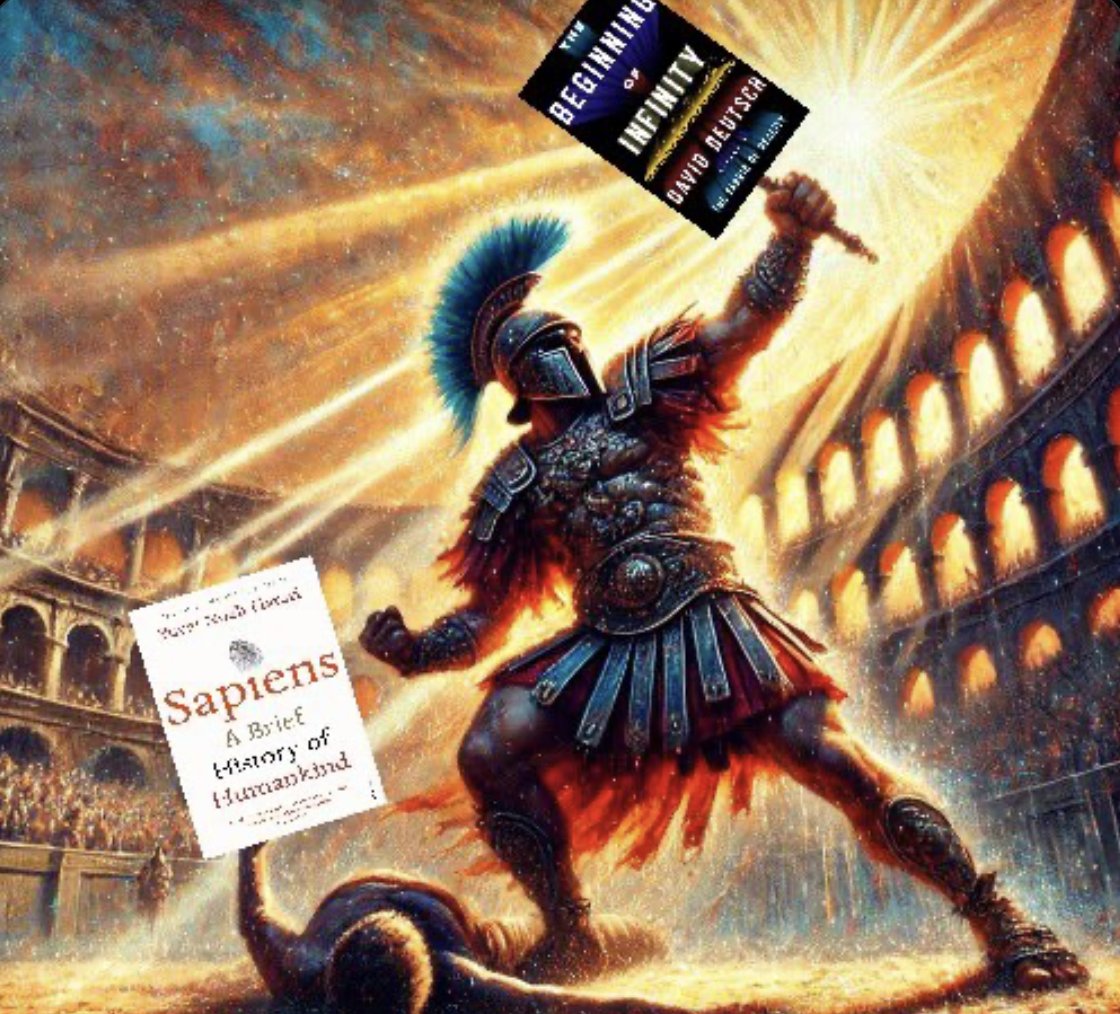
I used to think Sapiens was a great book. Sweeping, provocative, the kind of book that makes you feel like you finally understand the big picture of human history. It's on every CEO's bookshelf, assigned in universities, praised as a masterwork of synthesis. Yuval Noah Harari is treated as one of the serious thinkers of our time.
But something nagged at me. Some passages felt off. Claims that human rights are just figments of our collective imagination, not real things, just stories we tell ourselves. That nations, laws, money, justice, doesn't exist outside our heads. That meaning itself is a delusion we've invented to cope. That we're far more powerful than ever before but not happier. That hunter-gatherers had it better because they had no dishes to wash, no carpets to vacuum, no nappies to change, no bills to pay.
That sounded depressing to me, but was perhaps just the realistic scientific worldview? What it meant to see the world clearly, without comforting illusions.
Then I read The Beginning of Infinity by @DavidDeutschOxf. Deutsch has a concept he calls 'bad philosophy.' Not philosophy that's merely false, but philosophy that actively prevents the growth of knowledge. Ideas that close doors rather than open them. That makes problems seem unsolvable by design.
After soaking in Deutsch's framework (it's dense, a bit like digesting a delicious whale), it becomes clear: Harari's books are riddled with bad philosophy. They're smuggling nihilism in under the guise of scientific objectivity. Some examples:
On meaning: "Human life has absolutely no meaning. Humans are the outcome of blind evolutionary processes that operate without goal or purpose... any meaning that people inscribe to their lives is just a delusion."
On human rights: "There are no gods in the universe, no nations, no money, no human rights, no laws, and no justice outside the common imagination of human beings."
On free will: "Humans are now hackable animals. The idea that humans have this soul or spirit and they have free will, that's over."
On progress: "We thought we were saving time; instead we revved up the treadmill of life to ten times its former speed." The Agricultural Revolution? "History's biggest fraud." We didn't domesticate wheat, "it domesticated us."
On our cosmic significance: "If planet Earth were to blow up tomorrow morning, the universe would probably keep going about its business as usual. Human subjectivity would not be missed."
On the future: "Those who fail in the struggle against irrelevance would constitute a new 'useless class.'" Homo sapiens will likely "disappear in a century or two."
This is bad philosophy. It tells us our problems are cosmically insignificant, our solutions are illusions, and that progress is neither desirable nor within our control. It's also perfect nonsense. No one would ever go back to being hunter-gatherers. Would you rather worry about your kid spending too much time on Roblox, or face the 50% chance she won't reach puberty?
And our so-called "fictions"? They ended slavery. They gave women equal rights. They solved hunger. They eradicated smallpox. They turned sand into computer chips. They got us to the moon, and hopefully soon, to Mars and beyond. These "fictions" are already reshaping the universe, and over time they may become the most potent force in it.
Now compare Deutsch:
"Humans, people and knowledge are not only objectively significant: they are by far the most significant phenomena in nature."
"Feeling insignificant because the universe is large has exactly the same logic as feeling inadequate for not being a cow."
"Problems are soluble, and each particular evil is a problem that can be solved."
"We are only just scratching the surface, and shall never be doing anything else. If unlimited progress really is going to happen, not only are we now at almost the very beginning of it, we always shall be."
Where Harari sees a species of deluded apes stumbling toward obsolescence, Deutsch sees universal explainers, the only entities we know of capable of creating explanatory knowledge, solving problems, and potentially seeding the universe with intelligence.
The difference isn't academic. Ideas shape action. If you believe life is meaningless, progress is a trap, and humans are hackable animals with no free will, how does that affect what you build? What you fight for? What you teach your children?
Harari's books sell because they flatter a fashionable pessimism. They let readers feel sophisticated for seeing through the "delusions" everyone else lives by. That smug cynicism is corrosive. And it's everywhere: in schools, in media, in bestselling books. More than half of young adults now say they feel little to no purpose or meaning in life. This is what happens when you teach an entire generation bad philosophy. Less progress, less health, less wealth. Less flourishing. And ultimately, a higher chance that civilization and consciousness go extinct.
Fortunately, there's another equally well-written, but much truer, account of homo sapiens, appropriately titled 'The Beginning of Infinity'. And this one smuggles no despair in by the backdoor. But let's give Harari credit where it's due. He is right about one thing: if planet Earth blew up tomorrow, we wouldn't be missed. Because there'd be no one left to miss us, just a careless universe, blindly obeying physical laws. We are the only ones who can miss, but we're not going to. We're going to aim, hit, and keep going.
Full credit for the amazing meme to @Ben__Jeff
I wanna start a show where I only talk to tech bros and finance guys and highly successful entrepreneurs about their personal lives. Marriage, starting a family, raising kids, divorce, failed relationships, etc.
It is very important that we do not strictly define success as material.
If you’re rich financially and poor in relationships, quality of life is terrible tbh.
Who would be a good first guest?
#EUdataact is officially here. This means that you can now request access for the data your electric toothbrush collected this morning, if you want to be extra sure that you did full 2 minutes.
For companies, this means that if your product generates data, users (and partners) can ask for it. How are you storing all that data?
When a highly experienced team with a proven track record builds and successfully operates a 70PB infrastructure serving demanding enterprise customers, we feel an urge to support them.
Read the full thesis...
https://t.co/vQBDh3S04l
cyber•Fund backs @spacetimeeu: nuke-proof, software-defined storage designed for AI workloads and built by datacenter veterans.
Cutting-edge architecture and a unique settlement layer enable enterprises to stay compliant while scaling effortlessly.
🧵 👇
SpaceTime is on @forbes!🔥
Read our CEO @andypennanen's interview about the importance of data sovereignty, backups and how our journey began with data drives on planes here:
https://t.co/PqXtjPDX1l
Today the European NIS2 cybersecurity directive is fully in force in Finland. Good day to write to you all a little bit about what we have been building lately.
At https://t.co/bCok5oX2w0 we do managed storage. In large scale for S3 objects and files. A good chunk of our business is security related. SpaceTime runs tens of petabytes of customer data from very secure certified data centers. The primary one having been built by Finnish defense forces, with EMP shielding. We offer immutable storage buckets where your data can’t be deleted by ransomware, malicious actors, or other system mishaps. Many customers backup their hyperscaler clouds with us. Integration to something like Azure is less than 60 seconds to get this rolling. We also customize workloads for customers, with a bit of CPU and GPU compute next to the storage. OT data from eg. factories, AI training data, analytics platforms etc are other common use cases. We can take on high data volumes: wan’t 50 petabytes today? Not a problem, it’s available.
SpaceTime is very fast, with 11 nines data durability. Megaport connection available to transfer data beyond the public Internet. Where we really perform fabulously is in massive scale technical performance: it’s no problem at all for SpaceTime to instantly restore 300,000,000 objects from your storage. Where other systems choke and can’t do it, ours just opens the proverbial fire hydrant and serves it all fast as requested.
NIS2 makes organizations accountable for their data security. Everyone needs to have their “house of data” in order. Hyperscaler clouds like MS, Google or AWS all have legal language in their terms that push responsibility of the data (and backups) to customers, not to them. We are happy to take that on and carry it. More than 5K customers are already using SpaceTime, and our growth makes me smile.
One clear reason why customers choose us is our pricing: it’s just amount of data used per month, plus used bandwidth - an no other fees. No ingress, egress, API, data read / retrieval, operation, inter-region, metadata, restoration, minimum capacity, or compute etc fees. Pricing is super simple and clear with no surprises. And the price point is very competitive.
We operate through resellers and partners. If this sounds like something your organization could sell?: be in touch!
Especially today with NIS2 out in force this is interesting to any organization with heaps of data. Ping me to continue the discussion. And happy NIS2 day ya all - stay safe out there in cyberspace :)
One of the biggest risks are ransomware attacks that don’t just encrypt primary data but compromise backup copies as well. Attackers love targeting backups: If a company has no clean recovery option, they are more likely to pay a ransom. This is where immutable storage comes in.
EU data compliance policies like GDPR and NIS-2 are strict, and failing to secure data properly can lead to heavy fines and astronomical headaches for any European company. Knowing where data is stored and how it’s protected is essential for compliance management.
#DataProtection #DataSecurity
To understand the Ross Ulbricht case, here are some excerpts from my article:
The reason why the libertarians cheered Trump’s announcement was that the sentence was profoundly unjust and crazy, and because Ross is an intelligent, good-hearted, and wonderful person whose work in this realm had nothing to do with a fixation on illicit drugs. It was about an experiment in market freedom, which he undertook because the technology allowed it. His purpose was simply to show that free markets work. Nothing more.
There was plenty that was fishy about the arrest and prosecution of this man who did only technical work, including the way in which named and unnamed accomplices were treated with kid gloves while Ross’s head ended up on the platter. The plaintiff’s arguments to the jury included accusations that were never even made in the indictment or came up in the course of the trial.
We can be sure that Ross is only one person among thousands or tens of thousands of people caught up and caged as a result of a criminal justice system that cares nothing for fairness or human rights. We might ask how it came to be that so many people held up signs with Ross’s name on it and why the former and likely future president, in addition to the independent Robert F. Kennedy, Jr., have taken up his cause.
There have been many wonderful people who have tried to raise awareness of his case over ten years. But one name stands out above the rest. Her name is Lyn Ulbricht. She is Ross’s mom.
Back in 2014 when she first started advocating for her son, hardly anyone could be bothered to care. I recall these days well and I was disappointed and astonished at the indifference toward his plight. The libertarians didn’t really raise a fuss either. Too many facts were in dispute, and there is always a risk associated with lobbying for a jailed convict.
But that didn’t stop Lyn. She figured out early on that if she was going to make any progress at all, the libertarians were going to be the most receptive. After all, she had not had much success in just posting signs on storefronts and telephone poles, which she also did tirelessly. She was happy for any audience even if only mildly interested. So she went to every possible meeting, at her expense.
She flew around the country. She raised money. She spoke to countless audiences. She traveled around the world. She would talk for hours to podcasters and media people, anyone who would listen. She mastered all the legal details, and was very precise in her language. She hosted events. She passed out bracelets and signs. She established social media accounts and humanized the life that he was enduring in prison. She gradually made progress. It was due to her tenacity born of a deep love—a mother’s love—that has been the background power of this movement for a decade.
Her faith never flagged. Not once. Yes, she cried often, prayed, and talked about hardly anything else for ten years. Even when appeals were denied and pushes for leniency were rejected, and Ross was transferred from one place to another, she did not give up hope. As a mom, her job was to do the impossible for her son even if the rest of the world regarded the cause as hopeless.
In her mind, there was always hope. She just needed to find a way.
As I saw the signs in the crowd this weekend, and heard two presidential candidates make an appeal for Ross to be freed, I immediately imagined the joy in Lyn’s heart. I’ve not spoken to her but I know her and I know it is there. This is a woman of incredible faith, boundless energy, unstoppable passion for what’s right, and a seemingly infinite ability to push, press, and lobby for her son’s life and freedom, with anyone who would listen, anyone with some minor hope of influencing outcomes.
If that story doesn’t fill you with inspiration and respect, there is something wrong with you. What we see in Lyn is something that is almost not of this world. But you know what? It is, in fact, very much of this world. It is all around us. It is the divine in everyone among us: the fire of a mother’s love for her child. Watching this all unfold should remind us all of the remarkable power of this beatific force at work. It is unstoppable, more powerful than all the lobbies and even the armies.
We’ve seen the power of maternal love strongly at work in the world over the last year. It was the moms who demanded that the schools be open. It was the moms who saw what their children were being taught and formed large and influential organizations to stop and block the corruption of the curriculum. It is the moms who are out there now demanding the right to have knowledge of medical procedures being pushed on the kids. It is the moms who are demanding choice over the shots being forced on the kids.
And what a gigantic difference it has made! The schools did open because of it and they are being reformed because of it. It’s the moms who have marshaled the energy to push back on the Great Reset and draft the kids into a creepy psy-op experiment in gender transitions. They will have none of it. It’s the moms that are fed up with seeing their daughters’ sports programs raided by boys in drag.
And looking back in time, it was the moms who demanded the carve-out legislation that made homeschooling possible. And it is the moms today who are getting ever more engaged in hugely important causes like food and medical freedom, without which we have no health.
This is what happens when you cross the moms: you face a power that is not of this world. The politicians have begun to understand this, and fear it.
I’m not speaking of some vague and ideological form of abstract “activism” promoted by the likes of Hillary Clinton and Melinda Gates. These are people who deploy gender as an ideological weapon against society.
I’m speaking of something far more pronounced and real, a tactical passion unleashed under particular conditions, one rooted in love. No amount of money can buy it and nothing can stop it once it is unleashed.
https://t.co/PzgbQsucXg
We’re thrilled to announce that today Permuto Capital, a joint venture between Chia Network and 3V Capital Partners, filed a Registration Statement with the Securities and Exchange Commission for a new type of equity product.
Read the announcement of the filing to get more details:
https://t.co/XQWQuTV4Ms
This option contract NFT was sold to @cameroncooper via #Chia offer file for 1 XCH (the premium).
Any time between now and the expiration date, he can choose to buy 10 XCH at $90/XCH. Otherwise the contract expires and I will take back that 10 XCH.
He can also choose to sell this NFT to somebody else to pass on the option. In fact, there's already a $15 offer on this NFT!