Ohad Asor is among the highest IQs on the planet
- math & comp sci prodigy
- joined swdev industry at 15yrs old
- early quant trader & ml researcher
what has Ohad been working on for 10yrs that's set to overhaul society?
To
Accelerate
Understanding
thread reveals all:
so...
- Coldcard was hacked in july
- Liquid was hacked in september
- Ledger was hacked in october
- Binance, the largest crypto exchange in the world had the biggest hack in history!
so many reasons to start paying attention to Tau.
The Binance hack shows that we urgently need better fraud prevention for Wallets.
Tau's Wallet enforces your spending rules on-chain, so the node enforces an approved-address rule.
An unapproved transfer is blocked even if the front end is compromised.
With programmable money and agentic payments, the future is more secure when your rules are enforced on-chain.
For example, you can choose who your account can pay in Tau Wallet, and Tau’s network blocks anyone else.
@CoinMarketCap@Tau_net, in the very relevant agentic payments and tokenized asset landscape, has built a wallet so that even with a leaked key, an agent's behavior must satisfy your on-chain security rules.
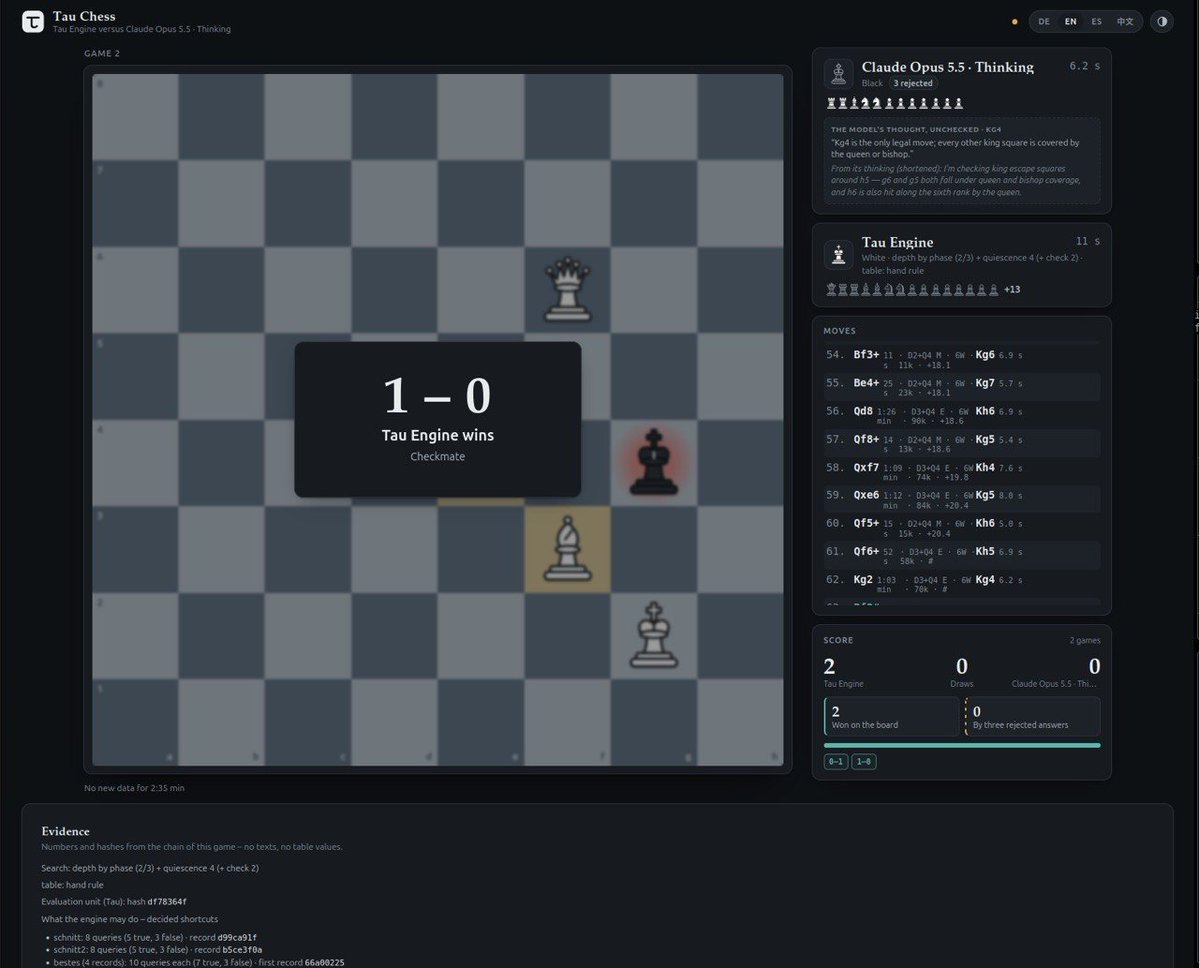
oh and it's currently beating Claude at chess live: https://t.co/H2MaEhwgR0
Sunday, 12:00 UTC: a chess engine that cannot bluff plays Claude Sonnet 5.5 with extended thinking — live. One side thinks in words. The other in decided statements you can read line by line. If it loses, you'll see exactly why.
https://t.co/eQ0mHnN8Bh
Sunday, 12:00 UTC: a chess engine that cannot bluff plays Claude Sonnet 5.5 with extended thinking — live. One side thinks in words. The other in decided statements you can read line by line. If it loses, you'll see exactly why.
https://t.co/eQ0mHnN8Bh
Devs are building agent-access layers on existing wallets and chains.
But Tau devs are redesigning the account layer so agent permissions and how they change are enforced on-chain.
So even with a leaked key, a signed payment must satisfy your on-chain rules before it settles.
have you seen ohad asor’s recent ocltl paper?
sounds adjacent to what you’re describing. treats the spec as the primary artifact rather than imposing semantics onto an existing language.
ltl+p realizability and synthesis modulo ω-categorical theories, with theory blowup independent of formula.
https://t.co/RN0db81fN1
would be curious what you make of it given your k-evm work.
Formal specification languages don't have this vulnerability. A constraint like "never respond to category X requests" is a logical constraint the system mechanically reasons within.
Worth watching where this lands over the next year. The systems that make safety a property of the language itself, not a behavior trained into a model, create a different category of AI Safety.
The Claude leak needed the rule "never send private data over the network." The Mercor breach needed "reject any update that hasn't been formally verified."
Obvious rules but no language can enforce them across all future states of a system apart from the Tau Language.
Tau Language is "The critical ingredient for Safe AI" - Ohad Asor
but isn't this the same gap we've always had?
take stack overflow. "A generation of devs who just copy-paste."
is whether there's a floor? some minimum reasoning you can't delegate.
I see tech incomming where the skill is knowing how to articulate what you want effectively in a spec. They used to call that programming :)
When the code is correct by construction what is there to debug?