🚨I launched a podcast!
🎙️ Leading Quality is a podcast highlighting the people moving healthcare forward.
Ep1 is live:
Dr. Lawrence Yang @GatewayMedic on #burnout, #JoyInWork, and quality improvement as "a science of hope".
Listen: https://t.co/bkq5XA8dOK
#LeadingQuality
🎙️ New episode of Leading Quality is out!
Dr. Kimiyoshi Kobayashi joins me to talk humility, command centers, data + storytelling, and the future of quality leadership.
Listen here 👉 https://t.co/kyTVKnx1ls
#Healthcare#Leadership#QualityImprovement
🚨I launched a podcast!
🎙️ Leading Quality is a podcast highlighting the people moving healthcare forward.
Ep1 is live:
Dr. Lawrence Yang @GatewayMedic on #burnout, #JoyInWork, and quality improvement as "a science of hope".
Listen: https://t.co/bkq5XA8dOK
#LeadingQuality
Incivility can have a significant impact on healthcare outcomes. Fortunately, there are concrete steps we can take as leaders to promote civility and have a big impact on care.
Promoting a Culture of Civility in High-Reliability Organizations - PubMed https://t.co/qaIAKLVxSD
My takeaway as a palliative physician is that teaching QI leadership is a lot like teaching serious illness communication: many different techniques, applied at the right time, in the right way, in authentic humanistic relationships.
https://t.co/60PjiS3Xm0
"The AI model had superior sensitivity for the primary endpoint of false-negative findings... of critical arrhythmia (98.6% (95% confidence interval (CI) = 97.7–99.4) versus 80.3% (95% CI = 77.3–83.3%)" https://t.co/LLeGOecYkK
FUTURE-AI: international consensus guideline for trustworthy and deployable artificial intelligence in healthcare | The BMJ
This will prove to be a very important framework for safe AI deployment in healthcare. https://t.co/3gUDDkzTK0
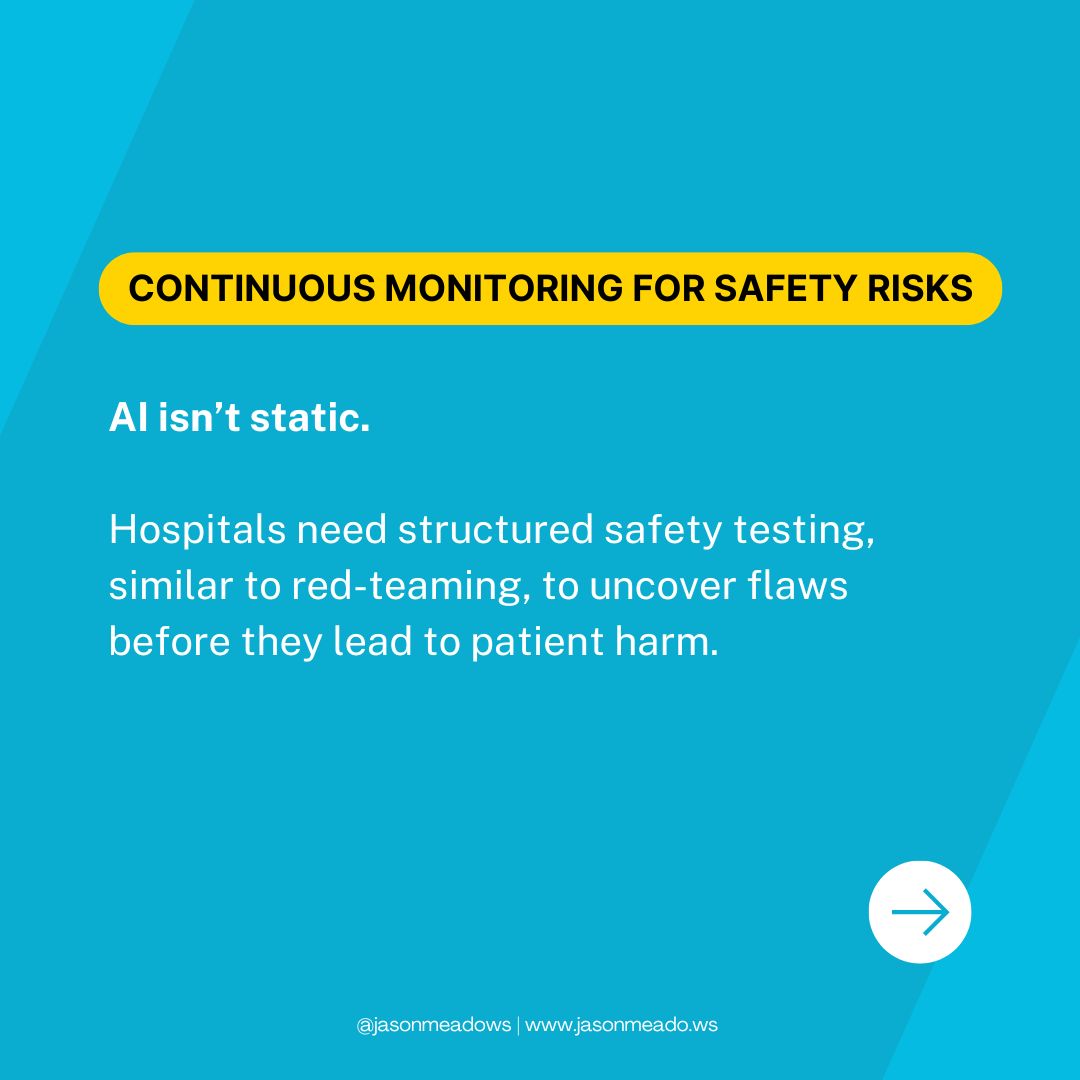
I found this great article in JAMA about Patient Safety and AI. The framework they provided really expanded my thinking on this topic. This is an exciting, growing area in healthcare.
Interested in learning more? Let’s connect! 📩
Read Full Article here: https://t.co/yPhfRaMQ6G
Behind many organisational failures are groups of people who knew bad things were happening but felt unwilling or unable to express their concerns. New research shows how leaders can make constructive challenge not just possible but an integral part of a thriving organisational culture. Five actions for leaders:
1) Ask better questions - ones that directly invite disagreement
2) Acknowledge the legitimacy of the challenge
3) Keep meetings interactive & friendly
4) Allocate enough time for open discussion
5) Create a sense of accountability among team members
Summary article: https://t.co/DIfcD7fwDk. From @mitsmr.
A fantastic free White Paper on "Facilitating Constructive Challenge" based on the research: https://t.co/otaXtuRO1Q. By @ProfCeliaMoore.