Today in @Nature, we’re presenting GenCast: our new AI weather model which gives us the probabilities of different weather conditions up to 15 days ahead with state-of-the-art accuracy. ☁️⚡
Here’s how the technology works. 🧵https://t.co/PWCNWbQnlU
I have updated my course notes on Optimal Transport with a new Chapter 9 on Wasserstein flows. It includes 3 illustrative applications: training a 2-layer MLP, deep transformers, and flow-matching generative models. You can access it here: https://t.co/m5nVCIpZYG
Generating cat videos is nice, but what if you could tackle real scientific problems with the same methods? 🧪🌌
Introducing The Well: 16 datasets (15TB) for Machine Learning, from astrophysics to fluid dynamics and biology.
🐙: https://t.co/PMAHK7i2lG
📜: https://t.co/6XLJA5lJnI
Can we learn dynamical systems from short, noisy #fMRI data? Building on advanced frameworks for dynamical systems reconstruction (DSR), we present a novel scalable SSM DSR algorithm for fMRI. With Eric Volkmann, Alena Braendle & #DurstewitzLab Explore: https://t.co/BUyy1wu1dT
Recent article!
Data fusion of sparse, heterogeneous, and mobile sensor devices using adaptive distance attention
👉 https://t.co/QHJF3STXcd
Combining #geostatistical tools and #DeepLearning models into a distance attention overcomes the issue of reduced amounts of information in isolated areas. Results suggest that #datafusion can be applied to space-time environmental phenomena.
Uncertainty modeling, grounded in 3D metric space, unlocks general-purpose state estimation.
https://t.co/PxpmGtVasE
MAC-VO outperforms SOTA methods and achieves reliable accuracy across platforms and datasets with no multi-frame optimization, loop closure, or fine-tuning! 👇🧵
‘We don’t know where the tipping point is’: climate expert on potential collapse of Atlantic circulation #AMOC#climate#climatecrisis#SDG13#SDG14 https://t.co/i16cblo9yL
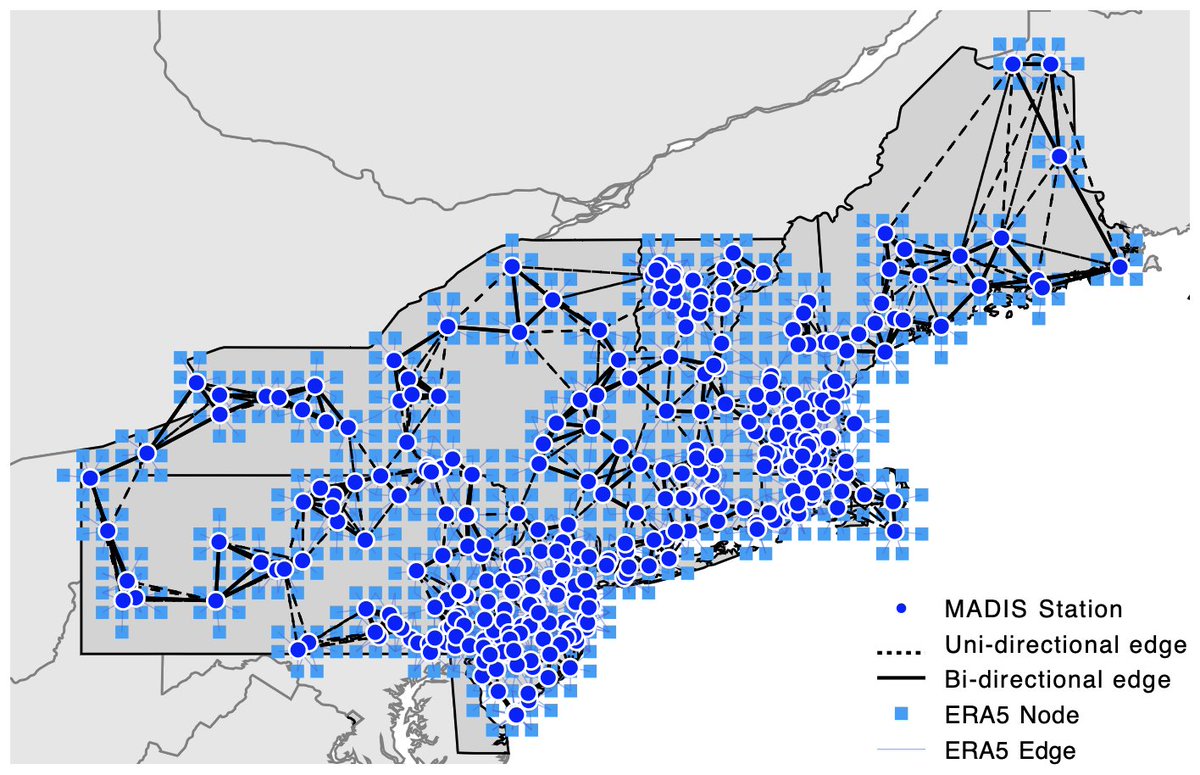
Thrilled to unveil our latest work: multi-modal machine learning to forecast localized weather! We construct a graph neural network to learn dynamics at point locations, where typical gridded forecasts miss significant variation.
Paper: https://t.co/bH8xLVd4hH
🧵
New #Jupyter Notebook Data Recipe: How to Generate Earthdata Prerequisite Files (e.g, .netrc, .urs_cookies, .dodsrc) needed to access the NASA's #GESDISC archives manually, or via #Python.
Access Notebook: https://t.co/YswEsSeUth
Explore resources: https://t.co/4uMaPkbEYN
This paper by Feller is a key starting point for diffusion approaches & a great illustration of two principles of effective writing
-It doesn’t obfuscate ideas with any more math than really necessary
-It’s clear, narrative, expository writing anchored in helpful examples
1/2
Yasmine Belkaid, directrice générale de l'Institut Pasteur : "Il y a très peu de perspectives en France pour des chercheurs : la France n'investit pas assez dans son écosystème de recherche." #le710Inter
Excited to share our new paper using transfer learning to better predict pCO2 in data sparse conditions (in the real world), by Shaun Kim, @juannat7, Zhewen Hou and @tz33cu https://t.co/NIOymrdaez
Interested in emergence, self-organization or morphogenesis?
Introducing CAX: Cellular Automata Accelerated in JAX, a high-performance and flexible library designed to accelerate cellular automata research. 🦎
📄: https://t.co/tOu4ejIBYu
🌟: https://t.co/0T5i2CRuJC
🧵1/12
New article: "Isotropic Neural Cellular Automata", a review of our previous work on making NCAs rotation and reflection equivariant
@RandazzoEttore@eyvindn @cwpfautz
https://t.co/ZcU4BoB8Xs
Contrastive Abstraction for Reinforcement Learning
Abstract states are first recognized via a modern Hopfield net. Reinforcement Learning then run on these states.
P: https://t.co/AH2hedjAO9
There are eight waterways across the capital that Londoners can already safely swim in.
Our brand new map shows where you can go open water swimming in London. So take the plunge—it’s a great way to keep fit and get closer to nature.