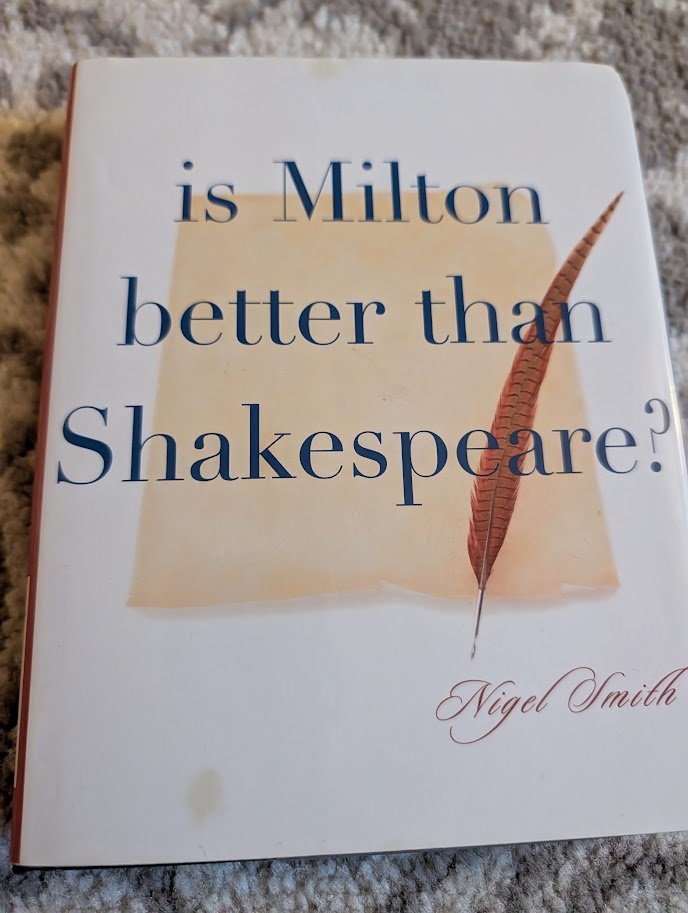
@kevin_farnham I just meant "take another look." It's just so abysmal. I was so hoping to see an Ivy League professor take seriously the possibility that criticism could again be part of literary culture instead of a swollen pustule on the outside of it, but not today alas.
When I saw the title of this book, I was so excited that I just bought it on impulse. Little did I know that the author was going to set up goal posts in such a preposterous and uninteresting place that only Milton could possibly kick the ball through them.
A book with a provocative question for its title; a book that then reformulates the question so as to render it utterly unrelated to anything an honest reader could care about.
As far as I can tell, the argument is that academic liberals can be down on Milton because he was a kind of Puritanical Christian (not exactly), but that academic liberals should really love Milton -- despite the fact that he wrote about stupid things like God and Jesus -- because Milton was really one of them. I have not yet had the heart to read far enough to see if the author ever actually addresses Milton's achievement as poet and writer, but I do know that the references to Shakespeare in the book are fleeting and superficial.
It would be impossible for him to add such a subtitle, because it is obviously the case that what he is saying is false and he is concealing the falsehood behind the vague "more riveting." It's comical. Take a look at the passage I photographed. He praises Shakespeare for all the things that 99% of people think of when they think of great literature, and then he praises Milton for doing things that 99% of people think of when they think of political philosophy, and then he suggests -- without ever saying, because it would be impossible to say -- that Milton's right-thinking political philosophy somehow is "better" than Shakespeare's actual literary qualities. I am actually chuckling just thinking about this.
Oh, there was a "hemorrhage" all right, a cerebral hemorrhage.
Literary historians will note his use of "legislative proposal" in the verse line and call this a modern golden style comparable only to that of the aureate metrics of Virgil.
@cmnelson71 I much enjoyed that book, three decades ago. I can't remember much about it now besides its attention to "gorgeous fragments" as one later critic put it.
@profrhodrilewis Good for Kermode to engage with charity someone like Paul de Man, but to see the names of two titans of serious learning and refinement such as Kermode and Abrams on the same page with any of the poststructuralist imposters makes me sad.
@crollyson The left is better, but I would experiment with colors for the typeface or some kind of label/onlay behind the type so that the title is easier to read and looks a little less homespun.
Delighted to see this from @sallyreadwriter, a work that is illuminating and enjoyable. If you are interested in deepening your appreciation of good literature in general, and poetry in particular, I recommend it.
& In reverse too, women are happiest when we see manhood as something strange and wonderful. Turning us against each other is one of the devil’s oldest tricks. Too many Christians fall for it.