Data released today by @CopernicusECMWF shows:
🌡️ It is now virtually certain that 2024 will be the warmest year on record. It is also virtually certain that the annual temperature for 2024 will be more than 1.5°C above the pre-industrial level.
#ClimateCrisis#COP29
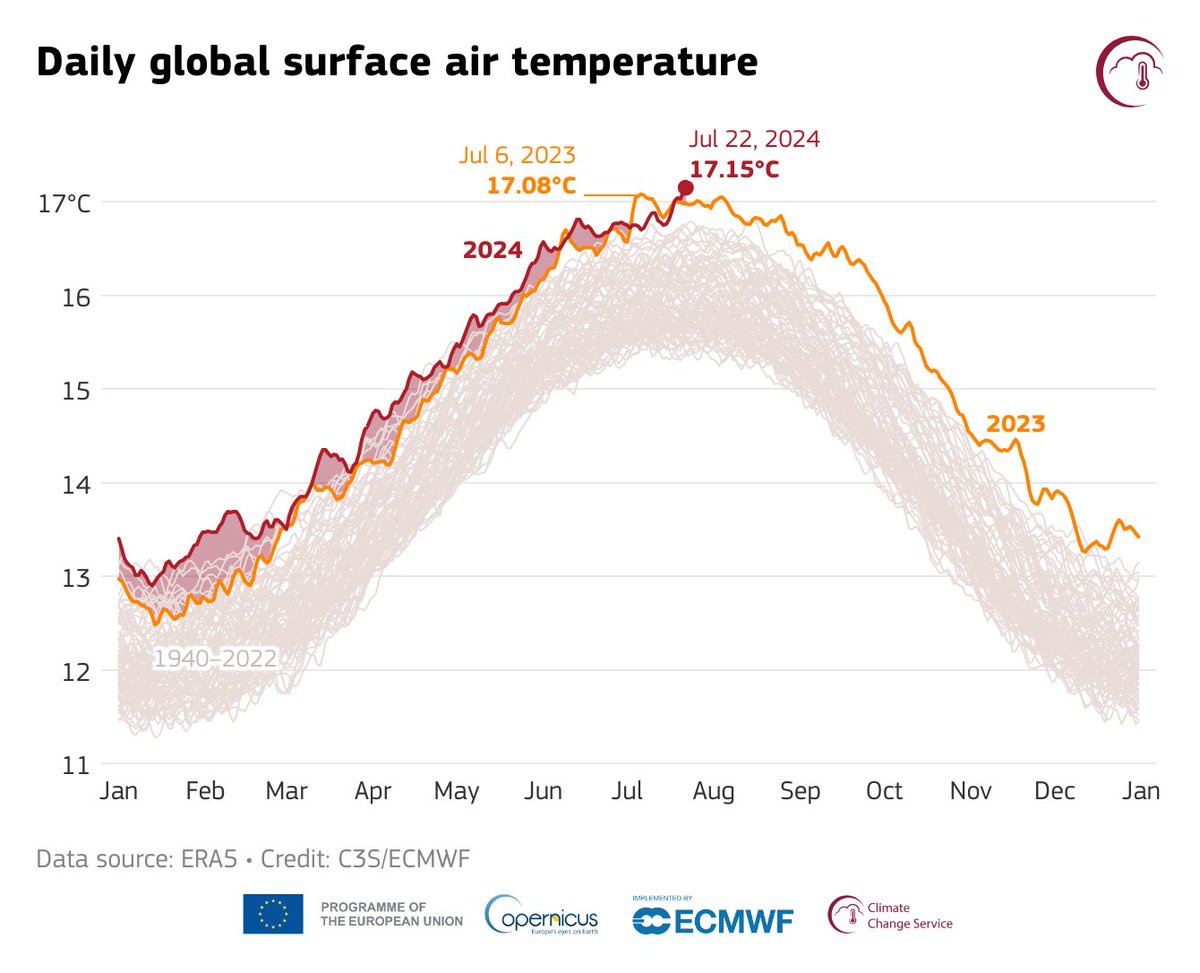
🌡️ New daily global average temperature record.
As anticipated, the #CopernicusClimate ERA5 preliminary data show that Monday 22 July was the warmest day in recent history, at 17.15°C, breaking the records from 21 July 24 and 6 July 23.
Read more: https://t.co/FCDXtIadxn
🌡️New global temperature record.
#CopernicusClimate preliminary data show the daily global average temperature reached 17.09°C (21 July 24), very marginally above the previous record of 17.08°C (6 July 23).
Find out more 👉 https://t.co/zl69Lxecui
@sdbernard@CopernicusECMWF@AttractaMooney Thanks Steve. Are the anomalies averaged over each latitude band, or something else? I'm trying to understand why each lat band has a range of values for each date instead of a single vertical stripe.
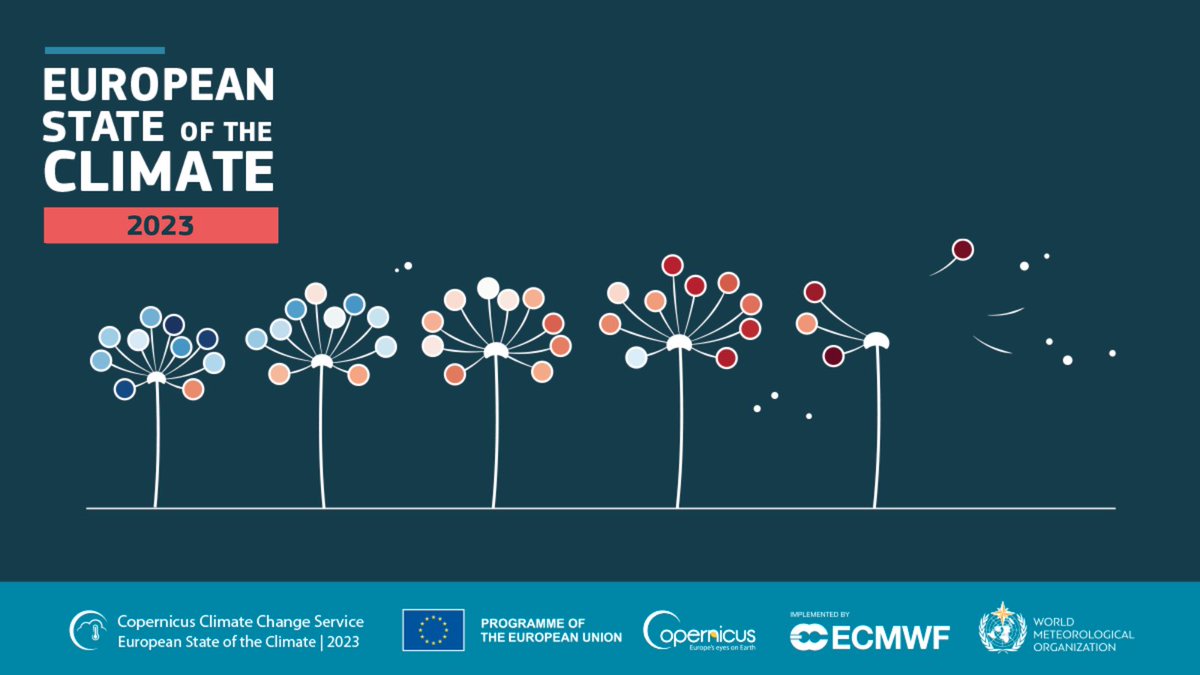
🌍🔬 Today, #CopernicusClimate and @WMO release the 2023 #ESOTC report. It details climate conditions, key events, their impacts, and discusses climate policy and action with a focus on human health.
Read the full report here 👉 https://t.co/eySbK69vJk
📣 #C3S is proud to launch a new tool: Climate Pulse.
The aim of this tool is to make climate monitoring more intuitive and available to everyone by providing a precise picture of the near-real time status of our climate.
Discover it here 👉https://t.co/pCzx92yDwB
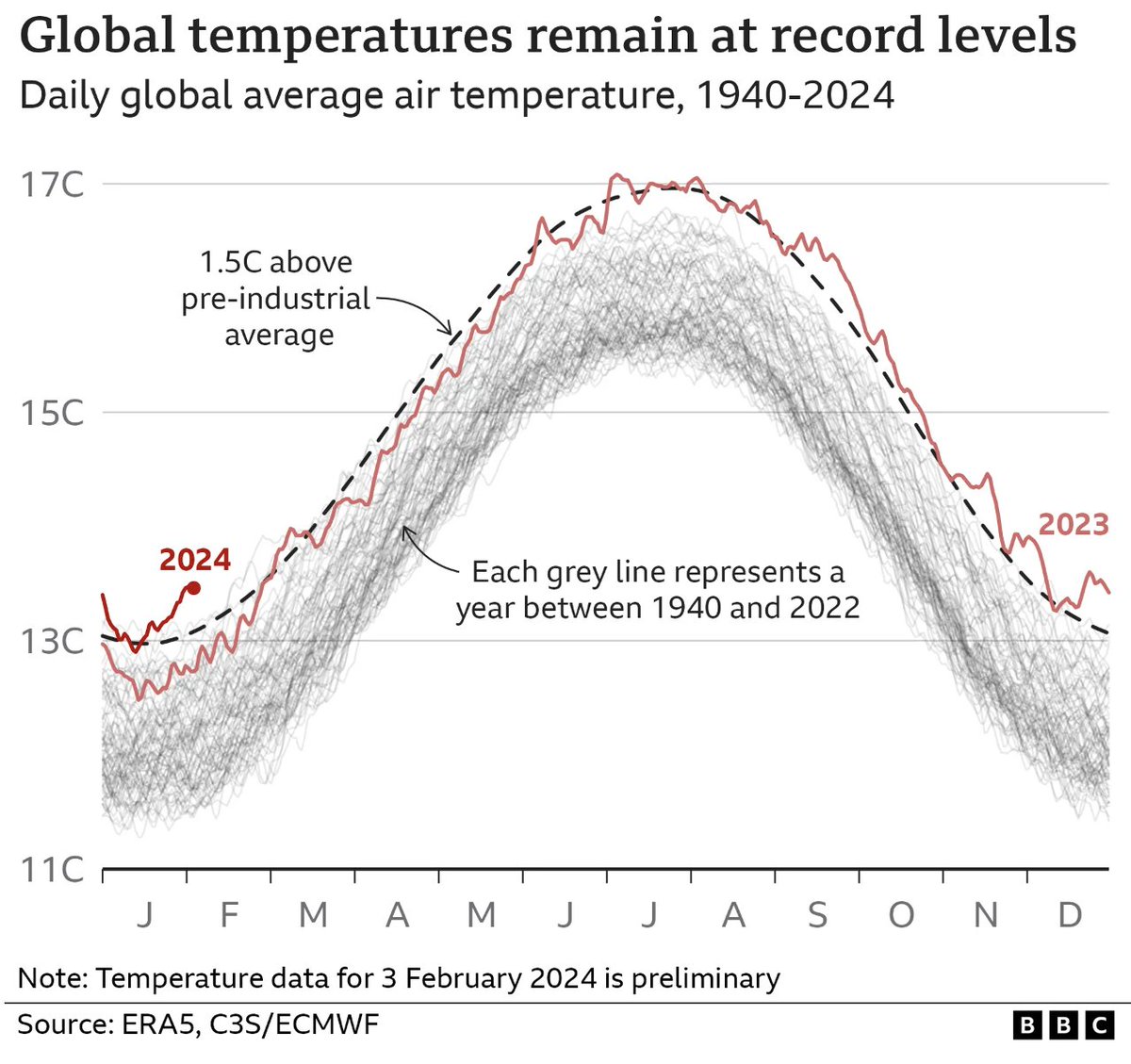
January 2024 was the warmest January on record.
New data from @CopernicusECMWF shows that we've now had:
- the eighth record breaking month in a row and
- twelve months (Feb 23-Jan 24) with global temperatures more than 1.5ºC above the pre-industrial reference baseline.
🌡️📈 According to data from the #CopernicusClimate Change Service, the first 3 weeks of July have already broken several significant records, including:
▶️Hottest day globally;
▶️Hottest 3 weeks globally.
#C3S data also show:
▶️July 2023 likely to be hottest month on record.
📈According to the #ERA5dataset, the 7 days from 3rd to 9th July 2023 were the 7 hottest days on record globally, making the first week of July 2023 the hottest week on record.
Get the data 👉 https://t.co/V3rirrGxRD
According to preliminary data from the #ERA5 dataset, the daily global average 2m #temperature reached 17.03°C on Tuesday, setting a new record.
Get the data 👉https://t.co/V3rirrGxRD
📢 📊 The #CopernicusClimate Change Service has just released the 2022 European State of the Climate report. A must-read for anyone interested in the latest analysis of #climatechange.
Check it out now ☞ https://t.co/Bika2dAAjK
#ESOTC#EUSpace
🌍 The #CopernicusClimate Change Service's report on the European State of the Climate for 2021 has just been released!
#C3S puts last year's climatic conditions into context with long-term trends.
#EarthDay #EarthDay2022
Explore the #ESOTC ➡ https://t.co/3M2k3iXEd🌍 The #CopernicusClimate Change Service's report on the European State of the Climate for 2021 has just been released!
#C3S puts last year's climatic conditions into context with long-term trends.
#EarthDay#EarthDay2022
Explore the #ESOTC ➡ https://t.co/3M2k3iXEdL
To journalists reporting on heatwaves: please ask whether climate change is ‘worsening’ these events, rather than ‘causing’ them.
As @FrediOtto says: “science has shown that every heatwave we experience is now made more intense by human-induced global warming. Every single one.”