🚨 Updated Working Paper Alert 🚨
When Fair Isn't Fair: Understanding Choice Reversals Involving Social Preferences
with Jim Andreoni, Deniz Aydin, Blake Barton, and Doug Bernhiem
Paper: https://t.co/nnB0OMNWh2
Blog post: https://t.co/cQhcMkYK4B
1/
@eshaghoulian Ed, are you sure you didn't just use one of those face-aging apps on a photo of yourself? This is exactly what I think you'd look like at 80.
@andrewheiss I only got this because it was one of my desperate guesses last week, and I looked it up after the fact.
#Worldle #50 3/6 (100%)
🟩⬛⬛⬛⬛⬇️
🟩🟩🟨⬛⬛↙️
🟩🟩🟩🟩🟩🎉
https://t.co/fcnwTwYAxk
Grad Students: Finish your Dissertation. Apply for those Professorships. There is a light at the end of the tunnel. When you reach it, it indicates the start of another tunnel, with another light at the end and so on. What I’m saying is: Academia is just a bunch of unlit tunnels.
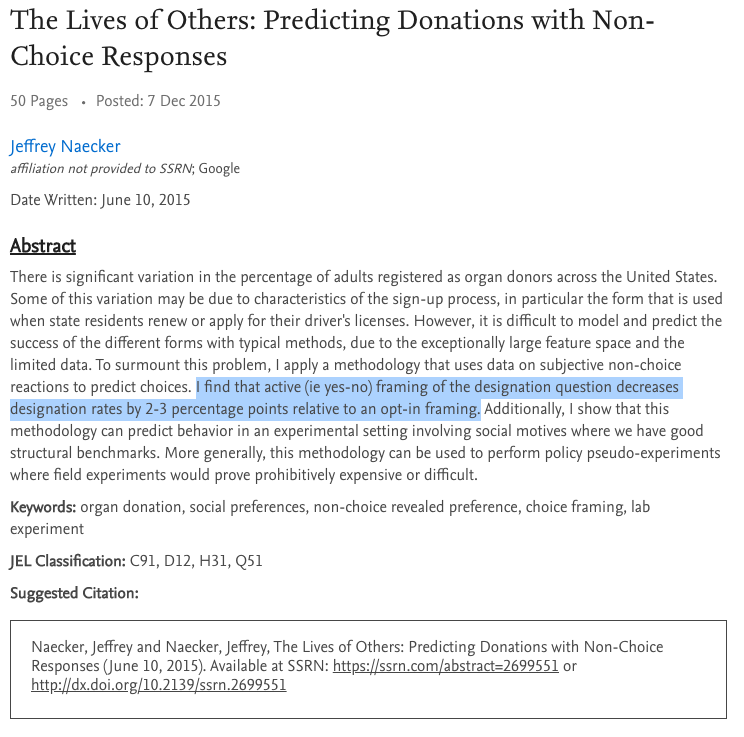
Our paper formalizes the methods that I used in my job market paper, to estimate the effect that framing had on organ donation decisions at the state level:
https://t.co/PWAQmWJl7a
Thanks to my friend and co-author @danbjork for tweeting about our exciting paper, and for doing the vast majority of the work on this version along with the brilliant Michael Pollmann.
We developed a method to estimate how factors affect choices, by combining what people say they'd do, with what people actually do. with Doug Bernheim, @jnaecker, Michael Pollmann (1/12)
We combine what people say and do: we use machine learning to uncover the relationship between hypothetical responses and real choices in observational data, and then use that relationship to predict the effects of counterfactuals. (4/12)