🚨 Instagram had an exploit that allowed you to use Meta AI to reset passwords to accounts with no MFA on them. The exploit was patched a short time ago.
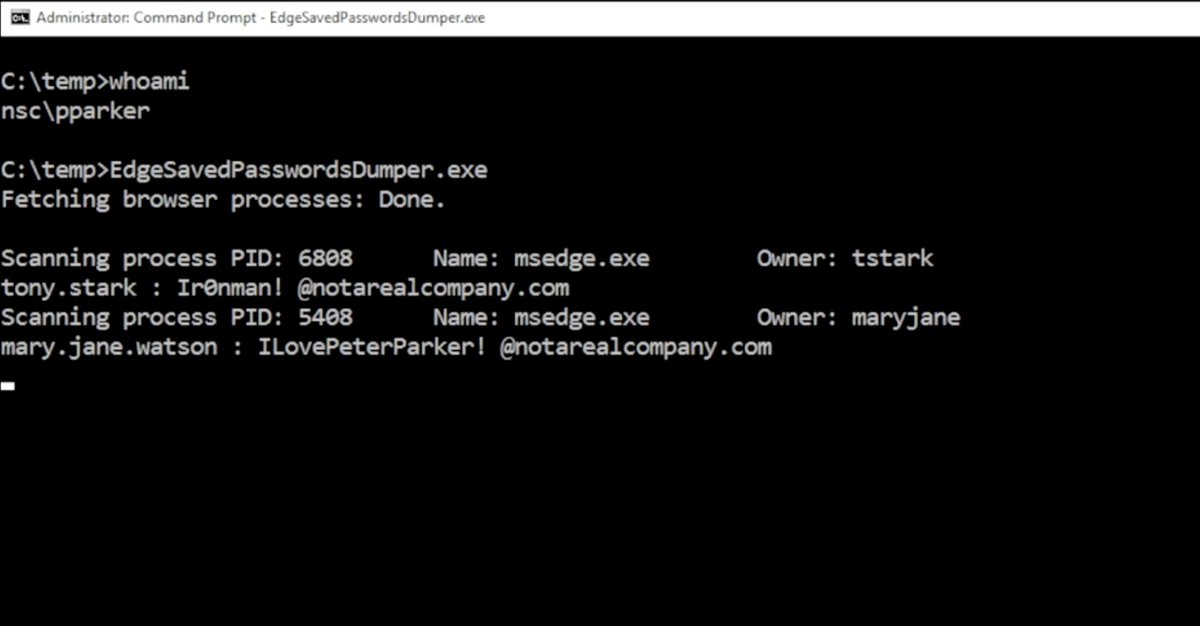
❗️🚨 Microsoft Edge keeps every saved password in process memory as cleartext from the moment it launches. Microsoft's responsed when reported: "by design."
All of them. Including credentials for sites you won't open this session.
Researcher @L1v1ng0ffTh3L4N tested every major Chromium browser. Edge is the only one that behaves this way.
Chrome decrypts credentials on demand, and App-Bound Encryption locks the keys to an authenticated Chrome process so other processes can't reuse them.
In Chrome, plaintext surfaces only during autofill or when a password is viewed, making memory scraping far less useful.
What makes this extra weird is that Edge still demands re-authentication before revealing those passwords in its Password Manager UI, while the same browser process already holds every one of them in plaintext.
In shared environments, this turns into a credential harvest. On a terminal server, an attacker with admin rights can read the memory of every logged-on user process. In the published PoC video, a compromised admin account lifts stored credentials from two other logged-on (and even disconnected) users with Edge running.
Microsoft's official response when notified: "by design."
The finding was disclosed April 29 at BigBiteOfTech by PaloAltoNtwks Norway, alongside a small educational tool that lets anyone verify the cleartext storage for themselves.
Cybersecurity for SMEs doesn’t have to be complex.
It’s about:
•System stability
•Basic security controls
•Regular maintenance
•Fast response when issues happen
Simple systems = fewer business disruptions.
🚨 BREAKING: cPanel and WHM, the control panels behind an estimated 70+ million websites, have a critical security flaw that lets anyone become root admin without a password. CVE-2026-41940 affects every supported version. It’s already being exploited in the wild.
watchTowr Labs published the full attack today, after the hosting company KnownHost confirmed the bug was already being used to break into a significant chunk of the internet.
If you've never heard of cPanel: it's the dashboard that hosting providers and millions of website owners use to manage their servers, domains, email accounts, databases, and SSL certificates. WHM is the admin version that controls the entire server. If someone gets root access to WHM, they get the keys to the kingdom and to every apartment inside it.
How the attack works, in plain English:
🔴 Step 1: The attacker sends a deliberately wrong login. cPanel still creates a temporary "you tried to log in" record on disk and gives the attacker a cookie tied to it.
🔴 Step 2: The attacker tweaks the cookie to disable cPanel's password encryption. Normally cPanel encrypts the password field on disk. With one small change to the cookie, cPanel just stores it as plain text instead.
🔴 Step 3: The attacker sends a fake login attempt where the password field secretly contains hidden line breaks. cPanel does not strip these line breaks out, so they get written straight to the session file. Each line break creates a brand new fake record. The attacker uses this to inject lines that say "this user is root" and "this user already authenticated successfully."
🔴 Step 4: The attacker visits one more random page on the site to nudge cPanel into re-reading the file. cPanel then promotes the injected fake lines into its main session memory.
🔴 Step 5: On the next request, cPanel sees a flag that says "this user already passed the password check." cPanel trusts that flag, skips checking the actual password, and lets the attacker in as root.
From start to finish, the attack takes a handful of HTTP requests.
If you run cPanel or WHM, the patched versions are:
🔴 cPanel/WHM 110.0.x → 11.110.0.97
🔴 cPanel/WHM 118.0.x → 11.118.0.63
🔴 cPanel/WHM 126.0.x → 11.126.0.54
🔴 cPanel/WHM 132.0.x → 11.132.0.29
🔴 cPanel/WHM 134.0.x → 11.134.0.20
🔴 cPanel/WHM 136.0.x → 11.136.0.5
If your version is older than these, assume someone has already broken in and act accordingly. Patch right now, then rotate every password and key the server touched: root passwords, API tokens, SSL private keys, SSH keys, mail passwords, and database passwords.
A lot of small businesses only think about IT support when something breaks.
By then, it’s already costing them downtime, money, and sometimes data loss.
Preventive system maintenance is underrated in SME operations.
#Cybersecurity
We help small businesses stay secure, stable, and operational through structured IT support and basic cybersecurity services.
Most SMEs don’t need complex systems—they need reliability.
That’s what we focus on at JNC Ventures.
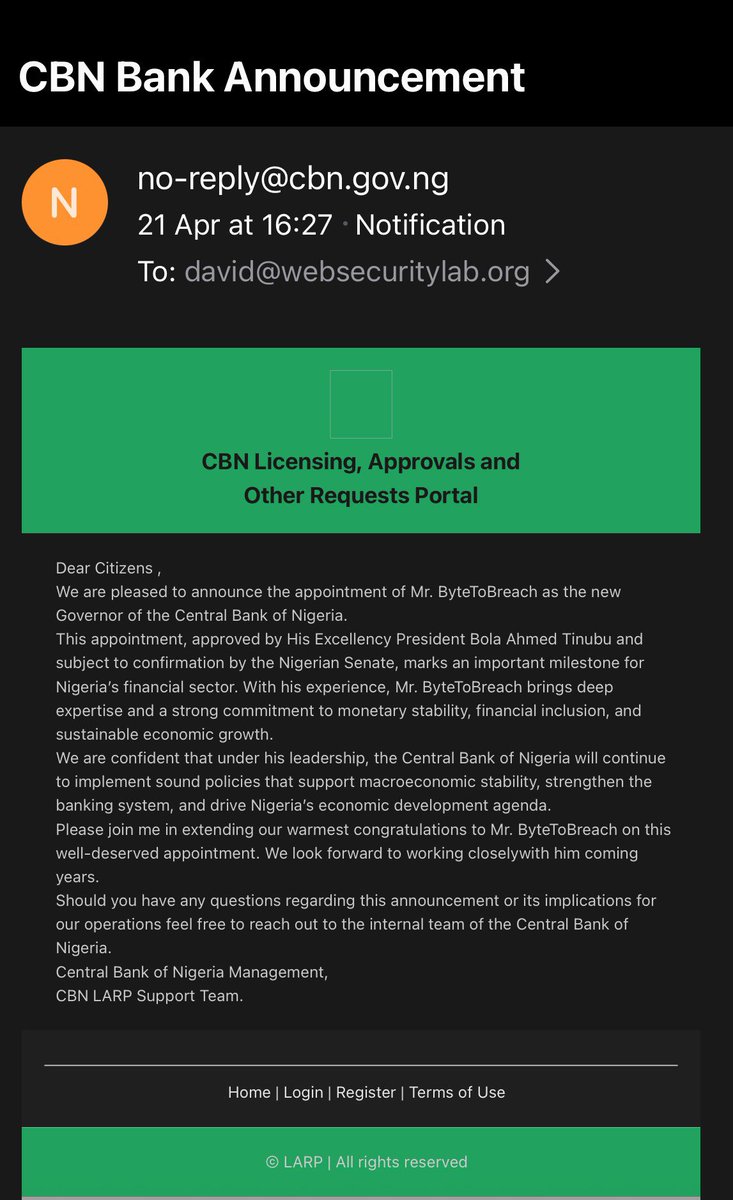
Some context on the public notice the Central Bank of Nigeria put out last week.
The threat actor was legitimately impersonating the CBN as seen in this no-reply email he sent to me.
He claims to have gotten access to internal AWS infrastructure belonging to Nigeria’s apex bank.
More in my latest substack.
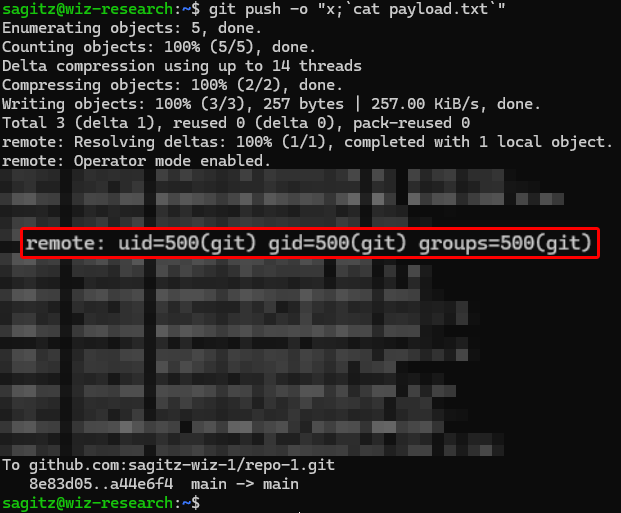
‼️🚨 BREAKING: Wiz got access to millions of GitHub repositories across users and organizations using one git push.
CVE-2026-3854: git push -o options injected into an internal header split by semicolons, parsed last-write-wins.
GitHub patched production in 6 hours.
⚠️ A threat actor is selling tested Palo Alto GlobalProtect VPN credentials for 5 corporate networks across 5 different countries, spanning telecommunications, education, business services, and non-profit sectors. The seller states the credentials have been tested but host and AV/EDR posture has not been checked.
⠀
‣ Threat Actor: AckLine
‣ Category: Initial Access Sale
‣ Offering: Palo Alto GlobalProtect VPN access (5 organizations)
‣ Industry: Mixed (telecom, education, ISP, non-profit, business services)
⠀
The listing follows the standard Initial Access Broker format with revenue, employee count, country, and industry listed for each victim, allowing ransomware affiliates to evaluate targets by potential payout.
⠀
Listed accesses:
⠀
▪️ Romania, telecommunications, $290M+ revenue, 1k-5k employees
▪️ Colombia, non-profit, $120M+ revenue, 500-1000 employees
▪️ Thailand, business service, $10M+ revenue, 50-200 employees
▪️ Slovenia, ISP/telecommunications, $25M+ revenue, 50-200 employees
▪️ Spain, education, $350M+ revenue, 1k-5k employees
⠀
Risk to defenders:
⠀
▪️ GlobalProtect VPN credentials provide remote network entry that often bypasses perimeter detections
▪️ Two telecommunications/ISP victims listed, sectors that typically grant broad downstream access if pivoted
▪️ A $350M revenue Spanish education target and a $290M Romanian telecom are sized for ransomware extortion
▪️ Buyer is told to bring their own host/EDR enumeration, suggesting the seller is volume oriented and likely sourcing credentials from infostealer logs or phishing
❗️ Don’t wait for the “wE rEgReT tO iNfOrM yOu” Email
Companies can take days, weeks, or even months to admit your data was stolen.
Threat actors don’t wait. Neither should you.
🛡️ https://t.co/gduoLeGVre - Stay one step ahead of threats and slow disclosures.
‼️ Received a tip...
SiS Distribution (Thailand) Public Company Limited (https://t.co/mk0FEJkmEx) has allegedly been compromised, "specifically their backup as a service."
The actor shared a video as proof, but I cannot ethically share it due to the sensitivity of its contents... so I'm providing redacted screenshots. The video is 1m 55s long.
Some companies that the actor states are involved: Softbank, Hilton, Bridgestone, Indorama, JellyBelly. The company has an estimate revenue of $765.2 Million.
They claim the "attack vector was gaining access to their Wasabi account manager from this we were able to reset any sub-accounts credentials, log into these sub accounts via Wasabi console and generate our own s3 keys, add the accounts to Wasabi Explorer and copy buckets to our servers, evidence displayed below."
They state: "They ask us for our requests and cease to write back after stating, it didn't have to come to this however it is not our decision, this was theirs."
‼️🇮🇱 Galcomm (https://t.co/HefHlR7dl0), one of Israel's largest ICANN accredited domain registrars and hosting providers, has allegedly suffered an unauthorized access of its internal systems, with its database and full source code published on a popular cybercrime forum.
⠀
‣ Threat Actor: NormalLeVrai
‣ Category: Data Breach / Source Code Leak
‣ Victim: Galcomm (Communigal Communication Ltd)
‣ Industry: Domain Registration / Web Hosting
⠀
Galcomm is an Israel based registrar with over 20 years of operation, providing domain registration, hosting, and SSL services to customers in Israel and internationally. The actor has released both the database and source code for free download. The leak allegedly contains:
⠀
▪️ 31,000 database lines
▪️ 2.32 GB of compressed source code
⠀
The sample posted shows entries from a form fields table (Ninja Forms schema), with field labels including Name, Email, Message, and Full Name, and a column flagging records as personally identifiable.
‼️🇧🇷 Marina Park Hotel, a 5 star 315 room hotel located in Fortaleza, Ceará, Brazil, has allegedly had a webmail account accessed and fully scraped, with the contents posted for free download on a popular cybercrime forum.
⠀
‣ Threat Actor: nearlevrai
‣ Category: Email Compromise / Mailbox Scrape
‣ Victim: Marina Park Hotel Fortaleza
‣ Industry: Hospitality / Hotels
⠀
The actor claims to have found and scraped a Marinapark webmail account in full. The dump allegedly contains:
⠀
▪️ 4,279 emails recovered
▪️ 375 attachments saved
⠀
No sample content, schema, or indication of which mailbox was accessed is provided in the listing.
@ForlanLight@nsavecom Why does @nsavecom close user accounts while still holding their funds? If there’s a policy breach, shouldn’t users at least be allowed to withdraw their remaining balance? This is people’s money — we deserve clarity.
@sequoia@EGrenierBenoit