ETH on-chain looks absolutely dead.
However, the latest Fusaka update was a major step towards massive adoption because on-chain fees went under $0.1, and transaction speed significantly increased, which were the main issues of ETH on-chain.
I think it is time to slowly expose yourself to ETH on-chain microcaps with the lowest risk but the highest upside possible before it becomes trending again.
Why before it gets trending? Simply because when it becomes how again, all the farmers and scammers will launch and will take your hard-earned money.
Here, I show you my ETH on-chain bets with the highest upside potential and lowest risk. Of course, none of them is financial advice.
$COR | @cortensor at $2.2m market cap.
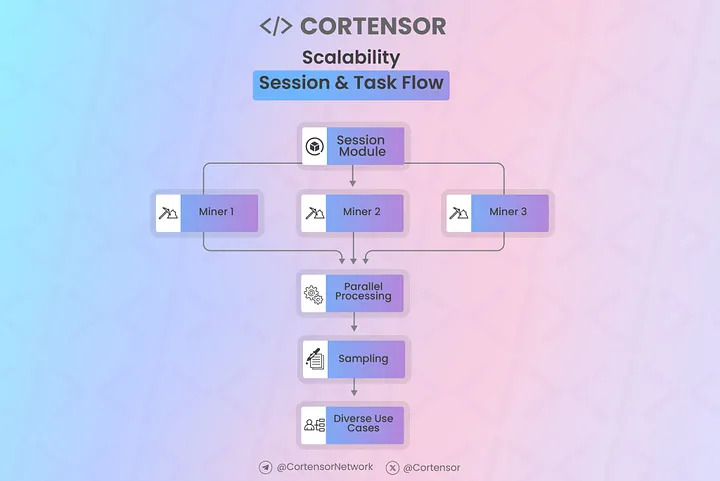
Cortensor is an open, decentralized AI inference and validation network where agents can run tasks, verify results, and pay per use.
It uses on-chain payments (x402) and agent identity standards (ERC8004) to make inference and trust checks seamless for autonomous systems.
The goal is a scalable infrastructure that lets AI agents operate reliably without central intermediaries.
🚀 Big win for #Cortensor!
$COR = adding a whole new batch of faster & smarter AI models. The team is now testing them so nodes can run more powerful tasks soon.
More models = more speed, more power, more growth. 🔥
#AI#DePIN#Crypto#DeAI@cortensor
The more I watch this AI industry grow, the more obvious it becomes that we’re heading straight into a wall unless things change.
- AI is getting so good that you can’t tell what’s real anymore.
- AI agents are about to influence trillions in purchases.
- IP is worth $80T, and there’s no reliable way to track who created what.
- And all the computing power is slowly concentrating in the hands of a few giant companies.
That’s not sustainable.
Decentralised compute, real payment rails for agents, and a way to actually trace where AI outputs come from, this is the part of the industry where crypto is genuinely useful.
And this is exactly where $COR naturally fits in.
COR is building the rails that the entire AI agent economy will need, whether people realise it yet or not.
Because
1. We need a way to trust AI outputs.
Agents are going to be everywhere, doing everything, and you can’t just “hope” they got it right. COR gives you a way to verify results with redundant inference and simple trust checks so you know the output wasn’t hallucinated.
2. Agents need a native payment system.
If AI agents are going to transact and make purchases, they need a way to pay automatically. This is where x402 comes in: tiny, fast, on-chain payments that let AI agents call services, pay instantly, and move on.
No API keys, no subscriptions, no middlemen.
3. Provenance actually matters now.
When IP is worth $80 trillion, you need to know where things came from. COR helps track and validate work so creators aren’t getting steamrolled by centralised models.
4. Compute needs to be open, not controlled by megacorps.
COR runs on distributed miners, not giant data centers.
It keeps the ecosystem neutral and gives everyone access, not just the top five tech companies.
To sum up, COR provides:
- Decentralised inference
- A validator system that any agent can call
- x402 is integrated directly into the workflow
- Compatibility with ERC-8004
- And eventually Corgent, a trust layer that agents can depend on
Everything the industry is struggling with;
trust, identity, payments, provenance, decentralisation
All lines up perfectly with what COR is building.
This is why I keep saying decentralised inference is going to be huge.
And COR is sitting in the right place at the right time, building exactly what the next wave of AI will need.
NFA, just a personal opinion.
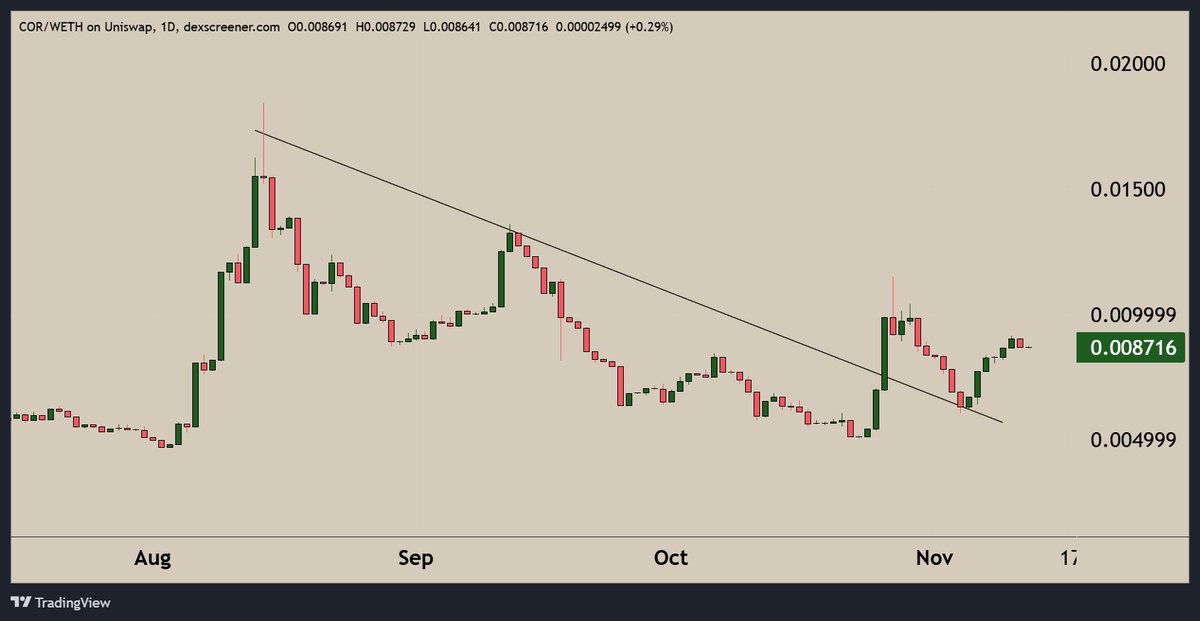
$COR looks bottomed out here.
If you look at the chart, we’re clearly still in the accumulation phase, and i’m expecting a breakout in Q1/2026.
Next up for @cortensor:
- Transition from testnet to mainnet
- Corgent integration with @virtuals_io
- Agent layer 402x, ERC8004, MCP
$COR chart is looking very juicy.
The decentralisation narrative is getting hot with the ICP pump and $COR has been building a decentralised AI inference network for over 1 year, and the testnet is coming this month.
Things are very obvious.
NFA, just a personal opinion.
I’ll tell you here and now..
$COR is cooking, and once the full @virtuals_io agent ecosystem is connected with @cortensor, things are going to move fast
The pieces are falling into place: 🧩
Router upgrades, x402, ERC-8004 alignment, and the Virtual integration are all converging to build a real, scalable agent economy.
Still early, still undervalued imo.
NFA/DYOR.
$ICP ’s latest moves signal the market is circling back to decentralised compute and AI.
$COR | @cortensor sits nicely in this narrative as the trust layer for AI. Cortensor is a decentralised AI inference network: every model query pays in COR and nodes all around the world prove the results via on-chain.
In practice, it uses Proof-of-Inference/PoUW to ensure each AI output is summed up as a decentralised AI inference network that leverages distributed computation and open-source models.
In short, $COR makes AI outputs decentralised, verifiable and trustless.
Think of ICP as a decentralised cloud/compute, and COR as decentralised trust/proof.
As new standards (like ERC-8004) underscore, AI agents need an on-chain trust, the meta-shift is clear:
If we’re entering a world of autonomous AI, someone has to verify its work. $COR is positioning itself to be that someone.
Enjoy the short read: @CryptoWizardd@IncomeSharks
Many people are asking what my highest conviction gem is that I hold with size.
It is $COR | @cortensor.
I made countless posts about it and am just waiting for its turn the come.
My main reasons are in the quoted post.
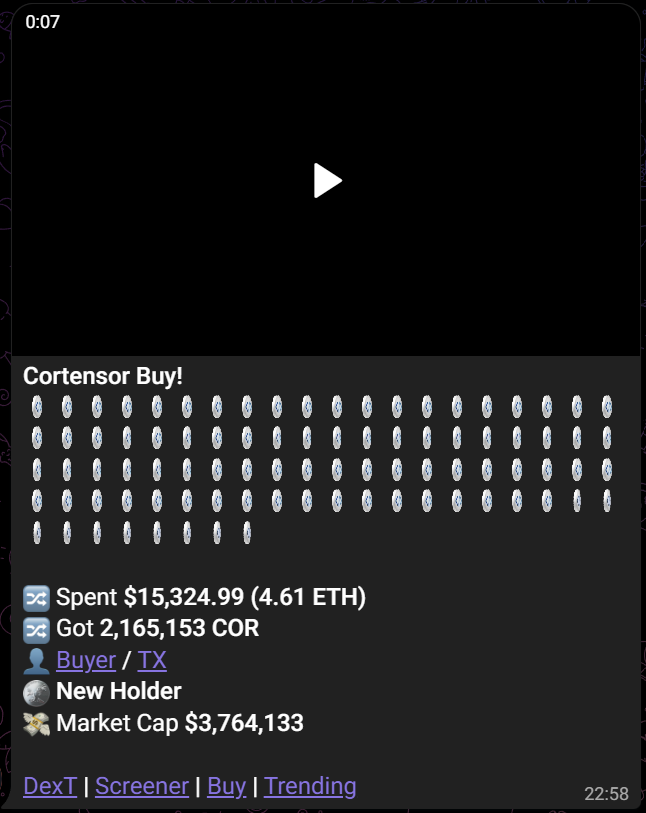
Looks like some people have started bidding.
nfa
$COR is the eth on-chain project I am the most bullish on.
> Decentralised AI inference provider
> Doxxed dev
> 0/0 tax #BASE pair live
> Testnet coming soon
> The first AI agent powered by decentralised infra for the Virtuals ecosystem is coming soon.
Enough catalysts
NFA
I heard from a fellow that $COR will play a vital role in the @virtuals_io ecosystem.
I can’t wait to follow the progress of “Corgent” that is now being built by @cortensor.
It’s an undervalued gem sitting at 3M. For me, this is a +100X play.
#BASE:
‣ https://t.co/h1WJNCGFYp
Vitalik said “privacy requires decentralization, decentralization is hard”.
Guess who has been building decentralized inference for over a year.
Yes, $COR | @cortensor.
I wouldn’t be surprised if he starts supporting $COR as well.
I keep saying it, but $COR is building the most important layer of the entire Virtual ecosystem, and updates like this make the picture even clearer.
They just released two early WIP documents that outline the “north star” for Corgent, and even though these are still drafts, the direction is very obvious. Corgent is becoming the trust oracle inside Virtual, built directly on top of Cortensor’s compute and verification rails, and these docs basically show how both ecosystems will merge at the infrastructure level.
Corgent is not another agent, it is not a wrapper, and it is not a side product. It is the layer that Virtual agents can call when they need delegation, validation, or arbitration. It shows the full picture of how Corgent uses Cortensor’s trust rails, how it plugs into GAME and ACP, and how it turns trust and correctness into an actual service that agents can rely on. It is the clearest explanation so far of how Virtual agents will offload heavy tasks or ask for proof-quality checks inside their workflows.
Corgent matters for both Virtual and Cortensor, and this is where the roadmap becomes important. They show the full evolution path: Router v1, Router v1.5 with MCP and x402, Router v1.6 with validate and ERC 8004 readiness, and then Router v2.0 which is where Corgent becomes a first-class component. In other words, Corgent is not a plugin to the network. It is the natural result of the Router upgrades, the validation endpoints, the ERC 8004 alignment and the trust rails Cortensor has been building since day one.
These documents are still early, and they will change as Testnet moves forward, but the core idea is locked in. Corgent is the trust layer for Virtual. It is the part that will give agents the ability to run tasks on Cortensor, verify the output, resolve disputes, and move forward with confidence. This is the piece that turns the Virtual agent economy into something reliable instead of something experimental.
This is exactly why I stay a $COR maxi inside the @virtuals_io ecosystem. They are building the rails everyone else will eventually depend on.
NFA, just a personal opinion.
You know, I am very bullish on the $VIRTUAL ecosystem and I am a complete $COR | @cortensor maxi, so nothing makes me more excited than seeing that $COR is building a massive agent "Corgent" inside Virtual that will accelerate the entire agentic economy on @virtuals_io.
What they shared today is basically the early blueprint of how Corgent will operate inside the Virtual ecosystem, and even though this is still early research, the structure already shows how deep this integration will go. Corgent is being shaped into the trust-oracle layer for Virtual agents, giving them three things they never had before: Delegation as a Service where any agent can tell Corgent to run a task on Cortensor with the reliability tier they choose, Validation as a Service where Corgent checks if another agent’s output is correct or useful, and Arbitration as a Service where Corgent can replay a full task flow and deliver an oracle-level verdict if there is a dispute.
The way it fits with GAME and ACP makes this even more clear. GAME handles agent planning and orchestration, ACP workers execute tasks, and Corgent becomes the bridge between them and the Router Nodes. When GAME decides something, ACP calls Corgent, Corgent calls the Router Node, Cortensor miners compute and produce proofs, and Corgent returns the validated result back into the agent workflow. It is a clean loop with each part doing exactly what it is designed to do.
Corgent is also becoming a smart client for Cortensor itself. It will create sessions, send tasks, request redundancy, gather miner outputs, collect trust signals, and then apply PoI for consistency and PoUW for usefulness so results are actually accurate instead of “just running a model.”
They even outlined validation tiers. Fast is one miner with a quick PoUW check. Safe is three miners with PoI consensus and PoUW scoring. Oracle-grade is five miners with strict PoI and PoUW thresholds for tasks that require extremely high trust. This is proper infrastructure, not wishful thinking.
The point is simple. Corgent will make Cortensor the native trust layer inside Virtual. Delegation, validation, arbitration, and replay all become first-class services for every agent in the ecosystem. When this goes live, Virtual agents will not just run tasks but run them with confidence, and that is exactly what the agentic economy has been missing.
NFA, just a personal opinion.
Testnet live. Virtual-integration coming. Corgent becoming the trust-oracle layer for agents
If #Cortensor even reaches mid-tier AI-infra valuations…
➡️ $1.19 – $2.38 per $COR 👀
AI × Agents × Validation = unstoppable
This is still early. Very very early...
#COR#AI#Agents