Money coming from where?
Rep. Michael McCaul's recent disclosure shows that he bought ~$2.4M worth of stocks
Most of the money went into:
- $PAYX (~$300K)
- $SPGI (~$145K)
- $MA (~$115K)
- And several other six-figure buys
$PAYX is an interesting one bc:
1. He started buying Paychex in March, racking up ~$550K worth of purchases
2. From the looks of it, the stock "might" be on the rebound
3. If it returns to its ATHs, it would be up ~69% from his average entry price
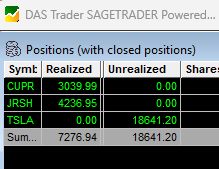
+$7,276.94 Lightning Fast Day Trading $CUPR $JRSH on @sagetraderusa
+$18,413.70 Swing Trading $TSLA on @sagetraderusa
Try Sage, in my opinion way faster than the free commission brokers: https://t.co/ng6XVKAdtx
Day 94 Of The Protocol:
DRC: A+
Lesson: Risk Management Is Everything
Disclaimer: Day trading is extremely risky. Most traders lose money. This content is for entertainment and educational purposes only and is not financial advice.
#stockmarket #trading #daytrader #daytradelifestyle #hardwork
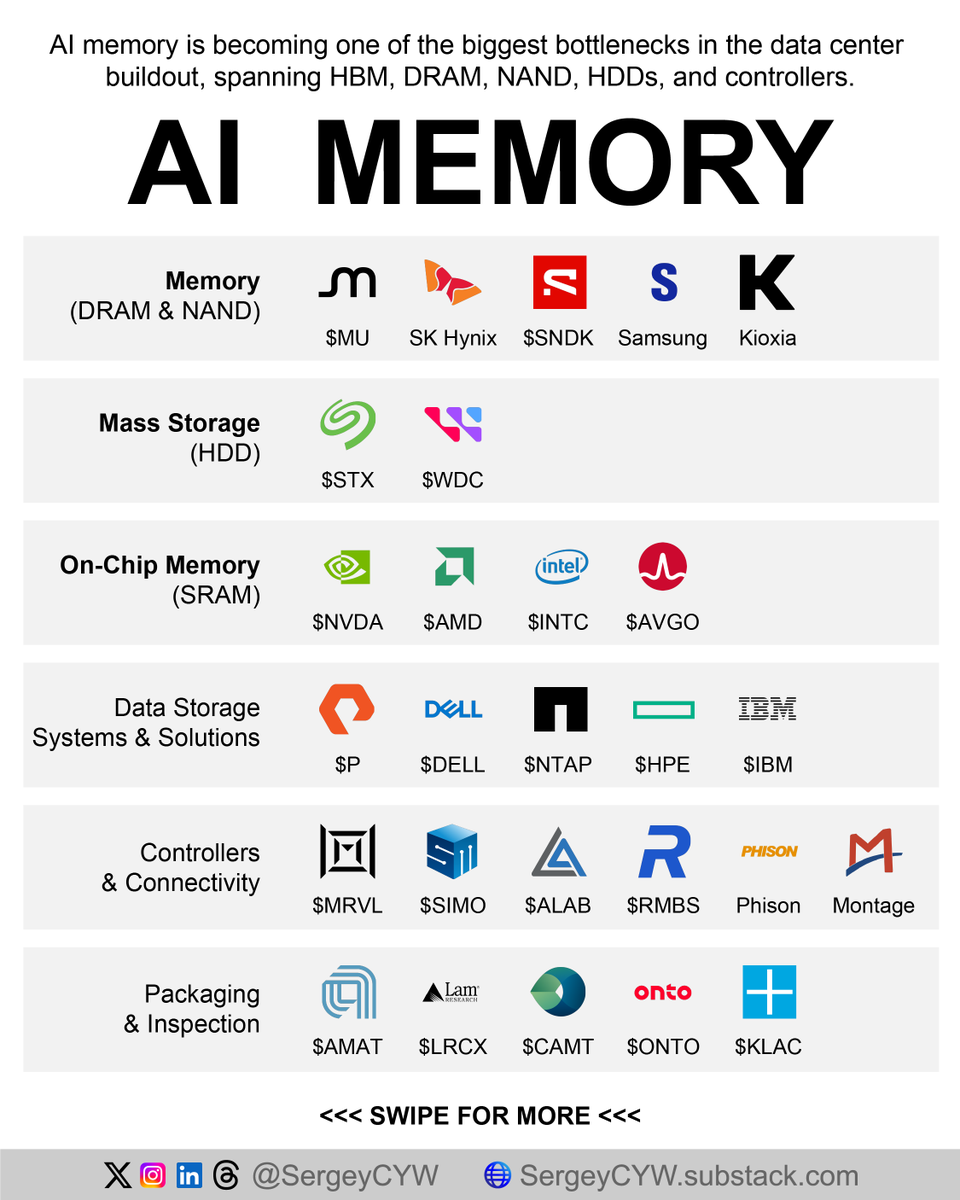
AI memory is becoming the real bottleneck behind the data center buildout.
Morgan Stanley calls memory “THE bottleneck” in AI, while Goldman Sachs flags memory, power, and labor as key physical constraints. Agentic AI, larger KV caches, multimodal workloads, and longer context windows are pushing demand beyond GPUs into HBM, DRAM, NAND, HDDs, SRAM, controllers, storage systems, and packaging tools.
Layer 1: DRAM & NAND
Core memory suppliers sit closest to the AI capacity shortage. HBM feeds accelerators. DRAM supports servers. NAND supports fast retrieval, inference storage, and active AI data pipelines.
$MU Micron: Micron is the U.S. pure-play memory supplier across HBM, DRAM, NAND, and SSDs. Its 12-high 36GB HBM4 moved into high-volume production ahead of schedule, while customer agreements cover HBM capacity through 2026. HBM4E base dies also shift to TSMC, strengthening advanced foundry integration.
$000660(.KS) SK Hynix: SK Hynix remains the key HBM supplier for Nvidia platforms. The company started full-scale 1b DRAM production for HBM4 and added 40,000 wafer starts per month at M15x. Its base-die transition to advanced logic nodes supports the 2048-bit interface needed for larger AI models.
Here are the top performing ETFs ranked by year-to-date returns.
$PSI $FTXL $SOXX $SOXQ $XSD $CHPX $TEKX $PTF $HECO $SHOC $SMHX $QQQA $MEME $PSCT $XES
Semiconductor-focused ETFs continue to dominate performance tables in 2026, with AI, chip manufacturing, and technology momentum themes leading the market.
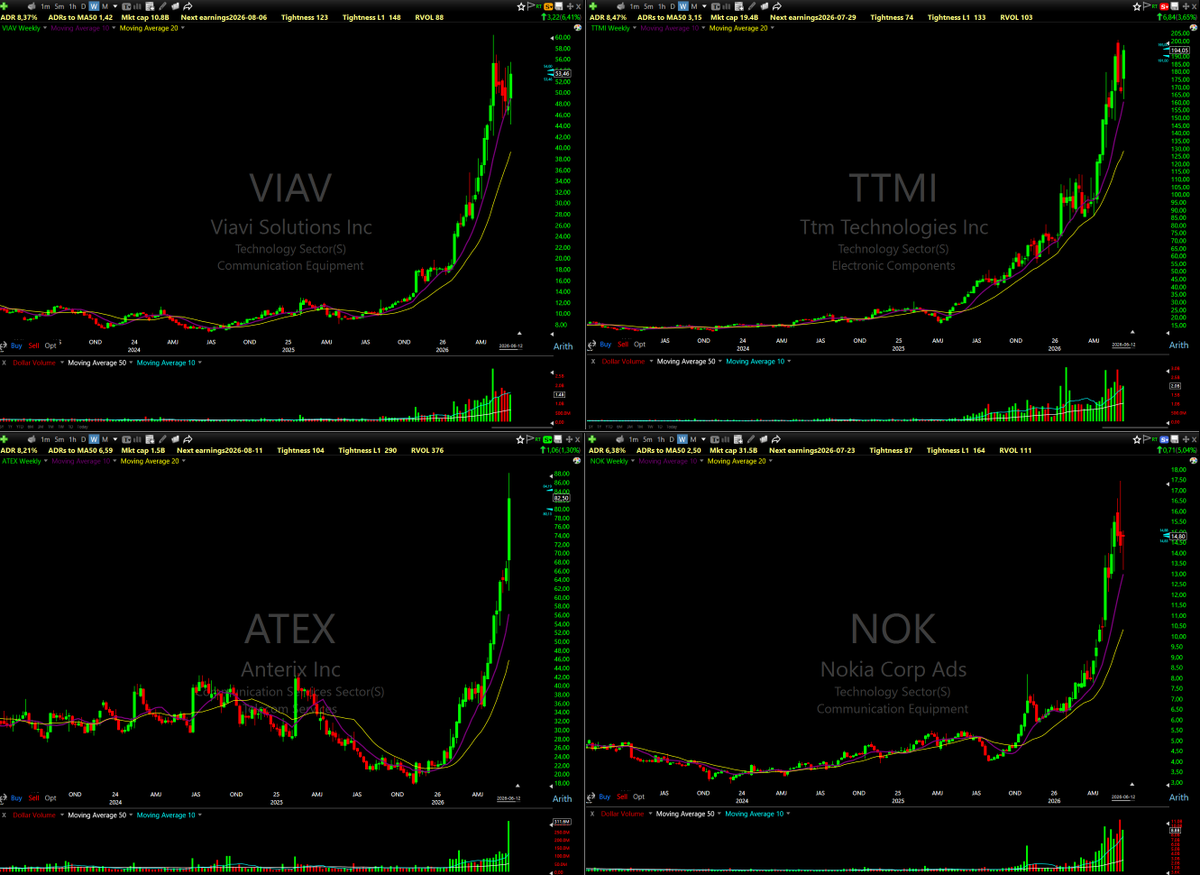
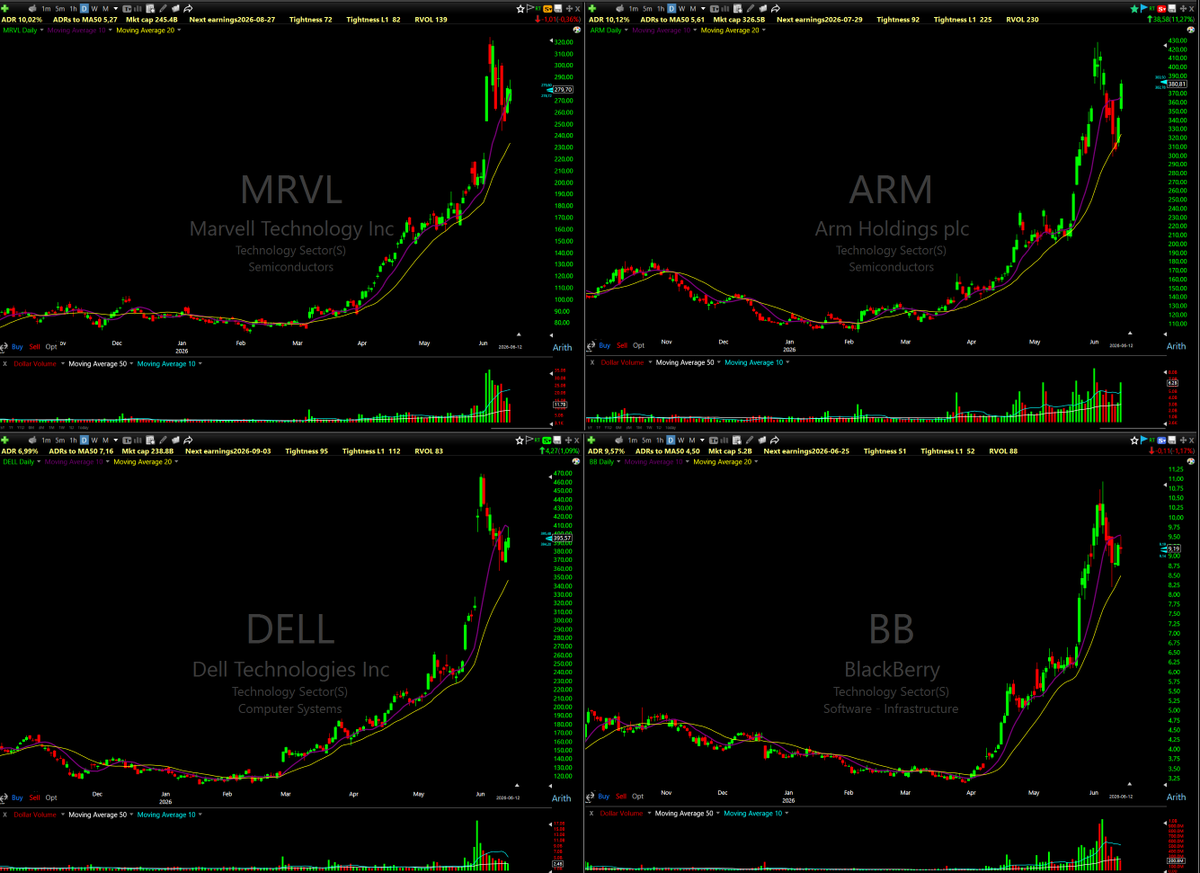
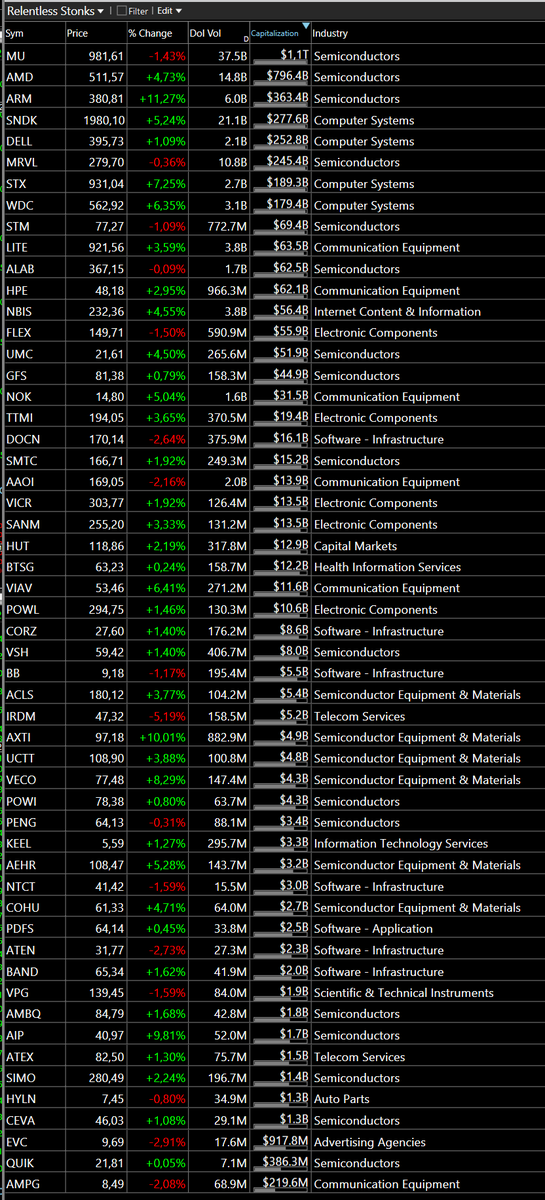
Current List of Relentless Stocks....
These stocks are MARKET LEADERS by price. Climbing up week after week respecting the MA10 MA20 MA50 all the way.....
ENJOY!
Un desarrollador ucraniano creó un agujero negro en su terminal para obligarse a tomar descansos.
Cuanto más trabajas sin parar, más crece y deforma tu código con su lente gravitacional. Descansas y se encoge.
Absolutamente increíble. Lo que hoy ha hecho Barcelona se recordará mucho tiempo. La Sagrada Familia, Gaudí y los que durante 140 años han creído en ello, lo merecían.
Best accounts to follow from each frontier lab to stay constantly up to date
Anthropic
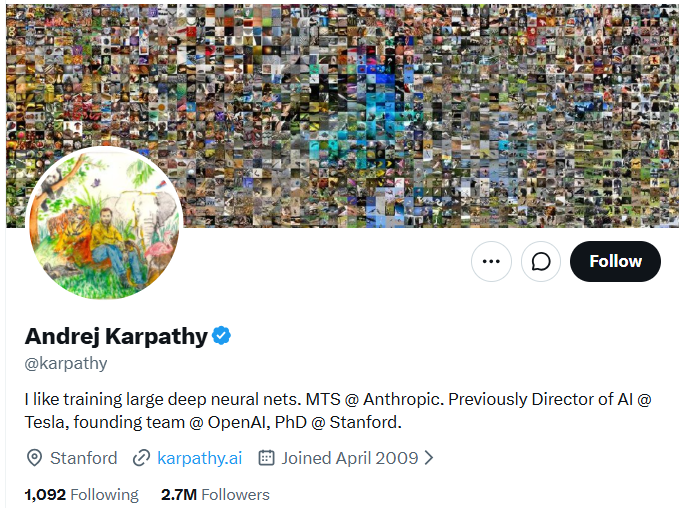
@karpathy
- must-follow account for AI; recently joined Anthropic
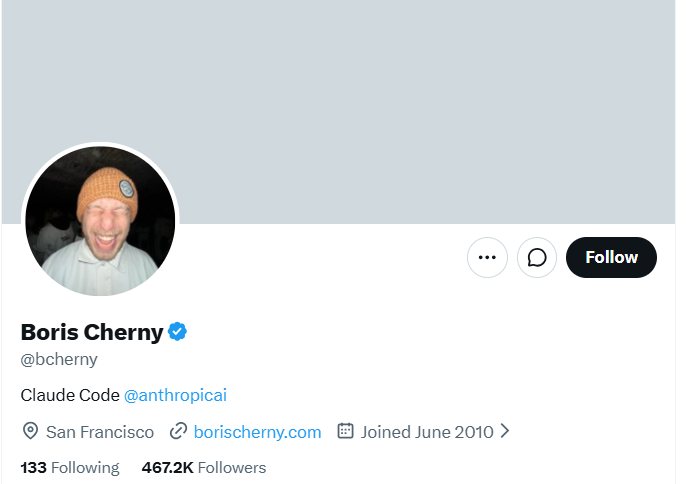
@bcherny
- Claude Code creator, always shares great tips
@trq212
- also a Claude Code developer; writes amazing articles on CC
OpenAI
@polynoamial
- works on reasoning research, shares a lot of technical details
@gabriel1
- Sora developer, great career path
@jxnlco
- works on dev experience, shares a lot about Codex
Google AI
@OfficialLoganK
- all the major Google Gemini and AI Studio updates
@ammaar
- product and design; shares great things about vibe-coding in Google AI Studio
@fofrAI
- cool use cases for generative models
Cursor
@leerob
- the loudest voice behind Cursor updates
@ericzakariasson
- shares great insights on using Cursor
@mntruell
- Cursor’s CEO; major releases and usage updates
xAI
@milichab
- recently joined xAI, shares updates on Grok
@skcd42
- also covers major Grok releases
@ai_explorer25
- covers all ai content and free resources
AI exposure is becoming more layered — and ETF selection now matters more
AIQ, BAI, and AIPO all give exposure to artificial intelligence, but each fund owns a different part of the value chain.
AIQ is the broad AI and big data ETF. It tracks the Indxx Artificial Intelligence & Big Data Index, holds around 90–100 names, and has about $7.65B in AUM. The portfolio works more like AI beta: memory, semiconductors, hyperscalers, cloud platforms, devices, software, data workflows, and digital ads.
Top AIQ holdings show how wide the AI stack has become.
$000660.KS SK Hynix is central to HBM3E and next-gen HBM supply. Its fabs are running close to full for Nvidia GPUs, with AI server DRAM and HBM cited as the key driver of record operating margin.
$MU Micron adds high-performance DDR5, HBM, LPDDR6, and storage exposure. A specific detail I like: internal GenAI tools reportedly cut root-cause analysis time by half and lifted developer productivity above 30%.
$005930.KS Samsung brings memory, logic, foundry, and advanced packaging into one AI silicon platform. Management plans to route roughly 60% of 2026 HBM output to custom ASIC clients alongside GPU customers.
$CSCO Cisco is the AI networking layer. It has already surpassed $1B in annual AI infrastructure orders from web-scale customers, with N9100 and 9300 switches built for AI Ethernet fabrics.
BAI is a different structure. It is BlackRock’s actively managed AI ETF, with roughly $16.3B in net assets and a 0.55% net expense ratio after waivers. Instead of tracking an index, BAI relies on active selection across AI and tech innovators.
The risk and opportunity are the same: manager selection.
$000660.KS SK Hynix is also a core BAI position. Management has stated AI chip demand may exceed manufacturing capacity, while next-gen HBM ramps aim to protect over 60% HBM market share.
$AMD AMD is positioned as the main high-end AI compute challenger. Its MI455 accelerator was described with 320B transistors, 70% more than MI355, and the ability to run 200B-parameter models locally.
$AVGO Broadcom gives BAI exposure to custom AI accelerators and Ethernet fabrics. Broadcom has a 10-gigawatt custom accelerator collaboration with OpenAI and a multi-generation Meta AI chip deal.
$TSM TSMC remains the advanced manufacturing bottleneck. Recent data showed 74% of wafer revenue from 7nm and below, 25% from 3nm, and 61% of sales from high-performance computing, including AI.
$LRCX Lam Research adds the equipment layer. Lam supports AI scaling through deposition, etch, and clean tools used in advanced DRAM, 3D NAND, and leading-edge logic.
$AIPO is the physical AI infrastructure ETF. It focuses less on software and more on the systems needed to power AI data centers. The fund has about $780M in AUM, 78 holdings, a 0.69% expense ratio, and about 56% exposure to industrials.
The thesis is straightforward: AI needs electricity, cooling, transmission, backup power, nuclear fuel, and grid expansion.
$PWR Quanta is the top holding. It builds high-voltage transmission lines, substations, and grid connections. Management highlighted a $2.40T addressable market through 2030 across grid modernization, reshoring, and data centers.
$ETN Eaton supplies switchgear, power distribution, backup systems, and electrical infrastructure for AI factories. Electrical Americas data center orders reportedly jumped about 240% YoY in Q1 2026.
$GEV GE Vernova provides gas turbines, microgrid solutions, and dispatchable power for utilities and data centers. Its Autonomous Tuning software uses AI to improve turbine efficiency and reduce emissions.
$VRT Vertiv builds cooling, power, and UPS systems for dense AI racks. Its roadmap is aligned with Nvidia GPU releases, including an 800 VDC power portfolio planned for late 2026.
$BE Bloom Energy provides on-site fuel cells for data centers trying to bypass grid bottlenecks. Its expanded Oracle agreement supports up to 2.8 gigawatts of fuel cell capacity for cloud and AI operations.
$AIQ is broad AI beta.
$BAI is active AI stock selection.
$AIPO is AI power infrastructure.
AI is now spans memory, GPUs, ASICs, foundries, networking, cloud, software, power equipment, cooling systems, uranium, gas turbines, and grid construction.
SAM ALTMAN HAS A NEW PROBLEM. 🤯
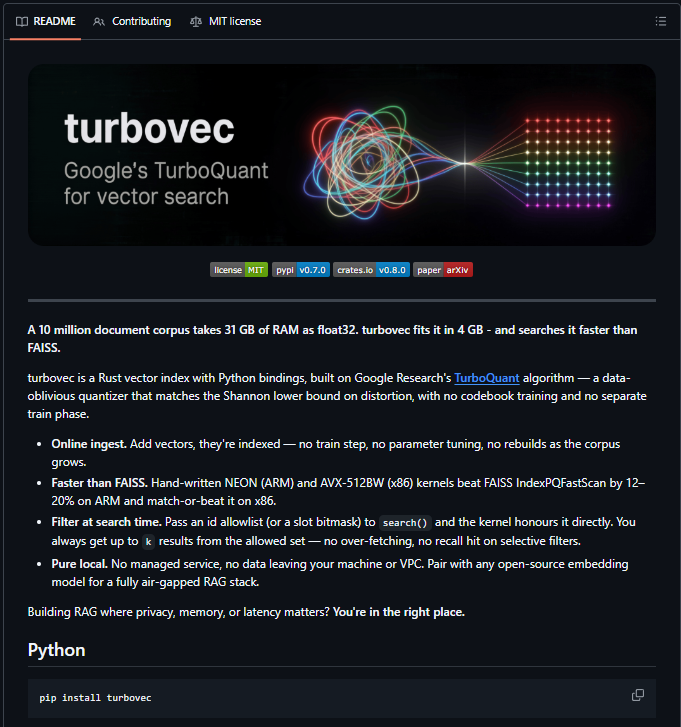
Google just shrunk 31GB of AI memory down to 4GB.
The tool is called TurboVec.
It uses up to 16x less memory, searches faster than FAISS, runs fully offline, and works on a regular Mac.
No expensive GPU cluster.
No cloud dependency.
No compromise on speed.
→ 16x lower memory usage
→ Faster vector search
→ Works with LangChain & LlamaIndex
→ 100% open source
The race to build bigger AI models is loud.
The race to make them dramatically cheaper just got a lot more interesting.
Repo: https://t.co/08TFGtHL6K