“Debemos aprender a caminar solos. Sin amigos, sin amores y, a veces, incluso sin familia. Solos llegamos y solos nos vamos. Una de las lecciones más duras de la vida es entender que no siempre tendrás a alguien a tu lado. No siempre habrá una mano que te levante, una voz que te calme o un abrazo que te salve del peso que llevas dentro. Y aunque al principio duele, con el tiempo también te enseña algo poderoso: la compañía más importante que tendrás toda tu vida será la tuya. Aprender a caminar solo no significa dejar de amar, ni renunciar a los demás, significa dejar de depender emocionalmente de su presencia para sentirte completo. Significa entender que, aunque muchas personas prometan quedarse, no todas lo harán. Algunas se irán por elección, otras por distancia, otras por el simple devenir de la vida. Y cuando eso pase, si no aprendiste a sostenerte por ti mismo, el vacío te puede romper. Por eso hay que fortalecer el alma, hay que aprender a escucharse, a acompañarse, a resistir los silencios y a seguir avanzando aun cuando el camino se vuelva frío y solitario. Porque la soledad, aunque duele, también moldea. Te obliga a conocerte sin máscaras, te enseña lo fuerte que eres cuando nadie te aplaude, y te muestra que muchas veces, después de perder a todos, es cuando por fin empiezas a encontrarte a ti. La vida puede dejarte sin amigos, sin amores y hasta sin el calor de tu propia sangre, pero mientras no te abandones a ti mismo, todavía tendrás algo valioso: la fuerza para seguir. Aprender a caminar solo no es una tragedia. A veces, es el paso más doloroso, pero también el más necesario para volverte invencible por dentro.”
CAPÍTULO III: "Caminar Solo" Pag. 54
#RimasDelAlma
« Combien d'hommes ai-je entendu dire qu'ils désirent une « femme intelligente » dans leur vie!
Je les encouragerai à y réfléchir...
Les femmes intelligentes prennent des décisions elles-mêmes, elles ont leurs propres désirs et elles mettent des limites.
Tu ne seras jamais le centre de sa vie parce que celle-ci tourne autour d'elle-même. Une femme intelligente ne se laissera pas manipuler ni faire chanter, elle assume des responsabilités.
Les femmes intelligentes remettent en question, analysent, se disputent, ne se contentent pas et avancent. Ces femmes ont eu une vie avant toi et elles savent qu'elles continueront à l'avoir une fois que tu seras parti. Elle prévient, elle ne demande pas de permission.
Ces femmes ne recherchent pas dans le couple un leader à suivre, un papa qui résout la vie, ni un fils à sauver. Elles ne veulent pas te suivre ni marquer le chemin de personne.
Elles veulent marcher à côté de toi.
Elle sait que la vie sans violence est un droit, pas un luxe ni un privilège.
Elles expriment la colère, la tristesse, la joie et la peur de la même façon, parce qu'elles savent que la peur ne les rend pas faibles de la même façon que la colère ne les rend pas masculines. Ces deux émotions et les autres, toutes ensemble, la rendent humaine c’est tout.
Une femme intelligente est libre car elle s'est battue pour sa liberté. Elle n’est pas une victime, elle a survécu.
N’essaie pas de l'enchaîner car elle saura comment s'échapper. La femme intelligente sait que sa valeur ne réside pas dans l'apparence de son corps.
Pensez-y deux fois avant de la juger pour son âge, sa taille, son volume ou son comportement sexuel, car c'est de la violence émotionnelle et elle le sait.
Donc avant de dire que tu souhaites une femme intelligente dans ta vie, demande-toi si tu es vraiment prêt à t'intégrer dans la sienne. »
Gabriel Garcia Marquez prix Nobel de littérature 1982
Stay With Me, Lord
Prayer of St. Pio of Pietrelcina
Stay with me, Lord, for it is necessary to have You present so that I do not forget You. You know how easily I abandon You.
Stay with me, Lord, because I am weak
and I need Your strength,
that I may not fall so often.
Stay with me, Lord, for You are my life,
and without You, I am without fervor.
Stay with me, Lord, for You are my light,
and without You, I am in darkness.
Stay with me, Lord, to show me Your will.
Stay with me, Lord, so that I hear Your voice
and follow You.
Stay with me, Lord, for I desire to love You
very much, and always be in Your company.
Stay with me, Lord, if You wish me to be faithful to You.
Stay with me, Lord, for as poor as my soul is,
I want it to be a place of consolation for You, a nest of love.
Stay with me, Jesus, for it is getting late and the day is coming to a close, and life passes;
death, judgment, eternity approaches. It is necessary to renew my strength,
so that I will not stop along the way and for that, I need You.
Stay with me tonight, Jesus, in life with all it’s dangers. I need You.
Let me recognize You as Your disciples did at the breaking of the bread,
so that the Eucharistic Communion be the Light which disperses the darkness,
the force which sustains me, the unique joy of my heart.
Stay with me, Lord, because at the hour of my death, I want to remain united to You,
if not by communion, at least by grace and love.
Stay with me, Jesus, I do not ask for divine consolation, because I do not merit it,
but the gift of Your Presence, oh yes, I ask this of You!
Stay with me, Lord, for it is You alone I look for, Your Love, Your Grace, Your Will, Your Heart, Your Spirit, because I love You and ask no other reward but to love You more and more.
With a firm love, I will love You with all my heart while on earth
and continue to love You perfectly during all eternity. Amen
Thirty-six years ago, two men dressed as police officers cut Jesus out of His frame with a blade.
March 18, 1990. Boston. 1:24 in the morning.
They walked into the Isabella Stewart Gardner Museum, tied up the guards, and spent 81 minutes taking whatever they wanted. Thirteen works of art. Half a billion dollars.
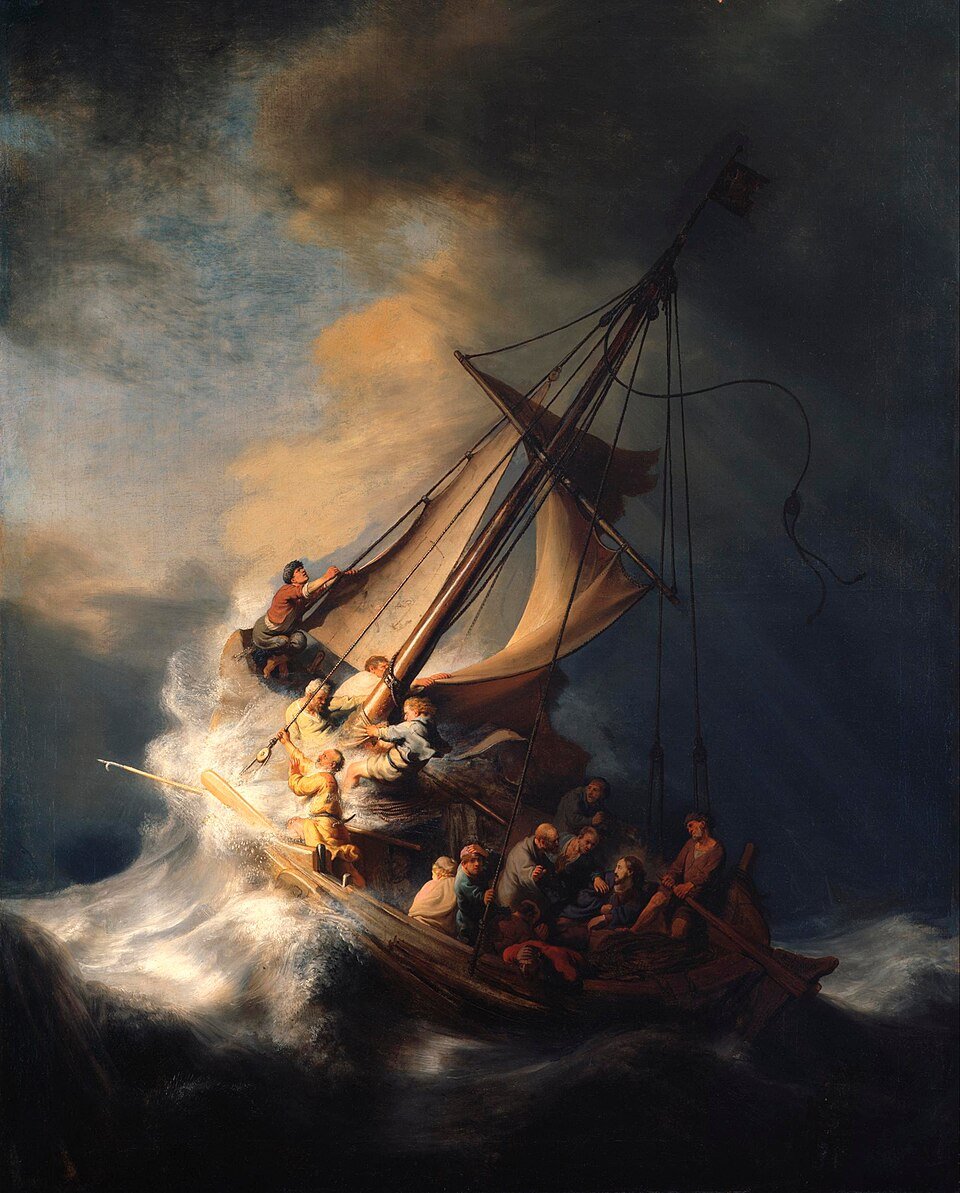
One of them was Rembrandt's The Storm on the Sea of Galilee.
Painted in 1633. The only seascape Rembrandt ever made. And he spent it on Mark chapter 4.
Look at what he painted.
A fishing boat tipped almost sideways. A wave breaking over the bow like a fist. The sail tearing loose. Men hauling on ropes that are winning against them. One disciple leaning over the rail, sick into the sea. Grown men. Fishermen. Men who had worked that water their whole lives, and their faces say they know this is the night it kills them.
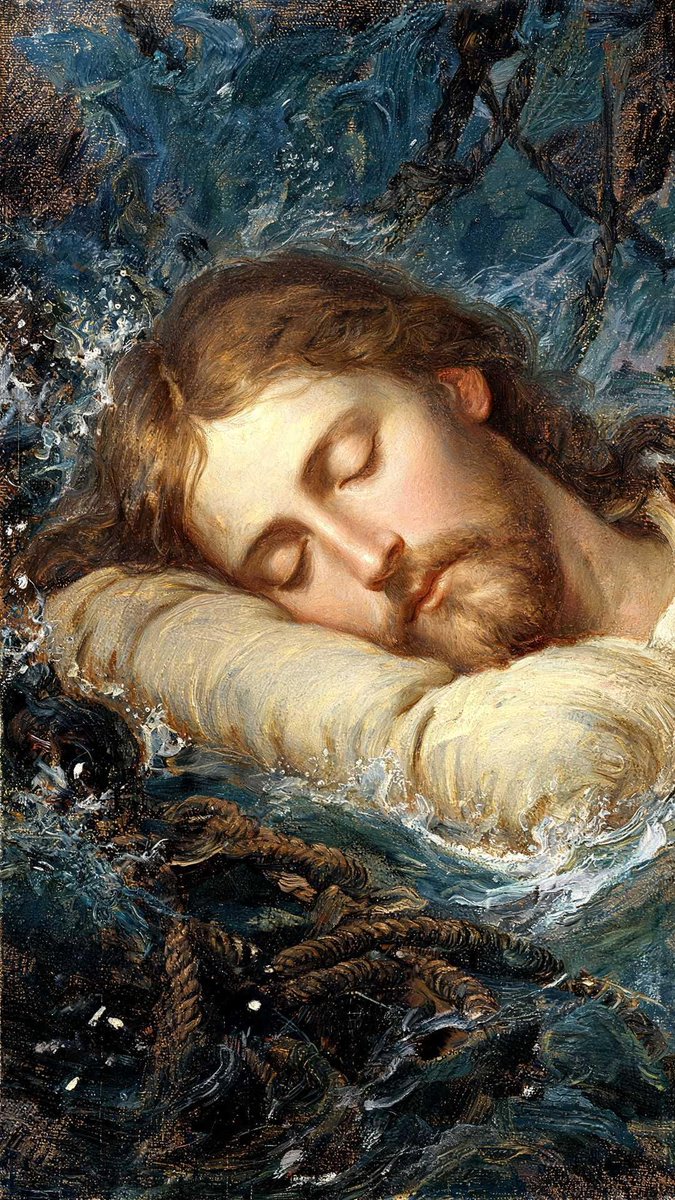
And in the stern, in the one patch of calm light in the whole canvas, Jesus.
Asleep.
Mark 4:38. And he was in the hinder part of the ship, asleep on a pillow: and they awake him, and say unto him, Master, carest thou not that we perish?
Carest thou not?
That's not a question. That's an accusation. Screamed over wind by men who watched Him heal lepers a week earlier.
Now count the men in the boat.
Twelve disciples. Plus Jesus. That's thirteen.
Rembrandt painted fourteen.
Look at the middle of the boat. One man is holding the rigging with one hand and his cap with the other. He isn't fighting the sail. He isn't bailing water. He isn't looking at the wave, and he isn't looking at Christ.
He's looking straight out of the canvas. At you.
It's Rembrandt. He painted his own face into the storm.
A 27-year-old Dutchman put himself in a boat on the Sea of Galilee sixteen centuries after the fact, because he understood something most people miss when they read Mark 4.
This story doesn't have thirteen men in it.
It has every man in it.
You're in the boat. You've been in the boat. The night the phone rang. The diagnosis. The marriage taking on water faster than you can bail. Wind you didn't ask for and can't argue with. And the same accusation rising in your throat that rose in theirs:
Carest thou not that I perish?
And He stood up in the boat, and rebuked the wind, and said unto the sea, Peace, be still. And the wind ceased, and there was a great calm.
Then He turned to them and asked the question that should still sting:
Why are ye so fearful? How is it that ye have no faith?
Not: Why did you wake me? Not: Why are you in a storm?
Why are you afraid with Me in your boat?
The painting has never been found.
The FBI searched for decades. Ten-million-dollar reward. Nothing. Somewhere in the dark: a warehouse, an attic, a wall it was never meant to hang on, that storm is still frozen mid-wave. And the museum never replaced it.
The empty frame still hangs in the same spot on the same wall in Boston. It has hung there empty for thirty-six years. Waiting for what belongs in it to come home.
Sit with that.
Because that's God.
He doesn't take the frame down. He doesn't hang something else in your place. However long you've been missing, however dark the room they're keeping you in, the space you were made for is still on the wall.
Thieves can steal the painting.
Nobody has ever stolen the Man in it.
He's still in the stern of every boat that carries His people. And the storm still needs His permission.
Peace. Be still.
Peter warmed his hands over the fire that ruined him.
John 18:18. The servants and officers had made a fire of coals, for it was cold. And Peter stood with them and warmed himself.
A charcoal fire. In the courtyard of the high priest. In the dark.
That's where it happened. Not on a battlefield. Not under torture. Next to a fire, warming his hands, when a servant girl looked at him too long.
I know not the man.
He said it three times. The third time, he was cursing and swearing while he said it. Fisherman's mouth coming back out of him like the old life never left.
Then the rooster.
Luke 22:61. And the Lord turned, and looked upon Peter.
Jesus was being beaten inside that house. Face already swelling. And through a doorway or across a courtyard, He turned His head and found Peter's eyes.
He didn't say anything. He just looked.
And Peter went out and wept bitterly.
This is the man who walked on water. The man who pulled a sword on an armed detachment. The man who said I will lay down my life for thy sake.
He folded in front of a servant girl. Beside a fire. In the cold.
Now watch what the Bible does.
The Greek word for that charcoal fire is anthrakia.
It appears exactly twice in the entire New Testament.
Once in the courtyard where Peter denied Him.
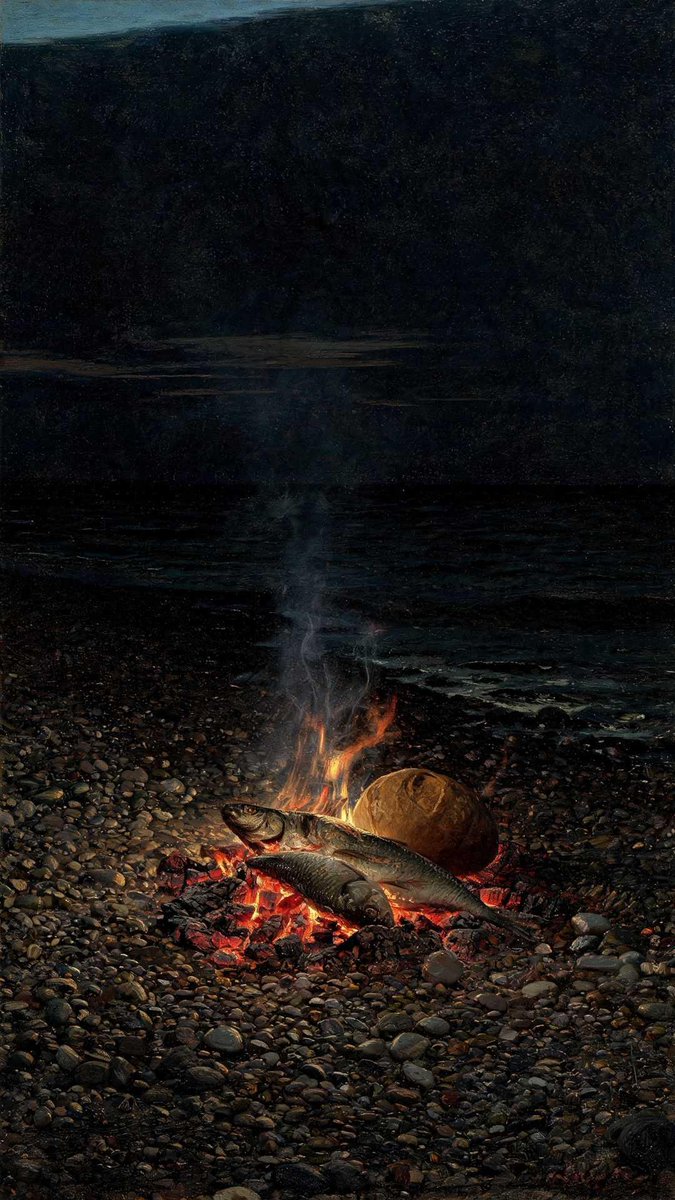
And once on a beach in Galilee. After the resurrection. John 21:9. As soon as they were come to land, they saw a fire of coals there, and fish laid thereon, and bread.
Jesus built it Himself.
He rose from the dead, conquered the grave, held the keys of death and hell, and then He gathered driftwood on a beach and built a charcoal fire and cooked breakfast.
For Peter.
He rebuilt the scene. The smell of the coals. The cold morning air. Everything Peter's body remembered from the worst night of his life, Jesus put it back in front of him on purpose.
And then He asked him three times.
Lovest thou me. Lovest thou me. Lovest thou me.
One question for every denial.
He didn't ask Peter to explain himself. Didn't make him relive the cursing. Didn't say I told you so, even though He had told him so, word for word, rooster and all.
He stood him next to the same fire and gave him three chances to say the opposite of what he said last time.
Peter was grieved the third time. He felt the arithmetic. He knew exactly what was being counted.
And every answer Jesus gave him wasn't punishment.
It was a job.
Feed my sheep.
The man who denied Him three times preached at Pentecost, and three thousand souls were saved. The coward from the courtyard died on his own cross, and the tradition says he asked to be hung upside down because he wasn't worthy to die like his Lord.
That's what Jesus does with failure.
He doesn't avoid the place where you fell. He doesn't tiptoe around it. He doesn't pretend it didn't happen.
He builds a fire in that exact spot and waits for you there.
The thing you did, the night you're still ashamed of, the words you can't take back, the moment you found out what you were actually made of.
He's not going to make you crawl past it.
He's going to meet you in it.
There's a fire on the beach.
He already cooked.
Come and dine.
Heavenly Father,
I come to You today in a season of waiting, not entirely sure what comes next, and I find myself wanting to rush toward answers that You have not yet given. So I pause here, in this quiet moment, and I ask You to meet me in the not-knowing.
Teach me to be patient, Lord. Not the reluctant patience that simply endures until it's over, but a deeper kind, the patience that trusts You are already at work, even in what feels like stillness. I know that growth often happens quietly, beneath the surface, long before it becomes visible. Help me believe that this season, too, is doing something in me, even if I cannot yet see what.
Quiet the restlessness in my heart that wants to force open doors before their time. Slow the anxious pace of my thoughts that keep reaching for certainty I don't yet have. Instead, let me settle into a calm confidence, the kind that comes from trusting Your timing more than my own timeline.
Help me hold my plans loosely, Lord, while still moving forward with intention. Let me use this waiting well, to grow, to listen, to prepare, rather than simply enduring it until something changes. And when the next step does come, let me recognize it clearly, because I have stayed close to You in the meantime.
I don't need every answer today. I just need to trust that You are leading, even now, even here.
I rest in that. I wait in that.
Amen.
Centuries ago, monks prayed all 150 Psalms every day.
But most ordinary people couldn’t read and they longed to pray too.
So the Church gave them something beautiful:
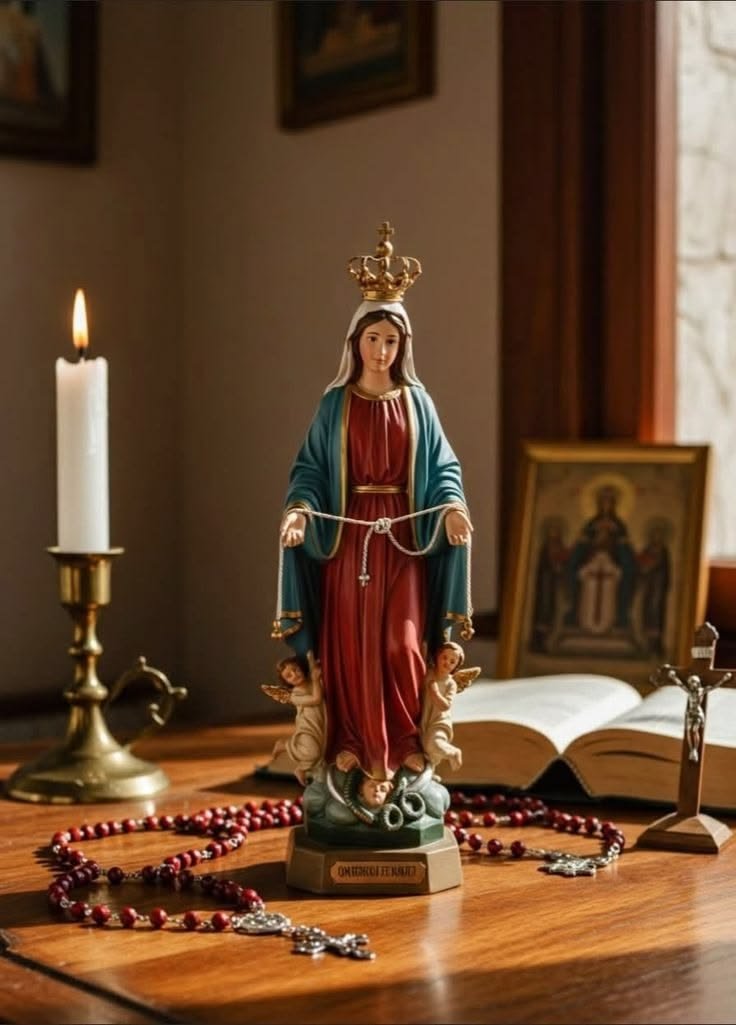
150 Hail Marys, counted on beads, in place of the 150 Psalms. It became known as “the poor man’s psalter.”That’s what the rosary has always been, a way for everyone to pray deeply. Not just monks. Not just scholars. Everyone.
And here’s what most people get wrong: the rosary isn’t worship of Mary. It never was.
It’s a meditation on the life of Jesus... His birth, His death, His resurrection, through the eyes of the one who knew Him best.
That’s why Our Lady asked for it at Lourdes and Fatima. That’s why popes have prayed it for centuries.
And it’s why you can pray it too, even if you’re not Catholic.
If you’ve been waiting for a sign to pick up a rosary, this is it.
Au Japon, pendant la guerre.
Ce petit garçon transportait sur son dos le cadavre de son frère.
Il entendait l'enterrer quand une occasion se présenterait.
Un soldat remarqua cela et lui demanda de le descendre afin de mieux courir.
Le petit garçon lui répondit. "Il n'est pas lourd". C'est mon frère !
Quand le soldat entendit cela, il fondit en larmes...
Depuis lors, cette image est devenue un symbole d'unité dans le Japon.
Laissons ceci inspirer notre quotidien.
"Il n'est pas lourd" c'est mon frère..
C'est ma sœur.
Si il tombe, relève le.
Si il est fatigué, transporte le.
Si il fait des erreurs, pardonne le et essaie de supporter ses égarements...
Aussi, si le monde semble lui tourner le dos, prends le sur le tien et transporte le car Il n'est pas lourd.
C'est ton frère. C'est ta sœur....
"¡El Señor te está concediendo un gran favor, pues te ha elegido para sufrir! Tienes dos hermanos que viven muy mal, y tus parientes viven igual, o quizás peor. Por la salvación de sus almas es que estás sufriendo y tu dolor se prolongará dos años más, después de los cuales serás
7 Saints Who Found Prayer Difficult
And What Helped Them Persevere
1. St. Francis de Sales
When your mind will not stay focused!
He struggled with constant mental distractions and a restless mind during prayer.
He learned to gently return his attention to God without self-reproach.
Simple, short aspirations and trust in God’s patience became his way forward.
2. St. Teresa of Ávila
When you need help staying focused!
She often faced dryness, wandering thoughts, and difficulty concentrating in prayer.
She used structured methods like meditation on Christ’s life and the Jesus Prayer.
Her perseverance and practical advice later helped countless others stay focused.
3. St. Thérèse of Lisieux
When you keep falling asleep!
She frequently dozed off during prayer, especially after long days of work.
Instead of despairing, she offered her sleepiness to God as a childlike gift.
Her “Little Way” taught that even imperfect prayer is precious to the Father.
4. St. Jane Frances de Chantal
When distractions last for years!
She endured decades of mental noise, dryness, and relentless distractions.
Guided by St. Francis de Sales, she practiced quiet fidelity without forcing feelings.
Steady perseverance through long barren periods became her path to deeper union.
5. St. Faustina Kowalska
When your heart feels cold!
She experienced periods when her heart felt empty, cold, and unresponsive in prayer.
Jesus taught her to trust in His mercy even when she felt nothing.
She continued praying the Chaplet and offering her coldness as an act of love.
6. St. John of the Cross
When God removes spiritual comfort!
He passed through the Dark Night of the Soul, when all consolations disappeared.
He taught that this purification strips the soul of attachments so God alone remains.
Faithful prayer in total darkness led him to the deepest mystical union.
7. St. Teresa of Calcutta
When God feels completely silent!
For nearly 50 years she lived in profound interior darkness and silence from God.
She continued to pray, smile, and serve the poorest of the poor without consolation.
Her hidden fidelity in silence became one of the greatest modern witnesses of love.
PERSEVERE IN PRAYER.
GOD IS ALWAYS LISTENING.
São Tomás de Aquino dizia que a ausência de sentimento não é ausência de Deus.
você reza e não sente nada.
pede e não recebe resposta.
faz tudo certo e o silêncio continua.
aí pensa que foi esquecido, ou que está sendo ignorado por Deus.
como o filho pequeno que puxa a camisa do pai durante uma ligação de trabalho, mas ele está ocupado demais.
São Tomás responderia que Deus não é objeto dos sentidos.
não é o que você sente, o que você vê, o que você consegue captar no momento da oração.
Ele é o fundamento de tudo que existe.
e o fundamento não some quando você não o percebe.
o sol não desaparece porque está nublado.
você é que não consegue vê-lo.
a fé mais nobre não é a que emociona.
é a que persiste, apesar do silêncio.
a que continua mesmo sem resposta.
a que fica de joelhos mesmo sem sentir nada.
Deus está lá o tempo todo
A parable.
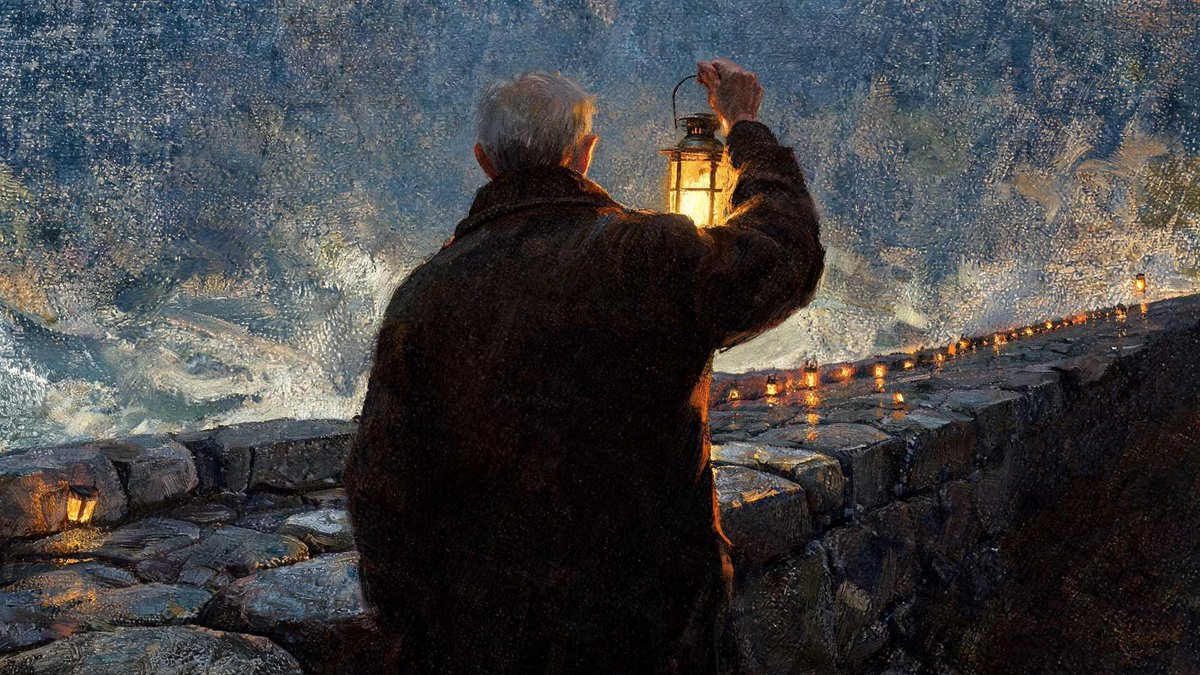
In a village on a cold northern coast, there lived an old man whose work was to light the harbor lamps.
Every evening at dusk he climbed the sea wall, trimmed the wicks, and set twelve flames burning along the stone: six on the north arm, six on the south so that any ship coming in through the dark would see the shape of the harbor mouth and find the way between the rocks.
He had done this for forty years.
But the fishing fleet was long gone. The trade routes had moved south. No ship had entered that harbor in eleven years, and everyone knew it. The young men laughed at him in the tavern. "Who are you lighting them for, old man? The fish?" Even the kind ones pitied him. His own son begged him to stop. "Nobody is coming, Father. Nobody sees it."
The old man only said: "The lamps are not mine. I was asked to light them. Whether anyone comes is not my work."
And every evening, he climbed the wall.
Then one night in late autumn, a storm came down from the north, the kind that turns the sea white. And somewhere out in that darkness was a boat that had no business surviving: a small fishing vessel from a village up the coast, blown miles off course, its crew bailing water and praying, unable to tell sea from sky.
The father at the tiller had given up steering. He was only holding on.
Then his daughter cried out and pointed, and there, low on the water, were twelve small flames in two steady rows, marking a gap in the rocks that none of them knew existed.
They came in through the harbor mouth just before the mast broke.
Nine people climbed onto the stone quay that night, soaked and weeping and alive, in a village they had never seen, met by an old man coming down from the sea wall with a lantern in his hand, as if he had been expecting them all along.
The village never learned their names. The old man never explained. He died the following spring, and it was his son who climbed the wall the evening after the funeral, and trimmed the wicks, and lit the lamps.
Who is the lamplighter?
And what are the lamps?
Tell me what you see in this story. 🔦
Most people assume Christianity's problem with sex outside marriage is that it thinks sex is dirty.
It's the opposite.
The Bible's sexual ethic exists because it holds a higher view of sex than the culture around it does, not a lower one.
Here's the actual biblical case, including the part that's usually preached badly. 🧵
Po 20 latach małżeństwa muszę w końcu powiedzieć to głośno...
Z moją żoną nie łączy mnie już nic.
Poznaliśmy się na egzaminie na filozofię ponad 20 lat temu. Byliśmy młodzi i głupi, nie słuchając rozsądnych opinii szybko wzięliśmy ślub.
A potem życie zrobiło swoje i dziś żyjemy w dwóch różnych światach.
Ona: dzieci, szkoła, dydaktyka, nauka, góry, natura, koty, dramaty.
Ja: firmy, fundusze, inwestycje, biznes, miasto, beton, psy, komedie.
Ona: kreatywna, empatyczna, marzycielska.
Ja: analityczny, rzeczowy, osadzony w faktach.
Zero wspólnych pasji.
Zero wspólnych zainteresowań.
Nie śmieszą nas te same rolki na Instagramie.
Każdy terapeuta ze śniadaniowej telewizji wystawiłby naszemu małżeństwu akt zgonu. Znajomi pewnie się zastanawiają, kiedy ogłoszę rozwód.
No to ogłaszam...
Kocham tę kobietę bardziej niż 20 lat temu!
I kiedy wieczorem opowiada mi o rzeczach, które kompletnie mnie nie interesują, słucham jej z przyjemnością, której nie tłumaczy żaden poradnik.
Bo przez te 20 lat zrozumiałem coś, co przeczy wszystkiemu, co wciskają nam media.
Wspólne pasje to nie budulec związku. To dekoracja. Ludzie po latach idą różnymi drogami, w różnym tempie i to nie jest awaria. Tak wygląda życie.
Prawdziwy budulec jest inny. Chcesz dla drugiej osoby lepiej niż dla siebie. Jej potrzeby stawiasz nad swoje. Wolisz dawać, niż brać. Jeśli tego nie ma, nie uratują was nawet identyczne playlisty.
Więc jeśli twoja druga połówka to twoje przeciwieństwo, przestań to naprawiać. Może właśnie tam mieszka wasz sekret.
Nie musicie kochać tych samych rzeczy.
Wystarczą te same wartości, ten sam kierunek, szacunek do różnic i troska o drugą połowę większa niż o siebie.
I na koniec coś, co zrozumiałem dopiero niedawno...
Przez 20 lat moja żona każdego dnia miała powody, żeby wybrać inaczej. Innego człowieka, inne życie, inny świat; bliższy jej gór niż mojego betonu.
Mimo to każdego dnia wybierała to samo... mnie.
Miłość to nie jest coś, co się czuje. To coś, co się codziennie wybiera.
Od 21 lat jestem czyimś wyborem i jestem z tego naprawdę dumny...