Introducing agystack, which transforms @Antigravity into an agentic coding powerhouse with closed-loop workflows, subagent orchestration, and rigorous engineering principles.
Inspired by @poteto, I brought pstack to Antigravity, leveraging Gemini's insanely fast token speeds, with the addition of cloud agent swarms.
Cloud agent swarms are setup through Google Cloud Run (uses GCP credits). Simply authenticate your Google Cloud and type /swarm to dispatch dozens of parallel cloud agents that test, benchmark, and return candidate diffs.
Use /create-verification-skill and /maintain-verification-skill to ensure your agents iteratively work in verifiable closed-loops.
Generally, use /poteto-mode for any task to match your prompt to a set of proven rules and skills written by a SpaceXAI software engineer.
(1/3)
Introducing agystack, which transforms @Antigravity into an agentic coding powerhouse with closed-loop workflows, subagent orchestration, and rigorous engineering principles.
Inspired by @poteto, I brought pstack to Antigravity, leveraging Gemini's insanely fast token speeds, with the addition of cloud agent swarms.
Cloud agent swarms are setup through Google Cloud Run (uses GCP credits). Simply authenticate your Google Cloud and type /swarm to dispatch dozens of parallel cloud agents that test, benchmark, and return candidate diffs.
Use /create-verification-skill and /maintain-verification-skill to ensure your agents iteratively work in verifiable closed-loops.
Generally, use /poteto-mode for any task to match your prompt to a set of proven rules and skills written by a SpaceXAI software engineer.
(1/3)
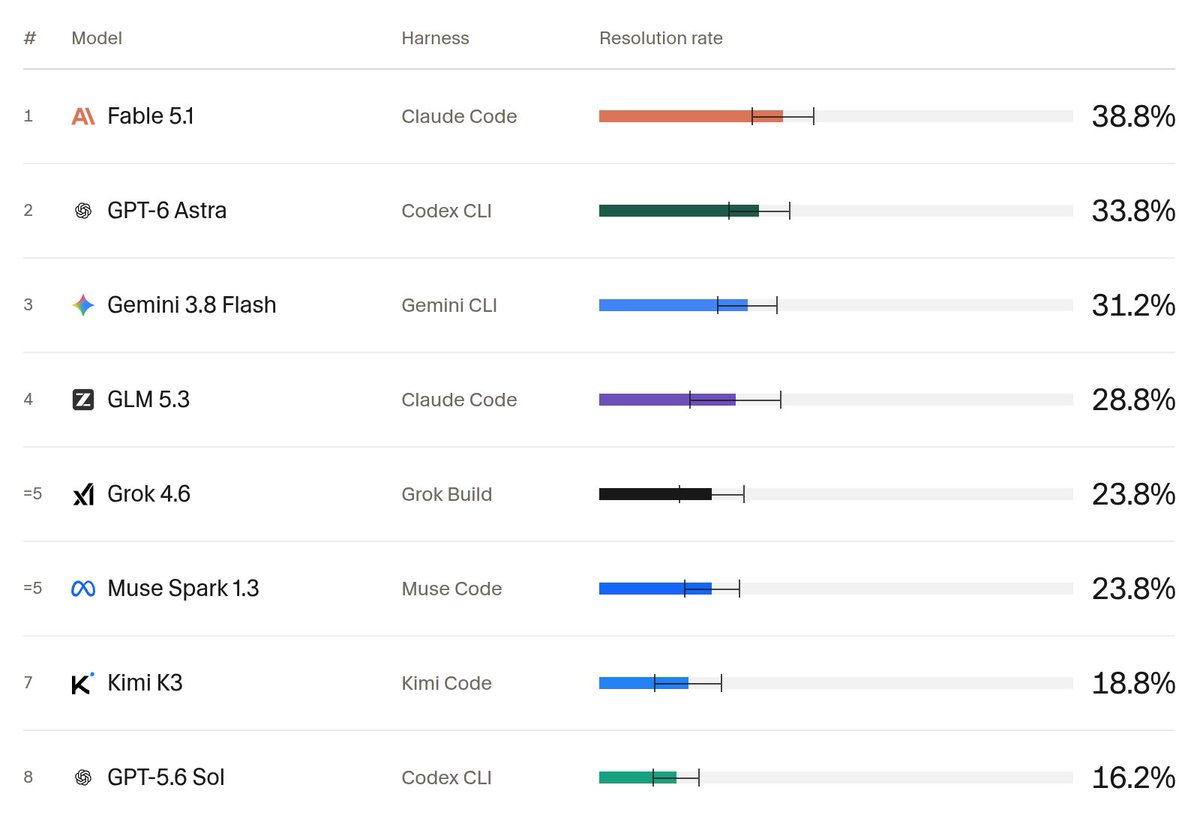
Introducing Real-SWE, a coding benchmark built from private company codebases.
We evaluate coding agents on real software engineering tasks that engineers performed, using private, out-of-distribution codebases.
These tasks come from real companies, examples include an app with 200K+ users, fintech platform processing 100K+ bank statements, enterprise sales tools, etc.
The results are quite surprising.
@zephyr_z9 Its actually criminal how underrated Gemini is for real software engineering instead of one-shotting random video games after a few hours https://t.co/rbD6DZegD4
Introducing agystack, which transforms @Antigravity into an agentic coding powerhouse with closed-loop workflows, subagent orchestration, and rigorous engineering principles.
Inspired by @poteto, I brought pstack to Antigravity, leveraging Gemini's insanely fast token speeds, with the addition of cloud agent swarms.
Cloud agent swarms are setup through Google Cloud Run (uses GCP credits). Simply authenticate your Google Cloud and type /swarm to dispatch dozens of parallel cloud agents that test, benchmark, and return candidate diffs.
Use /create-verification-skill and /maintain-verification-skill to ensure your agents iteratively work in verifiable closed-loops.
Generally, use /poteto-mode for any task to match your prompt to a set of proven rules and skills written by a SpaceXAI software engineer.
(1/3)
Not necessarily hundreds, but more subagents than folks’ hardware allows, especially for folks like me with only a little macbook lol
Cloud agents are more scalable, and I think with Google’s resources, it would be very useful for researchers discovering new findings or people tackling complex problems
Gemini is cheaper and faster, so I don’t think it should only be large companies using cloud agent swarms for their million dollar experiments
Introducing agystack, which transforms @Antigravity into an agentic coding powerhouse with closed-loop workflows, subagent orchestration, and rigorous engineering principles.
Inspired by @poteto, I brought pstack to Antigravity, leveraging Gemini's insanely fast token speeds, with the addition of cloud agent swarms.
Cloud agent swarms are setup through Google Cloud Run (uses GCP credits). Simply authenticate your Google Cloud and type /swarm to dispatch dozens of parallel cloud agents that test, benchmark, and return candidate diffs.
Use /create-verification-skill and /maintain-verification-skill to ensure your agents iteratively work in verifiable closed-loops.
Generally, use /poteto-mode for any task to match your prompt to a set of proven rules and skills written by a SpaceXAI software engineer.
(1/3)
Introducing agystack, which transforms @Antigravity into an agentic coding powerhouse with closed-loop workflows, subagent orchestration, and rigorous engineering principles.
Inspired by @poteto, I brought pstack to Antigravity, leveraging Gemini's insanely fast token speeds, with the addition of cloud agent swarms.
Cloud agent swarms are setup through Google Cloud Run (uses GCP credits). Simply authenticate your Google Cloud and type /swarm to dispatch dozens of parallel cloud agents that test, benchmark, and return candidate diffs.
Use /create-verification-skill and /maintain-verification-skill to ensure your agents iteratively work in verifiable closed-loops.
Generally, use /poteto-mode for any task to match your prompt to a set of proven rules and skills written by a SpaceXAI software engineer.
(1/3)
Introducing agystack, which transforms @Antigravity into an agentic coding powerhouse with closed-loop workflows, subagent orchestration, and rigorous engineering principles.
Inspired by @poteto, I brought pstack to Antigravity, leveraging Gemini's insanely fast token speeds, with the addition of cloud agent swarms.
Cloud agent swarms are setup through Google Cloud Run (uses GCP credits). Simply authenticate your Google Cloud and type /swarm to dispatch dozens of parallel cloud agents that test, benchmark, and return candidate diffs.
Use /create-verification-skill and /maintain-verification-skill to ensure your agents iteratively work in verifiable closed-loops.
Generally, use /poteto-mode for any task to match your prompt to a set of proven rules and skills written by a SpaceXAI software engineer.
(1/3)
@GergelyOrosz For most people, Flash models are all that's needed,
"Intelligence" starts to matter less,
But a trustworthy system design starts to matter more,
Cost and speed start to matter more https://t.co/rbD6DZegD4
Introducing agystack, which transforms @Antigravity into an agentic coding powerhouse with closed-loop workflows, subagent orchestration, and rigorous engineering principles.
Inspired by @poteto, I brought pstack to Antigravity, leveraging Gemini's insanely fast token speeds, with the addition of cloud agent swarms.
Cloud agent swarms are setup through Google Cloud Run (uses GCP credits). Simply authenticate your Google Cloud and type /swarm to dispatch dozens of parallel cloud agents that test, benchmark, and return candidate diffs.
Use /create-verification-skill and /maintain-verification-skill to ensure your agents iteratively work in verifiable closed-loops.
Generally, use /poteto-mode for any task to match your prompt to a set of proven rules and skills written by a SpaceXAI software engineer.
(1/3)
@z4v3n I implemented this solution in antigravity, the orchestrator can spawn in many parallel cloud agents with bidirectional communication, so each agent can only communicate back and forth with the orchestrator https://t.co/rbD6DZegD4
Introducing agystack, which transforms @Antigravity into an agentic coding powerhouse with closed-loop workflows, subagent orchestration, and rigorous engineering principles.
Inspired by @poteto, I brought pstack to Antigravity, leveraging Gemini's insanely fast token speeds, with the addition of cloud agent swarms.
Cloud agent swarms are setup through Google Cloud Run (uses GCP credits). Simply authenticate your Google Cloud and type /swarm to dispatch dozens of parallel cloud agents that test, benchmark, and return candidate diffs.
Use /create-verification-skill and /maintain-verification-skill to ensure your agents iteratively work in verifiable closed-loops.
Generally, use /poteto-mode for any task to match your prompt to a set of proven rules and skills written by a SpaceXAI software engineer.
(1/3)
@Surendar__05 its speed/cost makes it formidable for subagent orchestration and fast iteration cycles, which is why I built this plugin https://t.co/rbD6DZegD4
Introducing agystack, which transforms @Antigravity into an agentic coding powerhouse with closed-loop workflows, subagent orchestration, and rigorous engineering principles.
Inspired by @poteto, I brought pstack to Antigravity, leveraging Gemini's insanely fast token speeds, with the addition of cloud agent swarms.
Cloud agent swarms are setup through Google Cloud Run (uses GCP credits). Simply authenticate your Google Cloud and type /swarm to dispatch dozens of parallel cloud agents that test, benchmark, and return candidate diffs.
Use /create-verification-skill and /maintain-verification-skill to ensure your agents iteratively work in verifiable closed-loops.
Generally, use /poteto-mode for any task to match your prompt to a set of proven rules and skills written by a SpaceXAI software engineer.
(1/3)
Introducing agystack, which transforms @Antigravity into an agentic coding powerhouse with closed-loop workflows, subagent orchestration, and rigorous engineering principles.
Inspired by @poteto, I brought pstack to Antigravity, leveraging Gemini's insanely fast token speeds, with the addition of cloud agent swarms.
Cloud agent swarms are setup through Google Cloud Run (uses GCP credits). Simply authenticate your Google Cloud and type /swarm to dispatch dozens of parallel cloud agents that test, benchmark, and return candidate diffs.
Use /create-verification-skill and /maintain-verification-skill to ensure your agents iteratively work in verifiable closed-loops.
Generally, use /poteto-mode for any task to match your prompt to a set of proven rules and skills written by a SpaceXAI software engineer.
(1/3)
@nlycskn@thtbee_@antigravity Built this antigravity plugin that has a set of rigorous engineering skills and lets you dispatch swarms of cloud agents using Google Cloud Run https://t.co/8uMOwuf1mz
Introducing agystack, which transforms @Antigravity into an agentic coding powerhouse with closed-loop workflows, subagent orchestration, and rigorous engineering principles.
Inspired by @poteto, I brought pstack to Antigravity, leveraging Gemini's insanely fast token speeds, with the addition of cloud agent swarms.
Cloud agent swarms are setup through Google Cloud Run (uses GCP credits). Simply authenticate your Google Cloud and type /swarm to dispatch dozens of parallel cloud agents that test, benchmark, and return candidate diffs.
Use /create-verification-skill and /maintain-verification-skill to ensure your agents iteratively work in verifiable closed-loops.
Generally, use /poteto-mode for any task to match your prompt to a set of proven rules and skills written by a SpaceXAI software engineer.
(1/3)
The good ending to this is that they put OpenAI into a pissing contest. You know what would prove that they solved it themselves? Solving a few more millennium problems
How hard could it possibly be, anyways
Introducing agystack, which transforms @Antigravity into an agentic coding powerhouse with closed-loop workflows, subagent orchestration, and rigorous engineering principles.
Inspired by @poteto, I brought pstack to Antigravity, leveraging Gemini's insanely fast token speeds, with the addition of cloud agent swarms.
Cloud agent swarms are setup through Google Cloud Run (uses GCP credits). Simply authenticate your Google Cloud and type /swarm to dispatch dozens of parallel cloud agents that test, benchmark, and return candidate diffs.
Use /create-verification-skill and /maintain-verification-skill to ensure your agents iteratively work in verifiable closed-loops.
Generally, use /poteto-mode for any task to match your prompt to a set of proven rules and skills written by a SpaceXAI software engineer.
(1/3)
People severely underestimate the direction the Gemini, Grok, Muse Spark models are going with fast speeds and low costs.
Sure, OpenAI solved a famous mathematical conjecture which is impressive in its own right, but this has very few near-term practical implications in the real world. However, the main lesson I am taking from this is that cloud agent swarms are extremely effective in solving problems, and we need to use them more.
On a smaller, more practical scale, we should deploy cloud agent swarms that don't cost millions of dollars and take 88 hours to run to engineer solutions with impact. This can be made possible with faster, more cost-efficient models.
These models can allow agents to rapidly hypothesize, execute, verify, reiterate, and then share their solutions to build progress in quicker cycles with a more accessible price tag.
We need cloud agent swarms to be more accessible, which is why I built the agystack plugin, allowing anyone to summon large cloud agent swarms.
Introducing agystack, which transforms @Antigravity into an agentic coding powerhouse with closed-loop workflows, subagent orchestration, and rigorous engineering principles.
Inspired by @poteto, I brought pstack to Antigravity, leveraging Gemini's insanely fast token speeds, with the addition of cloud agent swarms.
Cloud agent swarms are setup through Google Cloud Run (uses GCP credits). Simply authenticate your Google Cloud and type /swarm to dispatch dozens of parallel cloud agents that test, benchmark, and return candidate diffs.
Use /create-verification-skill and /maintain-verification-skill to ensure your agents iteratively work in verifiable closed-loops.
Generally, use /poteto-mode for any task to match your prompt to a set of proven rules and skills written by a SpaceXAI software engineer.
(1/3)
I ran a 64 cloud agent swarm in Antigravity to take the #1 spot in @eigenlabs' matrix factorization challenge
Each agent conducted an experiment to optimize sparse symmetric matrix factorization, 14 of them had direct contributions, which mostly powered 6 of my promoted leaderboard submissions
Even from the failed runs, other solvers were able to draw inspiration from their findings, totaling 47 direct/indirect contributions to the frontier
More details on each cloud agent in the swarm below...
https://t.co/geSQFYyJJL