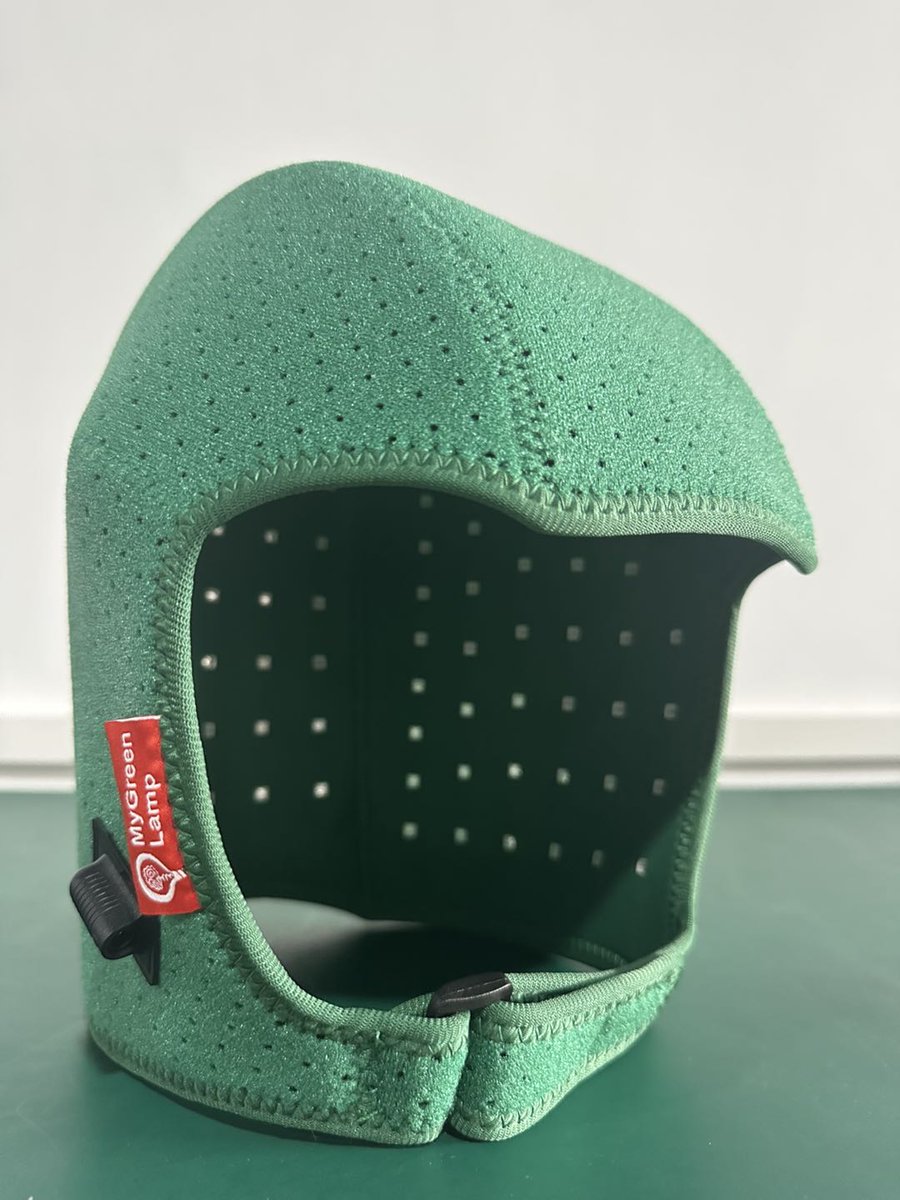
Red light photobiomobulation (PBM) devices for hair growth fail to target the skin. Most of their energy penetrates too deep below the hair follicles.
The MyGreen Hair Growth hood deploys only the wavelengths that are proven in clinical trials to regrow hair:
- 532nm green targets melanin in the epidermis
- 660nm red targets mitochondria in the dermis
- 730nm to target hair follicles
This is the most efficient PBM device anywhere in the world for regrowth of lost hair.
https://t.co/0RDv5rs3FQ
Please write up a brief handoff document describing everything we've tried and what we are attempting to achieve so I can pass it along to another agent
A neuromyth is a widely accepted, incorrect claim about how the brain works.
One common neuromyth is that matching instruction to student "learning styles" improves learning.
If pressed, virtually everyone will state a preference for a learning modality—visual, auditory, haptic, etc. The learning styles neuromyth suggests that if a person is taught in a way that fits with this preference, they'll learn more and better. Consistent with this, people do seem to have specific skills and specialties. However, these preferences and differences have not manifested in a generalized increase in learning if a person is matched to a learning modality matching their supposed learning style.
Evidence for the opposite of learning styles is abundant, however. In fact, people tend to learn specific material in similar ways: the modalities that work for a particular form of content tend to work well for most people. If you're familiar with the controversy around phonics lately, you probably don't need this fact repeated to you.
The learning styles literature has failed to bear fruit since confronted with its lack of evidence and, indeed, its contradiction, at least 14 years ago (Pashler et al., 2009).
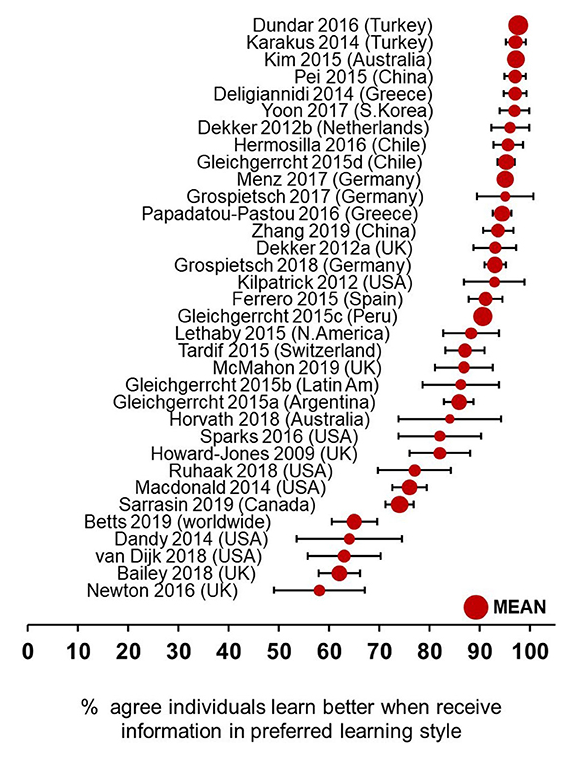
Despite its mythical status, as of 2020, somewhere between the majority and almost all educators, depending on the country, stated a belief in the importance of learning styles.
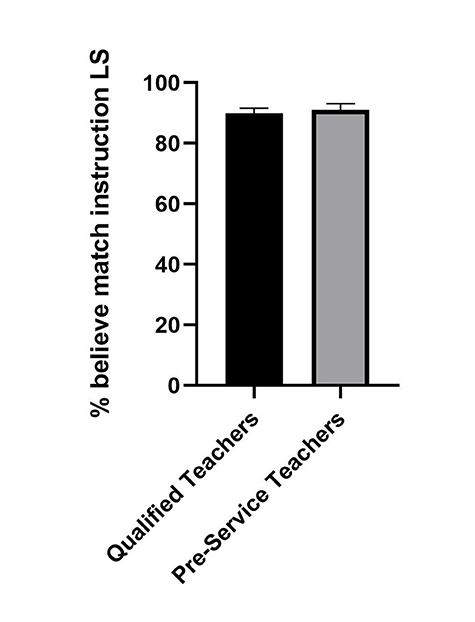
And this isn't just a problem of people with the wrong views slowly aging out: even though learning styles were debunked a long time ago, both already-qualified and trainee teachers overwhelmingly believe in their importance.
A learning style-based teaching curriculum may displace using learning methods that work, so if these beliefs manifest in action, then we have a problem.
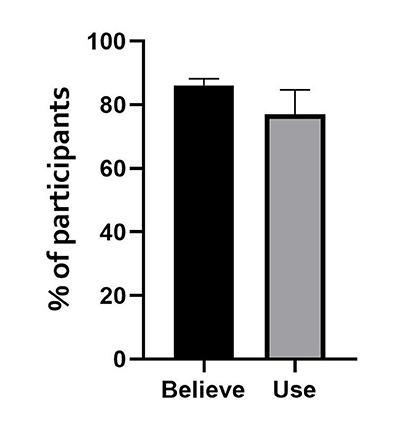
Despite the vast majority of educators believing in learning styles, a non-significantly (p = 0.146) smaller percentage said they actually use or intended to use them. This could be hopeful, but since it's not significant, I'm holding back judgment.
Regardless, it's clear that many teachers claim to both believe and either use or intend to use learning styles-based teaching methods, which should, if anything, be harmful to student learning if they displace methods with proven efficacy.
An important fact that may help to explain this is that there's no significant difference in the percentage of educators (both >80%) who believe
1. Students have learning preferences
2. Matching those preferences to learning methods will increase learning
This could suggest that the reason for this evidence-free belief in learning matching may have to do with a strong belief that students know what's best for them when it comes to education. This belief is not a good one!
We know this because we have interventions, like the implementation of direct instruction and active learning, which both show that students do better with them, while evaluating them worse (e.g., Deslauriers et al., 2019).
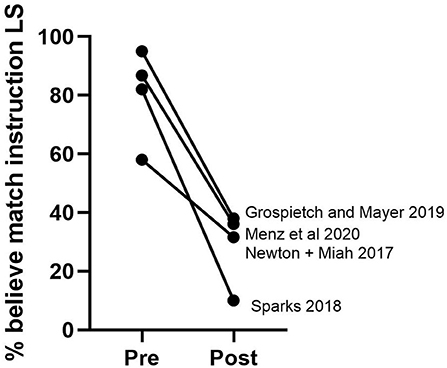
But things are not hopeless. Four studies have asked participants to proclaim their beliefs about learning styles before an intervention in which their lack of evidence was explained to participants. The result across all four studies was a massive decline in misbelief!
Learning styles are a pernicious neuromyth and there's no telling how many kids have been harmed as a result of them and related beliefs in the need to tailor instruction to children rather than to teach with the methods that have been found to be the most effective for the majority of students.
But there's hope: teaching educators about the poverty of these beliefs may work to get them to stop believing and, hopefully, to stop acting on them.
Only time will tell if we end up reducing this belief to the point where it's no longer a threat to students.
Sources:
https://t.co/G7goYwBi19
https://t.co/cOjrQqsmku (see also: https://t.co/7YoOoQGJnR)
https://t.co/JALYn4vSRu
Tangentially related paper on another neuromyth (Gardner's multiple intelligences): https://t.co/ThruPOzDSU