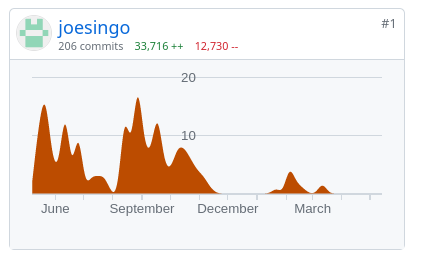
Making sure all my phd stuff is backed up on GitHub before university IT wipe my laptop. Quite a few commits, with a tiny blip of viva prep at the end...
@ha1fling I had the same thought... Didn't really like Zotero etc so wrote my own (very very minimal) tool: https://t.co/CSfQO1r6NO. Pretty basic but it was fun and worked well enough!
Pleased to say I passed my PhD viva! Thanks to my supervisor @mukau71 and examiners @StevenSchockae2 and Andreas Herzig.
Thesis is now online at https://t.co/s8Cl5OW7HY
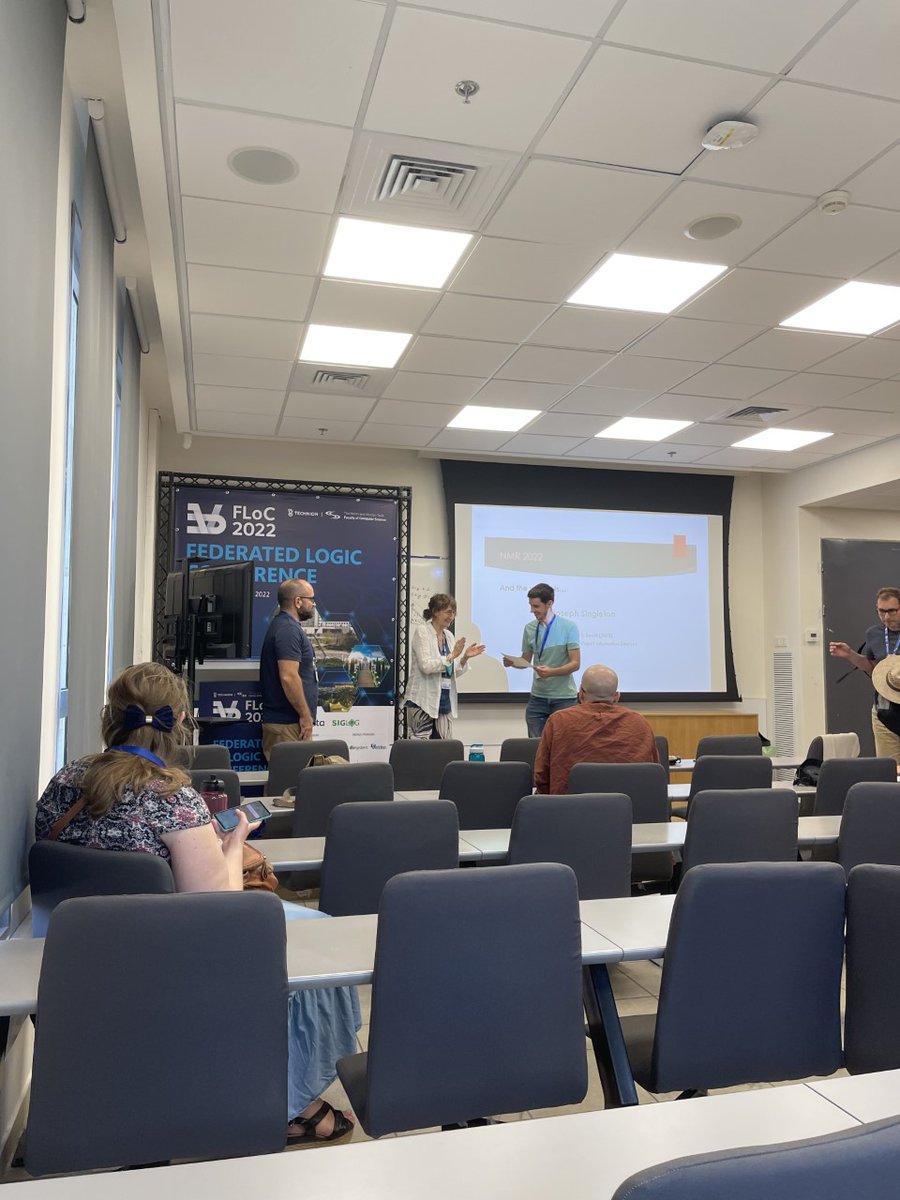
📢The good news in the group continue📢 The work by our PhD student Joe Singleton @joesingo2 on Truth-Tracking with Non-Expert Information Sources gets the best student paper award at NMR @FLoC2022🏆🏆 - under the brilliant supervision of Richard Booth! @mukau71
More good news! Our members Joe Singleton and Richard Booth got a paper accepted to KR'22 @joesingo2@mukau71. They look at a belief merging problem with multiple non-expert information sources. So, who is the expert? 🤔 https://t.co/Y4NJiNHcOQ
Main results are a link between this logic and S5 epistemic logic (expressing expertise in terms of *knowledge*) and a sound and complete axiomatisation
Great first two weeks at ESSLLI (@ESSLLI_official). On Thursday I presented my work "A Logic of Expertise" at the student session
Paper: https://t.co/YfeGsUU4C5
Slides: https://t.co/KEJLfnhowl
In the paper we introduce a modal logic framework for talking about the expertise of an information source. We also look at how information might be false, but becomes true when discarding the parts on which the source has no expertise
@JDHamkins One thing to consider is that having a piece captured is not always a bad thing, provided you can recapture in a favourable way. So if the attacked player wants to allow a trade of pieces, they have incentive to lose in the subgame(s). As you already noted, this seems undesirable
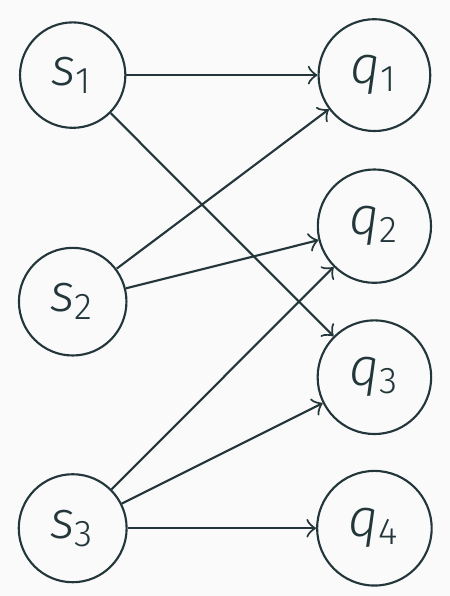
An example of a bipartite tournament is students vs questions in an exam: students do not go head-to-head, so ranking them based on exam performance can only be done by looking at the indirect comparisons via the questions
In it we look at rankings for bipartite tournaments, where two different kinds of "players" compete indirectly via matches against the opposite kind. We mainly focus at properties of *chain editing* (a graph editing problem), adapted as a tournament ranking method
Happy to announce our paper "Rankings for Bipartite Tournaments via Chain Editing" was accepted at #aamas2021
Preprint is now on arXiv: https://t.co/Xpc0adWQYh
Joint work with Richard Booth (@mukau71)
@firthcity Thanks, David. Agree about setting the method out in advance - any team who goes down in an alternative ranking will surely not agree to it now. But would be good to have a system in place for future, especially given the £££ that is at stake for promotion, relegation, Europe...