@FarzaTV ‘s @heyclicky gave the perfect UX for solving personal context .Context fragmentation was always a personal itch, it always seemed stupid to me that devices can’t understand and use the context of what I have done using it.
Comment if you would like to try this out!
@FarzaTV ‘s @heyclicky gave the perfect UX for solving personal context .Context fragmentation was always a personal itch, it always seemed stupid to me that devices can’t understand and use the context of what I have done using it.
Comment if you would like to try this out!
A win gets you on stage for a night. A build gets you remembered for years.
Last month at our Kochi meetup, a few builders from our previous year hackathon came to share their experience.
@shajin_shas (Shajin) built Design Lumo at the hackathon. An AI design tool for ads, posters and social posts. He bootstrapped it to over $1.5K in revenue and sold it. His first exit. Today he is a product engineer at Latelogic, building world class products.
@boywithacap (Sreedhar) built Pazham, a fun app, at the hackathon, right when everyone was in a frenzy trying to make cool AI images using Nano Banana and had no idea how to prompt for them. Pazham helps you browse and compare AI prompts inside the app, so you stop guessing and start getting results that actually work. Today he is working with Shyjal Raazi's team at https://t.co/jmW08dkGvt.
Johan Biju Paul built DPWRK at the hackathon. An app that helps you cut out distractions. It did not get much traction. But it opened doors. He is now a product engineer at https://t.co/gq4rwxXXar.
Some doors opened, some closed. None of them saw it coming when they started. What they walked away with either way was what they learned in the process.
KPH Hackathon is all about building, learning and experimenting, and helping every developer become the best version of themselves.
Our next Hackathon is coming this September. Bring your ideas and build something people will remember because hackathons were never about certificates, they are about building, experimenting and learning.
Build, Ship, Launch, Grow, Scale.
Link: https://t.co/htIGW036P7
Smart glasses are finally going mainstream, unlike when I entered the space 9 years ago.
In 2020, I built fully standalone AR glasses. Then I built one of the first ultra-portable Spatial Computers and a Spatial OS designed for productivity. We were simply too early.
We even received an acquisition offer from one of the world’s largest PC companies. Unfortunately, the deal fell through after both sides spent 6 months on it because of some tricky Indian regulations. Happy to share the story if people are interested.
I paused hardware and started building the first Canvas AI Workspace, Nimo Infinity.
Now it’s time to come back with Glasses + AI.
Below are actual working products, not AI...
@Mat_Sherman Workplace from Meta was an enterprise communication and collaboration platform that brought familiar social networking features (like Chat, Groups, and live video) into the corporate environment. They recently shut it down.
@FarzaTV ‘s @heyclicky gave the perfect UX for solving personal context .Context fragmentation was always a personal itch, it always seemed stupid to me that devices can’t understand and use the context of what I have done using it.
Comment if you would like to try this out!
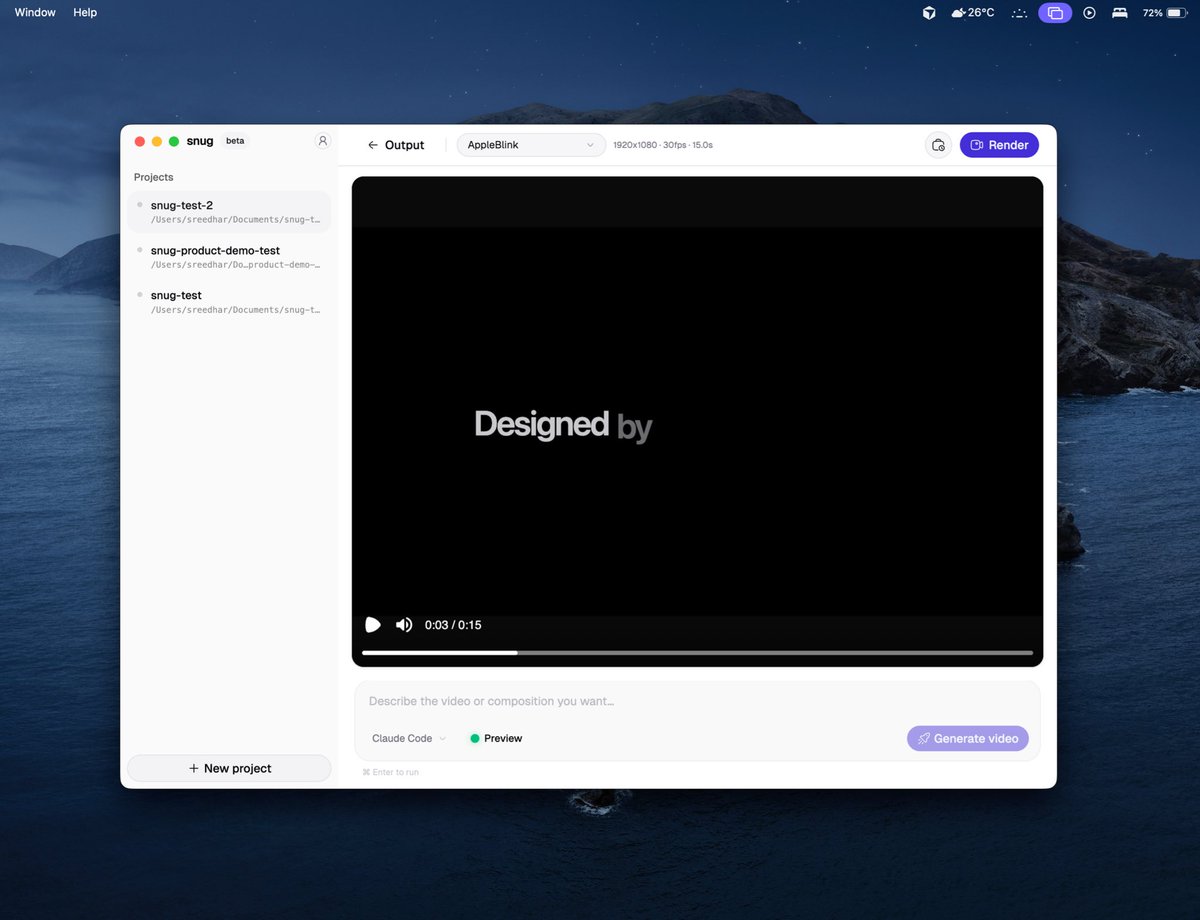
anyone actually shipping programmatic video generation without losing their mind?
trying @Remotion + @claudeai and the feedback loop is brutal - setup overhead, token spend, and a CLI command every time i want to see a 2 second change
what are you using instead
If you feel like giving up, you must read this never-before-shared story of the creator of PyTorch and ex-VP at Meta, Soumith Chintala.
> from hyderabad public school, but bad at math
> goes to a "tier 2" college in India, VIT in Vellore
> rejected from all 12 universities for US masters despite 1420 on the GRE
> fuckit.jpg
> goes to the US anyway on a J-1 visa to CMU with no plan
> applies for masters (again) to 15 universities
> rejected from all except USC and with late admissions, NYU in 2010
> finds this guy called Yann LeCun (before he was famous)
> starts getting into open source
> rejected from all jobs including DeepMind
> only job is Amazon as test engineer
> his PhD mentor helps him get a job at a small startup (MuseAmi)
> rejected from DeepMind
> couldn't get H-1B because of J-1 home return issue; gets waiver through months of approval with USCIS and US State Dept
> very low on confidence
> In 2011/12 builds one of the fastest AI inference engines on phones
> rejected from DeepMind
> emailed Yann again and joins FAIR because of Torch7 open-source work
> scrapes through bootcamp at Facebook, struggling on an HBase task
> L8/L9 engineers at Facebook struggle to get ImageNet working
> figures out numerics / hyperparam issue as an L4
> first big win!
> FAIR goes well, runs 3 person torch7 team and co-creates PyTorch
> because of politics, management wants to shut down PyTorch
> cries-at-bar.jpg, literally
> eventually some people save PyTorch and it launches in 2017
> gets a EB-1 green card!
> the rest is history...
Think about that. He went to a tier 2 college. Was rejected from all Masters programs 2x. Rejected from every single job except Amazon test engineering. Rejected from DeepMind 3x. Nearly had his baby project shut down. Struggled with visa issues. After 12 years of failures (2005-17), he eventually rose to became a VP at Meta one of the most influential people in AI!
Soumith's story is one of resilience and he's living proof that no matter how down in the dumps you are, there's always hope.