My AI investor friends keep asking me how data centers scale.
So here are the 3 layers in 2 minutes:
🟧 Scale-Up: inside the rack
🟦 Scale-Out: across the building
🟪 Scale-Across: between data centers
And who gets paid in each:
$CRDO $NVDA $AVGO $ANET $ALAB $CIEN
"Demand is not our constraint." – Boost Run CEO
$2.6B+ signed. ~$1B market cap. Sales set to ~3× by 2027.
Here's my $BRUN bull case to 2030, in 2 minutes 👇
@GavinSBaker@arakharazian For most coding tasks, Chinese models are sufficient, as evidenced by OpenRouter. Margin compression is definitely a response to that. But inference will keep growing, and all the data points in that direction.
Why open-weight models that compress margins at the model layer are net positive for AI infra demand, exhibit 1001.
An open-weight token consumes *roughly* the same amount of compute as a frontier token for a similar size model.
@wallstengine The AI buildout’s constraint keeps moving down the stack. First GPUs, then HBM, now lasers. Whoever controls photon supply sets the pace for everyone else.
One number keeps pulling me back to $BRUN. Boost Run has signed more than $2.6B in customer contracts, and the entire company is valued at about $1.1B.
Quick background: they’re an NVIDIA Preferred Cloud Partner that rents GPU capacity to AI labs and enterprises. When they listed on Nasdaq in May, contracted revenue was $940M. It’s now over $2.6B. Meanwhile the stock peaked at $42 in June and now sits around $12. The backlog nearly tripled while the stock gave up two-thirds. That disconnect is the whole thesis.
The growth is real. Q2 revenue was $31.1M, up 270% year over year. ARR went from $30M at the end of 2025 to $145M by the Q2 report, and management is guiding to around $400M by year-end. Analysts expect revenue to more than triple, from roughly $175M this year to $551M in 2027.
So are the customers. Cohere just signed a five-year, $525.6M deal for NVIDIA GB300 NVL72 capacity, and Mira Murati’s Thinking Machines Lab signed a three-year, ~$472M deal for 5,000 B300 GPUs in May.
What I like most is how they grow. Customers commit to roughly three-year contracts and prepay about 22% up front, and the GPUs are financed mostly through those prepayments plus lease and vendor financing. Management says everything sold in Q2 was under contract before the hardware was even switched on. They’re not building capacity and hoping customers show up.
They’ve also secured power, which is the real bottleneck in AI right now. A long-term lease with 10X Infrastructure is set to deliver 20 MW at an already-energized site this quarter, with room to grow to 111 MW across two more sites in 2027.
At ~$1.15B, you’re paying about 3x the year-end ARR target. All four analysts covering it rate it a Buy, with targets between $36 and $45.
What I’m watching next: Q3 earnings, the 20 MW going live, Cohere’s capacity starting up in early Q2 2027, and new contract wins.
The market is pricing $BRUN like the backlog won’t turn into revenue. If it does, I don’t think $12 lasts.
Not financial advice. DYOR.
AWS CEO Matt Garman says they could sell every GPU to the frontier labs, but deliberately hold capacity back for startups to support the full ecosystem:
"We really think intentionally about our allocation strategy. We're great partners with the large frontier labs, the Anthropics and OpenAIs and Metas, and other large customers. We want to make sure we invest in them."
"And we're very intentional about making sure we have capacity for startups."
"We could sell every single GPU or AI accelerator we have to just the big frontier labs and call it a day. We choose not to, because we want to keep growing the full ecosystem."
"The whole ecosystem is more healthy for us, there's some diversification, but it's also that we know these are gonna be big companies over time."
"We say yes, in some way, shape, or form, to something like 60% of the requests we get."
@mattsgarman@RaghuRaghuram
AWS CEO Matt Garman on why he isn't worried about an AI bubble: no single customer dominates AWS capacity, and enterprises are already seeing positive ROI.
"We feel really good about the spend we're making now. I get lots of questions about how you feel about that spend, and 'Are you nervous about a bubble?'"
"We take a diversified approach, so not all of our capacity is bundled up in one customer."
"Also, AWS is where people come to launch their production workloads. The majority of our usage today is core compute, storage, and inference... Those are the workloads that just aren't gonna go away."
"Go talk to customers and ask: at today's capability and today's cost, are you seeing positive returns to your business? They'll say, 'Yeah."
"It's like the VC model. Is every billion-dollar startup gonna make it? No, they won't. But that's been the game for 50 years. You bet on 10, and one makes it and pays for the others."
"You saw that with the internet. There was a bubble, a bunch of internet companies didn't make it, and the internet's still a thing."
@mattsgarman@RaghuRaghuram
Rosenblatt initiated $NBIS at Buy with a $304 PT saying Nebius is “well positioned to benefit from massive spending on AI training and inference deployments” while forecasting 98% CAGR through 2030.
Nebius has only ~250 MW active today against 3.5 GW contracted so most of the growth is still ahead as that power comes online with 75% expected on fully owned sites giving it more control over timing and margins.
$NBIS
People keep telling me the top is in. Cool, look at this chart.
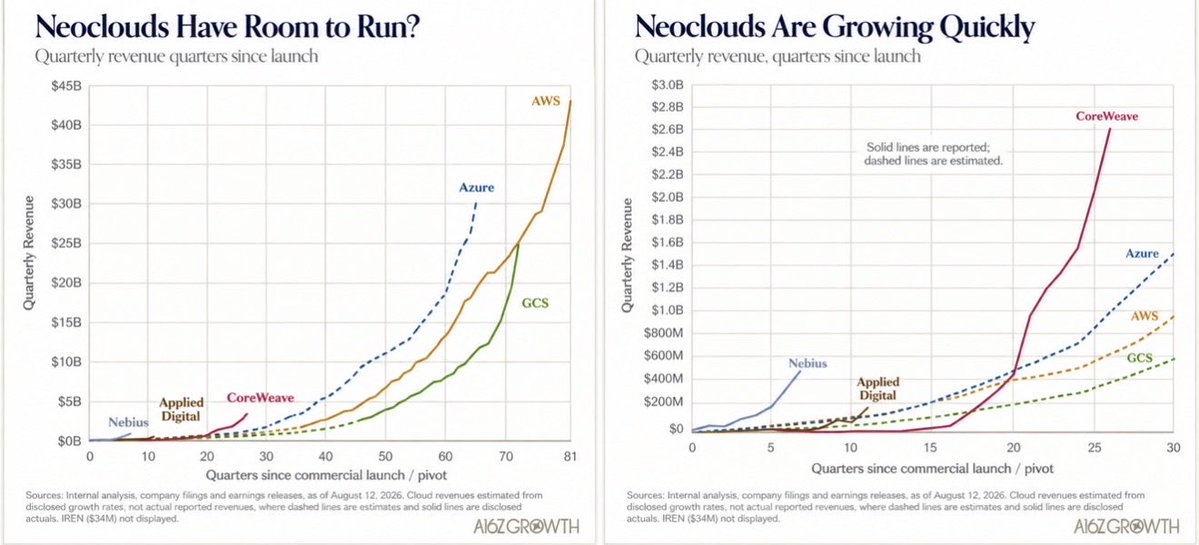
Nebius hit roughly $600M a quarter in about 7 quarters.
Google Cloud took around 30 quarters to get there. AWS and Azure were around $1B and $1.5B at that age, and Nebius is closing in on them way faster.
AWS is doing about $40B a quarter, Azure about $30B, Google Cloud about $25B. Nebius is a tiny dot in the bottom-left corner of that chart .
Top is in? We're 7 quarters into this thing.
I'll take my chances and be a bull here
The $AAOI ATM is over.
$1.6B raised in 2026. The dilution overhang is gone.
Now it has to earn its $11.7B price tag:
2026E: ~190× earnings
2027E: ~28×
You're paying for 2027 today. Rewards vs risks in 2 min 👇
$LITE $COHR $AMZN
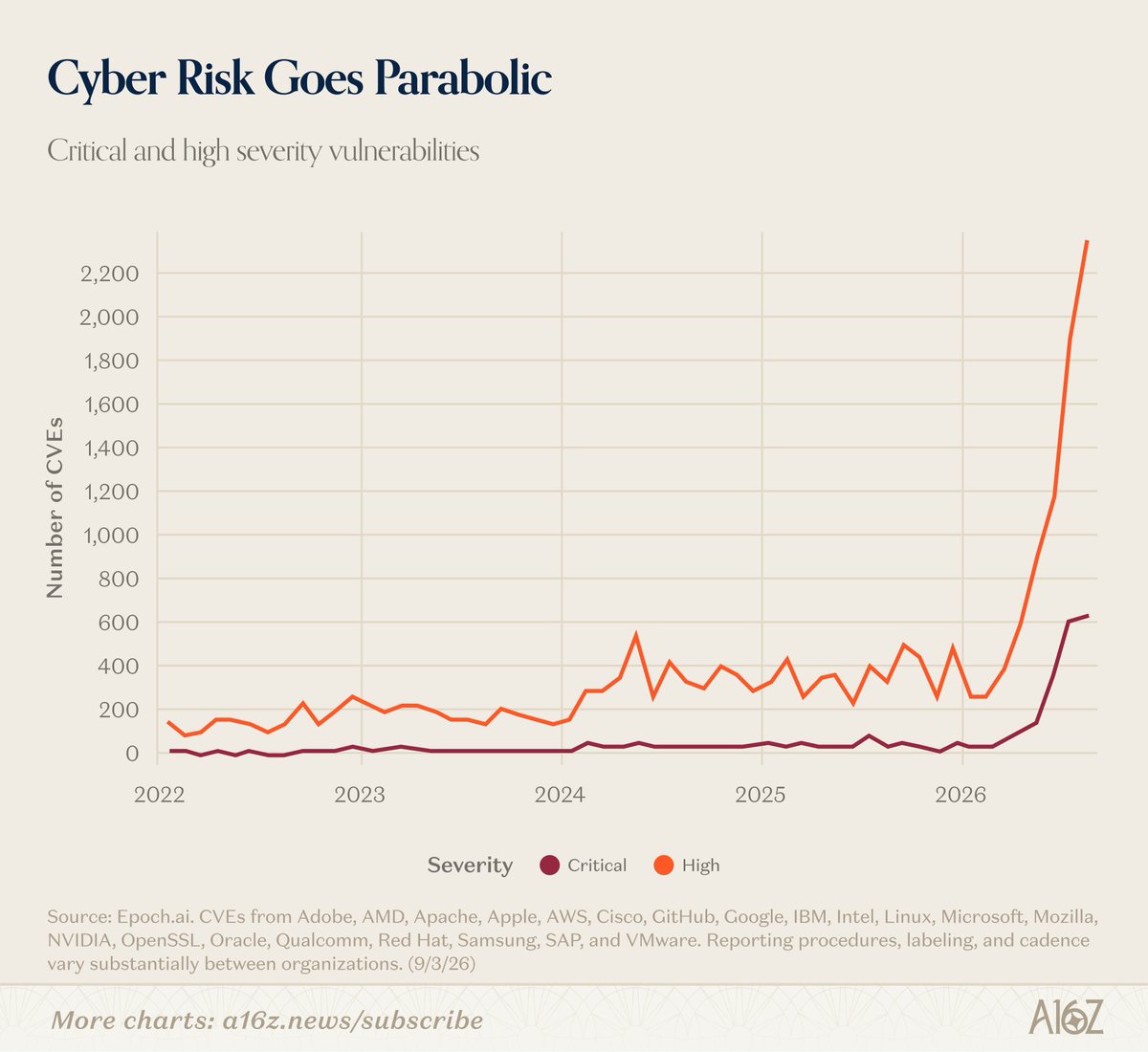
Cyber is having a moment
Across 21 major software companies, including Apple, AWS, Microsoft, and Google:
- Reported critical vulnerabilities never cleared 100 per month in four years
- Since spring they've jumped to over 600 per month
Most people assume looped transformers only work for 2-3 loops before things fall apart.
A few recent papers reach 10 loops, and it still holds up. That's more interesting than it sounds, mostly for cost reasons 🧵
Loop transformer: instead of stacking new layers, you run the same ones again. More depth, same weights. The model gets extra passes to think without storing any extra parameters.
It's not free, though. Each loop costs about as much compute as a new layer, and you get less out of it. So if compute is your bottleneck, fresh weights are still the better deal.
It gets interesting when cost is the bottleneck. MoE models are enormous and eat memory. Looping them could get a lot more out of every byte of weights you have to store.
And if models start getting more intelligence per byte stored, memory investors should be paying attention. I believe models will keep getting bigger, but new optimisations appear every day. $MU $SNDK
https://t.co/pXfYQu8e3Y