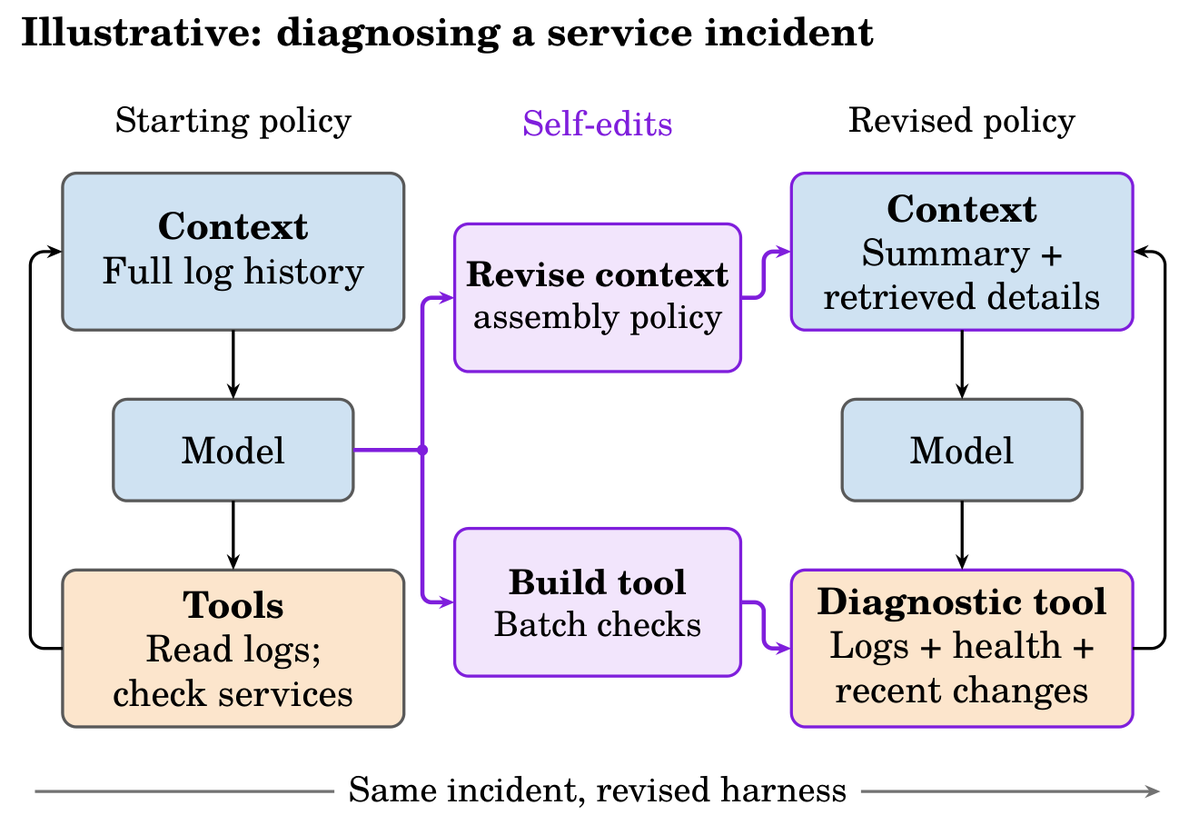
Agent harnesses are usually hand-tuned, or optimized offline against benchmarks. What if an agent could improve its own harness *while doing the work*?
Introducing Exo, a harness architecture for runtime self-improvement 🧵
(paper: https://t.co/0PZQms3Jo0)
You can now build live apps in Cursor and share them with a link.
Agents have made it easier to write code, but most apps never make it off localhost. Describe the tool you want - Cursor will build it, set up a database, run deterministic and agentic security checks, and deploy.
I’m incredibly proud to share what we’ve been building at the AItonomy Foundation: Science’s Last Exam (SLE). 🧪✨
Can AI do science? Instead of Q&A, we give agents actual research goals and real-world tools (lab data, software), then grade them against hidden expert checks.
Deeply grateful to the brilliant minds at 34 institutions (Harvard, MIT, Stanford, etc.) who helped craft 113 tasks across 9 disciplines. ❤️
The results? Science is hard. Of 8 frontier models, the best scored 37.5/100. On true end-to-end research? All scored 0. We have an exciting journey ahead! 🚀
(Claude Opus 5.5 & GPT-6 Astra coming soon—just clearing bio safeguards).
Everything opens Nov 6. 🗓️
🌐 https://t.co/yXGbbwXCBq
💻 https://t.co/p16ai2WqSy
🤗 https://t.co/3cSiDuAgf6
Thread below on how the exam works and where models break. 👇 (1/14)
#AGI #AIforScience #AIAgents #SciencesLastExam #OpenAI #Anthropic
The era of System One Vision Model is here! Introducing VFlash: parsing the visual world in parallel at unmatched speeds for Physical AI.
Most embodied prediction tasks like object localization, robot trajectory planning, and dense 3D motion are fixed-length float vectors. For example, a bounding box is always 6 tokens, a 10-waypoint robot arm trajectory is 54: we know these beforehand. Instead of decoding one token at a time, we can output the entire geometric shape in one go.
VFlash enables up to 12x faster action decoding and a 5.1x overall robot inference speedup on edge GPUs like the Jetson Thor and DGX Spark. What’s surprising is that it ends up even more accurate than the VLM backbone, with up to 61% lower 3D trajectory error. The intuition is that VFlash avoids the cascading errors of autoregressive decoding, where every coordinate is written in ink and every later point loses the chance to backspace.
Everything that moves will be autonomous, and everything autonomous will need to think on its own chip. The next inference revolution is physical reasoning at the speed of reflex.
And as always, it’s open paper, open source! Link in thread:
Meet Gemini Omni 1.2 Flash ⚡️
We’ve made the model more cost-effective, bumped the video generation and editing limit up to 15 seconds, and made updates to how scenes hold together over time. We've also given character speech an upgrade, reduced visual glitches like jump cuts, and made sure the model stays even truer to any reference assets you upload.
So… what does all of that actually mean for you?
It gives you more room to tell your story. With up to 15 seconds to work with, you have more flexibility to create what you need — videos look more cinematic and smooth, offering stronger consistency that keeps objects anchored from start to finish. And when characters speak, the dialogue sounds more fluid and natural.
Creators and everyday users can start directing scenes and multi-turn edits in @FlowbyGoogle, generating 15-second clips at no additional cost in Google Vids, or creating 15-second videos in the @GeminiApp. Plus, for developers and businesses building with the API, we've dropped the price by 30% from the previous generation, making it available at just $0.07 per second for 720p video.
Watch the model in action as it turns a single style frame into a 4-shot, 15-second macro science explainer of a living beehive ↓
This isn’t video footage.
It’s a Gaussian splat rendered in real-time, walked by a simulated person filming on a virtual phone: gait, head turns, motion blur, rolling shutter, footsteps.
You can tap to burn the Gaussians it's made of. 🔥
Built with @playcanvas
🧵 👇
together ai built an agent that keeps re-tuning their inference compiler while live traffic shifts. speedups that never stop shipping, kinda wild
h/t @agiapiorg
Join us in this livestream next Tuesday, learn how to shrink models to fit in your laptop and make them go brrr 💨
We will have @mervenoyann@maximelabonne@TadimetiAditya@bartowski1182 and @mgoin_ giving a primer and know-hows on quantization with llama.cpp and vLLM ⚡️
OpenAI’s latest security research shows how AI could make cyberattacks faster and cheaper.
In one run, an upcoming cyber model helped find 948 Linux kernel vulnerabilities and build working exploits that could give an ordinary user full control of a machine. The system also generated proposed patches for human review.
The exploits required existing local access. But that access could come from a stolen account or an already compromised application.
To understand the significance:
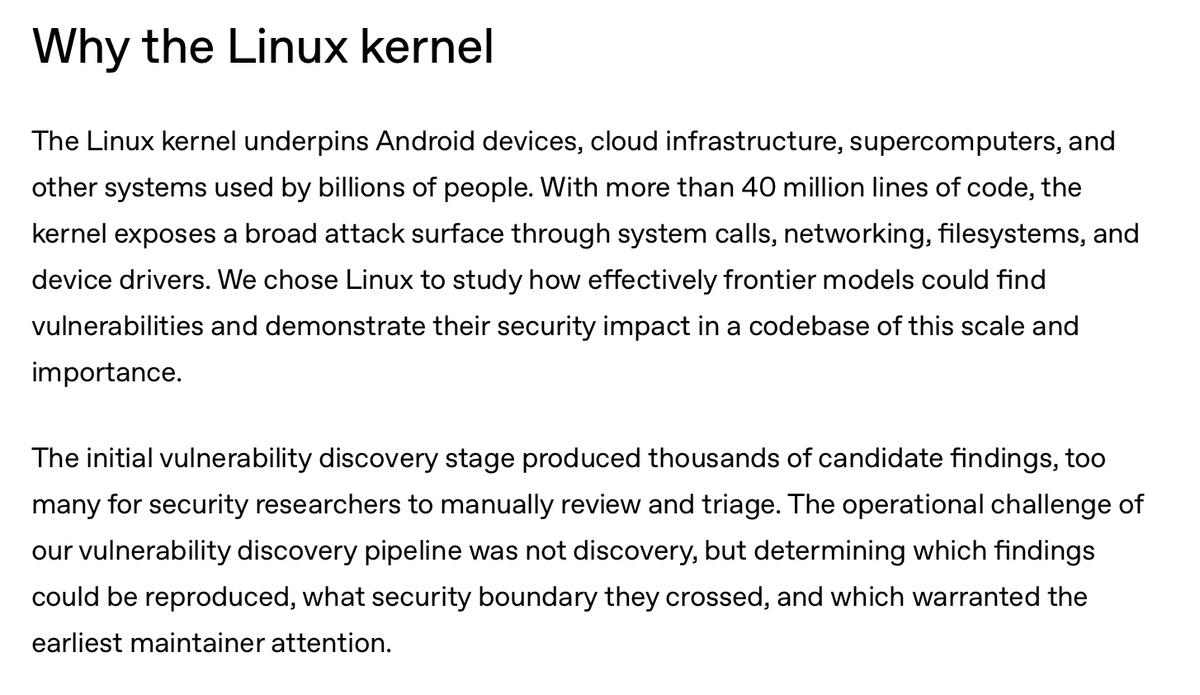
"The Linux kernel underpins Android devices, cloud infrastructure, supercomputers, and other systems used by billions of people. With more than 40 million lines of code, the kernel exposes a broad attack surface through system calls, networking, filesystems, and device drivers. We chose Linux to study how effectively frontier models could find vulnerabilities and demonstrate their security impact in a codebase of this scale and importance."
Hy4 from Tencent scores 35 on the Artificial Analysis Intelligence Index v5 and is the #2 model from a China-based AI lab
Hy4 is the latest model from @TencentHunyuan and is the successor to Hy3 released earlier this year. It scores 35 on the Artificial Analysis Intelligence Index v5, equal with Grok 4.7 (xhigh) and 1 point behind Claude Haiku 5.5 (max). Hy4 is the #2 model from a China-based AI lab, behind only Kimi K3.1 Pro, which scores 46. Hy4 is priced at $0.834/$2.501 per 1M input/output tokens.
Key takeaways:
➤ Hy4 excels at agentic coding tasks. Hy4 scores 31% on FrontierCode 2.0, compared to 32% for Claude Fable 5.1 (max). It is the leading model from a China-based AI lab, with DeepSeek V4.1 Flash 1017 (max) scoring 28% and Kimi K3.1 Pro scoring 25%. On Terminal-Bench 4.0, it scores 37%, the fourth-highest score among models from China-based AI labs
➤ Hy4 outperforms its peers on knowledge and reasoning. Hy4 achieves accuracy of 50% on AA-Omniscience v1.1, 1 point ahead of Kimi K3.1 Pro, but has a high hallucination rate of 89% compared to Kimi K3.1 Pro’s 37%. On HLE-Diamond, it scores 33% compared to Kimi K3.1 Pro’s 37%
➤ Hy4 offers a competitive Capability vs. Cost trade-off compared to to peers. With a Cost per Intelligence Index Task of $0.78, Hy4 (35) is 10-times cheaper than Grok 4.7 (xhigh, 35) and 13-times cheaper than Qwen3.8 Max (0902) (34) but almost twice as expensive as Claude Haiku 5.5 (max, 36)
Other model details:
➤ Context window: 1 million tokens
➤ Pricing: $0.834/$2.501 per 1M input/output tokens. Cache reads $0.042 per 1M tokens
➤ Multimodality: Text and image input, with text output
The Hermes Agent Plugin Hackathon starts now!
It runs for 7 days, with $20,000 in cash prizes and more.
Plugins are the most powerful way to extend Hermes Agent, and we want this hackathon to show what they can do. A plugin can change anything from the model Hermes runs on, where it stores its memory, where it runs commands, which messaging apps it works in and what Hermes Desktop shows. Plugins in the marketplace already let Hermes do things like control a phone or turn a photo into a printable 3D model.
Every kind of plugin is eligible, so build whatever functionality you want Hermes to have. We'll list accepted entries in the new Hermes Marketplace, where every Hermes user can install them.
Prizes
1st: $10,000 + neon sign + merch + $1,000 creds
2nd: $5,000 + neon sign + merch + $1,000 creds
3rd: $2,500 + neon sign + merch + $1,000 creds
4th: $1,500 + merch + $500 creds
5th: $1,000 + merch + $500 creds
Runners up (x5): merch + $250 creds
Submissions are due 5PM EST on Nov 11th. To enter:
1. Open a pull request that adds your plugin to the Hermes plugin catalog: https://t.co/mXvYukJ0mZ
2. Post a demo video on X and tag @NousResearch
3. Submit both links through the form: https://t.co/jlduHHW3dr
Your entry is the plugin itself. Judges score it on usefulness, reliability, polish and creativity, and they favor plugins that do more than a prompt or a skill could. Keep the demo under 90 seconds and show the plugin working.
The developer guide shows how to build and test a plugin: https://t.co/FVGjSgjNoV
When submissions close, we'll open a thread for every entry in the Nous Research Discord, so you can browse all the plugins and talk to the people who built them.
You can submit the form as soon as your pull request is open. The catalog checks run once a maintainer starts them, and we review entries every few days.
If you have any questions stop by the Nous Research Discord: https://t.co/qxek9haYeb
GLHF!
Introducing V0.5, Verne’s open-weight world action model for industrial robots.
We believe democratizing robotics starts with making frontier foundation models open to everyone.
Bringing robots to every industry will take many teams, building on shared progress across many workflows.
V0.5 is the leading US-made open-weight model on LIBERO and RoboTwin 2.0 benchmarks.
We hope you’ll join us in putting V0.5 to work.
Kimi K3.1 Pro weights are now available on HuggingFace under the “Kimi K3.1 Pro” License.
> “Kimi K3.1 Pro is an open-weight, natively multimodal agentic model, and our most capable 3T-class model to date.”