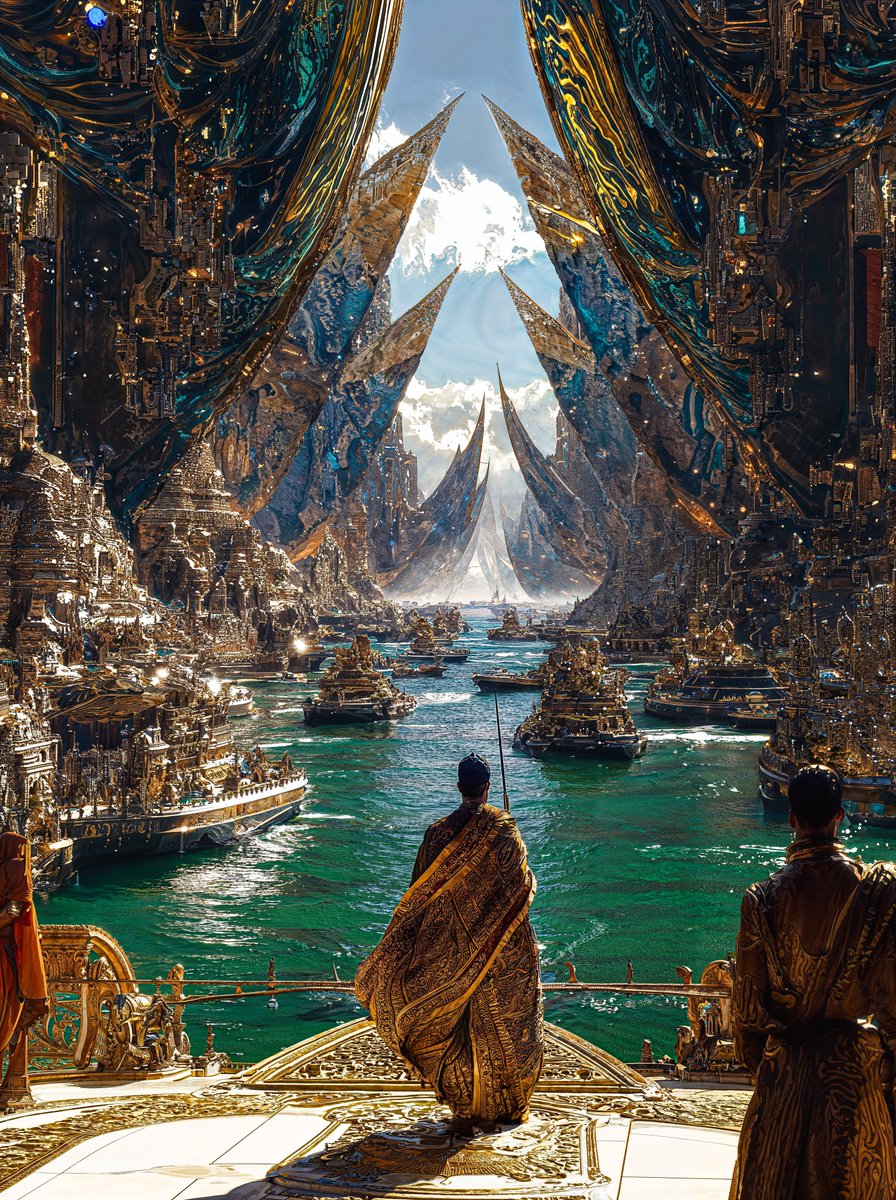
How do we modify the human perceptive system and/or unconscious processing so that a (super) homo sapien develops a superset of a human internal world model? (And a superset giving it meaningful new capabilities)
I think the concept of "introversion" impeded my development as a young person, and I think we need to do away with the introvert/extrovert distinction. It made me feel like socializing and social graces were the province of a certain kind of person that I was not
Maybe monoliths would be spread out. They can represent more of reality so their domain is larger. The network would be spread across a far wider space. Each one developing an internal representation of more of reality, and communicating with other monoliths to create synergy in an analogous way to the network of humans.
If LLMs are the distributed knowledge from the internet compressed into one entity, you scale that up further (and include other modalities) so it contains the collective consciousness of humanity.
Our (as even the economics of AI might wind up being, ie model distillation) is the monolith a repository for the collection of information representation, where there are many smaller explorers of reality that represent fragments of that repository that try to build new/richer representations of reality to then contribute back into the repository (like humans).
Is longevity actually possible? Maybe we can solve death in the way we currently understand it, but will it just change form? What is death's role in the development of the collective consciousness we are all part of?
In order to navigate the world indefinitely, our minds will have to continue to adapt to the stream of experience bombarding our body. If you continuously adapt over hundreds or thousands of years, at a certain point do you basically have a completely new entity occupying the same physical body? Are *you* really living forever or just your body?
Right now, since our bodies die, reproduction allows consciousness to continue. New bodies that can adapt to experience as the old ones' ability to do so degrades. If our bodies can live forever and maintain the ability to continue to adapt to new experiences then maybe reproduction is only necessary if someone is forcibly killed, or if you want more explorers of reality.
One other possibility is expanding the individual's capacity to intake new adaptations. Higher capacity nervous systems, more powerful abstractions, better search through our accumulated internal representation of reality. If this was a functional strategy why is human knowledge so decentralized, spread across many humans, instead of a tiny number of monolithic humans. Does search become too complex? Or is it a resource problem?
@bryan_johnson
AGI Exploration with o1
Bookmark and enjoy.
"Create a novel connection between two unrelated things so that the outcome is useful to the progress of artificial general intelligence research.
It should be technically accurate and actually useful.
This should be the first time this connection has ever been made.
It should not be simplistic like adding AI to "X".
You should actually put some thought and reasoning into it to form a useful novel connection.
Do not reference memory, custom instructions, or training data. Do not search.
Present it in a technical format.
Make sure this connection has never been made before.
---
Before outputting your response, rate the connection for novelty, technical feasibility, utility, and efficiency. If it doesn't rate highly, adjust and try again. Repeat until you have a highly rated connection to share.
Novelty: Measured using novelty-detection algorithms, e.g., comparing the generated idea against known concepts in a global knowledge base (e.g., research papers, patents).
Technical Feasibility: Assessed using physics/engineering simulations or expert-model evaluation.
Utility: Evaluated by how well the idea solves a predefined problem or its alignment with broader goals (e.g., energy efficiency, medical advances).
Efficiency: Penalizes overly complex ideas with marginal improvements.
Do not include your ratings in your output. Just use them for your thought process."
This is too non-specific though to help a lot with current practical issues.
Maybe a way to think about it as that any “logistical” functions gets taken over by bots. In a way where money starts to satisfy some Austrian-purist notion of price signals. Money as a piece of infrastructure to direct society’s attention instead of an end. And more of what we consider “value” gets priced in. The AI can see the nth-order effects of everything we do so you could actually know how much value a parent added to society by raising their children, for example.
But again if capabilities expanded out like that, the AIs would probably be pursuing way more complex problems to the point where the emergent structures in the human-machine network are doing things beyond our imagination that are also beyond any entity’s ability to “price/value”.
@kimmonismus Meaning that being able to solve those optimization problems is associated with having way more variables to optimize over now.
In the same way human consciousness could grow. We could individualize further and have more psyche to explore.
one day, I will be 90 years old. I will have made untold wealth due to being early to distributed data systems, AGI, robotics, and second wave industrialization. My grandsons and granddaughters will gather around and ask "grandpa, how were you so early?"
I'll simply respond:
"we're still early"
The heaviest resistance to AI right now is coming from artists, sadly, since they (creatives) are probably really well-positioned to navigate a world with mature AI relative to most people.