Why is the SOGIESC Equality Bill still not a law after more than two decades?
The proposed measure seeks to protect people from discrimination based on their sexual orientation, gender identity, gender expression, and sex characteristics (SOGIESC). But despite being repeatedly filed in Congress, it has yet to become law.
Prof Leo (E.) D. Battad breaks down what the bill actually does, why it has stalled for decades, and the misconceptions that continue to surround it.
Why can't two men get married in the Philippines?
Same-sex marriage is not recognized under Philippine law. As a result, LGBTQ+ couples are denied many legal rights tied to marriage, from survivorship benefits and joint adoption to medical decision-making and inheritance.
Atty. Virginia Viray explains what the law currently says and the legal rights LGBTQ+ couples are unable to access.
Two regimes that jail and hang gay men just played the World Cup’s Pride match.
Both demanded FIFA shut it down. FIFA refused, so they had to compete in the gayest stadium of the World Cup.
I'd call that poetic justice.
Ms. Earth Philippines Joy Barcoma will not have her final walk tonight, but she chose to stand for something bigger.
Happy Pride. 🏳️🌈 #LoveLaban#LoveLab4n
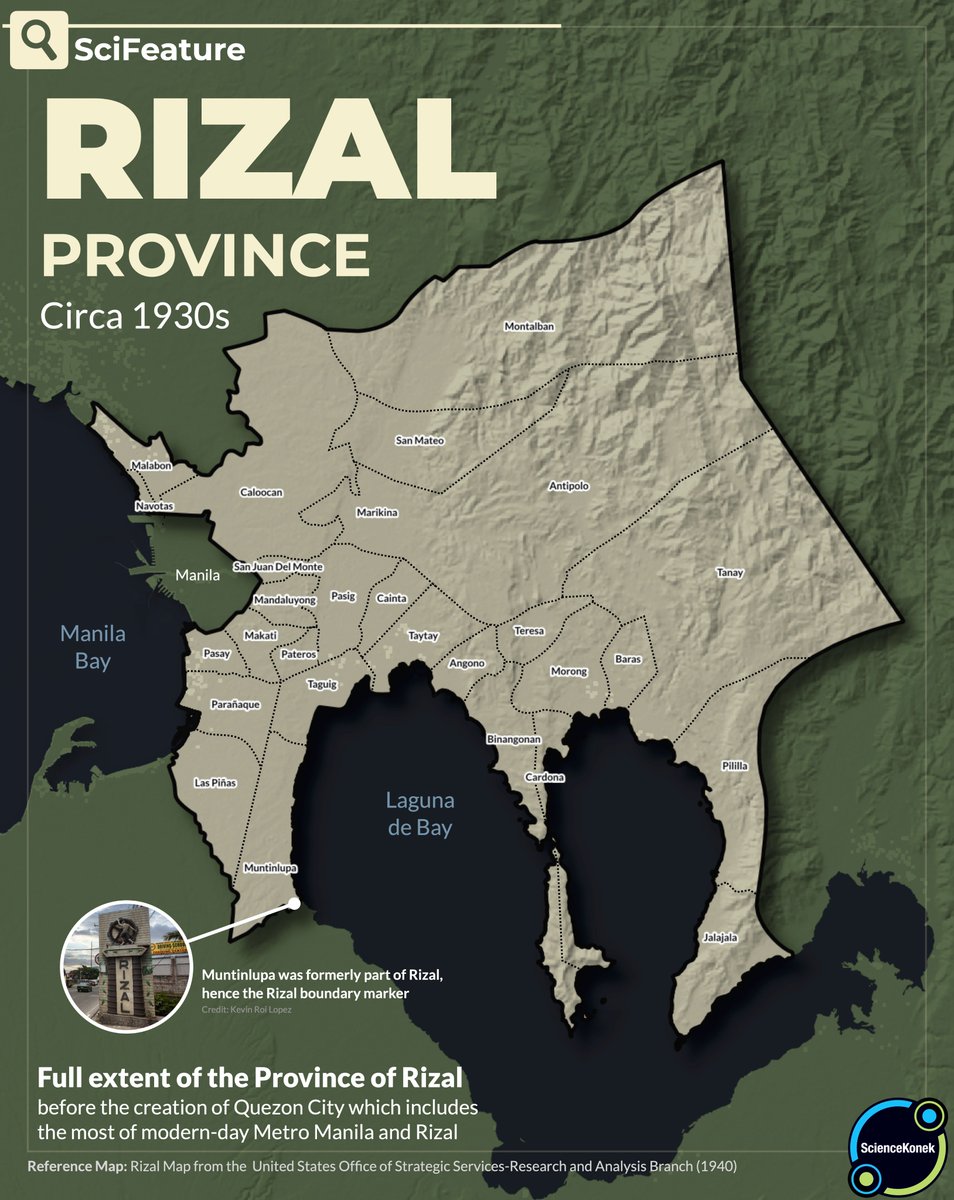
#SciFeature 𝗥𝗜𝗭𝗔𝗟 𝗣𝗥𝗢𝗩𝗜𝗡𝗖𝗘 𝗜𝗡 𝗧𝗛𝗘 𝟭𝟵𝟯𝟬𝘀
Ever wondered why there's a Rizal boundary marker in Muntinlupa? As we commemorate the birth anniversary of Dr. Jose Rizal today, let's once again take a look at the might province of Rizal in the 1930s.
In the early 20th century, Rizal once covered a vast area stretching from the slopes of Sierra Madre to the shores of Manila Bay, surrounding the City of Manila.
On June 11, 1901, the Province of Rizal was officially created through Act No. 137 of the First Philippine Commission. It was named after Dr. Jose Rizal.
The province was formed from 32 municipalities taken from the former Province of Manila and the Politico-Military District of Morong. Pasig served as the provincial capital, although San Felipe Neri (now Mandaluyong) briefly became the seat of government in 1904.
Over the years, Rizal’s boundaries changed as municipalities were merged, transferred, or reorganized. Some towns, such as Bosoboso and Novaliches, were absorbed by neighboring municipalities, while Muntinlupa temporarily became part of Laguna before returning to Rizal.
A major milestone came in 1939 with the establishment of Quezon City, which incorporated portions of Caloocan, Marikina, Pasig, and San Juan.
Rizal underwent its most significant transformation on November 7, 1975, when Metropolitan Manila was created through Presidential Decree No. 824. Several municipalities and cities were separated to form the new region.
The remaining towns continued as the Province of Rizal, shaping the province we know today. #Rizal
Read more: https://t.co/PecJln73dZ
#KilalaninAngPinas 𝗧𝗛𝗘 𝗣𝗛𝗜𝗟𝗜𝗣𝗣𝗜𝗡𝗘𝗦 𝗜𝗦 𝗡𝗢𝗧 𝗔 𝗦𝗠𝗔𝗟𝗟 𝗖𝗢𝗨𝗡𝗧𝗥𝗬 🇵🇭
At first glance, the Philippines may seem small on a world map, but appearances can be misleading. With over 300,000 km² of land spread across its islands, the country is actually larger than many assume.
This misconception largely comes from the Mercator projection, one of the most commonly used map styles. While it preserves shape and direction, making it useful for navigation, it significantly distorts size. Areas near the poles appear much larger, while countries closer to the equator, like the Philippines, are minimized.
Because of this, places like Greenland often look enormous, sometimes comparable to Africa, when in reality, it spans about 2.1 million km², roughly seven times the size of the Philippines, not dramatically larger as maps may suggest. Meanwhile, the Philippines even exceeds the land area of the United Kingdom, which measures around 243,000 km².
Maps help us understand the world, but they don’t always tell the full story. Recognizing how projections influence what we see allows us to better interpret global size and scale, and appreciate the Philippines for its true geographic extent. #Philippines #Kalayaan2026 #PatuloySaPagtuklas