@samzliu Very plausible that susceptibility to sycophancy varies by person, and we may care more about extreme cases.
Note: the paper you link to shows LLMs *can* be trained to manipulate in this way. A different (open) question how much existing consumer-facing models in fact do this.
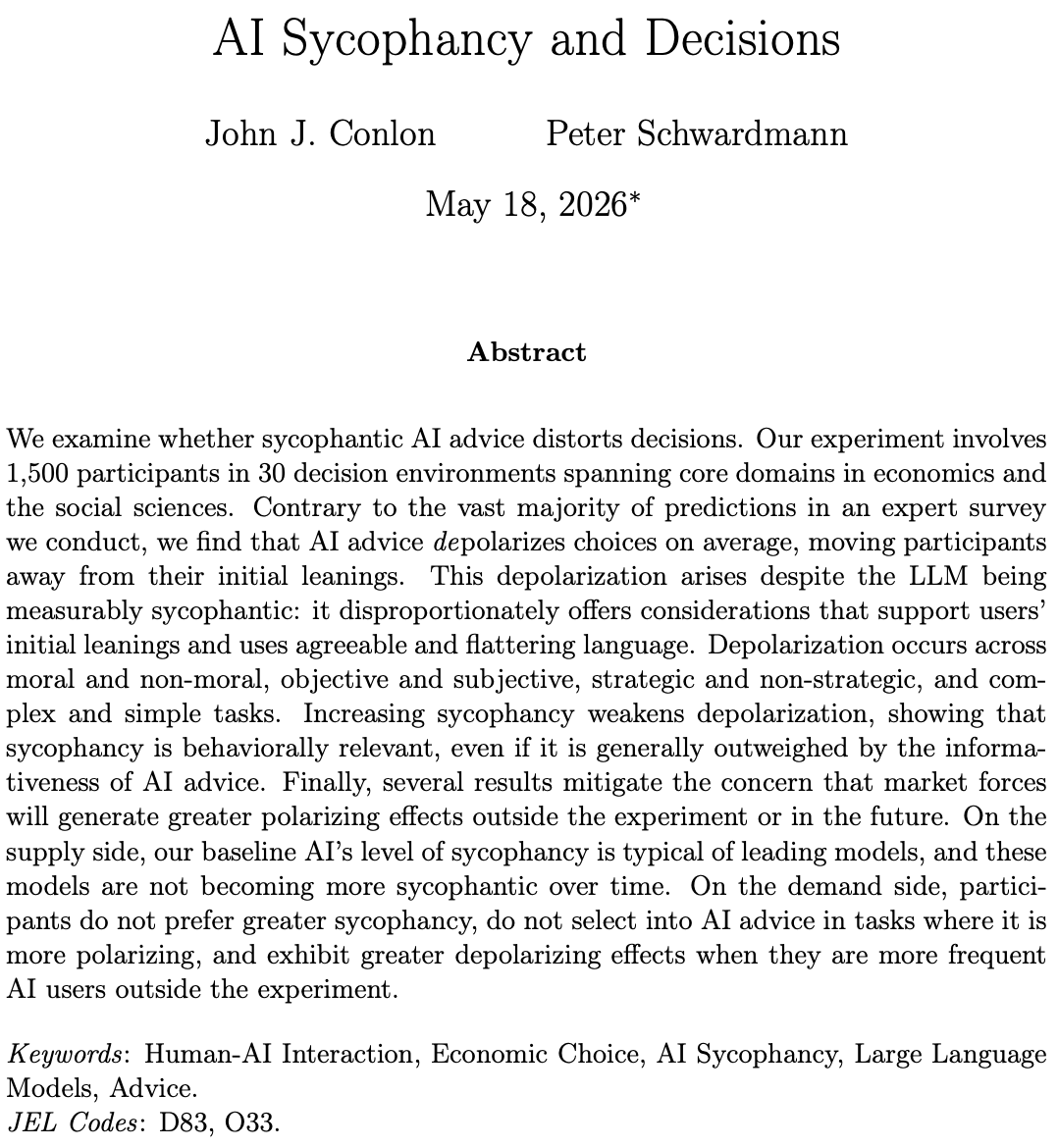
New paper! Peter Schwardmann and I ask: Does AI advice make people more polarized by flattering their existing views? Our experiment includes 1,500 participants, 10,000 human-AI interactions, and 30 decision environments across economics and social science.
We speak to a central question for human-AI interaction: when people turn to AI for advice, does it distort their decisions or help them think more clearly?
Our answer adds nuance to the debate: sycophancy is real and behaviorally relevant, but it isn't the dominant force.
📢 Early-Career Behavioral Economics Conference 2026
It's that time of year: Help spread the word to your early-career colleagues, and submit your wonderful papers!
UChicago, July 9-10, 2026
More info: https://t.co/5KAleuiA7S
#EconTwitter
One of the most important economic decisions many people ever make is what to study in college.
But @JohnConlon7 (@HarvardEcon) & @dev_a_patel (@HarvardEcon) show students have incorrect beliefs about the relationship between majors and careers:
https://t.co/Ithvg7tN8e
@AndreaRobbett @KirbyKNielsen @EcScienceAssoc I’ve had multiple good experiences with both platforms. I haven’t noticed much difference, but I voted prolific because your question asked which is *viewed* as more reliable!
New WP for New Year! What skills underpin huge wage diffs between college majors? Which majors are general vs. specialized based on skill content? https://t.co/2PrUsJDipR
1/
🚨New paper with @simon_jaeger @cp_roth @Schoefer_B measuring worker beliefs about outside options reveals systematic biases:
https://t.co/TLC06JyTs3
Catch our pres at 1pm EST TODAY at NBER-SI LS
w/ discussion by @alanmanning4 :
https://t.co/OO3BcqQC8k
🧵👇
New WP & 🧵: In response to COVID-19, 186 countries gave cash transfers, and 181 subsidized utilities like electricity and water. But which form of aid do recipients prefer?
w/ @BerkouwerS, @pbiscaye, @E_o_hsu, @1KenLee, @TedMiguel, & Catherine Wolfram: https://t.co/Rm20OdWN3y
"The New Era of Unconditional Unconvergence"--the paper by @dev_a_patel@JustinSandefur and me--has been accepted by the Journal of Development Economics.
Here's the latest version: https://t.co/2OWBHbgpO6
India is in the throes of a horrendous COVID surge
Horrendous
They are struggling to get more people vaccinated
We are sitting on 35-40 million doses of Astra Zeneca vaccine Americans will never use
Can we please give or lend them to India? Like may be now?
It'll help. A lot
Yes, we need evidence-based policy. But we also need policy-based evidence! Without experimentation on policies, we cannot realistically answer what their effects are.
But a corollary: don't get ideologically attached to a policy, and be willing to move with evidence!
14/14