I guess I’m old-fashioned but I think if you accuse someone in Congress of committing perjury based on your own confusion of the Iowa Hawkeyes and the Atlantic Hawks, you ought to take a minute and apologize.
Every single service member’s life is sacred, and to minimize that loss is shameful and un-American. The Commander in Chief should know that and revere their sacrifice.
Downtown Fitchburg is building on its momentum. Secretary Matias recently toured Main Street to see homes already delivered and the next opportunities ahead. Thanks to @JohnCronin_MA for joining us and Mayor @SamSquailia for her leadership.
Not understanding the basics of AI - the most important technology of our lifetime - should be disqualifying for a U.S. Senator. This is why we need a new generation of leadership. The future is now.
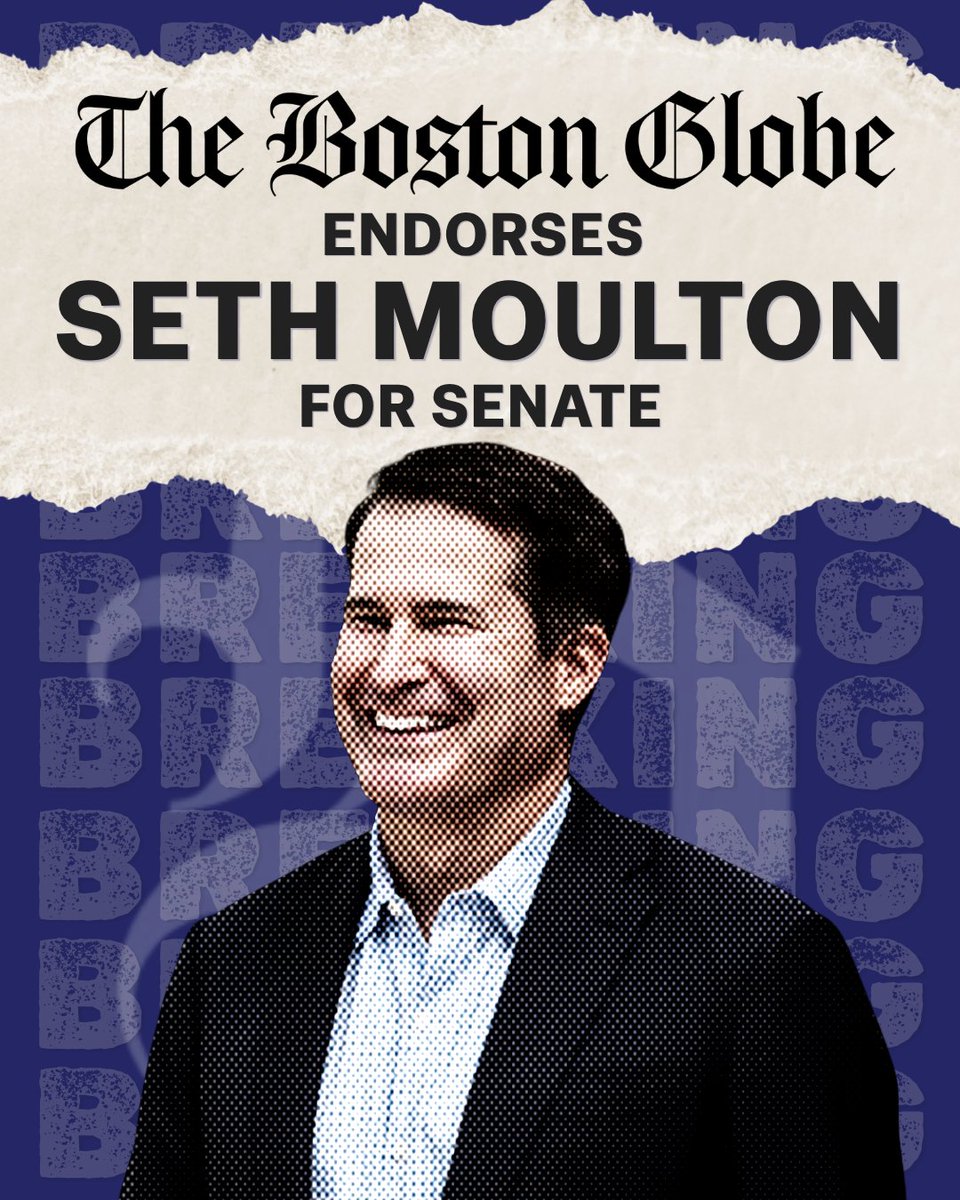
I am honored to receive the endorsement of The Boston Globe.
When I served in the Marines, leadership meant taking on the toughest fights and delivering results.
Massachusetts deserves a new generation of leadership focused on the future and ready to deliver.
Let’s get to work.
“On his proven courage in battle and in public life, in his independent nature, in his ideas for modernizing Massachusetts, in his willingness to push back against rigid ideology on both right and left, Seth Moulton is the right person for the job.” https://t.co/NLVJSpmgnZ
In the best case scenario, Trump struck a deal to reopen a Strait that was open before the pointless war he started, with the IRGC demonstrating its control over the Strait and potentially extracting fees plus sanctions relief. Thousands of innocents - including hundreds of children - dead in Lebanon and Iran for no reason. U.S. troops killed and wounded. U.S. embassies and bases in the Middle East badly damaged. U.S. standing in the world obliterated. U.S. munitions badly depleted. Hundreds of billions spent. Prices up everywhere. More global economic fallout to come. Putin strengthened and enriched. Just a catastrophic situation even in the best of circumstances. A profoundly shameful episode in American history no matter what happens next.
When Obama sent Iran $400m + $1.3bn in interest in 2016 Trump called it "insane" and he and others spent a decade mocking the idea of "pallets of cash" even though it was Iran's own money, American prisoners were released, courts were likely to require the U.S. payment, and Iran had just agreed to significant and verified reductions and restrictions on its nuclear program for 15+ years. Now Trump is giving Iran up to ten times that amount of revenue--one of the most significant measures of sanctions relief provided to the Islamic Republic since its founding--in exchange for marginal and temporary relief from the big increase in oil prices his actions have caused, without any concessions from Tehran, and even as Iran continues to target the United States, its allies, and world oil supplies. No way to read as anything other than desperate recognition of the situation Trump's own actions have created and the lack of available alternatives for dealing with it.
"There is now unambiguous, solid economic evidence, not just abstract economic theory, that rent control would make the affordability problems facing [Massachusetts] worse, not better."
- Jon Gruber, Chairman of the Economics Department at MIT
There have been many defining moments in the course of the Russia–Ukraine war.
But I believe the true spark that ignited Ukraine’s heroic resistance was Zelenskyy’s decision not to flee Kyiv - to “ask for ammunition, not a ride,” to remain in the capital, and to speak directly to Ukrainians through daily video addresses that gave the nation hope.
Had he fled, the trajectory of the war would have been fundamentally different.
Tkachuk bros are the neighborhood kids who use your pool without invite when you're away for vaca.
The Hughes bros are the neighborhood kids who mow your lawn without you asking.
This video should unsettle anyone who takes the United States seriously as a nation.
Because it exposes something dangerous: the trivialization of the world's most consequential office. It shows how carelessly the power, credibility, and accumulated moral authority of a superpower can be squandered for a few seconds of viral attention.
In any other major democracy, this behavior from a head of state would trigger a constitutional crisis. Paris would burn. Berlin would convene emergency sessions. In the Nordic countries, resignation would follow within hours. Across functioning democracies, the public, institutions, and political class would recognize this for what it is: an assault on the dignity of the state itself. Leaders are not free to perform as entertainers without consequence. National honor is not personal property, it's held in trust.
But the United States is not just another country with a provocateur in charge. It is the linchpin of global order. It maintains formal alliances and security guarantees with forty to fifty nations. It underwrites the financial architecture, trade systems, and diplomatic frameworks that billions of people depend on daily. When the American president speaks—or posts—it doesn't land as satire, meme, or personal whim. It reads as a signal about what the country is becoming.
American power has never relied solely on carrier strike groups or economic output. It has rested on something more fragile and more valuable: trust. The belief that beneath domestic turbulence lies institutional seriousness, predictability, and a baseline commitment to dignity. That belief is now disintegrating in real time.
Millions of American companies operate globally. They negotiate multibillion-dollar contracts in environments where reputation is currency. Boardrooms in Frankfurt, Singapore, and Dubai aren't debating whether a post was clever—they're asking whether the United States remains a reliable partner. Whether agreements signed today will be honored tomorrow. Whether American leadership has devolved from institutional to purely theatrical.
Consider tourism, which sustains millions of American jobs—airlines, hotels, restaurants, museums, entire regional economies. Soft power isn't an abstraction. It materializes in flight bookings, conference locations, study-abroad programs, and decades of accumulated goodwill. A quiet, decentralized boycott doesn't require government action—only a collective sense that a nation no longer respects itself.
Now picture this image being studied by foreign ministers, central bank governors, defense strategists, and sovereign wealth fund managers. Picture them asking a coldly rational question: How do we write binding thirty-year agreements with a country whose public face will be this, relentlessly, for years to come? How do we plan for the long term when the tone is impulsive, mocking, and unbound by the gravity of office?
This is where the real calculus begins. Trillions in foreign capital depend on confidence that America is stable, credible, and rule-governed. That confidence is now being traded for what, exactly? Applause from an online mob? A dopamine rush from manufactured outrage? Content designed to dominate the news cycle rather than serve the national interest?
Every serious nation eventually confronts this choice: burn long-term credibility for short-term spectacle, or safeguard the reputation previous generations bled to build. The United States spent eighty years constructing an image of reliability, restraint, and leadership under pressure. That image wasn't born from perfection—it came from a visible commitment to standards that transcended impulse.
This isn't a partisan issue. Europeans who value democratic norms recognize something ominously familiar here. Americans—Democrat and Republican alike—who believe in responsibility and restraint should see it too. Power attracts scrutiny. Leadership demands discipline. A superpower cannot behave like a reality TV contestant without paying a price.
The presidency is not a personal broadcast channel. It's a symbol carried on behalf of 330 million people and countless international partners who never voted but whose lives are shaped by American decisions anyway. Every post either reinforces or erodes the idea that America can be counted on when it matters most.
So the question is no longer whether this is offensive. The question is whether this is who America chooses to be: a nation that trades a century of hard-won reputation for viral moments. A country that replaces statecraft with content creation. A republic governed like a season of reality television.
History offers a harsh lesson here. Great powers don't fall because enemies mock them. They collapse when they begin mocking themselves—publicly, proudly, and without grasping the cost until it's far too late.
Stay connected,
Follow Gandalv @Microinteracti1
As a liver doctor who has treated patients with hepatitis B for decades, this change to the vaccine schedule is a mistake. The hepatitis B vaccine is safe and effective. The birth dose is a recommendation, NOT a mandate.
Before the birth dose was recommended, 20,000 newborns a year were infected with hepatitis B. Now, it’s fewer than 20. Ending the recommendation for newborns makes it more likely the number of cases will begin to increase again. This makes America sicker.
Acting CDC Director O’Neill should not sign these new recommendations and instead retain the current, evidence-based approach.
Why would we pardon this guy and then go after Maduro for running drugs into the United States? Lock up every drug runner! Don’t understand why he is being pardoned.
https://t.co/o6Owzskkca
Here's something fascinating happening in the apartment market right now.
The cheapest, oldest apartments (Class C) are getting crushed right now.
But ONLY in cities that just delivered tons of new apartments.
Let me show you the numbers:
Denver: Class C rents down 13.9%
Naples: Class C rents down 13.5%
Austin: Class C rents down 13.3%
Phoenix: Class C rents down 10.5%
San Antonio: Class C rents down 7.2%
Dallas: Class C rents down 6.5%
What do all these cities have in common?
They just absorbed a massive wave of new apartments.
But here's the twist...
In cities that DIDN'T get a big supply wave?
Class C rents are actually RISING.
20 cities saw Class C rents go UP more than 3%.
19 of those 20 cities had supply BELOW the national average.
So what's going on?
It's basically musical chairs.
When a brand new luxury apartment opens up, where do those renters come from?
They don't appear out of thin air.
They move from slightly older apartments.
Those apartments now have vacancies. So they drop their rents to compete.
That pulls in renters from even older apartments.
And down the chain it goes.
Eventually it hits the oldest, cheapest apartments at the bottom.
And here's why they get hit the hardest:
People living in Class C apartments are already spending a huge chunk of their paycheck on rent.
To fill empty units, landlords have to cut prices A LOT.
Sometimes enough to attract people who couldn't afford market-rate apartments before.
It's like a waterfall effect.
The water (new supply) at the top pushes everything down.
But here's the important part:
This proves that building new apartments - even "luxury" ones - reduces rents all the way down the spectrum.
If it was just an affordability crisis, you'd see Class C rents falling everywhere.
In high-supply cities AND low-supply cities.
But we're not seeing that.
We're seeing a perfect split:
Lots of new apartments = falling Class C rents
Few new apartments = rising Class C rents
New supply at the top creates relief at the bottom.
Also: wages have been growing faster than rents for 3 straight years.
More people can afford apartments today than before.
The bottom line?
This is what happens when you actually build housing.
Supply works.
(Chart and analysis from Jay Parsons - one of the sharpest real estate economists out there)