5 star reviews for my #CX podcast @socialimpactcx!
“The best CX intro available” ⭐️⭐️⭐️⭐️⭐️
“Best in CX” ⭐️⭐️⭐️⭐️⭐️
“Insightful and encouraging!” ⭐️⭐️⭐️⭐️⭐️
Listen to SocialImpactCX on iTunes https://t.co/VH6WaTLVgN or YouTube https://t.co/8sJIVoaxC8
Rebate aggregators: a company your PBM owns that skims every manufacturer rebate before the "pass-through" even starts. Your contract still says 100%. 100% of whatever's left after the PBM paid itself first. One definition away from the truth.
It would be pretty cool if billionaires started competing over who could plant the most trees, house the most homeless people, and remove the most pollution from the Earth.
Admin: “we are rolling out Epic Chat!”
Doctor: “ok… how many messages will I be getting”
Admin: “only about 10-20 per hour, 24/7.”
Doctor: “oh… so I need to silence my notifications then”
Admin: “oh heavens no! Then you might miss that one message that is critical. And we will hang you out to dry if you do.”
Doctor: “what about when I sign into epic in my clinic”
Admin: “well that’s a different context for epic. So none of your messages will reach you until you log back into the hospital epic.”
Doctor: “but I’m still responsible for all the messages even when they don’t reach me?”
Admin: “bingo”
Epic chat is evil
A popup appears on your screen while you’re working with a patient.
Its immediately distracting
And pretty much anyone can message you
My favorite is the radiology techs
“Doc, your CT order in 6 weeks is slightly wrong. Can you re-order it” ?
And I’m like … this requires interrupting actual patient care???
And you couldn’t …
1. Call my office
2. Message my nurse
3. Message my MA
4. Send me an Inbox message?
Pro tip: Whenever your health insurance company denies your care, call and request to speak with the HIPAA compliance director. Then, ask them to provide the names, educational backgrounds, certifications, and medical credentials of all individuals involved in the denial of your claim. You’ll be amazed at how swiftly they reverse the denial.
People claim that this tactic actually works. However, I believe we should be more concerned of these health insurance companies that are amassing millions of dollars in profits while denying patients essential care.
To add a bit of flair, ask for the individual’s name, rank, and serial number, followed by the question: “Are you willing to accept full responsibility for the loss or irrevocable harm caused by your denial?”
It’s time we take action and fight back.
The CEO of a 107-year-old hospital told Becker’s this week:
“The day we can’t make payroll, it’s over.”
107 years.
Older than insulin therapy.
Older than antibiotics.
Older than Medicare itself.
His answer?
Begging Saint Paul for $115 million.
His board should resign tonight.
https://t.co/PXU1dBtD41
@EvidenceOpen@CedarsSinai This is interesting and it’ll be fascinating to see new AI solutions develop in clinical settings. From #patient perspective, will Epic certify that data is 100% clean in the EHR? Dirty data = big risk for patients…and it seems unlikely EHR provider will not make profits.
A massive issue in an era where the vast majority of your de-identified medical data can be re-identified via AI. Have we gone from protective #patient data policies to predatory?
𝐏𝐁𝐌 𝐀𝐜𝐭 𝐭𝐨 𝐁𝐚𝐧 𝐏𝐁𝐌 𝐨𝐰𝐧𝐞𝐫𝐬𝐡𝐢𝐩 𝐨𝐟 𝐏𝐡𝐚𝐫𝐦𝐚𝐜𝐢𝐞𝐬 𝐈𝐬 𝐑𝐞𝐥𝐚𝐮𝐧𝐜𝐡𝐞𝐝 𝐢𝐧 𝐂𝐨𝐧𝐠𝐫𝐞𝐬𝐬
Yesterday, a bipartisan group of US Senators and Representatives relaunched the Patients Before Monopolies Act (PBM Act) in Congress.
The central provision of the bill would prohibit a PBM or insurer from owning a pharmacy business and require that it be divested within one year.
American Pharmacies strongly supports the PBM Act. When PBMs own pharmacies, the resulting self-dealing and conflicts of interest distort the marketplace and too often undermine affordable, accessible, patient-centered care. American Pharmacies and our 700 independent pharmacy members across the country thank the bill’s sponsors for their leadership in confronting one of the root causes of rising costs and barriers to care.
The sponsors are Sens. Hawley (R-MO), Warren (D-MA), Marshall (R-KS) and Fetterman (D-PA) and Reps. Harshbarger (R-TN), Auchincloss (D-MA), Carter (R-GA), Landsman (D-OH), Nehls (R-NY) and Nadler (D-NY).
The bill can be viewed here: https://t.co/0IGFnb16sE
Exactly.
When a doctor makes a clinical decision, we carry malpractice risk.
When an insurer overrules the treating physician and denies care, it is effectively making a clinical decision too.
If harm follows, accountability should not disappear just because the decision came from an administrative layer.
FT Exclusive: NHS England has granted external staff from companies including Palantir “unlimited access” to identifiable patient data while working on a part of its flagship data platform. https://t.co/sxgWCuZua6
Traditional Family Doctors are not a dying breed. Conventional Healthcare is dying.
I am a Direct Primary Care Family Physician. I'm making a House Call today. My patients get same/next day 30-60 min visits. I make social visits for the elderly who are lonely. We may spend 10-15 min on medical issues but the other 45 min is just visiting. They're lonely. They told me they are. I suture my patients again for an extra $15 for the suture tray. I've even sutured someone on a House Call.
I was the 1 o 2 DPC Docs her 7 years ago. Wen now have 8 and still growing. We also have numerous Direct Care Specialists. We are the Past and Future of Medical Care.
#Hospital #HealthInsurance #scam #CORRUPTION
https://t.co/rrN2QdREyK
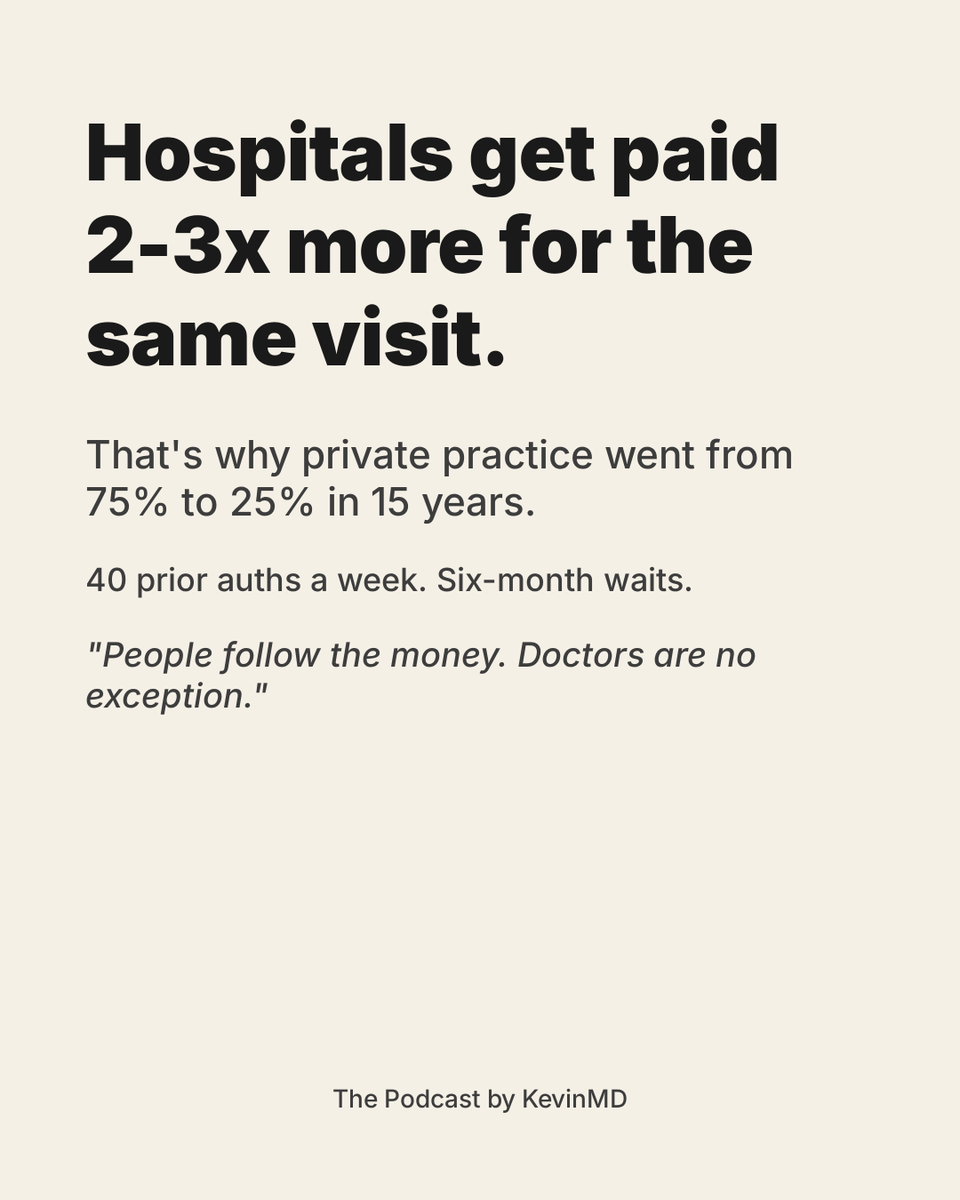
Fifteen years ago, 75 percent of US physicians were in private practice. Today, around 25 percent are.
That is not market evolution. That is a policy outcome.
Hospitals are paid 2 to 3 times more than independent practices for the same office visit. For echo and MRI, 3 to 5 times more. Same physician work. Same diagnosis. Different check, because the door has a hospital logo on it.
Then layer the prior auth burden. The typical small practice now runs about 40 prior auths a week. Generic medications that did not require approval five years ago now require approval. Every MRI requires approval. Most denials are algorithmic, with no specialist on the other end who can actually override anything.
Then layer MIPS, MACRA, and the 2013 Misvalued Code Initiative that cut reimbursements for office-based echo and EMG by more than 50 percent while leaving hospital-employed physicians shielded.
The result, per neurologist Scott Tzorfas on The Podcast by KevinMD, is that wait times in his area now run six to nine months for a specialist and close to a year at the academic hospitals. Not because there are too few doctors. Because the small offices that used to absorb that volume have been driven into hospital systems where payment is higher and overhead is somebody else's problem.
He proposes site-neutral payment, repealing the restrictions on physician-owned hospitals, and applying the qualified business income deduction to physician practices. Reverse the financial incentives that bent the field, and the field bends back.
There is also a perverse premium incentive baked into the ACA. Insurance profits are capped at 15 to 20 percent of premiums, but that is a percentage cap, not a dollar cap. Higher hospital prices push premiums up, which pushes the dollar value of that 15 to 20 percent up too. The system is paying more for the same work and calling the result a market.
The structural fix is not complicated. The structural will is what is missing.
Search "The Podcast by KevinMD" wherever you listen to podcasts. Link in the replies.
What policy lever would actually pull more clinicians back into independent practice?
#ThePodcastbyKevinMD
If insurance companies can deny care and call it "medically unnecessary", why aren't they required to have malpractice insurance doe when they get it wrong and someone gets sicker or tragically dies ?
@heynavtoor The promise of AI is extraordinary. But there are some questions to be asked and answered. Does this AI promote sponsored products/services without your knowledge? What % clean is the data used to create this AI? Will this AI work against my best interests? Do not go blindly...
Remember Dan Price...that CEO who took a pay cut so he could pay all his employees a minimum annual wage of $70,000? Here’s what happened next:
“Six years later after the decision that others said would destroy his business, Dan reports that revenue has tripled, the customer base has doubled, 70% of his employees have paid down debt, many bought homes for the first time, 401(k) contributions grew by 155% and turnover dropped in half. His business is now a Harvard Business School case study.”
In his own words:
“6 years ago today I raised my company's min annual salary to $70k. Fox News called me a socialist whose employees would be on bread lines.
Since then our revenue tripled, we're a Harvard Business School case study & our employees had a 10x boom in homes bought.
Always invest in people.”
Courtesy of Craig Henley
Mark Cuban just drew the sharpest line in the modern economy.
Most people are already on the wrong side of it.
Cuban: “There’s two types of approaches to AI. Some people who use it so they don’t have to learn anything, and some people who use it so they have the opportunity to learn everything.”
Same tool. Opposite outcomes.
The first group found the most powerful knowledge infrastructure ever built and used it to stop thinking.
They offload the reasoning. Skip the friction. Hand the cognition to the machine and call it productivity.
What they’re actually doing is hollowing out the one thing that cannot be replicated once it’s gone.
Their own mind.
The second group uses the same machine to learn faster than any generation in human history.
Cuban: “AI is a tool, it’s a way to learn, it’s a democratization of knowledge.”
For centuries, elite knowledge was locked behind three things.
The right institution. The right geography. The right capital.
Entire generations of potential died quietly because the information was never within reach.
Not for lack of intelligence. Not for lack of drive.
Lack of access.
That wall is gone.
A kid with a phone now has access to more knowledge than a Harvard student had ten years ago.
Entire disciplines on demand. Mental models that once required years of expensive education now available to anyone willing to ask the right questions.
The knowledge is democratized.
The ambition is not.
That is the real divide Cuban is describing.
Not technical literacy. Not better tools or faster connections.
Cognitive initiative.
The willingness to use the machine to go further instead of using it to go nowhere.
One group is outsourcing their mind.
The other is building something the machine will never replace.
The gap between them compounds daily.
And it will be irreversible within a decade.
Atrophy doesn’t announce itself.
It just arrives one day when the thinking has already stopped.
To everyone who thinks that AI will eliminate the middlemen in healthcare:
Remember electronic health records. Everyone assumed moving from paper charts to computers would improve efficiency.
Regulations and bureaucracy ensured we got the opposite.
It can happen with AI too.
Jensen Huang just buried the one metric civilization has run on for a century.
Be the smartest person in the room.
Huang: “Intelligence is going to be commoditized.”
Sit with that word.
Commoditized.
Like oil. Like electricity. Like bandwidth.
We built an entire civilization around producing human calculators.
Sorted by GPA. Ranked by IQ. Rewarded for how fast they could process what nobody else could.
That market just collapsed.
You can rent a sharper mind than any person alive for twenty dollars a month.
So what happens to the man who spent forty years being the sharpest at the table?
He loses the table.
Huang is not a philosopher warning you from a safe distance.
He is the man whose chips are making it happen.
He said it without flinching.
Huang: “My life would suggest that being lower on the intelligence curve than everybody around me doesn’t change the fact I’m the most successful.”
The CEO of the most valuable company on Earth just told you plainly he was never the smartest in his rooms.
He won anyway.
Because intelligence was never the actual edge.
The people most terrified of AI are the ones who built their entire identity around being the fastest processor in the building.
That identity just got priced out.
Huang named what replaces it.
Huang: “Character, humanity, compassion, generosity. I believe those are superhuman powers.”
Things you cannot scrape from a dataset.
Things you cannot distill into weights and parameters.
The machine will out-compute you in milliseconds.
But it cannot bleed for something.
It cannot walk into a room with conviction and move people who did not want to be moved.
It cannot be you.
Intelligence is now infrastructure.
The electricity humming behind the walls.
Nobody wins by owning the electricity.
You win by what you build with it.
When intelligence becomes a commodity, humanity becomes the premium.
The human calculator had a good run.
That run is over.