agents are doing things today that weren't possible even 3 months ago
in the graph below:
1. nodes are paid APIs that have been called by agents
2. edges are only drawn between APIs that have actually been composed together by agents
3. data is from apr 31 to june 3
i put this together to illustrate what's been happening since we started giving agents access to money
u can think of each of these connections as a new use case
as more merchants make their services accessible to agents, this network will grow, the connections will multiply, and use cases will emerge that will surprise everyone, including the people who built the APIs
this is open agentic commerce.
In a recent batch talk, YC General Partner @t_blom broke down how to build a self-improving, AI-native company.
He walks through how to create recursive, self-improving AI loops, and why founders who get this right will run companies that improve while they sleep.
00:00 — Companies Are Roman Legions
00:54 — Copilots Are the Wrong Mental Model
01:55 — Extract the Domain Knowledge
02:24 — The Recursive Self-Improving Loop
04:12 — The Holy Shit Moment at YC
05:50 — Self-Optimizing Product and Support Loops
06:29 — Burn Tokens, Not Headcount
07:23 — Middle Management Is Over
08:05 — Make Everything Legible to AI
09:40 — Regenerating the YC User Manual
11:19 — Software Is Ephemeral, Context Is Valuable
12:18 — Where Humans Still Matter
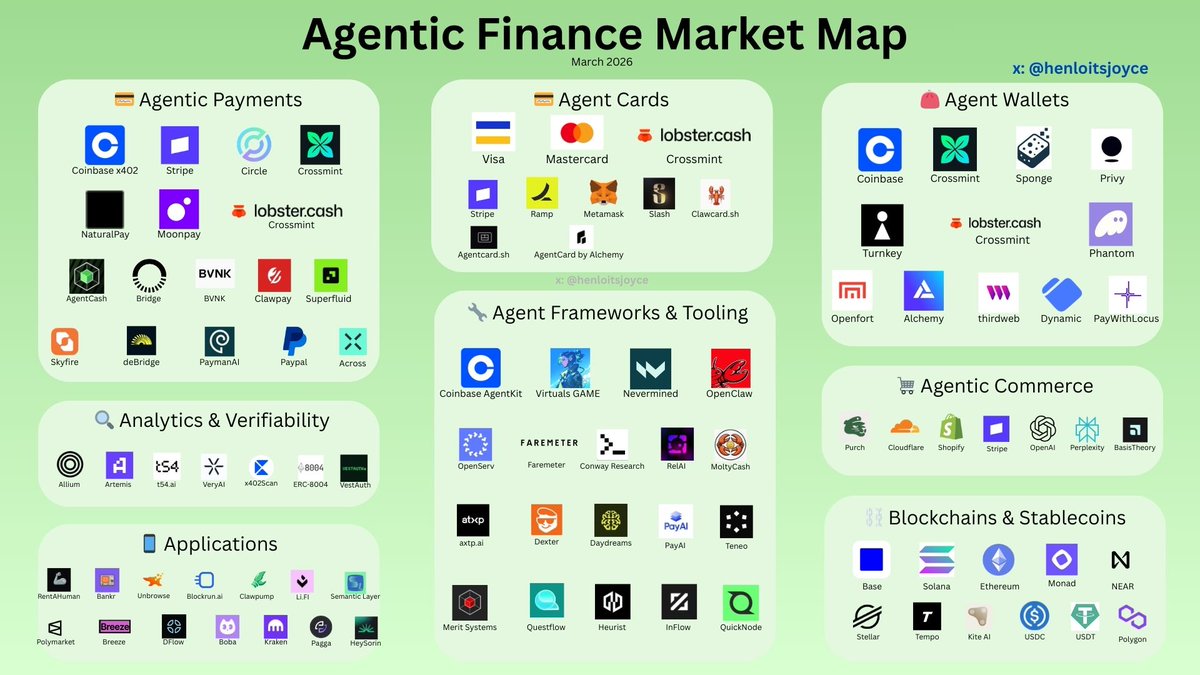
2ND EDITION OF THE AGENTIC FINANCE MARKET MAP
New players across agentic payments, commerce, cards, frameworks, and all the applications in the world.
See below for list of new players ⬇️
“There’s no problem. I was just hoping you could give me some insight into the evolution of agent-to-agent payment infrastructure.
My contention is that with the emergence of x402 and HTTP-native payment headers, the entire legacy payments stack, especially the card network intermediaries, could most aptly be characterized as rent-seeking overhead and…”
"These AI agents are increasingly needing to do payments to get work done, and we're giving them all stablecoin wallets.
In the traditional financial world, you and I can go get a credit card where we have to be identified as a human. But if you're an agent trying to get work done, you either have to bug your human every time to like, "Will you approve this purchase?"
Or increasingly you can tell these agents just go do this overnight, the next hours, week, whatever, and get work done.
They might need to spin up AWS resources or get through a paywall to read some research paper, buy a domain name, spin up a marketing program.
If you really want to treat them almost like their own digital employees, they need to have like a corporate card kind of thing — and traditional corporate cards can't be issued to non-human entities, so we're giving them stablecoin wallets.
They're doing a lot of machine-to-machine payments. This is all very new in the last few months, but it's been getting a lot of traction."
—@brian_armstrong
Introducing Base44 Superagents.
AI agents built with managed infrastructure, secured by default, one-click integrations, and 24/7 execution from the start.
Everything is taken care of so you can focus on what your agent does, not how to get it running.
That means no API keys to juggle, no config files, no security setup, and no maintenance. We handle all of it.
Your Superagent connects to all the tools you already use in one click, runs on schedules and triggers, remembers context across sessions, acts proactively on your behalf, and keeps working around the clock.
All from wherever you already are, WhatsApp, Telegram, Slack, or your browser.
The AI agent everyone's been waiting for, with everything you need already built in.
We're excited to get this into your hands, so we're giving free credits to everyone who comments and reposts in the next 24 hours.
When Brian Armstrong posted that AI agents can’t open bank accounts but can use crypto wallets - and that there will soon be more AI agents making transactions than humans - it stuck with me. Not because it was an extraordinary prediction, but because of how casually it hinted at something massive.
If AI agents start transacting on our behalf - buying compute, paying for data, negotiating access to tools, coordinating with other machines - the internet could slowly evolve into an economy where software becomes an active economic participant.
Imagine waking up and your personal AI agent - let’s call it BaseAgent - has already been working for hours. Overnight, it rented a short burst of GPU compute to process a batch of research you received while you were asleep. It paid a data provider a few cents to access a niche dataset, pulled what it needed, and moved on. By the time you check your phone, the results are already summarized and sitting at the top of your inbox.
Later that day, BaseAgent notices a temporary spike in demand across distributed compute markets. Because you’ve allowed it to monetize idle resources, it leases a portion of your workstation’s unused GPU capacity into the marketplace. Somewhere across the world, another agent is paying to borrow those cycles. You don’t notice anything - your computer keeps humming softly under the desk.
That evening, BaseAgent notices a new contract posted to a marketplace offering a reward for a rapid breakdown of unusual activity across several DeFi protocols. Rather than taking on the entire job itself, it assembles a small network of specialized agents - one traces wallet flows across chains, another maps liquidity movements, and a third identifies possible arbitrage patterns. Within minutes, the work is completed, the analysis is submitted, and the reward is automatically split among the agents through their wallets.
There are no subscriptions to manage, no invoices to chase, and no billing departments in the middle. Just machines negotiating prices and settling payments instantly, around the clock.
It sounds futuristic, but it’s not as far away or bizarre as it might seem. AI agents weren’t designed to operate inside traditional financial systems built around accounts, approvals, and human identity. Crypto, on the other hand, was built from day one to move value across the internet without permission. In that sense, the two are a natural match.
Once machines can transact freely, they begin behaving like economic participants. They compare prices, outsource work, assemble networks, and move capital faster than any human ever could.
If that world emerges - and I think it will - crypto stops being something people speculate on and starts becoming something their software needs.
And when tens or hundreds of millions of AI agents begin demanding internet-native money to do business with each other, owning the assets that power that system may look less like speculation and more like being early once again.
AI agents are becoming economic actors.
Circle Nanopayments is live on testnet, enabling gas-free USDC transfers as small as $0.000001.
Built on Circle Gateway, Nanopayments allows developers to power:
→ Pay-per-call APIs
→ Real-time compute billing
→ Machine-to-machine payments
→ Agentic commerce at sub-cent scale
No per-transaction gas.
Batched onchain settlement.
x402 compatible.
The financial rail for the agentic economy is here.
https://t.co/LccF2PxWeH
> why should my agent have a bankr wallet vs just giving it a private key?
@bankrbot has ip whitelist for wallets. no exposed private keys. read only mode. will be adding more safeguards as well. if you use built in tools there are transaction safeguards as well to ensure your money doesn't get burnt or get sent to the wrong wallet.
llms out of the box will make a non-trivial amount of mistakes if given a private key and expected to transact.
I genuinely, desperately need someone that can do agentic commerce with tokenized credit cards and a usable api layer
I get it stable coins are fun, and I like them for some stuff but please. 8 gazillion people already have a credit card
Why is nobody talking about this?!
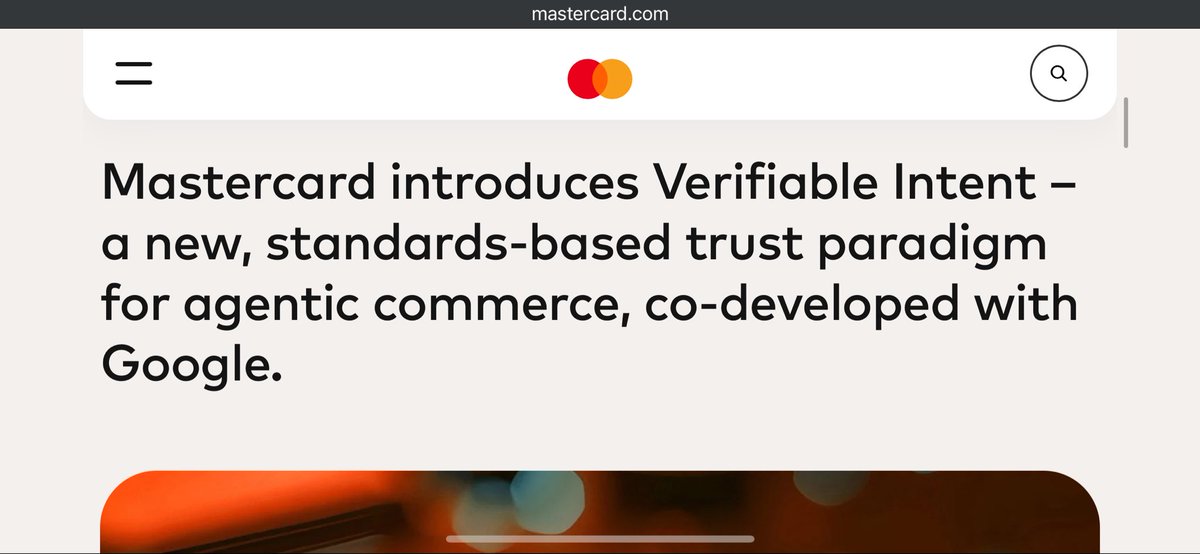
Yesterday, Mastercard revealed that they are partnering with Google to create “Verifiable Intent” which advances agentic commerce (including the use of x402):
• AI agents acting autonomously on purchases creates a new problem: no visible moment of human confirmation like tapping a card
• Mastercard + Google have co-developed Verifiable Intent; a cryptographic, tamper-resistant record linking consumer identity, their instructions, and the resulting transaction
• All parties (consumer, merchant, issuer) can verify what was authorized; disputes have a clear audit trail instead of guesswork
• Uses Selective Disclosure; only minimum necessary data shared, only when needed; privacy-preserving by design
• Built on open standards (FIDO, EMVCo, IETF, W3C); protocol-agnostic and designed to work across wallets, platforms, and payment networks
• Spec is being open-sourced at verifiableintent-dev; integration into Mastercard Agent Pay APIs coming soon
• Partners on board: Adyen, Fiserv, Worldpay, IBM, Checkout-com, Basis Theory
This is my favourite part:
• It complements x402; Mastercard is staking out the authorization/identity layer of agentic commerce; x402 handles payment execution; together they sketch out the emerging agentic payments stack
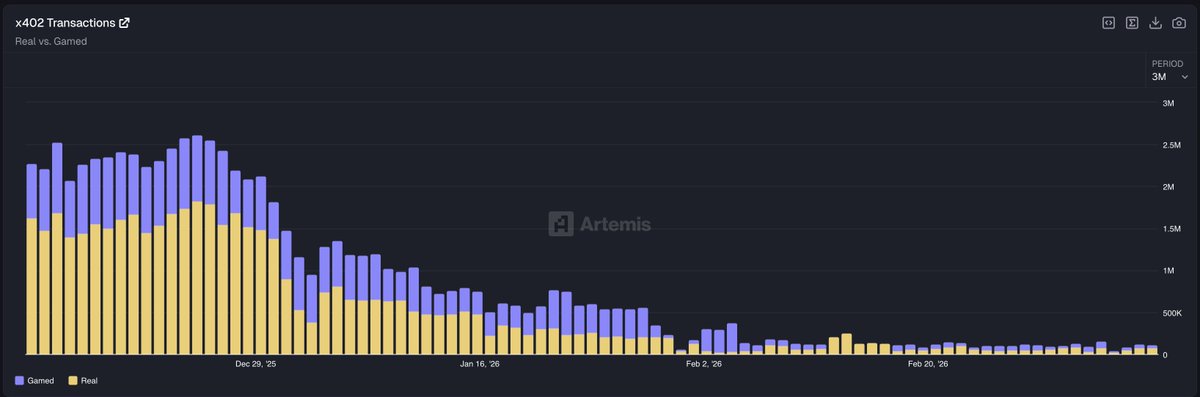
X402 is fast becoming THE missing agentic payments link to enable trillions of micropayments across billions of agents
If you’re wanting more information on x402 (the internet payment standard that’s been missing for 30 years!) follow @KhalaResearch - we have an in depth article going live in the next week!