Given the success of the data-engineer-handbook, we’ve released a brand new open source GitHub repo called the ai-engineer-handbook!
This repo has all the projects, newsletters, and creators you need to follow to stay up to date in AI!
If there’s anything missing, please open a pull request and we will review it! Let’s crowd source this material together to stay up to date!
Link: https://t.co/0wyQhTC1nq
Make sure to join our free vibe coding challenge on February 21st and 22nd. We will be building a full fledged SaaS product: https://t.co/y5SbRHdlP5
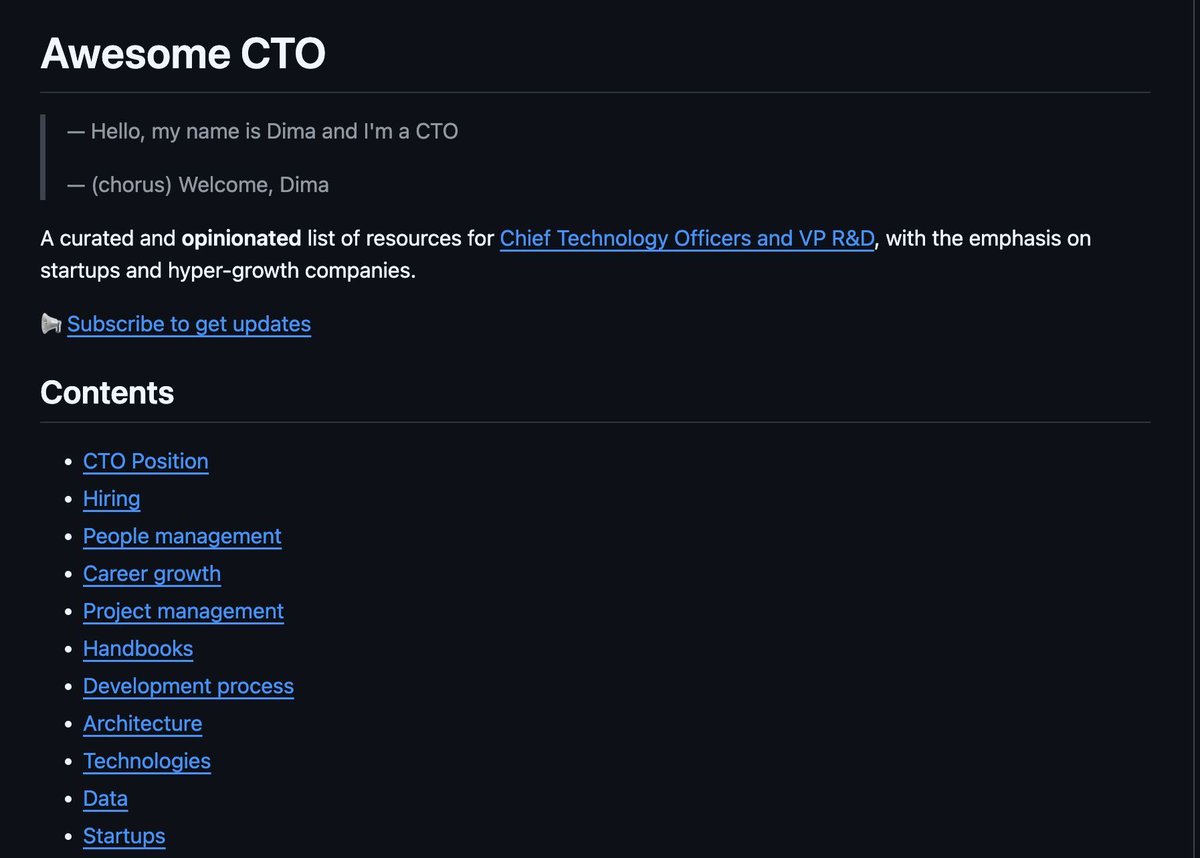
Awesome CTO
A great github repo full of resources for software engineers and aspiring CTOs:
- Software Development Processes
- Hiring for technical roles
- Software Architecture
- Product and Project Management
- Career growth
Check it here:
https://t.co/2l1aCAqv2c
One interesting observation: inside a Big Tech, the internal token leaderboard is dominated by… very very experienced engineers. Distinguished-level folks who you rarely saw code day to day before LLMs. Also, some VPs (!!)
Being "Early" is a lonely place—until the future arrives.
On March 1, 2018, I stood on a stage at the Google Community Space in San Francisco. The audience was filled with the top minds in economics from CEGA, Stanford, Google, the World Bank, and many others.
My talk was titled "I, Development Economist" (a nod to Asimov's "I, Robot").
My 2018 thesis was radical at the time: I argued that AI wouldn't just be a tool for better regressions or predictions—it would eventually handle the end-to-end research and implementation pipeline.
The reaction? Deep skepticism. Back then, Transformers were brand new. Many felt the human element of development was too complex to be modeled this way.
The Turning Point: In 2020, I was on the verge of joining Stanford to lead a lab at the intersection of machine learning and social science. When the pandemic froze those plans, it was a "sliding door" moment.
Shout-out to Berkeley's Center for Effective Global Action (CEGA) and Algorithmic Fairness and Opacity Group (AFOG) for having me as an honorary researcher during that transition. Ultimately, I realized I didn't want to just research this future—I had to build it.
I founded:
Machine Learning X Doing: Bridging the gap between research and real-world AI.
Development Economics X: Making that "end-to-end" vision a reality for global development. (Of course, many things still don't require AI per se—but they always need to be data-driven).
Fast forward to 2026:The skepticism of 2018 has turned into the industry standard of today. As I prepare for my upcoming TEDx talk, I’ve been reflecting on that 2018 video.
It’s a reminder that as a founder, your job isn't to be right today—it’s to be right about where the world will be in 8 years. The legacy institutions of the past were built for a different era; we are building the infrastructure for the next one.
The futures of development and AI are both here. What do the next 8 years hold?
#AI #DevelopmentEconomics #Startups #FounderJourney #MachineLearning #TEDx2026 #GlobalDev #Impact