Passing on $ABVX at this valuation is equivalent to passing on buying it at $55 in the post-market following the induction data readout.
The market is getting a second chance at the same mistake.
Here is the question the market will answer over time: what is the right value for what may be the best UC drug ever developed? Obefazimod appears to be a safe, once-daily oral therapy with no pre-prescribing burden, no meaningful ongoing monitoring burden, a unique mechanism of action, and exposure to what should become a ~$20B IBD TAM?
The answer is likely more than ~$7B.
Let’s put this in perspective: ~$7B is roughly what Pfizer paid for etrasimod before the Phase 3 UC data read out, which was a second-in-class S1P modulator behind ozanimod, with weaker efficacy, QT-related considerations, ECG screening, monitoring burden, and a less differentiated commercial profile.
So what is capping the stock today?
Outside of the cancer debate, based on conversations with market participants, the current pushback appears to be that there is “no catalyst.” They appear to have missed there is a major safety update expected by the end of this month that should nearly double the total patient-years of obefazimod safety exposure.
I know pods have short-term thinking, but three weeks does not seem that far away when the next dataset has the potential to directly address the central bear case.
That matters because the current bear case is safety. If the upcoming dataset continues to show that the malignancy rate is in line with UC background risk and non-JAK UC comparators, it should materially reduce the central sentiment overhang on the stock.
That is the broader setup. The market appears to be treating the June 1 safety update as a structural impairment. That interpretation is wrong. These data now establish obefazimod as a potential frontline “prescribe and forget” oral therapy in UC which is a profile often hoped for and talked about in IBD and I&I more broadly, but rarely realized.
The concern around non-NMSC events reported on June 1 is overblown. The June 1 data update should strengthen, not weaken, the core $ABVX thesis. The 50 mg safety concern is best understood as a red herring when evaluated against pooled exposure, the elevated baseline cancer risk of a refractory UC population, and malignancy rates observed with other UC therapies that do not carry black box warnings. The more important signal is efficacy. The 50 mg dose remains highly effective, with potentially best-in-disease endoscopic remission data, while the 25 mg dose provides meaningful flexibility for chronic maintenance, labeling, and physician adoption.
The market reaction materially over-discounted safety-related risk, underappreciated the commercial significance of 25 mg / 50 mg dose flexibility, and failed to appreciate that the strength of the endoscopic remission data supports potential earlier-line use in UC while materially increasing the probability of success in Crohn’s disease. UC supports the base case. Crohn’s is the key upside driver for valuation.
The reported 50 mg obefazimod malignancy data should be evaluated in totality by combining the pooled 96-week Phase 2b dataset, which used the same dose and similar NMSC surveillance, with ABTECT Maintenance Part 1. The right question is not whether there were headline malignancy events. The right question is whether the rate looks out of line for a refractory UC population that is already at elevated risk of cancer, and whether it looks out of line versus other UC therapies that do not have black box warnings. On the totality of the data, it does not.
By construction, per regulatory convention, and consistent with standard practice in clinical IBD trials, dysplasia should not be counted as a non-NMSC malignancy event. Dysplasia is pre-malignant and, by definition, is not cancer. Such findings are also not uncommon against the background risk of longstanding ulcerative colitis. Including dysplasia as cancer distorts the safety interpretation and makes the 50 mg dose look worse than the data support.
There were two non-NMSC events reported in ABTECT Phase 3 Maintenance Part 1. There was one non-NMSC event reported in the ongoing Phase 2 series of trials. It is unclear whether this event occurred during the 96-week portion of the Phase 2 series, but conservatively counting it against obefazimod still yields an event rate of approximately 0.58/100 patient-years. This places obefazimod in the middle of the range across UC comparators, including ustekinumab, vedolizumab, etrasimod, ozanimod, and mirikizumab, none of which carry black box warnings for malignancy, and ahead of black-boxed JAK inhibitors, including upadacitinib and tofacitinib. That is not what a broken 50 mg safety profile looks like.
The safety debate is distracting from what should be the dominant interpretation of the update: the efficacy data are exceptional. Obefazimod has produced what may be the most impressive endoscopic remission dataset observed in ulcerative colitis, particularly after adjusting for how refractory the ABTECT population was. This was not an easy-to-treat biologic-naive UC trial. The study included substantial advanced-therapy inadequate responders and prior JAK inhibitor inadequate responders, yet the 50 mg dose still delivered a level of mucosal efficacy that appears best-in-disease or near-best-in-disease on a refractory-adjusted basis.
That is the point the market appears to be missing. RINVOQ likely remains the stronger acute induction/rescue benchmark, but upadacitinib’s pivotal UC trials did not face the same degree of prior JAK-exposed disease biology. For chronic maintenance, obefazimod appears highly competitive and potentially superior when adjusted for baseline severity, with particularly strong endoscopic remission and corticosteroid-free remission performance. A non-JAK oral drug delivering this level of mucosal efficacy in this population is not just “strong data.” It is a potential frontline-enabling efficacy profile.
This is what creates the frontline “prescribe and forget” opportunity. Community GIs manage many moderate UC patients before they become severe or refractory. A clean 50 mg profile would offer a rare combination: enough efficacy to keep moderate UC patients controlled, and enough safety comfort that physicians do not feel burdened managing the drug. Oral dosing, strong efficacy, no infusion logistics, no JAK-label discomfort, and minimal incremental workflow burden create a practical profile that community physicians can use earlier. The larger opportunity is not merely post-biologic / pre-JAK positioning; it is post-generics / pre-biologics use by physicians who want an effective, low-friction oral option.
The 25 mg dose further strengthens this profile. It is not a rescue thesis; it is a strategic advantage. It provides flexibility for chronic maintenance, labeling, and physician adoption, while preserving 50 mg for induction, higher-need patients, or flex-up dosing. A commercially viable regimen could mirror the established IBD treatment paradigm used with RINVOQ: higher-intensity induction followed by lower-dose chronic maintenance. In practice, patients could receive 50 mg obefazimod induction or JAK induction followed by 25 mg obefazimod maintenance, with the ability to flex back to 50 mg in selected patients who require additional disease control.
This preserves the key commercial attributes of the asset: potent induction optionality, a lower-exposure 25 mg maintenance backbone, oral dosing, dose flexibility, and strong mucosal efficacy. A potential 50 mg chronic-label limitation should therefore be viewed as a manageable dosing/labeling issue rather than a thesis-breaking safety problem. If the practical regulatory choice were between preserving broad 50 mg chronic dosing at the cost of a black box warning versus adopting a cleaner regimen of 50 mg induction and/or selective flex-up with 25 mg maintenance, the rational commercial strategy would be to prioritize the label that maximizes broad chronic use, physician comfort, and adoption.
Even if, for the sake of argument, obefazimod ultimately received a black box warning, the asset would still not be broken. RINVOQ is black-boxed and still represents a multi-billion-dollar IBD product. That creates a reasonable downside commercial anchor for obefazimod: constrained label, not zero. In that scenario, obefazimod could still have a role in the post-biologic / pre-JAK setting, and potentially as maintenance after RINVOQ induction or after 25 mg / 50 mg obefazimod induction. If obefazimod is viewed as safer and more effective in maintenance, it could still be used ahead of RINVOQ for chronic disease control in selected patients.
But the Crohn’s readthrough is the major upside driver, and the headline of the maintenance data should have been "Crohn's now appears largely de-risked".
Can anyone think of a therapy that produced this degree of mucosal efficacy in UC and then failed to work in Crohn’s?
Tofacitinib is the closest example, but it is not a close comp: inferior mucosal healing, a much easier-to-treat UC population, and a JAK mechanism with a very different safety and commercial profile.
The point is not that UC success guarantees Crohn’s success. It does not. The point is that a non-JAK oral drug producing this degree of mucosal efficacy in a hard-to-treat UC population should materially increase the prior probability of CD success. Above a coin flip certainly seems reasonable given prior UC to CD translational examples, and we would venture should be closer to 75%, but regardless, meaningfully above where the market appears to be underwriting it today.
That makes Crohn’s a real valuation driver today, not a free option worth zero.
Global peak obefazimod sales can be reasonably framed at approximately $3.5–5.0B in ulcerative colitis alone, with upside to $6.0–10.0B if Crohn’s disease is successful. On a risk-adjusted basis, assuming a high probability of UC approval and a 66% probability of success in Crohn’s disease, a reasonable underwriting range could be approximately $4.5–6.5B in global risk-adjusted peak sales across IBD. There is additional upside approaching or exceeding $10B globally if the safety profile remains benign and the drug moves into frontline or earlier-line UC/Crohn’s use.
The UC-only case is supported by a differentiated profile: oral once-daily dosing, strong maintenance efficacy, robust endoscopic remission, potentially cleaner chronic safety, 25 mg / 50 mg dose flexibility, and a refractory-adjusted efficacy dataset that compares favorably with leading advanced therapies.
The base case is that obefazimod remains a multi-billion-dollar IBD asset. The downside case is a narrower 50 mg maintenance label, a 25 mg-centered chronic-use strategy, or even a constrained/black-box label, which remains commercially manageable and still anchored by a RINVOQ-like IBD revenue framework rather than zero. The upside case is a clean label, earlier-line UC positioning, community-GI adoption in the post-generics / pre-biologics setting, and successful Crohn’s development, which could support global peak sales toward the high end of a $6–10B range.
To sum it all up: The risk/reward appears highly attractive because the market is focused on a worst-case interpretation of the 50 mg safety signal while failing to credit the durability, mucosal efficacy, Crohn’s readthrough, and commercial flexibility of the 25 mg / 50 mg profile.
Layered on top of that is fast short money arguing there is “no catalyst,” despite a major safety update expected before the end of the month that should add a truckload of patient-years and directly address the only real bear case.
If that dataset is clean, the debate should quickly shift from “is 50 mg impaired?” to “why was a potential best-in-disease oral IBD drug, now post-pivotal UC data, ever valued below inferior IBD assets acquired before their Phase 3 readouts?”
Disclosure: May hold or trade securities mentioned, including $ABVX, and views/positions may change without notice. Not investment advice.
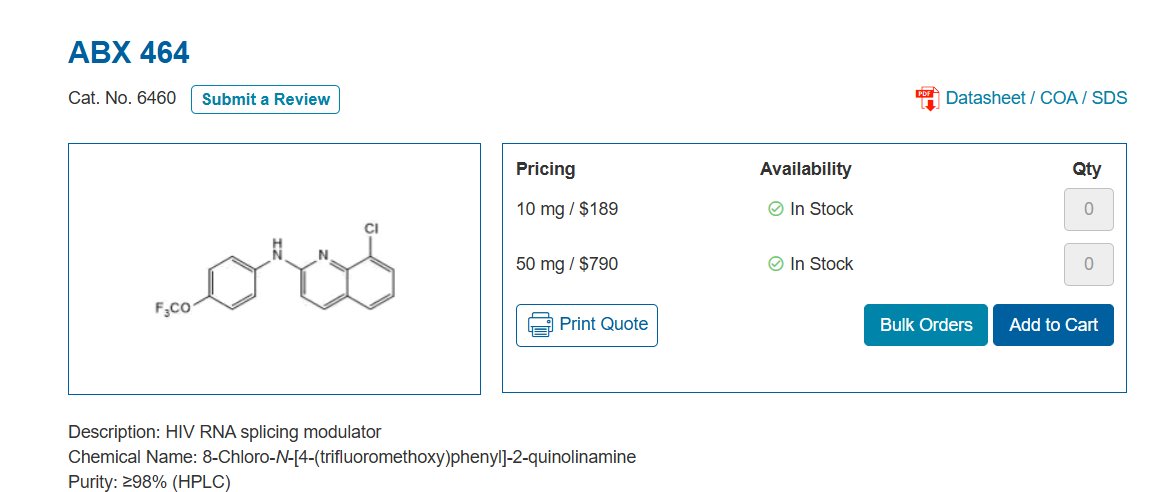
$ABVX Should I buy it for $790 and see if I die of cancer? I'll have a first person point of view of cancer. Bulk orders who want to have cancer with me
$ABVX I hope it wasn't my tweet that cause this. I think it was halted until 2:25, so people had 20 minutes to think about it, and it did go up. So it wasn't me.