Most login screens give you two buttons. This film is about the third.
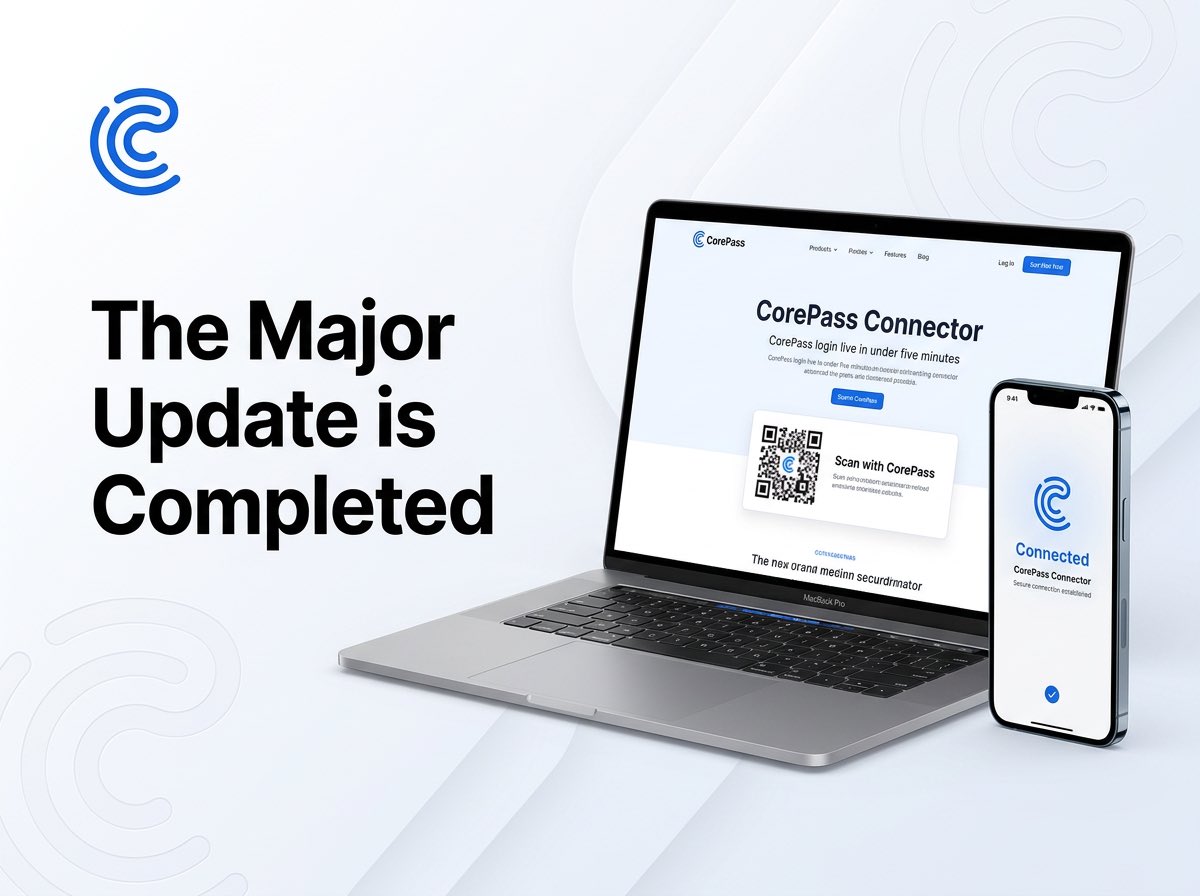
Sign in with Google or Apple is easy, but your login lives on their servers. The CorePass Connector moves it to your phone: scan a QR code, approve the sign-in in the CorePass app, and you are in.
The app receives your Core ID, the only identifier it needs to keep. No password, no email address, no phone number stored.
For builders, a working login takes about five minutes: https://t.co/tFkdAkhmaL
Right. This one is bloody MASSIVE.
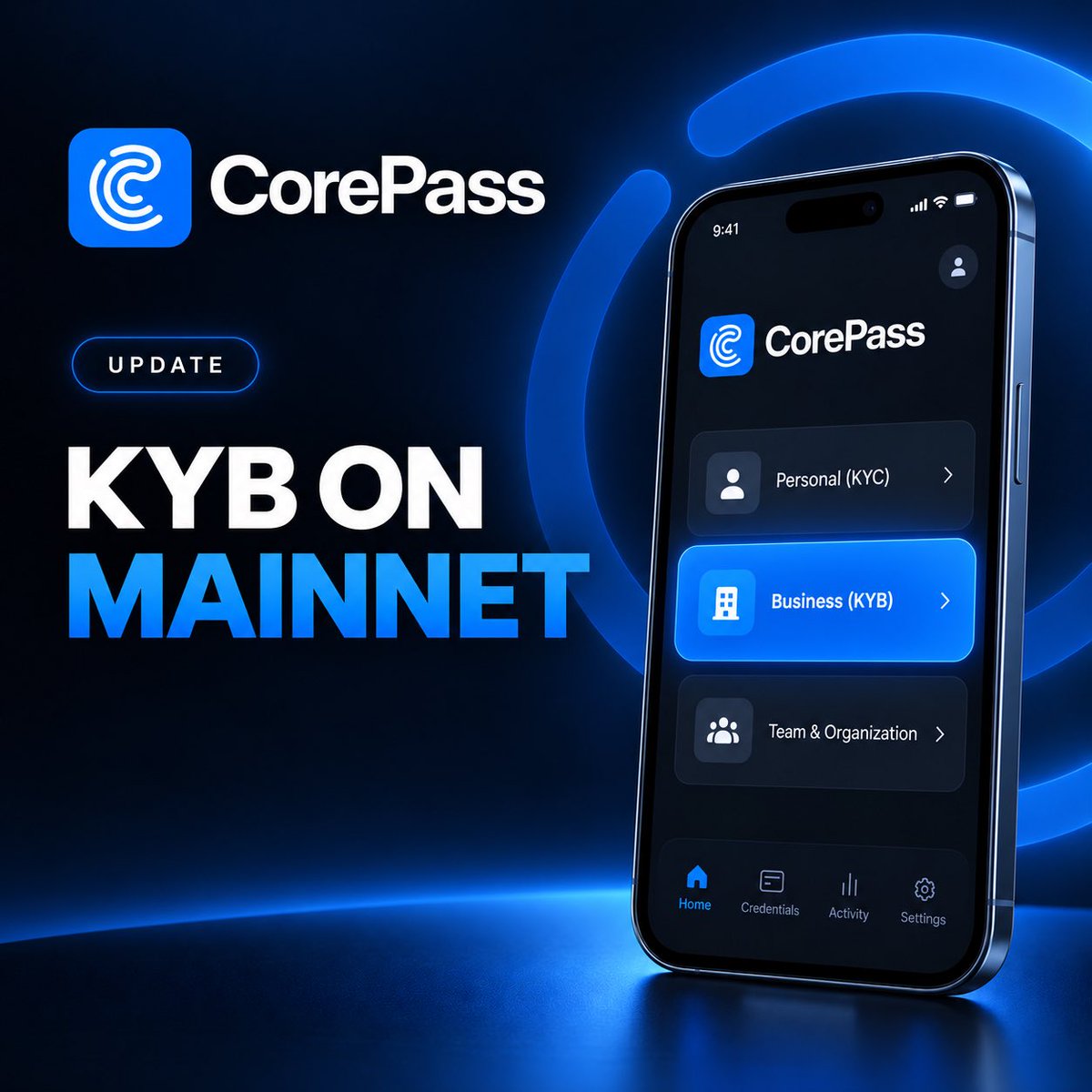
KYB is deployed on @CoreCoinCC Mainnet. The updated @CorePassCC app is with the App Store and Google Play for final approval.
And yes… ANOTHER WORLD FIRST BY @CoDeTechCC.
We should probably stop saying that like we’ve found parking.
Know Your Business. On Core. We’re talking about opening the ecosystem to businesses, and the teams, customers and commerce they bring with them.
The business end of mass adoption. Literally.
This is an UPDATE. Not the release announcement, Derek. Cancel the marching band. Nobody authorised a marching band.
We’ve done the blockchain bit. Now two app stores get to approve our excitement.
Final approvals pending. Then it’s a-for-away. 🚀
#KYBonBlockchain
Another login button would have been easy.
We built the layer behind it.
Now businesses can connect.
CorePass Connector is live.
An ecosystem should not end at the boundaries of its own applications. Its real potential begins when other businesses can connect, bring their own customers and build things we have not imagined yet.
For people:
Log in without a password. Share exactly what a platform needs: your birth date, not your passport. Approve every request on your phone. Get paid in Core Token for what you share.
For businesses:
No password database. No ID copies on your servers. Verified data, requested field by field, with the person's approval.
For developers:
Start with passwordless login through OAuth 2.0. Your users arrive with a Core ID, not another email and password. Extend into verified onboarding when you need it.
Your business does not have to become our business. Your platform does not have to become our platform. You connect to the infrastructure and build your own experience.
Mass adoption will not come from asking everyone to understand the technology. It comes from making it useful inside the services people already use.
This is where "look what we built" becomes "look what you can build with it."
https://t.co/TsenJlzo8K
#CorePass #CoDeTech
Statt dir zu widersprechen, zeige ich dir lieber, wie du sowas in zwei Minuten selbst prüfst. Sechs Klicks, kein Terminal, keine Anmeldung:
1 — Läuft die Chain? https://t.co/72jajRiANA öffnen. Du siehst die aktuelle Blockhöhe. Warte zehn Sekunden, lade neu — sie ist gestiegen. Gerade eben Block 18.511.285. Klick einen Block an, du siehst Hash, Zeitstempel, Adressen. Das geht bei einem privaten Test nicht.
2 — Gibt es Code? https://t.co/qsGwuOiFZk. 45 öffentliche Repos, die Organisation existiert dort seit dem 11. Januar 2018. Klick auf go-core → „Commits". Du siehst jede Änderung mit Datum und Autor, bis in dieses Jahr.
3 — Gibt es Produkte? App Store oder Google Play öffnen, „CorePass ID" suchen. Steht in beiden Stores, Release 31.12.2023, letztes Update 23.06.2026. Installieren kannst du sie sofort.
4 — Ist das dokumentiert oder Behauptung? https://t.co/67m2vYlIsE — die Entwickler-Doku. Und https://t.co/oAUWANsz8Y, die Core Improvement Proposals: der öffentliche Prozess, über den Änderungen am Protokoll vorgeschlagen und diskutiert werden. Jeder kann mitlesen.
5 — Ist der Zahlungsstandard erfunden oder veröffentlicht? https://t.co/st87gWu02S — der payto-URI-Standard, auf dem CorePay aufsetzt. Ein öffentlich dokumentierter RFC, den jeder lesen und implementieren kann. Das Produkt dazu: https://t.co/938vkFOgga.
6 — Handelt jemand die Assets? https://t.co/7B5M3yPoZg.
Schweizer Exchange, eigener BIC (PINGCHB2), Login über CorePass.
Das war's. Sechs Links, unter zwei Minuten, kein Vorwissen nötig.
Zur Jahreszahl noch: 2018 war Projektstart, das Mainnet läuft seit dem 7. Mai 2022 — über vier Jahre öffentlicher Betrieb, keine fünf Jahre private Tests.
Ich sage nicht, dass du das gut finden musst. Prüf es, komm zu deinem eigenen Urteil, sag mir wo ich falsch liege — dafür ist der Kommentarbereich da. Aber eine Prognose bis 2027 ist billiger als zwei Minuten Nachschauen.
We’ve accepted something for far too long.
We’ve accepted that creators should lose a significant percentage of their income to payment gateways.
We’ve accepted that artists should need multiple payment accounts just to reach a global audience.
We’ve accepted that charities can be blocked from receiving donations because of where they operate.
We’ve accepted that developers can publish software to anyone on Earth, but still struggle to receive payments from everyone on Earth.
We’ve accepted that entire countries can be excluded from the global digital economy simply because the financial infrastructure doesn’t exist where they live.
Somewhere along the way, we stopped questioning it.
We called it “just the way things work.”
I don’t believe it has to be.
The internet gave billions of people a voice.
It allowed anyone to publish an idea, build a business, educate the world, create art, entertain millions, or change lives.
But it never gave everyone an equal way to receive value for what they create.
I believe that has become one of the greatest barriers to true digital inclusion.
Your opportunity should never depend on:
• Where you were born.
• Which bank accepted you.
• Which payment gateway supports your country.
• Which platform decides you’re allowed to monetise.
• Or how many intermediaries take a percentage before your work reaches you.
If someone creates value for another human being, they should be able to receive value in return.
Simply.
Securely.
Globally.
That’s the future we’ve been working towards for years.
Today, we take another step in that direction.
Not by building another payment platform.
But by making the identities people already use capable of receiving value.
I don’t know if history will remember this moment.
But I genuinely believe we’ll look back one day and wonder why sending value was ever more complicated than sending a message.
Watch the latest Core Chronicle below.
I’d love to hear one thing:
What has been the biggest barrier you’ve faced trying to receive payments online?
#DigitalIdentity #CreatorEconomy #Fediverse #Payments #FinancialInclusion #FinTech #Web3 #Blockchain #DigitalAssets #OpenFinance #CoreBlockchain #WallMoney #CoreID #MoneyX #FutureOfFinance
@jack@Mastodon@bsky_app@FIDOAlliance@OpenWalletFdn
@w3c
@Visa@Mastercard@swiftcommunity@BIS_org@WorldBank@IMFNews@GitHub@Patreon@substackcc
Why MoneyX will always work? Simply it is unstoppable and working without the internet also. X money are live but we are rails https://t.co/AUyJFXkaxS 🚂 Let's see how the people will like it. In your Bio: $XCB:YOURCOREID @OckertLoubser@micmicl@TellMeAboutCORE
Listen carefully and understand what these guys have built.
This is real infrastructure for real people on new rails.
This is a revolution in finance 💸
The fax machine didn't disappear because email was faster.
It disappeared because email removed the requirement for owning one.
Today...
we ask the same question about money.
What if all you needed to receive value...
was your identity?
#WallMoney#CoreBlockchain#Fediverse
Bye bye STC2 stablecoins, aka $USDC and $USDT.
Now you get a real competitor with MoneyX, aka STC1, backed 1:1 with real fiat. ✍️
Let the games begin. 🌚