Reprezentacja Haiti na oficjalnych koszulkach w których zagra na Mistrzostwach Świata umieściła POLSKĄ FLAGĘ!
To nie błąd projektanta ani przypadek – to wyjątkowy gest pełen szacunku, który porusza serce każdego Polaka. W 1802 roku Napoleon wysłał kilka tysięcy żołnierzy z Polskich Legionów na San Domingo (obecne Haiti), żeby zdławić tamtejsze powstanie niewolników. Polacy jednak wybrali inną drogę. Zamiast walczyć przeciwko walczącym o wolność, wielu z nich przeszło na stronę powstańców i stanęło do walki ramię w ramię z Haitańczykami przeciwko wojskom francuskim. Po zwycięstwie rewolucji i ogłoszeniu niepodległości w 1804 roku, pierwszy przywódca Haiti – Jean-Jacques Dessalines – oddał Polakom wielki hołd. Przyznał im pełne obywatelstwo, a w konstytucji nazwał ich „Białymi Murzynami Europy”. Były to słowa najwyższego uznania i braterstwa w tamtych czasach. Część polskich żołnierzy (ok. 400–500) została na wyspie na stałe, głównie w regionie Cazale, gdzie ich potomkowie mieszkają do dzisiaj. Dziś, ponad dwieście lat później, pamięć o polskiej odwadze i solidarności wciąż żyje na Haiti. Kiedy ich piłkarze wychodzą na murawę, niosą na piersi symbol naszej wspólnej historii – historii walki o wolność, która nie zna granic ani koloru skóry.
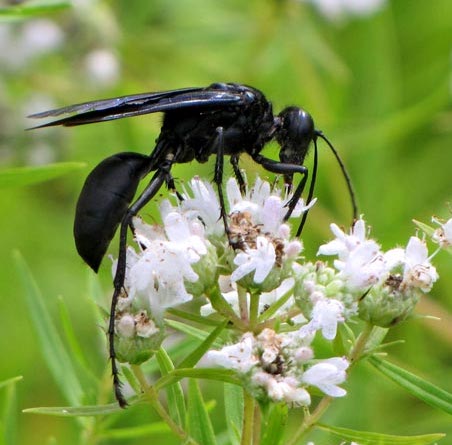
There are about 18,000 species of wasps in North America. Roughly 20 of them can hurt you.
The wasps people fear are all from one family: Vespidae. They make up less than 1% of wasp species on the continent. They build the visible nests, they defend them aggressively, and they're the ones you remember from a bad encounter.
The other 99% live solitary lives and ignore humans entirely. Many can't sting at all. Many more have stingers but never use them on people because they don't have a nest to defend.
What they do instead is hunt other insects. A single mud dauber stocks her nest with paralyzed spiders, including widows and recluses. A braconid wasp lays eggs in tomato hornworms. An ichneumon wasp parasitizes wood-boring beetles that kill ash trees. A cuckoo wasp infiltrates the nests of other wasps and bees. Some species control aphids; others control caterpillars, beetle grubs, or flies.
Most agricultural pest insects in North America are controlled, in part, by parasitic wasps that almost no human ever sees. There are over 25,000 species of ichneumon wasps alone, and they keep entire orders of insects in check.
The five or so wasp species that ruin a picnic in late August are real. The 17,995 species that are running the pest control infrastructure of an entire continent get almost none.
When the President of France visited the United States in April 1960, he asked the FBI to help him find a man.
The man he was looking for was an American citizen. He was sixty-four years old. He had been awarded fifteen French military decorations and — six months earlier, in a ceremony in Paris — had been made a Knight of the Légion d'honneur, the highest civilian honor France can give. The medal had been pinned to his chest by the President himself, who had publicly called him un véritable héros français. A true French hero.
The FBI located the man within a few days.
He was operating an elevator at Rockefeller Center in New York City.
The elevator operator's name was Eugene Bullard. He had been born in Columbus, Georgia, in 1895, the son of a man whose own father had been a slave.
He had run away from Columbus at the age of eleven, after watching a white mob nearly lynch his father.
He spent the next several years drifting through the American South. At sixteen, he stowed away on a German freighter at Norfolk, Virginia. He landed in Aberdeen, Scotland. From there he made his way to London, where he learned to box. By 1913, at eighteen, he was prizefighting in Paris.
When Germany invaded France in August 1914, Bullard was nineteen years old. He had no legal obligation to fight. He had no French citizenship.
He went to the recruiting office on October 19, 1914, and signed up for the French Foreign Legion.
He spent the next eighteen months as an infantryman in some of the worst fighting of the war — at the Somme, at Champagne, at Verdun. He was wounded three times. The third wound, on March 5, 1916, tore open his thigh and left him with permanent damage to his leg.
He was twenty years old. The doctors told him he would not return to the infantry.
He decided he wanted to fly.
In a Paris café in the spring of 1916, while he was recovering, Bullard mentioned to three white American friends that he was thinking of joining the French air service. A Mississippian named Jeff Dickson laughed.
Gene, Dickson said, you know damn well there aren't any Negroes in aviation.
Bullard answered: Sure do. That's why I want to get into it. There has to be a first to everything, and I'm going to be the first.
Dickson bet him two thousand dollars he would not make it.
Bullard took the bet. He earned his pilot's license on May 5, 1917. He won the bet.
He reported to the front in August 1917 and flew approximately twenty combat missions over the next three months in a SPAD VII. The fuselage was painted with a bleeding heart pierced by a knife and the French phrase Tout le Sang qui Coule est Rouge — All Blood that Flows is Red.
He carried, on every combat flight, a small capuchin monkey named Jimmy in the front of his flight jacket.
The French press began calling him L'Hirondelle Noire — the Black Swallow.
When the United States entered the war in 1917, Bullard immediately applied to transfer to the U.S. Army Air Service.
His application was rejected.
The U.S. Army Air Service had a policy, in 1917, of not accepting Black pilots. The other American pilots flying for France in his unit, all of them white, were transferred to the U.S. Air Service.
He was the only one who was not.
For the next twenty years, he was one of the most familiar faces in the Montmartre nightlife of Paris between the wars. He owned a nightclub called L'Escadrille. He spoke fluent French, English, and German. Hemingway drank there. Fitzgerald drank there. Langston Hughes drank there. Josephine Baker performed there. Louis Armstrong was a personal friend.
When Germany invaded Poland in 1939, Bullard was forty-four. His fluent German and his ownership of a nightclub frequented by German officers made him useful to the French Resistance. He became an intelligence agent — eavesdropping in his own bar on conversations between German officers who did not know he understood every word.
When France fell in June 1940, friends in the Resistance smuggled him across the Spanish border before the Gestapo could arrest him.
He came back to the United States for the first time in twenty-eight years.
He arrived in New York with thirty dollars in his pocket and a permanent limp.
He did not return to a hero's welcome. He returned to a country that had no idea who he was.
He worked at a perfume counter. He worked as a security guard. He worked at the Staten Island shipyards. By the late 1940s, he had taken the job that he would hold for most of the rest of his life.
He operated the elevator at Rockefeller Center.
He was wearing the elevator uniform on the day a producer from NBC came down from the studios upstairs to ask if he was the man Charles de Gaulle had been looking for.
A few weeks later, NBC sent a film crew to interview him in the lobby. The studios where NBC produced The Today Show were on the floors above. He had operated the elevator that took the network executives up to those studios every morning for nearly ten years. He had not been recognized as he did it.
He went back to operating the elevator the following Monday.
He died of stomach cancer on October 12, 1961, three days after his sixty-sixth birthday.
He was buried in the French War Veterans' section of Flushing Cemetery, in Queens, in the uniform of the French Foreign Legion. The casket was draped with the French flag.
In 1994 — thirty-three years after his death — the United States Air Force formally commissioned Eugene Jacques Bullard as a Second Lieutenant, posthumously.
It was the first commission the U.S. military had ever offered him.
He had been the first Black combat pilot in American history.
The French had been calling him a hero since 1917.
The Americans got around to it in 1994.
@BigAl_PHD@stoyatel I’m not saying you are lying, but in most states you cannot drive your car off the impound lot with expired tags. You’d have to get it towed for the same reason it was towed; it cannot be legally operated on the road.
A 24-year-old Polish tennis player arrived in Paris last week ranked 114th in the world, with no sponsors, no guaranteed income, and no certainty she could even pay for her hotel room.
She had to win three qualifying matches just to enter the French Open main draw. Prize money is only paid at the end of the tournament, so a Polish sports drink brand quietly stepped in and covered her hotel bill.
Her name is Maja Chwalinska. And today, she plays in the French Open final.
Before this tournament, she had won exactly one Grand Slam main draw match in her entire career. She had battled depression so severe that in 2021 she couldn't get out of bed. She underwent knee surgery in 2022. She spent years grinding through small tournaments across Europe just to stay afloat.
Then she arrived in Paris, won three qualifiers, and kept winning. Zheng Qinwen. Elise Mertens. Maria Sakkari. Diana Shnaider. Nine straight matches. One set dropped.
She is now the first qualifier in French Open history to reach the final. The last time a qualifier reached a Grand Slam final, it was Emma Raducanu at the 2021 US Open. Raducanu won.
By simply making the final, Chwalinska has earned more prize money than her entire career combined. The runner-up cheque alone is $1.6 million. If she wins today, she takes home $3.25 million.
One week ago she couldn't pay for her hotel room.
Entering month 6 of the Mamdani mayorship of NYC and Robberies are down 11%, Retail theft is down 19%, and Murder is down an astounding 21%.
And he did so without "Adding 5000 new cops" to the streets. Instead, he's invested in public safety with free childcare, accessible infrastructure, and better funded schools and libraries. He's proven once again that if we want safer communities, we must invest in People—not Punishments.