One of the biggest lies people tell themselves is that no company will hire them because they have spent less than a year in their current role.
As a result, many people force themselves to stay for three years or four years, not because they are growing, but because they believe it gives them a safety net when the next opportunity comes
That's not always true.
If your profile is strong, your skills are relevant, and you can clearly demonstrate value, companies will still take a chance on you.
I spent less than a year at my previous organization before this current company.
During the interview, the CEO and CCO jokingly asked me:
"Hope we won't spend all this money bringing you in only for you to leave after one or two years?"
I smiled and replied, "No, I'll stay."
We all laughed and moved on. The game is the game.
The headache will be on the company to figure out how to make you stay.
The truth is that organizations are not always looking at how short you stayed somewhere. They are looking at what you can do, the problems you can solve, and the value you can bring to the table.
This is why I always tell young professionals to focus on building themselves.
Learn the skills.
Gather the experience.
Develop the character.
Build a profile that speaks before you even enter the interview room.
Once you become valuable enough, opportunities will continue to find you.
In fact, there are people who have spent only a few months in a role and still get approached for bigger opportunities and they get it.
Just be good at what you do and move with grace.
Very deep cover.. something that stands out beyond anything is that SpaceX is a company destined to break a lot of high grounds in what we thought we believe about space and AI.
Also the emphasis of having good people on the team who stuck through it all. Good work culture there
3 days ago, Elon Musk sat in front of JP Morgan’s 3,500 wealthiest investors and explained why the AI economy is moving to space:
1. Starship is the first rocket in history designed to be fully reusable. Every other mode of transport... planes, cars, ships... you take reusability for granted. Rockets have always been thrown away after one use. That ends with Starship. Once you achieve full reusability, the only cost is fuel. Starship runs on liquid oxygen and methane. Both are cheaper than jet fuel.
2. Sending cargo to orbit will soon cost less than international air freight. This is not a distant projection. It is the direct mathematical outcome of reusable rockets plus cheap propellant. The economics of space change entirely.
3. Starlink V3 is 10 to 20 times more capable than what's currently in orbit. The satellite is so large it can only launch on Starship. It cannot fit on any other rocket on Earth. 100 times more bandwidth. Half the latency. It may become the highest bandwidth, lowest latency communication system that exists.
4. AI and robots will consume bandwidth at a scale humans cannot picture. Peak human bandwidth is a few hundred bits per second. A computer runs at a trillion. The appetite of AI for data infrastructure will be unlike anything built for human use. Starlink V3 is being built for that world... not this one.
5. Data centers are moving to space. Not as an experiment. As the primary way to scale AI compute going forward. It is increasingly hard to build power plants on the ground. Nobody wants one near their home. Space removes that constraint entirely.
6. From the moon, you can scale to 1,000 terawatts of compute per year. From Earth... maybe 1. The moon has no atmosphere and one-sixth Earth's gravity. You can manufacture solar panels from moon materials and launch data centers with a railgun. No rockets needed. The math on this is not close.
7. Current human civilization uses less than one trillionth of the sun's energy output. You could scale to a million times Earth's entire economy and still be using less than one millionth of what the sun produces. The ceiling on what's possible is so far above us it barely registers as a ceiling.
8. There is not a single high-volume computer memory fab in America right now. Zero. The chips needed to build the AI future do not exist in sufficient quantity anywhere in the Western world. That is why SpaceX is building one. Not to compete. Because there is no other option.
9. SpaceX has been cash flow positive since around 2014. The IPO is not a distress move. Past funding rounds were not even fundraising... they were liquidity events for employees. The company bought back its own stock. The IPO is happening now because the next phase requires capital private markets cannot absorb.
10. The senior team has barely changed in over a decade. The CFO has been there 15 years. Musk joined as the seventh employee in 2002. He says people who believe in the mission don't leave. And above technical skill, he now looks for one thing... whether someone is genuinely a good person.
I like food so when a friend was asking for recs on where to eat in Lagos, I was like “hold my beer”
Caveat: This is a rough made-in-the-moment draft
Limitations: Locations are limited to only one side of the bridge
Bias: I follow the food mostly. I like green spaces
Enjoy!
I hate the negative PR against Nigeria and it’s really disturbing. At this point , we really need to start fighting back. This scam didn’t start or originate from Nigeria.
In 2014/2015, Uber entered the Chinese market and got locked in an incredibly aggressive, multi-billion-dollar turf war with the local ride-hailing giant, Didi Chuxing.
To win over drivers, Uber was burning through massive amounts of cash, often paying drivers 2X -3X the actual fare of a ride in performance bonuses.
This extreme distortion of market value created a massive loophole, and Chinese drivers were the first to systematically exploit it using the exact methods later seen globally.
Because Uber used the exact same playbook to enter almost every new country, they had the same issue.
Nigeria simply became a prominent case study because obviously we can’t shut up out mouth.
@Trevornoah get your story right!
When I started angel investing in 2021, one of my biggest mistakes I made was applying traditional fundamental analysis to early-stage investing. Seemed smart at the time but most of those checks I wrote went to zero.
Wrote five small $5k checks then, nothing serious. Three of them went to zero. One returned my money while the last one appreciated a bit, but still has no clear path to any liquidity event.
At the time, I worked in a private investment firm with an investment process closer to PE, so naturally, that shaped how I approached investing. I was trying to analyze startups like mature businesses. Crunching numbers that, frankly, had very little bearing on the true fundamentals of the opportunity. Not saying crunching numbers aren’t great but heavy reliance shouldn’t be placed on them esp at the early stage where a company is still trying to find its bearing.
2024 I came back for round 2 and went down the rabbit hole to gather insights from the OGs. Watched almost every Olumide Soyombo, Kola Aina, and Iyin Aboyeji video I could find on the internet, studying how they approached startup investing and a recurring theme I noticed was that their early-stage investments thesis were mostly driven by qualitative judgment. Things like Founder quality, market insight, distribution, Industry direction etc and the potential for that industry to attract capital for future liquidity were the recurring theme I noticed.
While I was busy building spreadsheets for businesses too early to be properly gauged that way, the prolific guys already knew the right questions to ask. Sometimes, they had already decided they wanted exposure to a specific sector and were simply looking for the right operator to back.
In 2024, I refined my philosophy and came back for round two.
Still nowhere near as prolific as the OGs, but the ROIC on my portfolio so far tells me one thing clearly that I’ve definitely gotten better at this 😃
It’s always amazing how people don’t see how time saving remote work is. I am almost tempted to ask
“Is it that most employers love the time wasted in traffic or moving to the offices?
💡 Here's one that I can't believe it took folks a pandemic to realize:
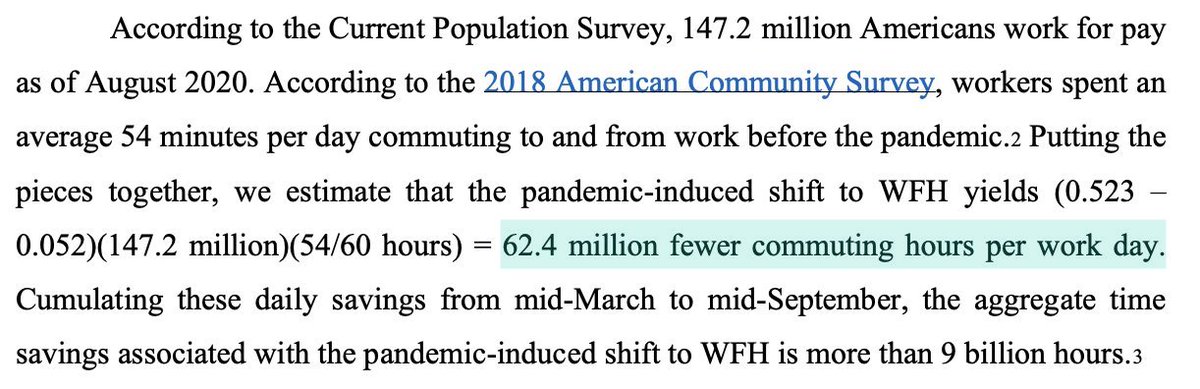
As of 2020, Americans saved over 60m commute hours per day with remote work.
Per day!
Assuming 5-day weeks, that's ~16.3B (billion!) hours saved per year, equivalent to:
• 1.9m years
• 23k lifetimes
"Until death, all defeat is psychological." - Marcus Aurelius
Refuse everything that would lead most people to give up.
Refuse it.
Rise from the dead 1000 times.
Commit to never stay down & never give up.
Everything you want is on the other side of struggle.
RSVP is French for “Répondez s'il vous plaît” which means “respond, please” and literally means “Respond, if it pleases you”. English uses lot of French phrases verbatim. Some of them are :
1. Faux pas (false step)
2. Quelle surprise (what a surprise)
3. À la carte (by the menu card)
4. Bon appétit (good appetite)
5. Résumé (summary)
6. Fait accompli (thing done / done deal)
7. En route (on the way)
8. déjà vu (I have already seen)
9. Au contraire (on the contrary)
10. Enfant terrible (disruptive child)
11. Touché (valid)
12. Voila (there it is)
13. C'est la vie (that is life)
14. Coup d'état (strikeout of the state)
15. Raison d'être (reason to be)
16. Tour de force (feat of strength)
17. Vis-a-vis (face to face)
18. M’aidez (help me) - distress mayday signal
19. Double entendre (double meaning)
20. laissez-faire (allow to do)
People have asked me how I feel about Udemy’s sale to Coursera. Honestly, I’m kinda pissed about it.
I want to be clear - I’m grateful for the opportunity to start and benefit from Udemy’s success. It changed my life.
But there’s another side to Udemy. A story of what could have been.
After our Series B, founders owned less than 30% of the company. Our investors took over and installed their own CEO to run it. We all liked this new CEO and honestly, for years it looked like a brilliant move. The company kept growing and growing. They launched B2B and built a $500M ARR business. Eventually, the company IPO’ed for $3B.
Yet all along there were clear cracks under the surface. Over Udemy’s history, there have been 7 CEO’s. The board replaced the second CEO with dud after dud. I’d often try to meet with the board or the new CEO, and was completely ignored. Eren had influence as Chairman of the Board but Oktay and I were so ignored they didn’t even invite us to the IPO. LOL WTF. There are like 50+ people invited to these things and nobody thought: “oh maybe we should invite the people who fucking invented the thing we’re all celebrating.” It shows how little respect they had for founders and for product innovation as a discipline.
I think they wanted a CEO they could control, a buttoned-up suit instead of a brash founder/CEO that is risk-taking, visionary, but a bit of a pain. For awhile, it looked like it didn’t even matter who was CEO - the company was run by the incredibly talented team that reported to them anyways.
Well, it worked until it didn’t.
The company made no major product innovations for 15 years. Instead, they took the original idea (video-based courses) and sold it in every place imaginable. It got us to $800M run-rate. That’s no joke; that takes serious execution and a great team that hustled hard to win the market.
But eventually the consumer business stopped growing. The B2B business has now flattened out as well. Meanwhile, Coursera was catching up.
Original Coursera was a far worse product than Udemy, but it got a ton of press. Learning ivory tower bullshit from academics doesn’t get you a real education, but it does create prestige. They raised from better investors on better terms, and had better leadership.
Udemy to this day has more revenue than Coursera, but Coursera won the court of investor opinion. They got higher multiples from both private and public markets.
Coursera innovated heavily. They added corporate courses to their university catalog, built fully-online degree programs, and offered a B2B competitor that kept Udemy on its toes. Still, the Udemy B2B business (and team) out-performed and so the two companies were deadlocked. Coursera was better at B2C, Udemy at B2B.
A merger was inevitable.
But WHY IN GODS NAME did we sell to Coursera instead of the other way around? Why are the combined companies under $3B in market cap?
Three reasons:
First, edtech didn’t live up to its promise. While these two companies had solid revenue and cash positions, their growth slowed, and public markets balked. This meant compressed multiples and significantly lower valuations.
Second, the companies stopped innovating. They are selling a product to businesses that their customers don’t love. They were category leaders, but they lead the category into mediocrity. They captured a significant share of learning and development (L&D) spending, but L&D as a whole actually lost budget within their organizations. That’s Udemy’s fault, and it doesn’t even realize it.
That brings me to my final point: I personally believe Udemy traded upside opportunity for downside risk. Us founders were unproven and young. We made lots of mistakes, including fighting amongst ourselves. A good investor would have supported us through it because they believe founders drive the highest long-term returns. Instead, they brought in outside CEOs to replace us. I sometimes wonder if they recognize this error; everyone makes mistakes and maybe they learned from it.
Either way - the consequences are real. By ignoring the founders, Udemy failed to innovate, which led to slowing growth which led to mediocre public market results. Furthermore, they don’t have a good evangelist and public markets don’t like a headless horse.
I sold my Udemy stock awhile ago. I think the merger was critical for both companies’ survival. Now, though, the new combined entity needs to innovate again.
On B2B, Coursera needs to help L&D become the heroes of the AI era so the entire market starts growing again. On B2C, they need to build the most educational AI product on the planet. (I’d focus on the former, since the latter is a lot harder and riskier).
Coursera can still achieve our original vision and likely build a $10B+ company in the meantime. Even though I’ve got no stake in its future, I’m mission-driven and I REALLY hope they figure it out.
The current education system sucks and the world deserves something better.
Dear struggling Kings,
I've had my own fair share of life's trouble and hopeless waiting.
Let me talk to you.
If you're
~ unsure what the future holds
~ feeling terribly lonely and all you get is rejections
~ ladened with responsibilities and no sign of help
OPEN THIS THREAD
A lot of businesses still suffer a major setback even in 2025!
Customer service!
And before you say, "I reply to customers well", quality customer service starts from the service rendered or product sold to them.
Did you sell good stuff to them?
Don't want a long thread!
Tbc.
The biggest mistake I see some small-scale retailers make is not understanding the lifetime value of their customers. So far, a couple of them have started running ads. Somehow, they think ads are the only way to keep bringing customers, and they start to pump more money into it.
"I can always get customers through ads", so they think, but the sad truth is that you won't make as much profit as you should be making when you depend only on ads as your only channel of acquisition.
There would never be regret for a business owner who shamelessly markets his business and shows up consistently making it known to whoever cares to hear. It is the most valuable skill any business owner can have.
The journey to building a country we desire doesn't start with the rivalry, blame games and the name calling! It starts from from us looking into our hearts and deciding what is good and evil and deciding to stand with the good. For the sake of those who/will depend on us.