4,838 / 5,000
Niba igihugu - isi, mu by'ukuri - gifite amahirwe menshi cyane, umuntu ukwiye aza, rimwe mu kinyejana cyangwa hafi, kugira ngo akore ikintu gikwiye. Abantu nk'aba bameze nk'abo bahita bagaruka mu mutwe? Winston Churchill, Kemal Atatürk, Martin Luther King, Mahatma Gandhi, Abraham Lincoln, Norman Borlaug, Nelson Mandela ... Uzaba ufite urutonde rwawe bwite, birumvikana, kandi nta n'umwe muri bo wari utunganye - ntushobora gutura hano hasi niba uhari - ariko bari batunganye mu gihe cyabo kandi nongera kuri urwo rutonde umwe rukumbi ukiriho, kandi uracyari umuyobozi: Paul Kagame, wavutse #OTD mu 1957. Ni umuhererezi mu bana batandatu, yari afitanye isano n'Umwamikazi w'Umwamikazi Rosalie Gicanda utangaje kandi mwiza cyane ... wishwe muri Jenoside mbi, yabaye mu maso y'isi iminsi ijana iteye ubwoba - kandi yagira uruhare mu kuyirangiza. Ibyo byonyine bigomba kumuhesha uburenganzira bwo kumubona, ariko hari byinshi - byinshi. Mu myaka mirongo itatu ishize, yayoboye, mu buryo budasanzwe, impinduka itangaje kandi idasanzwe muri iki gihugu gito kidakora ku nyanja mu mutima wa Afurika. Igihugu cyonyine cya Afurika kitigeze kigira ubucakara mu buryo ubwo aribwo bwose - nticyabyemeraga. Igihugu cyari gifite Ubwami bukomeye mu gihe cya Shakespeare. Igihugu cya nyuma cya Afurika cyakoronijwe - mu 1894, ikinyejana mbere y’iyo jenoside, ubwo Umudage, Gustav Adolf Graf von Götzen, yatangazaga ko u Rwanda ubu, mu by’ukuri, ari igice cy’'Ubudage bwa Afurika y’Iburasirazuba', nyuma yo kugabanywamo ibice mu nama ya Berlin yo mu 1885. Hari urwenya rubabaje ruboneka muri iyo nkuru ya "Dr Livingstone, ndakeka?" yatakaje muri Afurika: umuntu yibwira abategetsi b’ibwami mu buryo bw’ikinyabupfura - igisubizo kiri mu mizi - wenda batanga igitekerezo cyo kunywa icyayi no kuganira, kuko byose bigomba kuba byarasaga n’ibiteye urujijo gato. Mbere na mbere... Abadage bari bisanze, nk'uko byavuzwe n'Umutegetsi wa Mecklenburg, basuye icyo gihugu mu 1907: "igihugu gitemba amata n'ubuki ... cyuzuye ahantu heza kandi gifite ikirere cyiza cyane kandi gifite ubuzima bwiza: igihugu cy'uburumbuke bwinshi, gifite imigezi ishobora kwitwa imigezi ihoraho..." (h/t @BradtGuides | @philipbriggs ) Amahano yose y'ayo mezi atatu yo mu 1994, mu by'ukuri, ntagereranywa - nk'aya The Shoah. Hari ibitabo hafi ya byose nka 'We Wish to Inform You That Tomorrow We Will Be Killed with Our Families' ya @PGourevitch na 'A Problem From Hell: America And The Age of Genocide' ya @samanthajpower', filime nka Hotel Rwanda, amafoto, amashusho ... ariko nta kintu na kimwe gishobora kugutegurira ikuzimu, cyangwa nyuma yabyo. Nyuma y'imyaka icumi iryo hohoterwa rikabije ryagwiririye abantu, nasuye u Rwanda mu gihe cyo kwitegura isabukuru y'imyaka 10, maze nkora akazi gakomeye gashingiye ku cyumweru namaze muri sitasiyo y'ubushakashatsi ya Mexique irimo igihembo cy'amahoro cya Nobel n'umuhinzi ukomeye w'ibihe byose, Norman Borlaug (@pennjillette wa Penn & Teller atanga ubuhamya bufatika mu nkuru zabo za 'Bullshit!' zivuga ko Stormin' Norm, wakoreye muri Afurika kugeza mu myaka ye ya 90, yari *IHENE* - kugaburira isi mu gihe cy'imyaka mirongo itanu atari ikintu kibi). Nari mpari kugira ngo ngerageze gufasha @Aegis_Trust ubwo barwanaga no kubona amafaranga ya nyuma akenewe kugira ngo huzuzwe Ingoro Ndangamurage y'Urwibutso rwa Jenoside mu minsi 10 kandi mu gihe cy'ibikorwa byizihiza imyaka 10 kuva icyo cyobo kibi cy'umukara mu mutima w'amateka ya Afurika. Byari ibihe bigoye cyane. Ubwo nageragezaga gukora, umubiri wanjye n'ubwonko bwanjye byagendaga bitegura buhoro buhoro ingaruka zikomeye z'ubwivumbure ku rukingo rwa Yellow Fever (urwo ba sogokuru na ba nyogokuru bari barakoreyeho, kuri @RockefellerFdn , muri Nijeriya mu myaka mirongo itatu mbere na nyuma y'Intambara ya Kabiri y'Isi Yose). Mu by'ukuri, iyi nkuba yubahwaga cyane yaranteye umusazi - nk'uko byagendekeye uwahoze ari umunyamakuru wa BBC @MalcolmBrabant wanditse ku buryo bukora ku mutima ku bijyanye n'urukingo rwe rwa yellow fever 'fire'. Nanasuye ahantu hatatu ha jenoside mu minsi itatu: kandi narabyumvise - kandi narabyumvise: amagambo n'amashusho ntibigutegurira igice cya kera kandi cyimbitse cy'uburyo ubwonko bukora; icyo cy'urumuri rw'impumuro. Ntabwo ari ukugaragazwa n'umugabo watakaje abantu 84 bo mu muryango we, hanyuma yerekeza buhoro ku kibuga aho French Turquoise Berets yakiniraga umupira w'amaguru aho bari bazi ko ari imva rusange. Nageragezaga gufasha uko nshoboye kose mu isi aho buri wese yari akiri mu mimerere mibi, nta kabuza yongera kwibuka ibintu bibi cyane aho yarebaga hose, umunsi ku wundi, ukwezi ku wundi. Hari gushidikanya ku bihugu byazoherezaga abahagarariye mu birori byo kwibuka. Amatagisi yari moto i Kigali (n'amagare hanze). Mbere gato y'uko nzagera muri medevac, igihugu cyari cyishimiye kumenya ko Jenerali @romeodallaire yari agiye kugaruka. Nyuma namenye uburyo abantu bamwakiriye neza cyane aha hantu hatangaje kandi abantu bamuhaye.
I don't think I managed to connect you to my friend Tim before he shuffled off the mortal coil (you would have loved or hated each other). Among his other gifts, he wrote a superbly evocative poem about this world - which his father inhabited... Are you checking your DMs? If so will send. And happy to do so to Gentleman Ways if DMable...
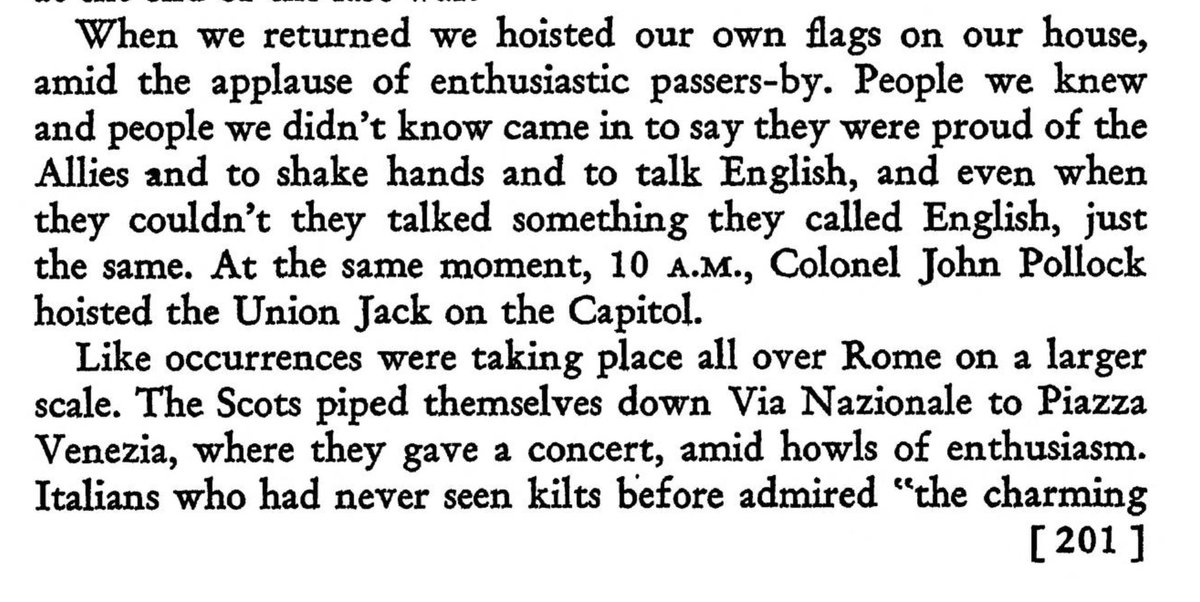
Meanwhile, far away, amid the so-called "D-Day shirkers", #OTD - the 'original' D-Day - my Scottish namesake grandfather is embedded with the Americans, tasked with reforming the Italian police &c. (He was a senior Metropolitan Police officer before the war).
He becomes, oddly, the first British officer to enter Rome... And raises the first Union Jack to fly in the city - later given to Churchill at Chartwell.
Extremely dour, he never talked about the war, like so many. So it was only after his son, my father - himself military but with a mother adding some notable 'fighting Irish' to the mix https://t.co/c4dEdGc1XF - died last year, that this dagger also washed up, very carefully hidden away: I suspect to avoid curious boys & their little boys getting fighty, rather than any other reason. As the first British officer into Mussolini's office he also 'borrowed' a cup for coffee &c. and, according to family legend, a couple of other even more extraordinary items, yet to re-surface...
In August 1971, during the Apollo 15 mission, astronaut David Scott placed a small aluminum sculpture called "Fallen Astronaut" on the surface of the Moon.
Beside it, he left a plaque bearing the names of 14 astronauts and cosmonauts from the United States and the Soviet Union who had lost their lives in the pursuit of space exploration.
The memorial honored pioneers who made the ultimate sacrifice, including the three astronauts who died in the Apollo 1 fire and Soviet cosmonaut Yuri Gagarin, the first human to travel into space.
Created by Belgian artist Paul Van Hoeydonck, the small figure was designed to represent all astronauts and cosmonauts regardless of nationality, race, or gender.
Quietly placed at the Apollo 15 landing site near Hadley Rille, the Fallen Astronaut remains on the Moon today as a lasting tribute to those who gave their lives advancing humanity's journey beyond Earth.
It is widely regarded as the first artwork and memorial ever placed on another world.
He Signed His Name as a Riddle. It Took 75 Years to Solve It.
One week before Christmas 1933, a small ad appeared in the Canton Repository. Nearly half of Canton, Ohio, was out of work. Children were picking coal off the railroad tracks. The ad, placed by a man calling himself "B. Virdot," offered to mail a check to anyone who wrote describing their hardships. He would not reveal his real name. The recipients would remain anonymous too. "B. Virdot," the notice explained, was a local businessman who had once struggled and recovered, and wanted to share that luck.
Hundreds of letters arrived: a baker, a bellhop, a steeplejack, a 14-year-old girl who wrote in pencil asking for shoes because her toes showed through the ones she had. B. Virdot sent $5 to 150 families, roughly $100 in today's money. The story ran front page. Speculation about his identity spread a hundred miles. B. Virdot went to his grave without ever telling anyone.
In 2008, journalist Ted Gup was handed a battered suitcase by his 80-year-old mother in Kennebunk, Maine. Inside were 150 handwritten letters dated December 1933, a stack of 150 canceled checks, and a yellowed newspaper clipping. The name on the checks: B. Virdot. The man had been Gup's own grandfather, Sam Stone.
Stone was a Romanian Jewish immigrant who had arrived in America in his early teens, falsified his birth certificate to read Pittsburgh, and built a men's clothing shop through sheer stubbornness. He had once washed soda bottles until the acid ate his fingertips. The name "B. Virdot" was not a random alias, it was a portmanteau of his three daughters' names: Barbara, VIRginia, and DOThy. He had hidden himself inside his own family.
Gup tracked down the descendants of every recipient he could find. Helen Palm, who had written as a 14-year-old girl begging for shoes, was still alive, 91 years old, the last person on earth to have received one of those checks. Gup told her who B. Virdot had been. She was quiet for a moment. "Well," she said. "God love him."
He smuggled kindness into a holiday he had no religious reason to celebrate, under a name that was always his family in disguise.
D-Day in Color: The Hours Before the Invasion (1944) 🇺🇸🇬🇧
Allied troops board landing craft and transport ships in Southern England before the launch of the D-Day invasion.
American soldiers carrying full combat gear pack tightly into LCVPs as convoys of landing craft head out toward the English Channel for one of the largest military operations in history.
The tense final moments before the Normandy landings began.
So good I wanted moah... and asked Grok Expert to Ballard it up:
"You pay thirty pounds for a lukewarm burger, a coffee the colour of surgical spirit and a plastic bottle of water. In the half-empty restaurant, listless men in ill-fitting uniforms drift between tables like malfunctioning automata, mouthing phrases they no longer believe. Their faces are smooth and interchangeable, as if the last traces of gender and nationality have been gently erased by some invisible corporate hand.
You push open the door to the lavatory. The room is vast and malformed, a cavernous white chamber lit by stuttering fluorescents. Rows of identical cubicles stand like confessionals for every conceivable pronoun, their doors scuffed and ajar. The toilets are foul, smeared with the casual evidence of bodies that no longer know which sex they are supposed to be. The abolition of separate conveniences has produced its own quiet tragedy of the urinary commons: a slow, democratic collapse into filth. Men and women wash their hands side by side at the long steel trough, eyes averted, the ritual reduced to a furtive, embarrassed choreography. The air is thick with the smell of cheap soap and unspoken panic.
Outside, the Tube is on strike again, though you would have taken the bus anyway. The vehicle is already a mobile abattoir of flesh, jammed solid with bodies that press and shift against one another in sullen complicity. Passengers block the doors, the stairs, the narrow aisle, their backs and shoulders forming a single sweating organism. Your teeth ache with a dull, metallic pain that feels curiously erotic, as though the city itself were biting down. The bus crawls past rows of shuttered pubs, their windows dark and expectant, like abandoned film sets waiting for the next disaster. Beside you, a young man speaks quietly into his phone, his voice soft and reasonable. “At least she’s trying,” he says, and the words drift through the stagnant air like the last broadcast from a dying satellite."
"I would read everything about the war and what Churchill was getting up to. I can still recite one of his speeches “If this nation, or a part of it, is overrun or conquered by the Nazis, our empire across the sea will continue to fight until the new world shall come to the redemption of the old.”
After feeling as if Churchill had spoken directly to Ralph, he decided to go to Britain, feeling it was his duty to help the “Mother Country”. So did many others, as he joined over 10000 people who wanted to support the war effort." https://t.co/Foy1S9rdQ5
🌺🇬🇧 We are saddened to hear of the passing of RAF veteran Ralph Ottey at the age of 102.
Born in Jamaica, Ralph travelled across the Atlantic in 1944 to join the Royal Air Force and serve during the Second World War. After his service, he built a life in Boston, Lincolnshire, where he became a respected member of the local community.
Those who knew Ralph remember his warmth, positivity and sense of humour. Described as someone who greeted everyone with a smile and a handshake, he leaves a lasting legacy of service, friendship and community spirit.
Our thoughts are with Ralph's family, friends and all who knew him.
Thank you for your service, Ralph. Rest in peace.
https://t.co/rPn83653CN
84 years ago today, four Japanese aircraft carriers were burning in the Pacific because of a man who went to work in a smoking jacket and slippers.
Washington took his job, buried his name, and blocked his medal for 44 years.
This is the story of Joseph Rochefort, the codebreaker who saved Midway.
December 7, 1941. Pearl Harbor burns. Rochefort, head of a Navy codebreaking unit on Oahu, takes it personally. He tells a colleague that an intelligence officer has exactly one job: to tell his commander today what the enemy will do tomorrow. On December 7, he believes he failed at it.
He decides he will never fail at it again.
His unit is Station HYPO, hidden in a windowless basement at Pearl Harbor that his men call "the Dungeon." It is cold, damp, and lit like a morgue. Rochefort wears a smoking jacket over his uniform to fight the chill and slippers because the concrete floor wrecks his feet. He works 20 hour days, sleeps on a cot in the basement, and lives on coffee.
His team is just as strange. Brilliant misfit cryptanalysts like Joe Finnegan and Ham Wright, plus the surviving bandsmen of the battleship USS California, sunk on December 7. The musicians turn out to be naturals at running the IBM punch card machines. Sailors who played trombones in November are reconstructing an enemy cipher by March.
Their target: JN-25, the Imperial Japanese Navy's operational code. Tens of thousands of code groups, layered with additives, changed regularly. On a good day HYPO can read maybe 10 to 15 percent of any message. They rebuild the rest from fragments, traffic patterns, callsigns, and Rochefort's freakish memory. He had spent three years in Japan learning the language. He could hold months of intercepts in his head at once.
By May 1942, processing up to 140 decrypts a day, HYPO sees something enormous taking shape. Admiral Yamamoto, the architect of Pearl Harbor, is massing nearly 200 ships for one decisive battle. The target appears in the intercepts as two letters: AF.
Rochefort is certain AF is Midway Atoll.
Washington is certain he is wrong. The Navy's own codebreaking office, OP-20-G, argues for the South Pacific. Others fear Hawaii again, or even the West Coast. The Army wants planes held back to defend San Francisco. If Nimitz bets his last carriers on Midway and Rochefort is wrong, the Pacific is lost.
So HYPO sets one of the great traps in the history of intelligence.
The idea comes from staffer Jasper Holmes. The order goes to Midway by undersea cable, which the Japanese cannot tap: broadcast by radio, in plain language, that your water distillation plant has broken down.
Midway sends the fake distress call.
Two days later, HYPO decrypts a Japanese intelligence report to fleet commanders: AF is short of fresh water.
Two letters, confirmed. The argument is over.
Now Nimitz goes all in. The carrier Yorktown, mauled in the Coral Sea and given 90 days of repairs, is patched up in 72 hours and sent back out. Three American carriers slip northeast of Midway and wait at a spot on the map they name Point Luck.
On May 27, HYPO cracks the Japanese date and time cipher, the final piece. Nimitz's intelligence officer Edwin Layton, Rochefort's closest friend and partner, gives Nimitz a prediction of nearly insane precision: the Japanese carriers will be spotted on bearing 325 degrees, 175 miles from Midway, around 0600 on June 4.
On the morning of June 4, 1942, a PBY scout plane radios in the sighting. Nimitz turns to Layton and says: well, you were only five minutes, five degrees, and five miles out.
What follows are the most consequential ten minutes of the Pacific war. American dive bombers catch the Japanese carriers with fueled planes and stacked ordnance on their decks. By nightfall, Akagi, Kaga, Soryu, and Hiryu, four of the six carriers that hit Pearl Harbor, are gone, along with thousands of men and the irreplaceable core of Japan's elite naval aviators. Six months after Pearl Harbor, Japan's advance across the Pacific is broken. It never recovers.
A basement full of misfits had handed the US Navy the greatest ambush in its history.
Then came the knives.
The same Washington officers who had called Midway wrong now claimed the credit. They whispered that Rochefort was difficult, an ex-enlisted man without the right pedigree. Nimitz recommended him for the Distinguished Service Medal. Washington killed it. Nimitz tried again. Killed again.
In October 1942, four months after the victory he made possible, Rochefort was pulled from HYPO. The man who outwitted Yamamoto spent much of the rest of the war commanding a floating dry dock in San Francisco Bay.
He never lobbied for himself, never wrote a self-serving memoir, and rarely spoke of it. He said his real reward came at Midway itself. He died in 1976, unknown to the public, medal denied.
His old shipmates refused to let it go. Layton and others fought the Navy bureaucracy for years with the declassified record. In 1985 the Navy relented, and on May 30, 1986, President Reagan presented the Distinguished Service Medal to Rochefort's children in the Roosevelt Room of the White House.
44 years late.
One man in slippers, in a basement, out-thought an empire and was punished for being right.