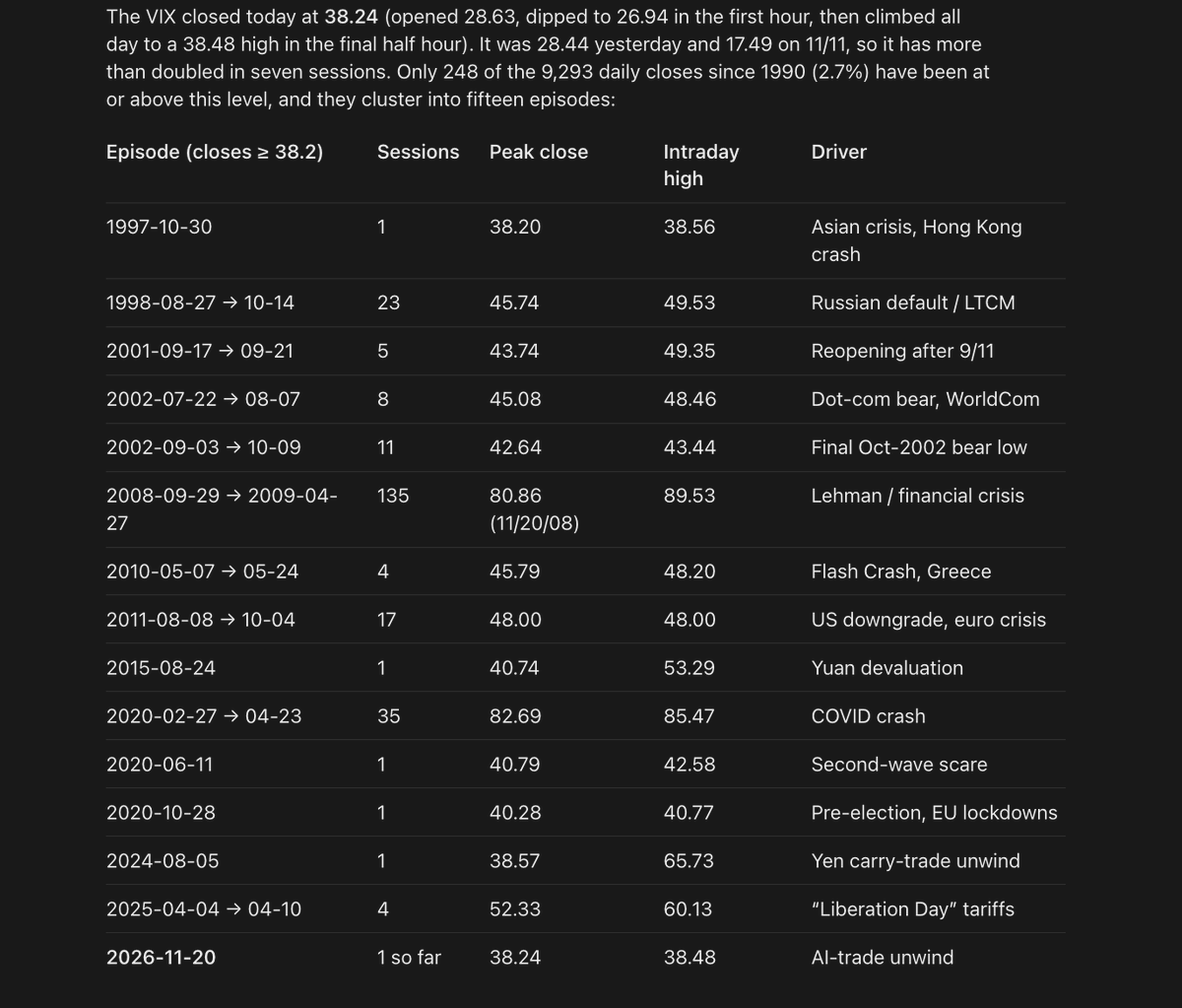
On the one hand, the president's intervention breaks every convention. He evidently joined the Nvidia board meeting yesterday which is unprecedented.
On other hand, the leak of classified info seems like it came from the administration as well. Likely the result of some internecine fighting in the chaos ladder of Trump.
🇩🇪🇺🇦 Germany's Chancellor Merz:
I think we can all see today, at least in retrospect, what a mistake it was not to follow the American proposal at the 2008 NATO summit in Bucharest to admit Ukraine into NATO.
If Ukraine had become a member of NATO, this war could probably have been prevented.
Germany's Chancellor Merz:
I think we can all see today, at least in retrospect, what a mistake it was not to follow the American proposal at the 2008 NATO summit in Bucharest to admit Ukraine into NATO.
If Ukraine had become a member of NATO, this war could probably have been prevented.
One reason founder CEOs are so hard to replace is that they’re effectively also the chief product officer. They know how the product was built, can hold the entire product in their head, and have the vision and authority to reinvent it.
When they leave, the CEO role gets filled, but the product role they played rarely does.
TIL: We have superintelligence but we still don't have level-5 autonomous driving.
A task that most 17 year olds can learn in 20 hours of practice.
And we have (you have) billions of hours of training data.
We don't have robots that can come close to doing what an 8 year old can do with no prior training.
And let's not talk about cats.
That's a rather strange kind of superintelligence.
I built a miniature San Francisco that runs in your browser.
Real buses, planes, boats, and weather. Plus robotaxis you can ride!
https://t.co/Ixyqxdn2H2
@TheStalwart@danielcincu@PercivalSweetw2@paulg He might be saying the founder dynamic in a tech company is a unique multiplier on a business that is not found to the same degree in other industries.
Admiral Bobby Ray Inman passed away this week at 95.
I first met Bobby in 1987, when he and George Kozmetsky joined the Dell board together. I was 22, and the company was three years old and not yet public. Bobby had already been a four-star admiral, director of the NSA and deputy director of the CIA. Having the two of them at the table in those early days made us a better company.
Bobby served on our board until late 1993. In those years Dell grew from about $160 million in sales to nearly $3 billion.
He gave more than three decades to the Navy and the country, then came home to Texas and helped make Austin a technology center.
In April we celebrated his 95th birthday. I am grateful for that day, and for nearly 40 years of friendship.
My condolences to the Inman family.
Another 10% down on the S&P seems the most likely here:
- Strip out the AI boom and much of the underlying economy, particularly housing, is actually contracting. Market concerned AI boom growth rate has peaked.
- Anthropic IPO breaking the offering price is a big negative.
- Excessive government borrowing may have locked us into a permanently higher interest-rate environment. Macro risk in the EU - debt defaults abroad exacertabe.
- Trump has lost his political “juice.” Whatever ability he once had to prop up markets through confidence, pressure or policy has largely evaporated. Fed is also currently negative.
Pluses?
- Oil will crash. Gas prices moderate. Pressure for Russia war to end (oil funds that war)
- I may be able to buy storage again for non outrageous prices some time this century
- if interest rates drop enough, other sectors might start to recover and overall S&P starts to bounce on that.
- Split government tends to reduce spending. Maybe these guys will do a deal on the deficit and shock everyone
I’m struggling to understand why this market hasn’t corrected harder.
Look at the setup:
Tech leaders are scrambling to adapt to AI, spending aggressively to defend their turf, and torching free cash flow to do it.
Deficits at 7% of GDP have quietly become the new normal. That’s a recession-level deficit with no recession.
Mortgage rates are still chilling the housing market which normally is a big driver of growth.
GDP is holding up reasonably well (apparently). But the one thing firing on all cylinders is AI capex and the data center buildout. One thing.
Then there’s Tuesday. Whatever happens, it’s hard to see Big Tech becoming less of a political target. Several highly visible CEOs chose to become political participants. Live by the sword.
Zoom out further: US foreign policy has spent two years tearing down the world order that kept America at the top of the food chain. What replaces it? Nobody seems to know.
Europe’s political risk is arguably higher still, and that kind of instability doesn’t stay contained — it bleeds into sovereign debt stress in Japan and the weaker corners of the EU. It can come back to bite us as well.
To be clear, I’m extremely bullish on AI over the long term. This isn’t a bear case on the technology.
It’s a bear case on the macro and political risk. The market feels like it’s run out of foam on top of its latte.
An idea for Anthropic’s 600 centimillionaires: Buy yourself a sweet pad, but also help solve San Francisco’s housing crisis.
Partner with Mayor Lurie to build homes across SF and the East Bay. Launch community lending programs with low-cost mortgages for low- and middle-income families.
Mathematically offset the lottery win. This is the biggest one I've ever seen. Meet the moment.
Makes no sense to me that young and small investors starting out don't get exposure to technology cos like Anthropic until the IPO.
Somehow a mortgage crisis induced Congress to make rules so IPOs are harder. Tech IPOs had zero to do with the financial crisis.
All that does is leaves these cos to the "already wealthy" super dumb. By the time it hits the IPO- it's pretty baked.