@SW_Help travelling from Waterloo to Crewkerne and disappointed there's no buffet car / trolley on a journey of over 3 hours. Many passengers I spoke to would also welcome this service being reinstated. Also a big thank you to Jason, the guard, for his help.
Italy’s infamous north-south divide in one map. Quality of life is clearly tied to economic circumstances: the wealthier, job-rich north dominates the rankings, while the poorer south fills the bottom. Turns out money doesn’t buy happiness, but it certainly helps with quality of life. Source: https://t.co/ZXEnuffYqy
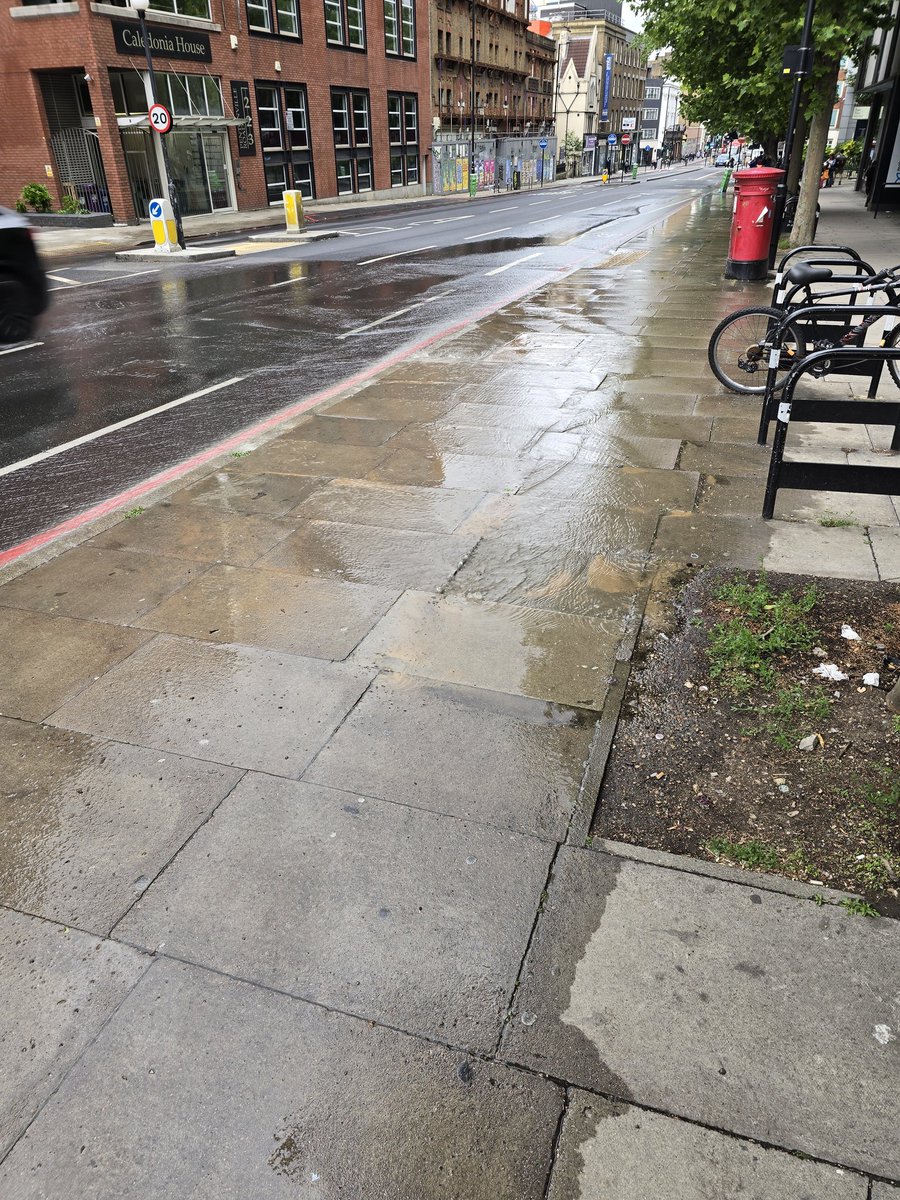
@thameswater there's a burst water pipe leaking in Museum Gardens, Bethnal Green.
I’m sharing a what3words address to help you find this specific location. Tap to see exactly where it is:
///editor.curiosity.save
https://t.co/SL1uLC0PYL
@thameswater there's a burst pipe leaking in Museum Gardens, Bethnal Green. I’m sharing a what3words address to help you find this specific location. Tap to see exactly where it is:
///editor.curiosity.save
https://t.co/SL1uLC1nOj
@BBCLondonNews an hour ago, a bus broke down in the bus lane at the junction of Pentonville Road and King's Cross Road. Massive tailback of buses now up Pentonville Road.
Researchers at the University of Nottingham in the UK have developed a groundbreaking protein-based gel that leverages calcium and phosphate ions, naturally abundant in human saliva, to repair and regenerate damaged tooth enamel.
This innovation, detailed in a study published in Nature Communications, represents a potential shift away from traditional "drill and fill" dentistry toward true enamel restoration.
The gel mimics the natural proteins that guide enamel formation during infancy. When applied to teeth, it forms a thin, robust layer that seeps into cracks and eroded areas.
Acting as a scaffold, it attracts and organizes calcium and phosphate from saliva (or even donated saliva samples), promoting "epitaxial mineralization"—a process where new enamel crystals grow in perfect alignment with the existing tooth structure, restoring its hardness and architecture.
Lab tests showed the regenerated enamel withstands real-world stresses like brushing, chewing, and acidic exposure (e.g., soda) as well as—or better than—natural enamel. It remained intact for weeks in simulated oral environments.
[Hasan, A. et al. Biomimetic supramolecular protein matrix restores structure and properties of human dental enamel. Nat Commun 16, 9434 (2025). DOI: 10.1038/s41467-025-64982-y]
@thameswater@thameswater I’m sharing a what3words address to help you find this specific location. Tap to see exactly where it is:
///period.blog.joke
https://t.co/ExI1Jkh7W2
One of the most thorough, well-explained and rational analyses of the logic behind #Trump's tariffs with @Sarah_Montague and @EvanHD on today's @BBCWorldatOne. Clear echoes of the reason so many in the UK voted for #Brexit. More like this and with video too please.
@JennyGriffiths_ I've tried accessing one of Snap Vision's case studies about collaborating with @westfieldlondon, but it links to a different company's website. Why? Can the original link be restored please?
Wow, cool interview with @doyne_farmer, who:
•Built the first wearable computer to win at #roulette
•Helped develop #chaostheory
•Beat the stock market
•Predicted the pandemic's economic impact on the #UK
•Is an #Entrepreneur. Thank you @jimalkhalili https://t.co/FDFQQIJLyR
If you’re in need of a smile, I’d like to remind you that one word for your intestines in the 14th century (first recorded in a translation of the Bible) was ‘arseropes’.


![Rainmaker1973's tweet photo. Researchers at the University of Nottingham in the UK have developed a groundbreaking protein-based gel that leverages calcium and phosphate ions, naturally abundant in human saliva, to repair and regenerate damaged tooth enamel.
This innovation, detailed in a study published in Nature Communications, represents a potential shift away from traditional "drill and fill" dentistry toward true enamel restoration.
The gel mimics the natural proteins that guide enamel formation during infancy. When applied to teeth, it forms a thin, robust layer that seeps into cracks and eroded areas.
Acting as a scaffold, it attracts and organizes calcium and phosphate from saliva (or even donated saliva samples), promoting "epitaxial mineralization"—a process where new enamel crystals grow in perfect alignment with the existing tooth structure, restoring its hardness and architecture.
Lab tests showed the regenerated enamel withstands real-world stresses like brushing, chewing, and acidic exposure (e.g., soda) as well as—or better than—natural enamel. It remained intact for weeks in simulated oral environments.
[Hasan, A. et al. Biomimetic supramolecular protein matrix restores structure and properties of human dental enamel. Nat Commun 16, 9434 (2025). DOI: 10.1038/s41467-025-64982-y]](https://pbs.twimg.com/media/HNv9kY0WQAAmSP6.jpg)