The 2nd amendment is not for hunting, it is not for self protection
It is there to ensure that free people can defend themselves if god forbid government became tyrannical and turned against its citizens
The United States Mission to Belgium condemns, in the strongest terms, Ghent University’s retaliation against an American scholar following his accurate whistleblower reporting on academic fraud.
The United States government regularly funds and supports research, academic exchanges, and other engagements with overseas universities. Dishonest, corrupt institutions that engage in, or reward, scapegoating mob behavior are not desirable partners for us. This is particularly true where the purpose and effect of the scapegoating is to punish accurate journalism unearthing academic dishonesty. We are therefore reviewing any relationships we have with Ghent University.
Bad-faith idealogues will try to make this a referendum on the content of Cofnas’s scholarship – or polemical distortions of it. That’s wrong. Free speech means that controversial views are protected. And Cofnas’s views were known to Ghent University when he was hired.
The ultimate purpose of freedom of speech is to overturn lies, fraud, and false ideologies. This is precisely what Cofnas was doing, and precisely the reason his home institution wants to silence him.
Thank you for your attention to this matter.
Derek Chauvin was unjustly convicted of murder, therefore he should be freed.
The facts show that he was not the cause of death, nor did he at any time intend for a death to occur. Whatever else he may be, he is not a murderer.
That is the truth.
Charlie Munger: "I always liked the story of P.J. O'Rourke, who said, 'The last Communist dictator of Albania was a pure Communist.
He threw out the Russian embassy because they'd lost the pure faith. Then he kicked out the Chinese Communists because they'd lost the pure faith.
Finally, he was only comfortable with two places in the world. One was the Communist dictator of North Korea and the other was the English department at Yale.'" 🤣
"There is a lot of extreme craziness in some of the liberal arts — and they select people who share their craziness."
(Caltech || 2008)
In 2007, a rival fund called Ken Griffin on a Sunday needing to dump a $30 billion book before Monday's open to meet margin calls. The senior banker on the competing bid went to bed.
Citadel owned all of it by 6AM.
This is him telling the whole story -- the 50-person team assembled in hours, the all-nighter, and the banker on the competing bid who called from Greenwich to say he was going to bed:
"And he said, look, it's getting late, this isn't gonna get done tonight. I'm heading off to bed, I'm telling my guys to go home, and we'll pick this up in the morning."
"And I said, there will be nothing to pick up in the morning. We're going to get this done. he sort of laughed and hung up."
"6AM before the opening of the markets, we bought that entire portfolio."
The quote he lands it on, from President Lincoln:
"Things may come to those who wait, but only those things left by those who hustle."
Bookmark & watch ↓
The Anglo-Scottish Enlightenment – the real antidote to Rousseau and Voltaire
The French Enlightenment and the Anglo-Scottish Enlightenment happened simultaneously, in the same century, reading the same books, arguing about the same questions. They reached completely opposite conclusions. One produced the Declaration of Independence and the American Constitution. The other produced the guillotine. This is the most important civilizational fork in modern history.
1. The French Enlightenment begins with the assumption that human beings can be improved by reason – that if you strip away the corrupting institutions of Church, tradition, and inherited authority, the natural goodness underneath will organize itself into a just society. This sounds like progress. It is a fantasy with a body count. Every attempt to implement it has required, at some point, a Committee of Public Safety to handle the people who turned out not to be naturally good enough.
2. The Anglo-Scottish Enlightenment begins with the opposite assumption: human beings are what they are, not what they could be if properly enlightened. Hume grounds morality in human nature as it actually operates – sympathy, habit, sentiment, the slow accumulation of social trust. Smith shows that self-interest, properly channeled, produces collective benefit without a planner. Neither man is building a utopia. Both are building with the actual material available.
3. Burke is the direct refutation, written in real time. He published Reflections on the Revolution in France in 1790 – before the Terror, predicting it precisely – because he understood that institutions are not obstacles to human flourishing, they are its precondition. They contain accumulated wisdom — the knowledge of the dead — that cannot be recovered once destroyed. Pull society apart to improve it and you don’t get the General Will. You get Robespierre.
4. The American founders read Burke, Hume, Smith, and Montesquieu – the Frenchman who looked at England and understood what France was missing. They built a system that takes human nature as given — self-interested, power-hungry, tribal — and constructs institutions to contain those tendencies rather than assume they disappear once the right people are in charge. Checks and balances are not a design flaw. They are what you build when you don’t believe in philosopher-kings.
5. 1776 versus 1789. Same Enlightenment, same century, same vocabulary of liberty and reason. One produces a constitutional republic that has survived two and a half centuries of stress, civil war, and upheaval. The other produces, in sequence: the Terror, Napoleon, 1848, the Commune, and eventually — via Marx, who was a Frenchman in spirit if not in birth — the entire catastrophe of the twentieth century. The difference was not intelligence or intention. It was the starting assumption about human nature. Get that wrong and everything that follows is wrong with it.
6. The guillotine is not the Revolution’s failure. It is its logical conclusion. If man is naturally good and the system is corrupt, then whoever seizes the system in the name of natural goodness is licensed to do anything. The General Will cannot be wrong. Those who resist it are not opponents – they are enemies of nature itself.
7. The real antidote to Rousseau and Voltaire was never a better French philosopher. It was a different civilizational tradition – one that builds with human beings as they are; that treats inherited institutions as repositories of wisdom rather than obstacles to progress; that distributes power rather than concentrating it in whoever currently claims to know the General Will. That tradition was built in Edinburgh, London, and Philadelphia. It is currently under sustained assault — from exactly the same ideas, in exactly the same form, with exactly the same confidence — that Burke watched demolish France in 1789. He was right then. He is right now.
Milton Friedman: “I am not a conservative. I’ve never been a conservative. Hayek was not a conservative.”
“We are liberals in the true meaning of that term: concerned with freedom. We are not liberals in the current distorted sense—those liberal with other people’s money.”
Lee Kuan Yew: "Hay que tener la disciplina que tienen los suizos. Nunca tengan déficits fiscales. En otras palabras, no pongan a funcionar la máquinita. Si tienen un déficit, pidan prestado, paguen. Nunca impriman billetes sin respaldo".
Thank you. The important part is zeroing out taxes on the bottom half. Best way to put money in someone’s pocket is to not take it out in the first place. Bottom half is only 3% of total tax revenue. But it’s very meaningful to that person. Zero it out.
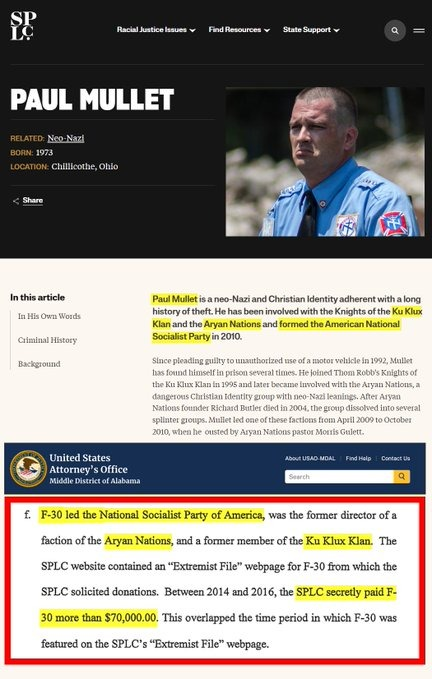
🇺🇸 The SPLC paid $70,000 to the leader of the American Nazi Party.
A former KKK member and Aryan Nations director… The same man they had listed as an extremist on their own website.
The organization that decides who is and isn't a hate group, was actually funding one.
Source: AP, @KanekoaTheGreat
It is just not safe to cross the road in NYC any more because so many e-bikes speed through red lights, go the wrong way, and disregard all road rules. And yet: Mayor Zohran Mamdani eased up on police enforcement of reckless e-bike drivers last month. Lawbreakers are his constituents.
Jamie Dimon has run JPMorgan for over 18 years.
Largest bank in America. $4 trillion in assets. Survived 2008 when others collapsed.
He spent 3 minutes explaining what actually builds a career:
"Work hard. There's no such thing as success without hard work."
"Some people have this quick get-rich-quick notion. I've never seen it. Maybe it's happened, but it's not the normal way."
On learning:
"You spend your life learning."
"I read four or five newspapers every morning. I read tons of stuff. I read everything that people send me."
"You learn from clients. Learn from competitors. You're always learning."
"And that could be a small thing that someone said, 'why do you do this?' And you think, my god, we should do that differently. To a very large thing."
On innovation:
"Sometimes it's not an aha moment. It's a lot of little things added on top of each other."
"The iPhone was 3G, the glass, the semiconductors, the batteries. It wasn't one thing that created the iPhone."
On career flexibility:
"Be willing to change your job a little bit. Don't worry about your income level."
"People say, 'I'll take that job, I love the people, but it pays less money.' You know what? Sometimes that's the absolute right thing to do."
"Be a little bit flexible in the job you take. In your lifetime, you should be prepared to do a bunch of different things."
On taking care of yourself:
"It's your job to take care of your mind, your body, your spirit, your soul, your friends, your family."
"You need to do that at any level. Because if you don't, you probably won't be a particularly productive worker."
"We can provide opportunities. We can't do it for you."
On management:
"Get it done. Follow up. Discipline. Planning. Get the right people in the room. Kill the bureaucracy."
"If you don't do these things, you won't be particularly good."
On leadership:
"The real keys to leadership aren't just doing that yourself. It's having people who want to work at the place."
"You might want to work for me if you trust me. If you know what I care about is the client, the country, something different."
"If the person's selfish, blames you and takes the credit, you're not gonna want to work there."
"Humility. Openness. Fairness. Being authentic. That's what creates leadership."
In 1942, the Japanese rounded up all Chinese men in Singapore.
They were filtering out the healthy young ones to execute.
Lee Kuan Yew was 18. A guard pointed at him and said: "Go to that lorry."
He knew what that meant. The lorry went to the beaches. The beaches meant machine guns.
He asked: "Can I collect my other things?"
They said yes.
He walked away, found his family's gardener, and hid in his quarters for two days.
When they changed the screening inspectors, he tried again. This time, he got through.
The ones sent to that lorry were taken to the beaches and shot. Somewhere between 50,000 and 100,000 didn't survive.
60 years later, he sat down at Harvard to explain how he built Singapore from a tiny island into one of the wealthiest nations on Earth:
On what the war did to him:
"We lived in happy, placid colonial Singapore in the 1920s and 30s. The British Empire would have lasted another thousand years, so we thought."
Then the Japanese came. In less than one and a half months, the British collapsed.
"Three and a half years of hell. Butchery. Brutality. Many didn't survive. I was fortunate. I did."
"But it changed us."
"What right did they have to do this to us? Why did the British let us down so badly?"
When the war ended, Lee went to Cambridge to study law. But he was watching with different eyes.
"Can they govern me better than I can govern myself? Because they scooted when the Japanese came in. And why shouldn't I be running the place?"
On learning languages to lead:
Lee was the best speaker in English. But only 20% of Singapore spoke English.
The masses spoke Hokkien, Mandarin, and Malay.
"So every day at lunchtime, instead of having lunch, I would sit down with a Hokkien teacher and laboriously and painfully learn to convert my Mandarin into Hokkien."
"Had I not mastered that, the battle would be lost by default."
His first speech in Hokkien, the kids laughed at him.
"I said, please don't laugh. Help me. I'm trying to get you to understanding."
By 6 months, he could get his ideas across. By 2 years, he was fluent.
"Believe it or not, at the end of two years I could speak better than most of them."
"That came respect."
It showed two things: how determined he was, and how sincere. Here was a man doing all these other things and still learning their language just to talk to them.
On fighting the Communists:
The Communists had been organizing since 1923. The year Lee was born.
"Here we were in the 1950s trying to beat them. And they are professionals at organization."
They had elimination squads. Guerrillas in the jungle. Killer squads in the towns.
Lee stood up and said no.
"They denied that they were Communists. 'We're just left-wing socialists.' So I did a series of 12 broadcasts to set the scene. And I made it in three languages."
English. Malay. Mandarin. 20 minutes each.
"When I finished each broadcast, the director of the station couldn't see me. Went into the room and found me lying on the floor trying to recover my breath."
"But it was a fight for survival. Life or death."
On where trust comes from:
"It's difficult to establish trust in times of calm. You just say, 'Well, it's an argument, therefore I'm a better guy than you.'"
"But when the chips are down and you can get eliminated in a very unpleasant way and you show that you're prepared for it and you'll fight for them, it makes a difference."
"Without that trust, we could not have built Singapore."
On IQ vs EQ:
Harvard asked him: would you prefer high IQ or high EQ in a leader?
"IQ, you can get beautiful paper done. Complex formulas worked out. Elegant solutions."
"But when you've got to get a team to work and put that formula into practice, you're dealing with human beings."
"If you're not good at EQ, you can't sense that A doesn't get on with B, and you put them in the same team. It's no good."
He rated his own EQ as 7 or 8 out of 10. His IQ as "maybe 120."
But he had colleagues who could sense a person instantly.
"He shook hands with the man and said, 'I recoiled when I felt his palm. Evil man.' And he was. How does he know? I don't know."
"So I learned whenever I had to do interviews to choose people, I would get people who are very good at seeing through a candidate."
On corruption:
Singapore in the 1950s was full of deals, bribes, and organized crime.
"When we took over, we decided that this was the critical factor. If we did not make it so that every dollar put in at the top reaches the ground as one dollar, we're not going to succeed."
"We came in and made a symbolic act. We dressed in white shirts, white trousers, and said we will be what we represent."
He put the anti-corruption bureau under his personal portfolio.
"I gave the director the authority to investigate everybody and everything. All ministers. Including myself."
One of his own colleagues took half a million in bribes. When the investigation started, he asked to see Lee.
"I said, if I see you then I'll be a witness in court. So best not see me. Better see your lawyer."
The man committed suicide. Left a note saying: "As an oriental gentleman who believes in honor, I have to pay the supreme price."
"It's a heavy price. But it reminds every minister that there are no exceptions."
On consistency:
Lee had three journalists analyze 40 years of his speeches.
He asked them: what was the dominant theme?
All three said the same thing: consistency.
"What I said at the beginning, throughout all that period, the theme stayed loud and clear."
"That made it simple. Because you know where you stand with me. And you know what I want to do."
On delivering results:
"We deliver the homes, the schools, the jobs, the hospitals."
"Today, 98% of our people own their own homes. The smallest would be about $100,000 US. The biggest about $300,000."
"Once you own that amount of assets, you are not in favor of risking it with a crazy government. Your assets will go down in value."
"But that was planned."
Why? Because Singapore is small. Everyone does national service. If you're going to fight, you better be fighting for something you own.
"So we give everybody a stake."
On changing culture slowly:
Lee wanted Singapore to speak English. But he couldn't force it.
"Had I passed a law and said you will all learn English, we would have had mayhem. Riots."
Instead, he let parents watch who got the best jobs. The jobs were already there, from the multinationals and banks. They all used English.
"They watched and saw who got the best jobs. And they switched."
It took 16 years.
"I did not want to have said 16 years. Because in those 16 years I lost 20,000 Chinese graduates who had poor jobs. I wanted to make it shorter. I couldn't. I would have run into flack."
On whether leadership can be taught:
Lee quoted Isaac Singer, the Nobel Prize winner for Yiddish literature.
Someone asked Singer: "Can you make a writer write great literature?"
He paused. Then said: "If he has the writer in him, I will make him a good writer in a shorter time."
Lee's version:
"Can you make a leader of anybody? I don't think so."
"He must have some of the ingredients. He must have that high energy level. He must have the ability to project himself, his ideas. He must have the desire, almost instinctively, to say 'let's do something better.' Of wanting to do something for his fellow men and not just for himself and his family."
"You can't teach those things. He's either got it or he hasn't got it."
"But if he's got that, then you can save him a lot of trouble."
On sustaining yourself:
Harvard asked how he managed despair over decades of leadership.
"If your message is one of despair, then you should not be a leader. You must give people hope."
"But there are moments when you feel very down. Either because you're physically down, or emotionally down, or because the world has turned adverse against you."
"When you are in that condition, the first thing you do is get a good night's sleep. Then get a swim or chase a ball. Get the cobwebs out of your mind."
"If you're not fit, you're going to make mistakes. Physically fit. You must stay physically and mentally fit."
In his later years, he learned to meditate.
"At the end of 20 minutes to half an hour, my pulse rate can go down from 100 to about 60. You can feel yourself subside. You still your mind. You empty your mind."
"Then when you are rested, you resume quietly. You still got the same problems. Maybe you sleep on it. Come back. Look at it for a few days. Then decide."
This 2 hour Harvard interview will teach you more about leadership than every business book you've read combined.
Bookmark & give it 2 hours this weekend, no matter what.
Universal HIGH INCOME via checks issued by the Federal government is the best way to deal with unemployment caused by AI.
AI/robotics will produce goods & services far in excess of the increase in the money supply, so there will not be inflation.
🚨 JUST IN: Supreme Court Justice Clarence Thomas is being praised nationwide for dropping this TRUTH on leftism and "progressivism"
"Progressivism seeks to replace the basic premises of the Declaration of Independence, and hence our form of government. It holds that our rights and our dignities come not from God, but from government."
"It requires of the people a subservience and weakness incompatible with a constitution premised on the transcendent origin of our rights."
You NAILED IT, Justice Thomas! 🇺🇸
This guy is the true GOAT.
JUSTICE CLARENCE THOMAS: “I think if we don’t stand up and take ownership of our country, and take responsibility for it, we are slowly letting others control how we think and what we think.”
"If you think it's losing confidence, then you get up and you participate. You don't sit on the sidelines."
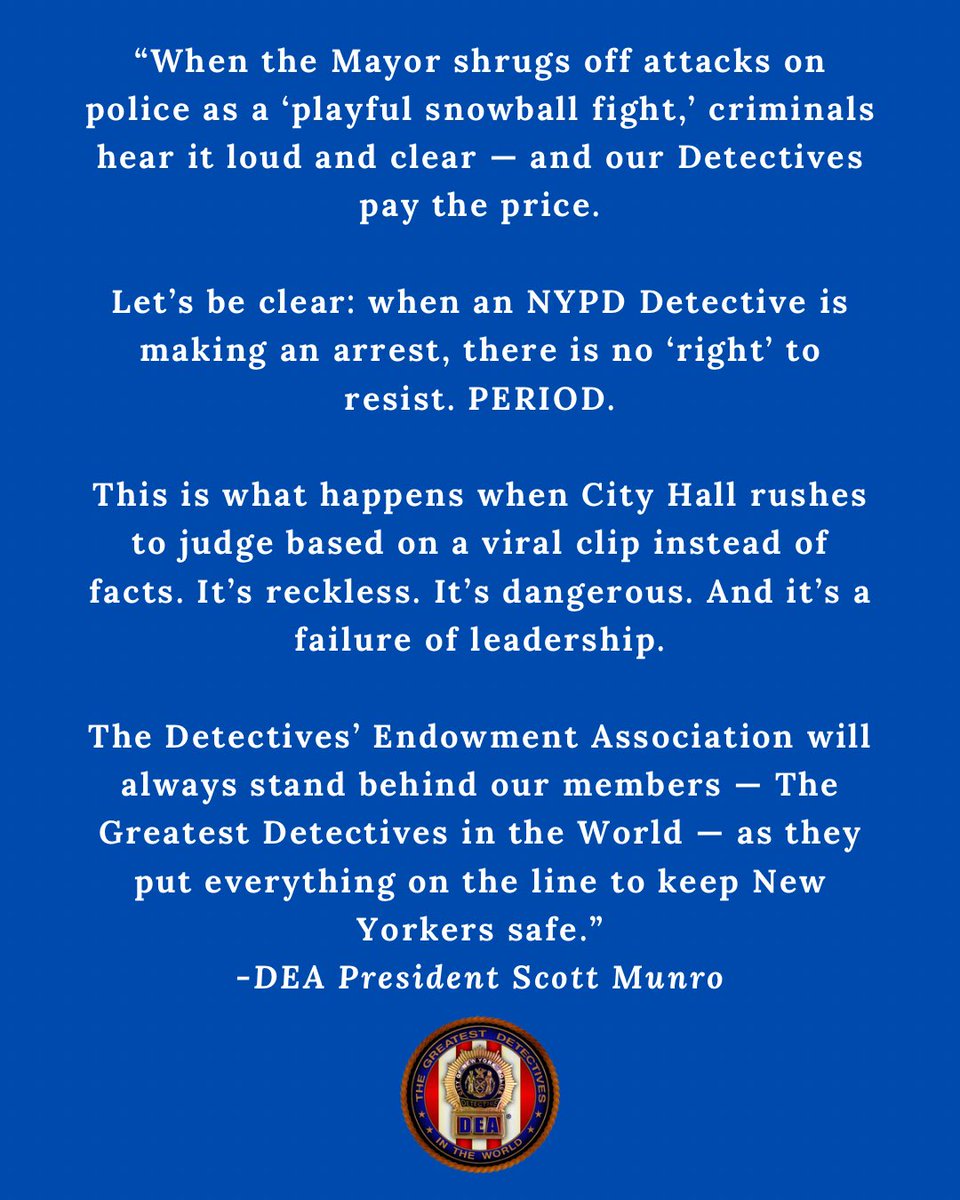
The mayor wants criminals to know that if you resist arrest violently enough, the NYPD will have to let you go.
The mayor also wants the police to know that if they attempt to arrest a criminal who violently resists, he will take the side of the criminal every single time.
Illinois Governor JB Pritzker signed House Bill 106, decriminalizing spreading HIV
“To Illinois after a Governor Pritzker signed a new law that decriminalizes spreading HIV. Now the new policy officially repeals a law that was passed back in 1986”
The signed by Governor Pritzker eliminated the HIV-specific criminal statute that made it a felony for someone who knew they had HIV to engage in activities like unprotected sex, sharing needles, or donating blood without disclosure
This is the Democrat Party