Hello #Desci Community, We noticed our previous Discord Link got Expired, Here's a new one https://t.co/HaX9J5rnRw
Join the conversation and keep amplifying the message of #AMR
A new month means new opportunities to build, collaborate, and push the boundaries of #DeSci.
To our incredible community of researchers, builders, creatives, and thinkers thank you for being part of this journey.
Together, we’re redefining how knowledge is created and shared.
Aquaculture is quietly accelerating antimicrobial resistance:
• Antibiotics used in fish & shrimp farming enter water systems
• Resistant bacteria & genes persist in sediments
• They move through food chains → into humans
Read more: https://t.co/OAF7tMIbfq
Learn more about Peggy and the Peggy Lillis Foundation, founded by her sons Christian and Liam to raise awareness about C. difficile and advocate for safer antibiotic use.
Link: https://t.co/ihKzZKSKj0
Peggy was hospitalized just one week after being prescribed antibiotics.
She developed a C. difficile infection linked to antibiotic use, progressed to sepsis, and sadly passed away.
Her story is a painful reminder that antibiotic misuse can have devastating consequences.
During that time, she listened to music often, fearing that each song might be the last she would ever hear.
#AMR does not only affect patients.
Sometimes, it affects the very people trying to save lives.
Dalene von Delft was a newly qualified doctor in South Africa with dreams of becoming a pediatric surgeon.
Then she was diagnosed with multidrug-resistant tuberculosis (MDR-TB).
Her treatment lasted 19 difficult months.
The treatment began to damage her hearing, threatening not just her health but also her medical career.
Dr. Dalene faced an impossible choice:
Continue treatment and risk permanent deafness, or stop treatment and risk her life.
The future of #Desci isn’t built by one voice, it’s shaped by the community.
👇 Tell us your pick:
🔹 Governance
🔹 Innovation
🔹 Community
🔹 All of the above
Let’s hear your thoughts. What should @join_MicroDAO prioritize next?
The cause?
A multidrug-resistant infection linked to pet store puppies.
Mike was one of 113 people across 17 states affected by the outbreak.
Only one drug worked.
Read full story and what it means for #AMR in our Discord.
Link: https://t.co/YWg5KvwSXY
PUPPIES MAKE PEOPLE SICK, yes! you read that right.
Mike, a 67-year-old retired professor, brought home a puppy named Mabel. Within a week, he was in the hospital.
What started as diarrhea and fatigue quickly escalated into kidney failure, ICU admissions, and emergency surgery
Antimicrobial resistance (AMR) is not a distant or abstract threat.
It is already undermining care on the frontlines of fragility and crisis.
Vanessa’s story is a powerful reminder that the impact of #AMR is not far away.
📽️ Watch the full video: https://t.co/JENCeU7x2L
Strong evidence from Kenya highlighting the silent burden of STIs especially among young people and key populations.
Early detection is antimicrobial stewardship.
@join_microdao supports research pathways that make advanced diagnostics faster, open, and globally accessible. 🧬
📢 New publication in @PLOS Global Public Health
Chlamydia trachomatis and Neisseria gonorrhoeae infections are curable but often asymptomatic. When left undiagnosed, they can lead to serious complications and continued transmission.
In Kenya, a multi-center prevalence study by GARDP, the @MOH_Kenya and the @DNDi found:
• Gonorrhoea prevalence was 1.0% in pregnant women and 9.4% in key populations (at higher risk for STIs)
• Chlamydia prevalence was high in both groups: 9.6% in pregnant women and 11.2% in key populations
• Younger individuals, particularly those under 20, carried the highest burden
With STI care being largely syndromic, strengthening diagnostics 🧪 and surveillance will be critical to protect reproductive health and support antimicrobial stewardship 💊
🔗 Read the full paper: https://t.co/hXloaLCfu2
#STIs #GlobalHealth #AMR #PublicHealth
Antibiotic use is rising fastest where access is easiest.
📈 Iran, South Africa, and Egypt lead global consumption; over 50 daily doses per 1,000 people, But misuse and over-prescription fuel antimicrobial resistance, a silent global crisis.👇
New antibiotics, including antifungals, may help improve patient treatment options and outcomes, especially against resistant infections, but the fight against antibiotic resistance cannot rely on drug development alone.
2/2 Approximately 30% of CRE carry mobile genetic elements
→ enzymes that destroy carbapenems
→ resistance that spreads fast between bacteria
Prevention & containment = protecting our last-line drugs.
Join our discord: https://t.co/HaX9J5rnRw
1/2 CARBAPENEM-RESISTANT ACINETOBACTER {CRE} is one of the most dangerous #AMR threats in healthcare.
Patients with devices (e.g. catheters) or long antibiotic exposure are at highest risk.
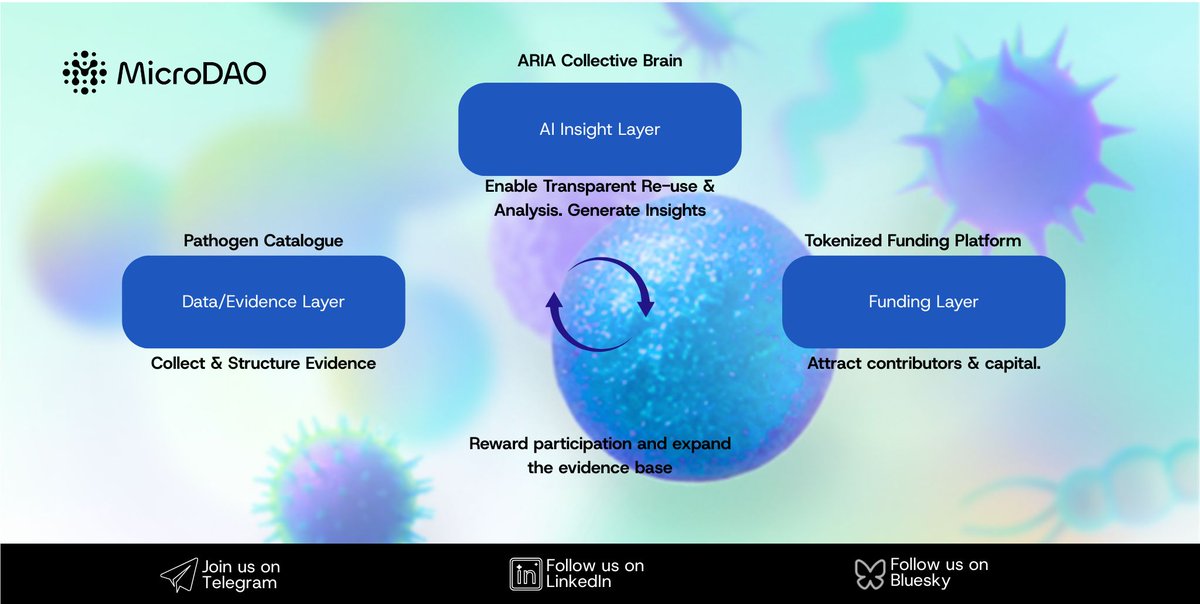
@join_MicroDAO's solution to the #AMR crisis is building a self-sustaining research engine for AMR.
🧠 Curated evidence to surface gaps & priorities
🤖 AI research agents to connect data and guide discovery
🧪 Tokenised experiments to fund validation of new vaccines
To slow AMR we must:
• Stop the blame game → everyone has a role
• Stop relying only on new drugs
• Start preventing infections first
• Improve antibiotic use in humans & animals
• Detect threats early
Action starts with us. 2/2
Join our Discord: https://t.co/7dwjCdHzwB
"The post-antibiotic era isn’t coming.
We’re already living in it."
Robert R. Redfield, M.D. Director, U.S. Centers for Disease Control and Prevention 1/2