Exactly, and that’s why $ZK is the endgame.
It’s not just “a chain” anymore. $ZK is the heartbeat of the Elastic Network, a growing web of 21+ zkChains, from @AbstractChain and @grvt_io to @Sophon, @LC, @ZKcandyHQ, @cronosapp, @Xsolla, @LiftDataAI, @zerodotnetwork, @heurist_ai, @spaceandtime, @NodleNetwork, @oncreator_, @Memento_Bc, @XPLA_Official, @LaChain_Network, @unionchain_io, @0xSANDchain, @ADIChain_, @0xhealthshared, and more coming. Every single chain contributes value, creating one shared, self reinforcing $ZK economy.
Every time assets move, every enterprise licenses modules, every zkChain grows, value comes back into the system. $ZK gets bought, burned, rewarded to stakers, and fuels the ecosystem. It’s real utility, not the illusions some are seeing. It’s control by design, not shallow attempts at dominance.
That’s the reason why this is bigger than any other regular L1 or L2. It’s a whole financial infrastructure secured by Ethereum and ZK cryptography, private and public, for real-world adoption. So, again, $ZK isn’t just a token, it’s the backbone of the next era of decentralized finance.
Spread the word.
What a sticky misconception 🙈
@ZKsync is no longer “a chain”.
@ZKsync is building Incorruptible Financial Infrastructure for the world.
It’s a network of public and private (enterprise) chains secured by Ethereum and ZK cryptography, not validators.
Spread the word frens 🙏
The 10 $ZK Fee That Could Turn Every Bank-to-Bank Message Into $ZK Buybacks
For over fifty years the world has run on infrastructure invented in 1973. Seven banks created SWIFT to fix chaotic cross-border messaging. Today it handles 53 million messages daily and routes roughly $150 trillion a year. Looks impressive from the outside.
Well, here’s the thing. Underneath all that volume are the same old 1970s limitations, multi-day settlements, batch processing, layers of correspondent banks, and core systems still written in COBOL, a language older than the internet. Capital sits idle. Opportunity cost piles up, you know. Every coordination between institutions burns time and money that should be working harder.
Not only that, but in March 2026 that era started to end.
Not because the old system broke down, but because something far better finally arrived.
With governance proposal v31 (ZKsync Connect native interop) now active, ZKsync has turned on something transformative. Atomic, programmable interoperability across any Prividium chain and the entire ZKsync network.
Every time two banks need to settle, pledge collateral, move tokenized assets, or sync state, it can now happen in roughly one second. Privately. Compliantly. And with a small protocol fee attached.
That fee is 10 $ZK per interop call.
Sounds tiny on its own. 10 ZK Token doesn’t feel like much. But scale changes everything. Because it’s not one call, it’s thousands. Not one bank, it’s hundreds. Not once a day, but constantly. And when all of that starts stacking, that “small fee” turns into a continuous stream of value flowing back into the system.
And this is where it starts getting really interesting…
Under ZKsync’s evolved tokenomics direction, 100% of protocol revenue, including every single interop fee, flows back into value accrual for ZK Token: open-market buybacks, programmatic burns, staking rewards, and ecosystem growth.
The fee is simple (as described above): 10 ZK Token per call.
But zoom out for a second, picture this.
A single large bank or consortium can easily generate thousands of these coordination events every day, treasury movements, collateral adjustments, settlements, compliance syncs… it adds up fast.
Now scale that.
With ~100 major banks and consortia running Prividium chains (a pretty conservative near-term number), the volume becomes structural.
Even capturing a small slice of SWIFT’s ~53 million daily messages pushes this into hundreds of thousands… even millions of interop calls per day.
A rough, conservative view:
500,000 calls/day × 10 ZK = 5 million ZK Token per day flowing into the protocol.
And that’s just the starting point.
At higher adoption, this easily moves into tens of millions of ZK Token daily, from actual usage, really. Sustained buy pressure, permanent supply reduction through burns, and real staking yield tied straight to institutional activity.
This is the first token that’s positioned to earn from the high frequency, high margin coordination that has always powered traditional finance.
What happens when regional banks finally stop losing ground to Big Banks and stablecoins? @zksync did something in between 💟
Post-2023 SVB-style stress, deposit competition became much more intense for regional banks. And with stablecoins accelerating after the 2025 GENIUS Act clarity, there’s growing risk of transaction balances and working capital slowly moving outside traditional banking systems altogether.
That’s a serious issue for many mid-sized and regional banks.
Low-cost customer deposits, the thing many banks rely on most, risk getting replaced by more expensive and unstable funding sources, putting pressure on lending, margins, and local economies tied heavily to regional banking networks.
And honestly, this is why we keep saying the whole tokenized deposit movement matters more than people think.
Because this is really not some abstract shift in financial infrastructure anymore. It directly affects the thousands of regional and community banks supporting Main Street America.
This is precisely where @ZKsync filled a very interesting gap.
Not by trying to fully replace banks with crypto but by building something practical sitting between traditional banking and fully open stablecoin systems. Through Prividium, their private, permissioned, privacy-preserving infrastructure for regulated institutions, ZKsync created a path where banks can modernize, move money faster, and operate with blockchain efficiency while still keeping the protections, compliance, and structure they already need.
This might give you a much easier way to understand what Prividium actually does:
Imagine your piggy bank is your normal bank account. Your money stays there safely, protected just like always.
But anytime money needs to move somewhere else, it’s usually slow, lots of waiting, paperwork, middlemen, and systems checking things behind the scenes before anything finally settles.
Now imagine banks suddenly getting access to a much smarter system connected directly to an ultra-secure digital fortress called @Ethereum.
Money can move faster, more smoothly, and almost instantly between banks, while still staying private, secure, and fully inside the banking system people already trust.
15M+ Users Now Have Easy $ZK Access 💟
If you missed this earlier, it’s worth paying attention to.
@Revolut is not some crypto app people download only for trading. It’s the app millions across Europe already use daily to pay bills, send money to family, split dinner costs, and check balances while buying groceries. Normal everyday financial life. And now $ZK sits right there beside their euros.
That’s the important part many are overlooking.
Around 15 million users across the UK + EEA can now access $ZK directly through an app they already trust and already have installed. No weird kind of onboarding, no hardware wallet tutorials, no exchange etc.
Just: open app → see ZK → buy ZK.
Zero FX fees on top of that. Which means someone in Germany, France, Portugal, wherever, opens Revolut, sees ZK, buys ZK. That's the whole flow. Nothing standing between curiosity and ownership.
ZKsync has been telling an institutional story for a while now. Settlement infrastructure, enterprise privacy, Ethereum anchoring. Big banks, big numbers, big vision. All real. But institutions move slow. Retail moves when access appears, and access just appeared in front of 15 million people who had never once thought about ZK before.
Arthur Hayes, #Privacy, and @ZKsync: The Perfect Storm That’s Coming in 2026
@CryptoHayes ( Co-founder of BitMEX) has always had a rare instinct for seeing where things are heading before most people notice the shift, and in 2026 he keeps making one thing clear: monetary privacy is slowly moving from a niche preference into something fundamentally necessary as governments, Big Tech, and AI surveillance become more embedded into financial life, which is exactly why Zcash remains one of his largest holdings after Bitcoin and why he sees zero-knowledge technology as one of the most important foundations for what’s coming next.
What intrigues us most is how this vision finds its practical counterpart in @ZKsync.
While Hayes mainly talks about privacy from the individual side, ZKsync has been building the infrastructure capable of supporting privacy at much larger scale for both institutions and everyday users through Prividium, a private permissioned ZK chain designed specifically for banks and enterprises that enables true transaction privacy within the network while still remaining verifiable underneath.
• Zero-knowledge proofs that enable verifiable, trust-minimized settlement on Ethereum
• Thoughtful compliance tools that respect regulatory realities
• Effortless bridges to ZKsync’s public chains (zkChains)
We know it feels like a meaningful bridge, one that honors Hayes’ call for privacy without forcing institutions into impossible choices between confidentiality and accountability. Banks can operate with the discretion they need, while still benefiting from Ethereum’s unmatched security and finality.
In many ways, it represents the best of both worlds: the philosophical depth of Hayes’ privacy thesis meeting the architectural maturity of ZKSync’s ecosystem.
As we move deeper into 2026, this alignment, visionary narrative and functional infrastructure, carries a certain elegance. Not a privacy coin in the traditional sense, but the rails upon which private finance may increasingly flow.
One network. One asset. $ZK
🟣 Banks Enter First. Millions Follow Without Knowing.
Most people are reading adoption wrong. They assume regular people comes first, institutions follow. This time the order is completely different.
Every bank that joins Prividium brings millions of customers onto @ZKsync infrastructure with them. Those customers have no idea. Their banking app looks identical. But the ground beneath them has shifted. We call this Shadow Consumer Adoption.
When banking systems move, everyone connected to them moves too. Without consent. Without awareness.
In the classic narrative, people enter first and banks follow. Here, banks never wait for the front door. They move underneath and bring millions along with them.
The mechanism:
→ Bank joins Prividium
→ Customer assets flow through that rail
→ ZKsync sees real demand
→ Customer opens their banking app. Nothing looks different.
What nobody is talking about right now: banks can’t simply undo this later. Once financial systems are rebuilt around Prividium, the shift becomes permanent. The infrastructure decision gets locked in long before the public even realizes the transition has started.
The moment Prividium connects into ZKsync, hidden liquidity starts becoming visible. It doesn’t need to fully move onchain. A single corridor is enough. And every new connection compounds the network effect.
One Network. One Asset. $ZK
I don't know which path to take.
On one side there's a path full of fleeting hype, sometimes fun, but that can suddenly fall apart, on the other side there's the most ideal solution ever invented for institutional and banks,
if my eyes weren't blindfolded, I'd know which one to go down.
Path 1 introduced the fun side of crypto, but Path 2 introduced the very purpose of crypto's existence.
@ZKsync is ready with bank stack of @Ethereum vision.
The meal is cooked, chef is waiting to serve.
.@ZKsync - “The Bank Stack of @Ethereum” is exactly what banks have been waiting for.
Today, Banks are stuck with painfully outdated and expensive systems, slow wires, endless middlemen, days-long waits, and trillions just sitting idle in locked-up cash.
Here’s how @ZKsync’s Prividium actually fixes this mess:
• Your bank gets its own private blockchain (like a secret vault right in your building or cloud).
• All the sensitive stuff, who sent what, exact amounts, client names, stays 100% hidden and private.
• But every batch of txs gets locked with zero-knowledge math magic and sent to Ethereum, the world’s safest public chain.
• Ethereum just checks: “Yep, all good”, without peeking at any details. Boom: unbreakable security + instant final settlement.
It’s like running a hidden WhatsApp group for your bank’s money moves… but the receipts are stamped forever on Ethereum’s public ledger for real trust. No more excuses.
TL;DR: Why @ZKsync Calls Itself the Bank Stack of @Ethereum
The institutional blockchain dilemma:
• Public chains (ex: Ethereum, Bitcoin, Solana) → global liquidity but no privacy
• Private chains (ex: Hyperledger Fabric, R3 Corda, traditional permissioned setups like Quorum variants) → privacy but cut off from global liquidity
• Alternative L1s (ex: Solana, Avalanche, Sui) → lose Ethereum’s security and credibility
ZKsync removes this trade-off.
It allows institutions to run transactions privately, while still accessing shared liquidity across the network and settling securely on Ethereum.
- Core Architecture ↓
• Prividium → Permissioned Validium chains designed for institutional environments.
• Elastic Network → Native interoperability across ZK chains (currently 19+) with ~1s confirmations.
• Ethereum L1 → Final settlement secured by zero-knowledge validity proofs.
- How it works ↓
• Private execution: sensitive transaction data stays inside institutional infrastructure.
• Proof-based settlement: only cryptographic validity proofs are posted to Ethereum.
• Shared liquidity: private ZK chains can access public liquidity across the Elastic Network.
• No bridge risk: interoperability happens without asset-locking bridges.
- Enterprise-grade infrastructure ↓
• Selective disclosure for auditors & regulators
• SSO integrations (Okta / Azure AD)
• Approval workflows & role-based governance
• Programmable compliance logic
• ERP and treasury system integrations
- Institutional adoption is already happening ↓
• Deutsche Bank collaboration through Memento
• Cari Network: Bank-governed tokenized deposit platform on Prividium with 5 U.S. regional banks (e.g. Huntington, KeyBank) representing $600B+ in deposits
• BitGo: Partnership for secure custody + tokenized deposit infrastructure; enables banks to issue, transfer, and settle tokenized deposits onchain with compliance
• ADI Chain supporting UAE-licensed stablecoin infrastructure
• EDENA Capital onboarding $20B+ sovereign-grade assets
• Integrations with Fireblocks, pilots with UBS
• $2B+ tokenized RWAs already live on
ZKsync
- Bottom line ↓
ZKsync is not trying to replace Ethereum.
It’s extending Ethereum into the world of institutional finance, turning it into infrastructure banks can actually run on.
That’s the reason why we always say ZK is the endgame.
POV: That moment when you crack open a cold ZK FIZZ. 💜
Crisp. Refreshing. Instant satisfaction.
Honestly… that’s how money should feel too.
Customer pays → you get the money instantly → your inventory supplier is auto-paid → your rent is settled on time → and your profit is already earning yield.
That is the kind of financial experience @zksync is shipping, the revolution retailers and the next generation actually want:
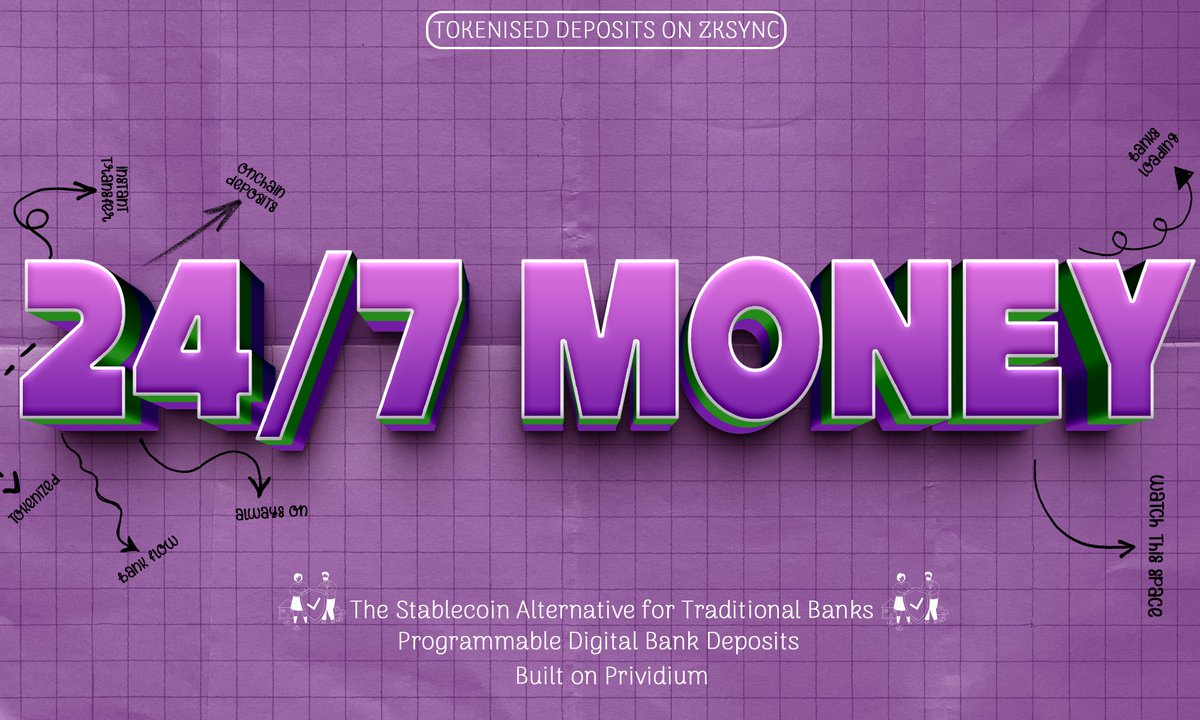
• Money moving at the speed of a tap, 24/7
• Programmable payments handling splits, rewards, invoices, refunds automatically
• Real bank money (FDIC-insured, on their books) with blockchain speed and ZK privacy underneath.
• Everything settling almost instantly instead of sitting stuck in limbo for days
And the best part?
Most people probably won’t even realize blockchain is underneath it all.
There’s Innovation that gets Attention, and Innovation that Changes the Standard.
@ZKsync Prividium Belongs to the Latter (The Standard).
Well, history shows that great financial systems have always solved the same core tension: how to keep sensitive operations private while maintaining verifiable trust at scale. The Medici used coded ledgers. Modern banks use permissioned databases and SWIFT. Both worked because they protected what needed protecting while allowing coordination.
ZKsync’s Prividium does something elegant here.
It gives institutions a full ZK-powered private chain they can run in their own infrastructure, sensitive data (trades, balances, strategies) stays completely off public view. Yet every state change is proven and anchored to Ethereum for finality and security. No trusted third parties. No vague legal promises. Only cryptographic enforcement.
Add built-in compliance tools (role-based access, AML/KYC hooks), native cross-chain connectivity, and you get something rare:
• Private where it matters (competitive edge and regulatory data)
• Connected where it counts (to other Prividiums, public ZKsync chains, and Ethereum)
As more institutions deploy their own Prividiums, like the Cari Network with its $600B+ in regional bank deposits, these private environments stop operating like separate systems. Native interop turns them into corridors. + institutional flows (treasury, tokenized deposits, RWAs) can move with near-instant settlement while respecting privacy.
And for ZK, that part matters a lot.
Every verified interop message, enterprise module and every element flowing through these systems feeds protocol usage back into the network economy. Which leads to buybacks, staking, burns and long-term value accrual, basically benefiting everyone (the holders).
That’s why Prividium stands out to us.
🏦 The Prividium Difference
Designed specifically for Institutions offering privacy, built-in compliance, cross chain connectivity and cryptographic enforcement.
Private where it matters.
Connected where it counts.
Tokenized Deposits vs Traditional Stablecoins: Why Banks Are Choosing a Different Path on @ZKsync
There’s a really interesting, under-the-radar things happening in institutional crypto right now, one that shows how traditional banks are actually starting to embrace blockchain on their own terms.
When most people think of stablecoins, they picture USDT, USDC, or similar tokens issued by private companies.
These have grown massively and solved a lot of real problems, no doubt. But for traditional banks, especially regional ones, they come with some hidden downsides. The biggest issue is the money moves off the bank’s own balance sheet and turns into someone else’s liability, which eats into their core deposit business.
On ZKsync, Prividium is doing something smarter and more thoughtful: tokenized deposits.
Instead of pushing banks to create a brand-new stablecoin, banks in the Cari Network (like Huntington, First Horizon, M&T, KeyBank, and Old National, together holding over $600 billion in deposits) can now tokenize their existing customer deposits. These tokens have some really powerful advantages:
• They stay right on the bank’s own balance sheet
• They remain fully FDIC-insured
• They’re still the bank’s direct liability
• They can move instantly 24/7 between participating banks with settlement in seconds
It’s a small difference on paper, but it changes everything in, like, practice.
For the banks, this means they don’t lose those valuable customer relationships or their stable funding base. For customers and corporate treasurers, they get programmable, super-fast money while still staying inside the trusted banking system they already know and rely on. And for regulators, it keeps everything comfortably within familiar rules instead of stepping into gray areas.
Where this really shines is in day-to-day operations that used to be frustratingly slow:
• Treasury teams can shift liquidity between banks in seconds instead of waiting days
• Corporate clients get way better cash management tools without ever leaving their bank
• Regional banks can now compete more effectively with the big guys and fintechs, all while keeping full control
Prividium makes this possible because ZKsync gives banks the privacy, compliance tools, and rock-solid execution they actually need, while connecting everything effortlessly to the broader ZKsync network.
Prividium is the ZKsync team's bet on technology.
Adoption = $ZK burning = Better price
The time has come for everything that has been built over the years.
That's it.
Introducing the $ZK flywheel simulator
Play around with metrics as you imagine, view your $ZK 2030 outlook
Predicted $ZK price and number of tokens burned.
Don't forget to share your card!
Check out now: https://t.co/bM5jQdprdE
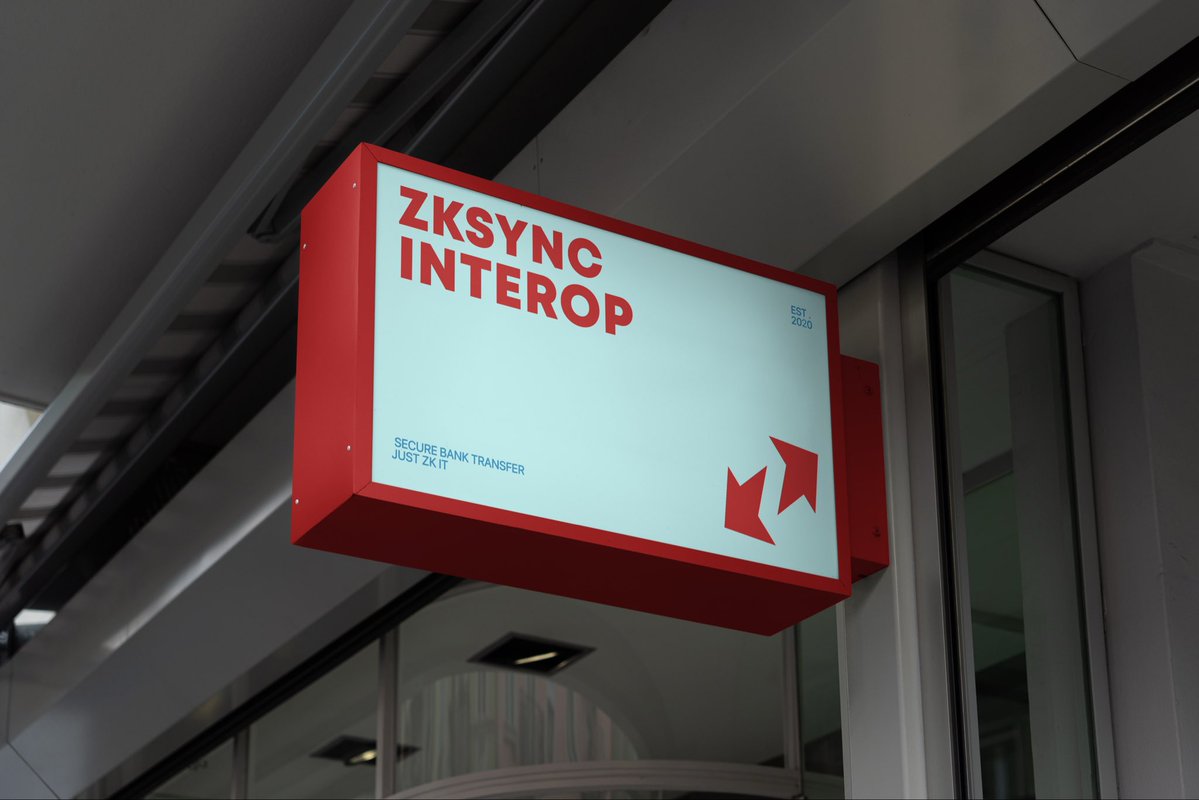
🚨Secure Bank Transfers, Just ZK It.
> ZKsync just made bank money move at light speed.
Do you know banks still run on systems built decades ago? Massive amounts of deposits sit in place, but moving funds between institutions or across different systems often slows down because of outdated settlement cycles, multiple intermediaries taking their share, and capital that stays locked up simply to manage risks. These inefficiencies operate at a scale that becomes clear only when looking closely at correspondent banking and the constant liquidity drag in traditional finance.
This is exactly where ZKsync’s work on the ZKsync Network (consist of more than 15 ZKchain) and native ZK Interop makes a meaningful difference. The foundation goes back to the zkLite days in 2020, and today it delivers native, trustless transfers that settle in roughly one second across public and private ZK chains, all with the full security and finality that Ethereum provides. No external bridges that introduce new risks, and no fragmentation that breaks composability.
The privacy and compliance approach stands out even more clearly through Prividium. Banks and institutions can keep sensitive details, exact balances, counterparties, and internal workflows, completely shielded from public view, while still generating ZK proofs that verify everything on Ethereum. This directly addresses the long standing challenge of balancing real confidentiality for financial data with the need for verifiable, auditable settlement.
The results are already visible with the Cari Network, developed in partnership with five major U.S. regional banks: Huntington, First Horizon, M&T Bank, KeyBank, and Old National. These institutions represent substantial scale, with hundreds of billions in deposits and trillions in assets across the broader group. They are issuing tokenized deposits that remain direct liabilities on the banks’ balance sheets, FDIC-insured, fully regulated, programmable, and capable of moving 24/7 in real time. This upgrades the flow of money within the existing banking system instead of pulling away from it.
For those tracking tokenized real-world assets (in short, RWA’s) and institutional onchain adoption, this represents one of the more practical and grounded developments in the space. It really, genuinely, tackles the actual frictions that have kept traditional finance on the sidelines, while, at the same time, delivering the speed, interoperability, and control that institutions require, without forcing difficult trade-offss.
From the early zkLite through to today’s full ZKsync Network capabilities, ZKsync team has shown a rare consistency. As traditional banking and onchain systems gradually converge, developments like this stand out, because they address the real frictions that have kept meaningful adoption at bay for years. And patient progress is exactly what the space needs if tokenized finance and institutional-grade infrastructure are going to scale sustainably.
So.
Just ZK It.
🚨 Behind the scenes:
Banks are launching tokenized deposits on ZKsync
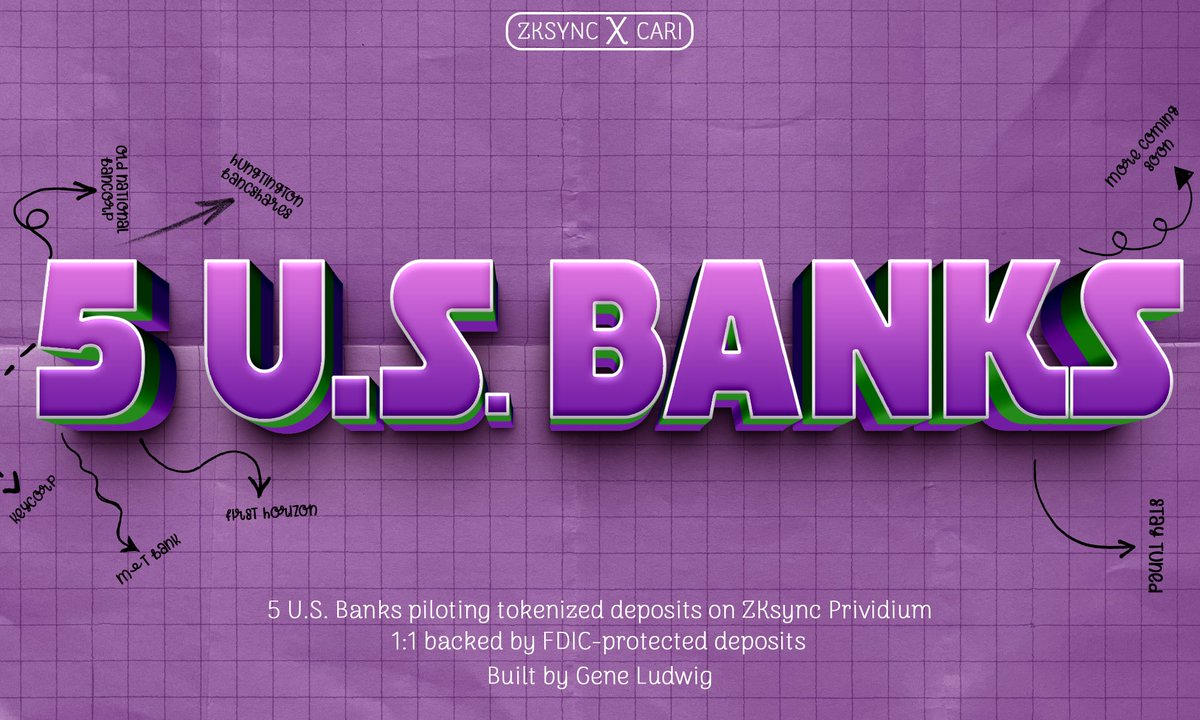
Five U.S. banks are preparing to pilot a tokenized deposit network built on @ZKsync technology.
Participants include:
• Huntington Bancshares
• First Horizon
• M&T Bank
• KeyCorp
• Old National Bancorp
The initiative is called Cari Network, a new banking infrastructure designed to bring tokenized deposits into the regulated financial system.
Here’s the key part most people will miss.
Cari Network is being built on ZKsync’s infrastructure, specifically using Prividium, Matter Labs’ permissioned zk-rollup built with the ZK Stack.
That means the system keeps the controls banks require, while still benefiting from zero-knowledge technology and Ethereum anchoring.
How it works:
• Deposits are tokenized into digital units called “Cari”
• Each token is 1:1 backed by real U.S. bank deposits
• Deposits retain protections like FDIC insurance (within limits)
• Transactions can move 24/7 with instant settlement
• Smart programmability enables automated financial workflows
In other words, it delivers stablecoin-like functionality, but inside the regulated banking system.
The project was founded by Gene Ludwig, former U.S. Comptroller of the Currency and founder of Promontory Financial Group.
Timeline so far:
• Q3 2026: pilot testing with partner banks
• Q4 2026: expected customer launch
Zoom out for a second and the direction becomes clear.
Banks are really not abandoning crypto infrastructure.
They’re adopting it, but on their own compliant rails.
And in this case, those rails are being built with ZKsync.
ZK Is Now Live on Revolut
If you missed this, we want to remind you.
Revolut is not a crypto app. It's the app Europeans use to pay their electricity bill, send money to their mom, and check their balance at the grocery store. 70 million people. And ZK now sits right next to their euros.
15 million users across the UK and EEA can buy ZK. Not through some sketchy exchange they've never heard of. Not after watching a 20 minute tutorial on how to set up a hardware wallet. Through the app they already have on their home screen.
That's the part people are sleeping on.
Zero FX fees on top of that. Which means someone in Germany, France, Portugal, wherever, opens Revolut, sees ZK, buys ZK. That's the whole flow. Nothing standing between curiosity and ownership.
ZKsync has been telling an institutional story for a while now. Settlement infrastructure, enterprise privacy, Ethereum anchoring. Big banks, big numbers, big vision. All real. But institutions move slow. Retail moves when access appears, and access just appeared in front of 15 million people who had never once thought about ZK before.
ZKsync - The Bank Stack of @Ethereum: Send Money Bank-to-Bank in Seconds | v31 Native Interop (ZIP-16) Proposal
The @ZKsync Network is one governance vote away from delivering what institutions have been demanding.
With the ZIP-16 proposal now live on the governance forum for the v31 protocol upgrade, ZKsync is set to activate ZKsync Connect, true native interoperability across public ZKsync Chains and Prividium™ private enterprise chains.
Means no bridges, no middlemen, no extra steps in between. Just a direct, ZK-secured transfer that settles instantly across any ZK chains in the ZKsync network.
- Let’s put it in a simple real-life scenario:
• A bank customer in Ohio sends tokenized dollars to another bank in California, it settles instantly, 24/7, while staying fully private and compliant. Same thing works for stablecoins, tokenized stocks, or any asset.
• Big banks are already testing this. Five major U.S. regional banks (with hundreds of billions in deposits) are building the Cari Network on ZKsync to make exactly this possible in 2026.
- Bonus for ZK holders:
• Every time these bank transfers happen, a small fee goes into the system, part of it in ZK.
The 10 $ZK Fee That Could Turn Every Bank-to-Bank Message Into $ZK Buybacks
For over fifty years the world has run on infrastructure invented in 1973. Seven banks created SWIFT to fix chaotic cross-border messaging. Today it handles 53 million messages daily and routes roughly $150 trillion a year. Looks impressive from the outside.
Well, here’s the thing. Underneath all that volume are the same old 1970s limitations, multi-day settlements, batch processing, layers of correspondent banks, and core systems still written in COBOL, a language older than the internet. Capital sits idle. Opportunity cost piles up, you know. Every coordination between institutions burns time and money that should be working harder.
Not only that, but in March 2026 that era started to end.
Not because the old system broke down, but because something far better finally arrived.
With governance proposal v31 (ZKsync Connect native interop) now active, ZKsync has turned on something transformative. Atomic, programmable interoperability across any Prividium chain and the entire ZKsync network.
Every time two banks need to settle, pledge collateral, move tokenized assets, or sync state, it can now happen in roughly one second. Privately. Compliantly. And with a small protocol fee attached.
That fee is 10 $ZK per interop call.
Sounds tiny on its own. 10 ZK Token doesn’t feel like much. But scale changes everything. Because it’s not one call, it’s thousands. Not one bank, it’s hundreds. Not once a day, but constantly. And when all of that starts stacking, that “small fee” turns into a continuous stream of value flowing back into the system.
And this is where it starts getting really interesting…
Under ZKsync’s evolved tokenomics direction, 100% of protocol revenue, including every single interop fee, flows back into value accrual for $ZK: open-market buybacks, programmatic burns, staking rewards, and ecosystem growth.
The fee is simple (as described above): 10 ZK Token per call.
But zoom out for a second, picture this.
A single large bank or consortium can easily generate thousands of these coordination events every day, treasury movements, collateral adjustments, settlements, compliance syncs… it adds up fast.
Now scale that.
With ~100 major banks and consortia running Prividium chains (a pretty conservative near-term number), the volume becomes structural.
Even capturing a small slice of SWIFT’s ~53 million daily messages pushes this into hundreds of thousands… even millions of interop calls per day.
A rough, conservative view:
500,000 calls/day × 10 $ZK = 5 million ZK Token per day flowing into the protocol.
And that’s just the starting point.
At higher adoption, this easily moves into tens of millions of ZK Token daily, from actual usage, really. Sustained buy pressure, permanent supply reduction through burns, and real staking yield tied straight to institutional activity.
This is the first token that’s positioned to earn from the high frequency, high margin coordination that has always powered traditional finance.