Kubrick. Lucas. Jonze. Nolan. Clarke.
Jobs. Luckey. Musk. Bezos. Zuckerberg.
Every great breakthrough started as fiction.
Tell your story. Make it reality.
Fiction is the future.
'I took the IQ test as a kid. They pulled me aside and told me I'm an idiot.'
From an IQ test score of 80 to multiple successful exits.
@sahin has lived nine founder lives: four companies in Turkey, four in Silicon Valley, and now his ninth venture.
From doing 1,000 meetings through Calendly to landing key partnerships remotely, this is a conversation about speed, risk, and the founder toolkit that makes the impossible feel normal.
Here's what we spoke about:
01:15 First business at 12
03:12 Video games, coding, and first real company
06:53 The founder pain that led to his current company
08:21 AI, entrepreneurship everywhere, and a new kind of capitalism
17:33 History, welfare, and why wealth can become service
19:58 His philosophy on risk
22:48 Betting on remote work before everyone else
27:20 Remote can build $100M, but $100B needs proximity
35:08 Religion, meaning, abundance, and the future of life
40:42 Advice to his younger self, investing, and the IQ story
🎶 It's the edge of the world and all of Western civisliation 🎶
sequel membership is now open to athletes, artists and entrepreneurs.
I'm moving to California.
'We're deeply aware that we are not the main characters' - tomorrow we share our new platform for founders.
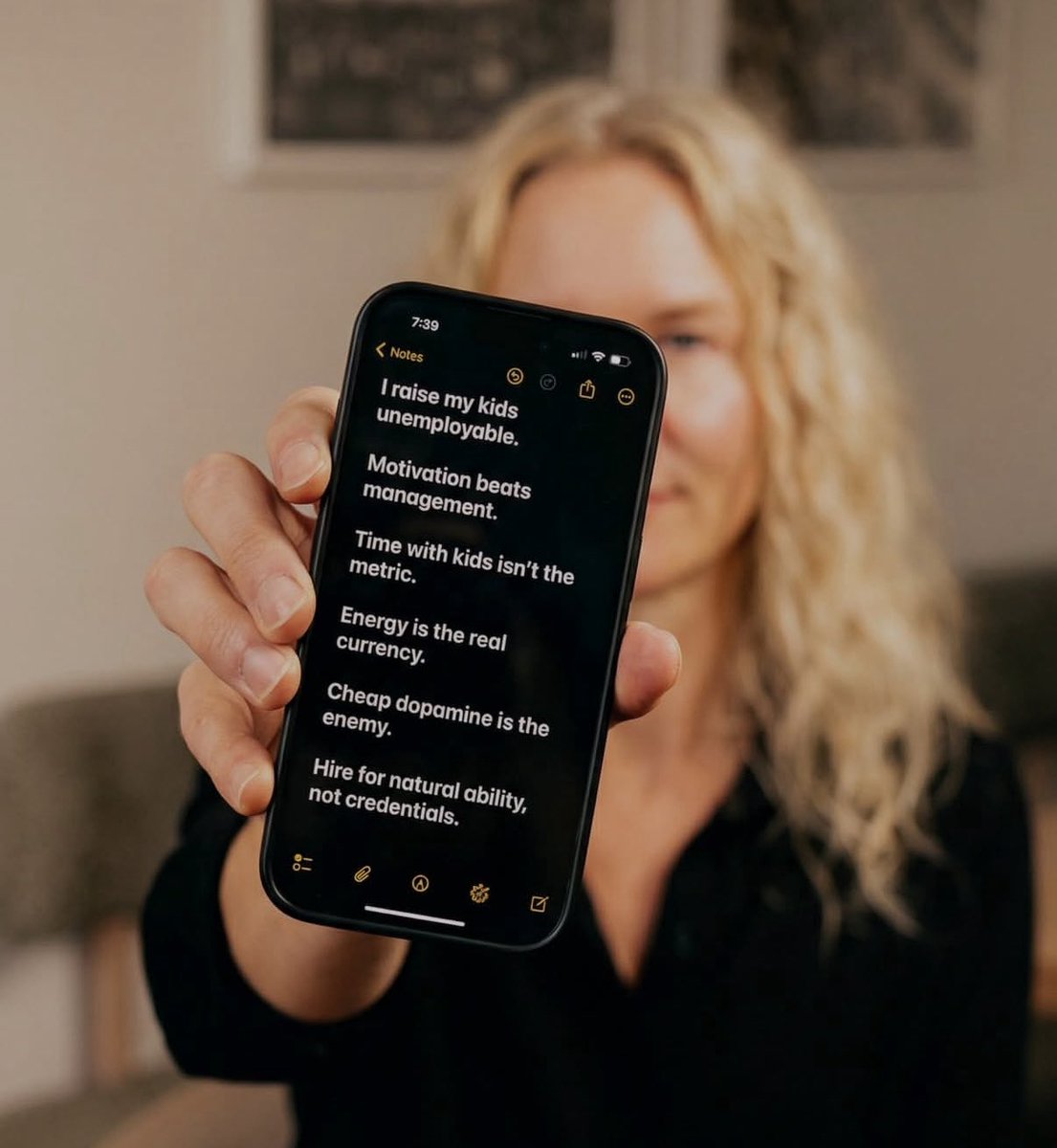
'I raised my kids to be unemployable.'
How do you build “big” without your family paying the price?
@AnasKoroleva is a four-time exited founder and the host of The Exit Paradox podcast. She has an unrivalled knowledge of Post-Exit pitfalls.
She is also the mother to 3 fascinating children, and in this episode she shares the techniques and processes on how she raised them.
From how she thinks about motivation to the boundaries that protect family time, this is a conversation about building success that doesn’t cost you what matters most.
Here's what we spoke about:
2:07 - Turning problem-spotting into a competitive advantage
6:34 - Hiring how people sell themselves
11:05 - Work + parenting pressure
11:19 - How to not fail the kids while also not failing the businesses
17:26 - Incentives as a tool for shaping behaviour
21:36 - Cheap dopamine and how it shapes attention and habits
27:52 - Sunk-cost loop, throwing good money after bad and getting stuck
35:41 - Angel investing vs cashflow businesses
40:07 - Raising your children to be unemployable
43:18 - Brain chemistry as a major driver of sustained change
How can a $100m+ exit leave you lonely, depressed and confused?
The typical unicorn founder is not a 20s college-drop out.
Founders who start in their 30s have a 14% higher chance of starting a unicorn than the average founder.
Which begs the question - how can you be a great founder and a great parent?
@AnasKoroleva has started and exited 4 companies, including her first $100m+ exit 13 years ago...
What should be a crowning moment in anyone's life, right?
No.
It cost her her marriage, friendships and millions. She found herself depressed, confused and lonely.
Since then she's sought wisdom and therapy through speaking to hundreds of exited founders.
Through this she built a solid foundation for her life, including for her children (who are all becoming very successful in their own right).
One of the secrets she discovered to being a successful mother & founder: creating artificial constraints.
'I raised my kids to be unemployable.'
How do you build “big” without your family paying the price?
@AnasKoroleva is a four-time exited founder and the host of The Exit Paradox podcast. She has an unrivalled knowledge of Post-Exit pitfalls.
She is also the mother to 3 fascinating children, and in this episode she shares the techniques and processes on how she raised them.
From how she thinks about motivation to the boundaries that protect family time, this is a conversation about building success that doesn’t cost you what matters most.
Here's what we spoke about:
2:07 - Turning problem-spotting into a competitive advantage
6:34 - Hiring how people sell themselves
11:05 - Work + parenting pressure
11:19 - How to not fail the kids while also not failing the businesses
17:26 - Incentives as a tool for shaping behaviour
21:36 - Cheap dopamine and how it shapes attention and habits
27:52 - Sunk-cost loop, throwing good money after bad and getting stuck
35:41 - Angel investing vs cashflow businesses
40:07 - Raising your children to be unemployable
43:18 - Brain chemistry as a major driver of sustained change
We think we understand the finances of professional footballers.
Salaries. Cars. Headlines. End of story.
The reality is far more fragile and far less talked about.
@mattjpsmith played 500+ games for Leeds, Fulham, QPR & Millwall.
Unlike most players, he didn’t outsource every decision.
University. MBA. Now co-founder of @joinsequel, a venture firm helping athletes think long-term.
What he reveals here is uncomfortable listening at times:
- Players paying tax on undisclosed agent fees
- Contracts with zero transparency
- Careers ending with no plan, no structure, no purpose
It’s an industry that discourages education, ownership and long-term thinking and the consequences that follow.
In this episode we discuss:
⚽ Why footballers often delegate every major life decision and why that backfires
💰 The hidden realities of agent fees, tax bills and financial exposure
📉 How fragile many football clubs actually are behind the scenes
🧠 Why education and decision-making matter more than earnings
📊 Venture investing, outliers and how athletes should really think about wealth
🔄 Transition, retirement and the identity shock players aren’t prepared for
This conversation explains why so many players struggle after football and what actually needs to change.
Youtube 👉 https://t.co/V8AynCSJ1B
Spotify 👉 https://t.co/khjRKfrTNM
Apple 👉 https://t.co/3cUD8S5xvA
All on Business of Sport 🔥
"They say in sport, you die twice.”
From applying for jobs at Accenture & Bain to 600 games in the Championship, @mattjpsmith's path to professional football was anything but conventional.
A University footballer. Going out three times a week. Then a scout spotted him…
15 years later, he's one of the longest-serving Championship strikers in history.
Now he's navigating the hardest transition of all: life after the game.
Here's what we spoke about:
2:28 - How spinning plates early made the transition easier
4:02 - The identity crisis no one prepares you for
10:14 - "I never had the most natural God-given talent"
11:21 - Why he's a big believer in the 1%
14:04 - What his dad sacrificed before anyone believed
17:37 - Advice to his 16-year-old self
25:46 - The myth that athletes have no spare time
28:43 - How Harry Stebbings reached out over Twitter—and what happened next
30:17 - The hardest part: being out of favour with managers
33:03 - The phone call that changed everything—wages slashed 50%
42:10 - "Always spin your plates early"
42:58 - "Try to be the dumbest guy in the room"
I’m thrilled to announce that I’ve recently joined the Athlete Advisory Board at @joinsequel.
They’re creating an outstanding platform designed for athletes to connect with peers, build valuable networks, access high-quality educational resources, and selectively engage in exciting investment deals.
How was 2025 for the @joinsequel team?
The scorecard is out...
Thank you to:
- the 18 new founding teams who chose to partner with us
- the 174 new pro athlete members who trusted us to grow our AUM 4.4x
- the 30 top tier funds who co-invested with us
- my team who created 460 pieces of content, 4 documentaries, 9 events and 147 introductions for portfolio companies
Some huge changes coming in 2026 as we continue to build out the sequel platform.
'Was I happy? No. I was a monster. That was part of my winning mindset.'
From sleeping on the streets of Paris to lifting the Champions League trophy. Sequel member Patrice @Evra 's story is proof that greatness isn’t given, it’s earned.
A five-time Premier League winner.
Manchester United legend.
Captain for France.
We sat down with Patrice Evra to talk about life after football. Finding identity beyond the game, fighting racism, surviving abuse, and redefining what purpose really means.
An honest conversation about greatness, discipline, and what it takes to succeed.
Here's what we spoke about:
3:04 - Finding his identity after football
5:48 - How storytelling changed his life
6:26 - Surviving childhood abuse
6:47 - “I’m not a victim, I’m a survivor"
9:29 - Discipline born from survival
13:01 - Buying his mum a house at 24
17:50 - His brutal Premier League “welcome”
19:57 - The moment that changed everything
23:28 - His mum’s strength and resilience
26:50 - Why he has zero regrets
29:13 - Losing £10 million and laughing
31:55 - Believing in himself from day one
36:09 - What success really means: sacrifice
Does the world need more listeners or more rebels?
From bootstrapping an idea to building a billion-dollar company.
Michele Attisani, along with his partners, built FACEIT, one of the leading esports platforms, scaling it to over 30 million users before a $1.5B exit.
Here's what we spoke about with @Mattisani :
1:53 - The emotional cost of building a billion-dollar business 
3:04 - What really happens after you sell a $1.5B company 
3:30 - The identity crisis no one warns founders about 
4:02 - The first emotion after the exit
5:14 - Investing in 70+ startups and what he looks for 
5:40 - The evolution of AI and machine learning 
6:49 - The first thing he bought after the exit
7:09 - Does success make you more or less cautious?
8:13 - Why the world needs more rebels
8:46 - The most overrated advice in entrepreneurship 
9:12 - The real test of whether you’re meant to be a founder 
9:32 - Why everyone thought they were insane
10:01 - Embracing ambiguity
11:56 - Democracy has failed
Talent is upstream of both sales and fundraising.
The very best founders prioritise hiring, developing and retaining talent ahead of all other processes.
If you want to learn more about @NStoronsky 's hiring and performance playbooks - he actually publishes them on the Quantum Light website (his investment vehicle): https://t.co/bfVNK2MS3J
'If it doesn't hurt, you're not doing it right.'
From the early days inside Revolut’s rise to becoming one of the youngest partners in @sequoia history, @_georgerobson has spent his career operating in the highest-performance environments.
He’s developed a rare eye for spotting winners, and understanding what it takes to build successful companies.
George opens up about his leap into Revolut, the lessons that defined his career, and the founder signals he looks for today.
Here's what we spoke about:
3:02 - Why Sequoia cares more about who you were before 21
4:14 - The difference between being driven and being ambitious
5:26 - Discovering the highest talent density of his career
5:40 - “We care more about slope than intercept”
7:44 - The founder question that matters more than the pitch
8:26 - Why hiring impressive CVs is usually a mistake
9:11 - Culture as a social contract
9:31 - “If it doesn’t hurt, you’re not doing it right”
11:55 - How Revolut taught him radical clarity and conflict
16:29 - Long-term thinking as a muscle most people never train
20:16 - What success really means
Humanity's Propulsion System: Storytelling
Investors and founders often talk about the power of storytelling from a capital raising perspective.
While this is a skill required to accumulate resources - this is a crude simplification of the importance of storytelling to mankind.
Stories are not simply vulgar tools for short-term gain.
Stories are not relics.
They’re not dusty records of what once happened or flat instruction sheets for what might be...
Stories are engines.
Sparks that detonate in the minds of the next generation and push humanity forward.
Every breakthrough begins as a story believed before the world is ready for it:
- Heroes heard tales of courage long before they ever stood in danger.
- Innovators imagined new worlds because someone else once sketched the outline.
Stories shape identity, sharpen ambition, and plant the ‘dangerous’ idea that the impossible is simply the unattempted…
Civilizations advance through this cycle:
a story inspires a mind -> that mind creates a leap -> the leap becomes a new story for those who follow.
Storytelling isn’t just entertainment.
It’s the mechanism of progress. Humanity’s propulsion system.
It’s how we move forward.
Humanity's Propulsion System: Storytelling
Investors and founders often talk about the power of storytelling from a capital raising perspective.
While this is a skill required to accumulate resources - this is a crude simplification of the importance of storytelling to mankind.
Stories are not simply vulgar tools for short-term gain.
Stories are not relics.
They’re not dusty records of what once happened or flat instruction sheets for what might be...
Stories are engines.
Sparks that detonate in the minds of the next generation and push humanity forward.
Every breakthrough begins as a story believed before the world is ready for it:
- Heroes heard tales of courage long before they ever stood in danger.
- Innovators imagined new worlds because someone else once sketched the outline.
Stories shape identity, sharpen ambition, and plant the ‘dangerous’ idea that the impossible is simply the unattempted…
Civilizations advance through this cycle:
a story inspires a mind -> that mind creates a leap -> the leap becomes a new story for those who follow.
Storytelling isn’t just entertainment.
It’s the mechanism of progress. Humanity’s propulsion system.
It’s how we move forward.
@julianweisser Our storytelling is rooted in the classics. Herodotus.
Stories are engines. Sparks that detonate in the minds of the next generation and push humanity forward.
https://t.co/OXde8QrVjT
Humanity's Propulsion System: Storytelling
Investors and founders often talk about the power of storytelling from a capital raising perspective.
While this is a skill required to accumulate resources - this is a crude simplification of the importance of storytelling to mankind.
Stories are not simply vulgar tools for short-term gain.
Stories are not relics.
They’re not dusty records of what once happened or flat instruction sheets for what might be...
Stories are engines.
Sparks that detonate in the minds of the next generation and push humanity forward.
Every breakthrough begins as a story believed before the world is ready for it:
- Heroes heard tales of courage long before they ever stood in danger.
- Innovators imagined new worlds because someone else once sketched the outline.
Stories shape identity, sharpen ambition, and plant the ‘dangerous’ idea that the impossible is simply the unattempted…
Civilizations advance through this cycle:
a story inspires a mind -> that mind creates a leap -> the leap becomes a new story for those who follow.
Storytelling isn’t just entertainment.
It’s the mechanism of progress. Humanity’s propulsion system.
It’s how we move forward.
'If it doesn't hurt, you're not doing it right.'
From the early days inside Revolut’s rise to becoming one of the youngest partners in @sequoia history, @_georgerobson has spent his career operating in the highest-performance environments.
He’s developed a rare eye for spotting winners, and understanding what it takes to build successful companies.
George opens up about his leap into Revolut, the lessons that defined his career, and the founder signals he looks for today.
Here's what we spoke about:
3:02 - Why Sequoia cares more about who you were before 21
4:14 - The difference between being driven and being ambitious
5:26 - Discovering the highest talent density of his career
5:40 - “We care more about slope than intercept”
7:44 - The founder question that matters more than the pitch
8:26 - Why hiring impressive CVs is usually a mistake
9:11 - Culture as a social contract
9:31 - “If it doesn’t hurt, you’re not doing it right”
11:55 - How Revolut taught him radical clarity and conflict
16:29 - Long-term thinking as a muscle most people never train
20:16 - What success really means