Slides for a new paper are now on my site (and below).
"Shockingly simple monetary shocks".
Joint work with Mu-Chun Wang.
Abstract: We identify monetary policy shocks by imposing that they produce a positive, monotonically declining path for nominal rates. We impose no restrictions on other variables, nor do we rely on external information. Nonetheless, this produces IRFs closely resembling those produced using high frequency instruments, with no price puzzle. We justify these restrictions by showing both that they are satisfied in a benchmark medium-scale DSGE model, and by showing that they are satisfied under optimal policy in simple models. Our shocks produce a large, immediate drop in the price level. Thus, the rapid response of prices to monetary shocks observed in recent studies is not an artefact of high frequency identification.
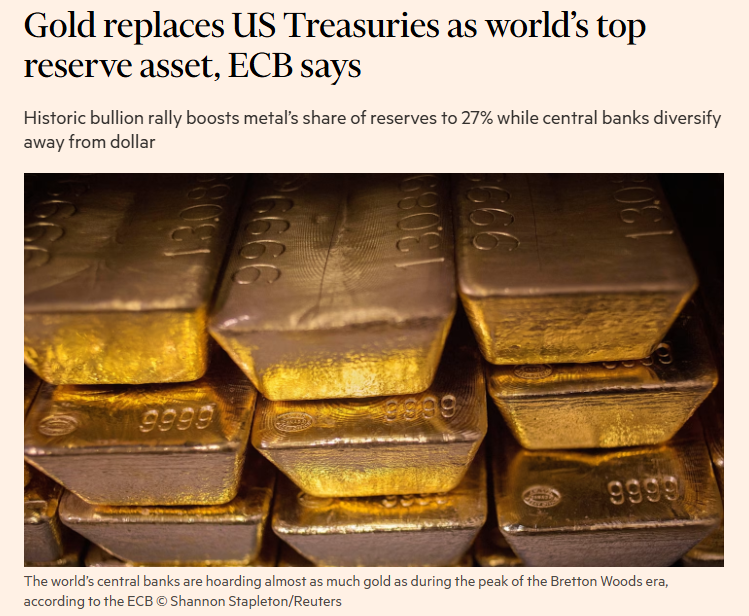
On today's FT- Gold has replaced US Treasuries as world’s top reserve asset(!) Fantastic excuse to advertise our new WP "Fool's Gold" with the great @KaiArvai @NunoCoimbra (both sadly✝️on X) where we rationalise the rise of gold via theory&empirics👉https://t.co/zmm3YSklPX 1/6
"Well, I’m glad that the EC has a pre-prepared “toolbox” of terrible ideas so that Member States don’t have to come up with terrible ideas all on their own."
The famous Diamond–Dybvig (DD) model sees bank runs as panics. Evidence from 4,000+ historical runs says otherwise. Another empirical nail in the DD coffin. (1/2)
Decline is a choice, not a fate.
Today, with @LuisGaricano (@LSEnews) and Bengt Holmström (@MIT), we launch The Constitution of Innovation - a manifesto for a new European renaissance.
We make 6 concrete proposals.
Read them at https://t.co/ydHHv0ltMm
#Europe#Innovation 1/6
In discussing the US - EU trade deal, let’s not forget about multilateral resistance. What matters isn’t the bilateral tariff rate, but the bilateral rate compared to the (weighted) average US tariff on the rest of the world.
📢 Hiring for a fully funded #PhD position in Behavioral #Macroeconomics at Uni Groningen, NL.
Work on expectations, biases & policy with lab/survey experiments & DSGE models with me, https://t.co/wde9ZlSWbE, @chrisvdkwaak
Start: Sept '25
Deadline: 25 May
🔗 Apply: https://t.co/pCuPZl21Is
#econjobs #econtwitter #economicscareers #EconPhD #RAJobs @EconJobs_com@Econ_jobs_@FindAPhD@Studyportals@econ_ra
Sharing an updated @BoE_Research version of my working paper with Niki Anesti & Vania Esady showing that food prices matter most for household inflation expectations. Many new results including uncovering persistent, non-linear, and asymmetric dynamics.
https://t.co/oRc3W6YAEi
Also, one should only "look through" supply shock inflation when inflation expectations are well anchored. That is not case for U.S. public right now given the scarring from the pandemic inflation. U.S. public is far more allergic now to inflation. I will expand on this in newsletter. Sign up here: https://t.co/OcJjhOgQhM
Huge demand shock as perceived by markets:
- Bund surge is matched by risk-free OIS rate
- higher real rates and higher inflation compensation matter
- term premium surge due to higher duration risk; slight increase in swap spread; no change in credit risk indicators
- Euro up
@BachmannRudi@bornecon@christianbaye13 We have an RCT on this in the UK (similar to https://t.co/crH4NtgQ0U for the EA) and find quite significant negative effects of inflation uncertainty on household spending. @PSchnattinger
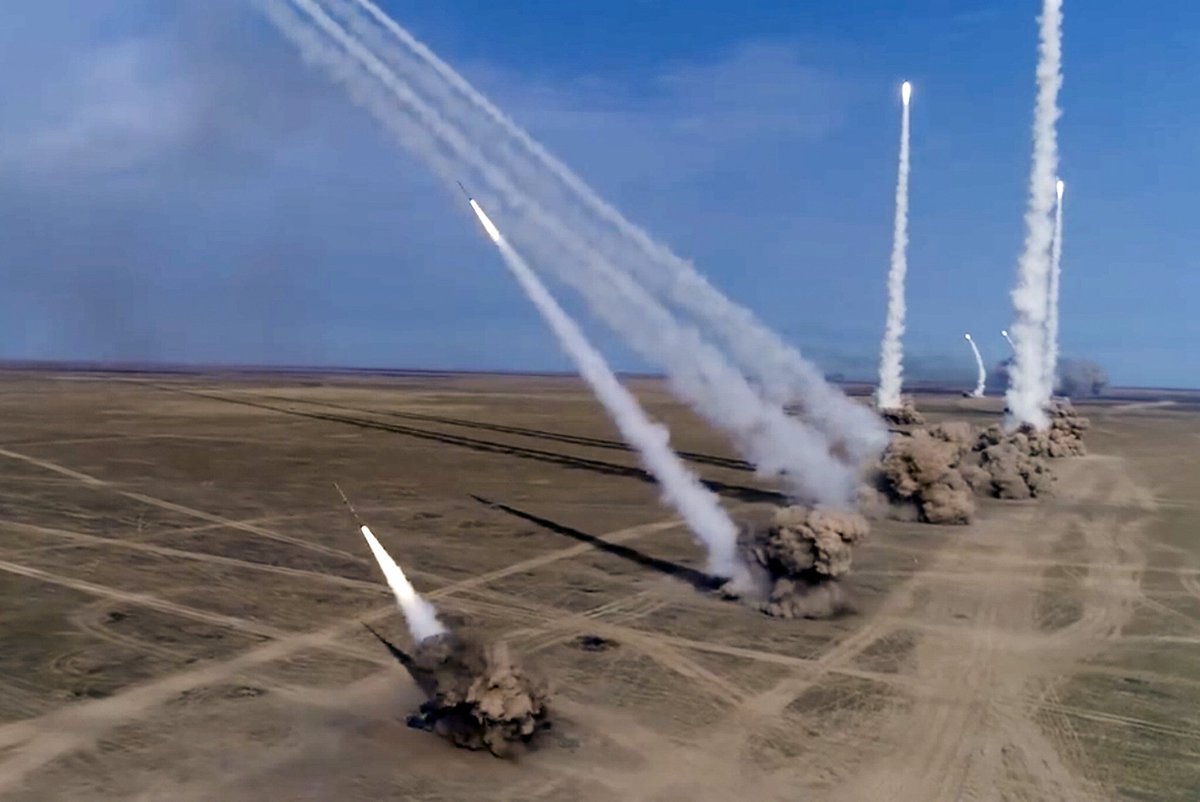
In this thread, I will explain why we are much closer to war with 🇷🇺 than most people realize and why our time window for rearmament is shorter than many believe. In my opinion, we have at best 2-3 years to re-establish deterrence vis-à-vis 🇷🇺. Here's why 👇 1/20
It's high time to have another look at interesting papers like this one!
"To what extent are tariffs offset by exchange rates?" by Olivier Jeanne and Jeongwon Son John.
Article in the J. Int. Money Finance:
https://t.co/a0Vk0rbVVM
Working paper:
https://t.co/Roe3RZ1HfT