Founder @DealStreetAsia (Nikkei Group). Journalist-entrepreneur.
@himangi_t's partner, blessed to be a father of two.
jojiphilip at dealstreetasia dot com
#WATCH | Dundigal, Telangana: Indian Air Force chief Air Chief Marshal AP Singh says, "It was really a dream come true. I started my journey with the same aircraft. I think I must be the only chief who's retiring while the basic aircraft he flew is still serving. So I think I'm very grateful. I'm very grateful to my instructor, VS Kochhar sir, who taught me flying in the beginning in this place itself. So I just wanted the circle to be complete. And I did my first sortie on 28th January, way back in 1984, in this very place with him, and today I did my last sortie in uniform with him in the same aircraft..."
Why Bill Ackman Expects a Venture Blowup
Bill Ackman says AI raises the risk of disruption for every business, and that even companies that look dominant today may disappear. He expects venture capital to hit a high-profile blowup, and tells founders to raise money now but spend it as if it were their own. Pershing Square owns only highly predictable companies, keeps its team stable for years, and does not use AI to build models. Ackman is also copying Buffett's playbook at Howard Hughes, where an insurer, permanent capital and a 47% stake are meant to let him think in decades. These signals are from an interview that @shaneparrish did with Bill Ackman on @TKPPodcast (The Knowledge Project)
1. Rehab Has No Payer. Bill Ackman says brain injury care breaks down after the surgery, because nobody is paid to follow the patient's recovery. Neurosurgeons are highly compensated for operating, many hospital rehab programs are "embarrassingly inadequate," and an insurer might pay for only 6 weeks of care. The head of rehab at Mass General told him the typical surgical patient ends up in a nursing home and dies a few months later from pneumonia. Ackman thinks technology can fill the gap, starting with AI as a speech therapist where a human one can cost $500 an hour. The institute he is building focuses on brain rehab, recovery and longevity, and he wants everyone to get the benefit. He also plans real food for patients, since he calls hospital meals frightening.
2. Zero Turnover. Pershing Square's investment team has stayed the same for 9 years, apart from a few additions. Ackman says that in an industry where top people move for $100 million bonuses, a revolving door leaves you unsure whether anyone is telling you every risk. After 9 years of candor, he doesn't question anything the team tells him, and he now generates only a minority of the portfolio's ideas. That frees him to work on strategy.
3. FOMO Pricing. Ackman sees bubble-like behavior in venture. A company he met that wasn't raising was preempted two days later by an investor who put in $50 million at a $400 million valuation, and two weeks after that it raised $50 million more at $1 billion. He also saw a Series A at a $5 billion pre-money. He describes a bubble as more and more money chasing one trade out of fear of missing out, until valuations overshoot. Berkshire stock hit an all-time low in the internet bubble because Buffett sat out the boom, and Ackman says staying out depends on whether you think short-term or long-term.
4. Raise Now, Spend Carefully. Ackman calls this a great time to raise capital and tells founders not to spend it as if the money will be there forever. In the internet bubble, a weekend Barron's piece listed every public internet company's cash and its months left before zero, probably the week before the market blew up. He expects another high-profile blowup where people lose a lot of money and the market resets. Companies with years of runway will survive, and the ones that must raise in 3 months will be gone. His advice is to treat every dollar as your own.
5. Bet on the Person. In venture, Ackman weights the founder over the idea, because the original idea is often not the one that works. His best venture investment was Coupang. Bom Kim pitched the Groupon of South Korea in 2009, and Ackman thought Groupon was a bad model, but he liked Kim and his case for South Korea as a launch market. Kim built the Amazon of South Korea, which had little to do with the plan. In public markets a bad CEO can be replaced, and Ackman says the best private companies without their founder are close to a write-off.
6. Disruption Is the Risk. Ackman says an investor's most important job is assessing risk, and AI has massively increased the risk of disruption. Buffett could not see the internet coming for businesses like World Book, and Ackman says every investor is now guaranteed to look foolish on at least one business. His discipline is to predict what a company looks like 10, 20 and 30 years out, and to buy only what he'd happily own if the stock market closed for 10 years.
7. Updates in Days. The pace of AI improvement is the fastest Ackman has ever seen. Microsoft's old 1.0 to 2.0 updates took a couple of years or more, and now a consequential update arrives in days, like a Tesla updating its software overnight. He says "scare" is probably the wrong word, and he wants investors to be thoughtful about how wide a moat really is. Ackman calls predicting disruption the most complicated question an investor faces, and he expects some of the most dominant-looking businesses in the world to disappear.
8. The Library of Companies. Pershing Square holds a library of great businesses it has followed for years but couldn't buy. At 35 times earnings, for example, it is hard to reach the 20%-plus return the firm wants, so the team does the work and sets the name aside. It waits for a macro event to reprice the business. COVID gave it chances, and the "SaaS apocalypse" let it buy Microsoft at what Ackman calls a very attractive valuation, along with other high-quality businesses.
9. The Fresh-Eyes Panel. Two team members do each deep dive, starting with 10-Ks, 10-Qs and call transcripts and moving to expert networks of former employees, industry experts and competitors. They build a model of the return at today's price and present a deck. Ackman and CIO Ryan are usually not the two, but they run an independent assessment that gives them "enough information to be dangerous" to ask the right questions. The other five team members, who haven't done the work on that name, challenge the deck, and the meeting ends in a decision or a list of open issues to chase.
10. Do What Nobody Has Done. Pershing Square uses AI as a research tool and doesn't use it to build models. Ackman says that when everyone has the same access to AI it is hard to be differentiated, and what's left is outside-the-box thinking, because AI reviews everything that already happened. His best investments were things nobody had done: credit default swaps before the pandemic, the stock of a bankrupt company, and shorting AAA credit before the financial crisis. AI would not have told him to do any of them. The same logic made money going into COVID, when the firm was weeks ahead of the world on a global shutdown, and again when it bet that rates would rise on inflation. He says an asymmetric bet, a view different from everyone else's expressed through an instrument that pays far more than the capital at risk, is how you make a lot of money.
11. The Stone Tablet. After a very large loss around 2015 and 2016, Ackman had the firm's investment principles engraved on a stone tablet and put it on his desk. The checklist asks for simple, predictable, free-cash-flow-generative companies, large and liquid, run by a strong management team or one with a named replacement ready. It also lists an aversion to short selling and a requirement that asymmetric bets pay far more than the capital at work. Ackman says a checklist is a good way to avoid mistakes.
12. Asymmetry in Reverse. Ackman never liked short selling, because you can lose infinity and the most you can make is finite. Pershing Square still shorted a company it saw as a fraudulent pyramid scheme, planned to hand the FTC a detailed analysis, and felt the wind was at its back. It underestimated market dynamics when Carl Icahn bought the stock against it, and the trade turned into a hedge fund squeeze on Ackman. Shorting also costs friends: Pershing held the vast majority of the short interest, so everyone else sat on the other side, and the company had built infrastructure to attack its critics.
13. Sell When the Thesis Breaks. Pershing Square bought a meaningful Netflix stake after a subscriber miss and shared its deck with management, who agreed with the thesis and said they would never run ads. A few weeks later Netflix missed subscribers again and said it would launch an advertising model. Ackman's rule is that new information inconsistent with the thesis means you either buy a lot more because the news is immaterial or you exit because the thesis is broken. He exited, because a firm that owns only the highest-certainty companies couldn't accept a much wider range of outcomes, and moved the money into Alphabet. Netflix then executed well and its stock went back to a high multiple. When the stock was later cut in half, Pershing bought it back at a price it liked.
14. A Modern Berkshire. Ackman owns 47% of Howard Hughes and is turning it from a real estate company into an insurance holding company. Pershing Square bought the specialty insurer Vantage Holdings and recruited what Ackman calls the best management team in insurance. The model is Buffett's: hold the float in short-term treasuries to pay claims, put the rest in common stocks, and earn a profit on both underwriting and assets. With liabilities that carry a negative cost, Ackman says an insurer can generate a 20% or higher annual return. Howard Hughes is about 70% real estate and 30% insurance by capital today, and he expects 70% to 75% insurance within 5 years, funded by real estate that throws off close to $300 million of net operating income. Wall Street has wanted nothing to do with the business for 14 years, so the stock still trades at a discount to its assets.
15. Never Forced by Circumstances. Asked about Charlie Munger's remark that Berkshire was almost never forced to make decisions by circumstances, so it always had options, Ackman says Pershing Square designed its business around that. The firm holds anchor stakes in each public vehicle it runs, with employees owning 28% of Pershing Square Holdings and investing more than $500 million in Pershing Square USA. If the market panics and people want liquidity, they can sell the stock while the capital stays in the vehicle, which let the firm buy in the COVID crash and the financial crisis. Ackman says allocators pull money when a fund does well because it gets too big a share of their portfolio, and pull it when it does badly. He traces his biggest investment mistake to being distracted by raising capital for open-ended funds. If the firm compounds at anything close to its historic rate, he says it will manage a trillion dollars in 20 years.
Had an interesting conversation yesterday about the future of established VC firms.
If you’re raising Fund IV or V, don’t own any of the major AI winners, and haven’t generated meaningful DPI, how do you raise another fund?
I think we’re going to see a lot of established managers struggle to raise at their previous fund sizes. Some may have to shrink dramatically. Others may not raise again.
What’s interesting is that a differentiated Fund I manager might actually have an easier story to tell than an established generalist with four funds of mediocre performance.
Curious how other LPs are thinking about this.
Sunak’s Slap in New Delhi: China Is a Superpower, India Is the Aspirant
Multipolar Reality Check: Vietnam Won ‘China+1,’ Not India
Rishi Sunak stood in New Delhi, in front of India’s business elite, and said the quiet part out loud: China is now a peer competitor to the United States. Not India.
For years, since the US–China trade war heated up in 2018, Indian elites have been thumping their chests, declaring India the “next economic superpower.” They told themselves that as America tried to “decouple” from China, India would be the natural replacement. Western think tanks and media fed this fantasy, calling India the “counterweight” to China. But Sunak’s words were a slap across the face: the world has already moved to multipolarity, and India is not sitting at the top table among the 2 superpowers.
Multipolar Reality
Sunak’s statement confirms what many outside the Western bubble already know: the US-led order is finished. Trump is not the cause of this collapse—he’s the symptom. His rise reflects America’s contradictions: a superpower drowning in debt, polarized at home, overstretched abroad. Just like late Ottoman sultans who clung to populism while their empire crumbled, Trump embodies decline, not renewal.
China, meanwhile, has emerged as a full-spectrum rival—economically, militarily, technologically. That’s the reality Sunak acknowledged. And he did it in India, where elites have been desperate to believe they are equal to China. The contrast could not be sharper.
India as “Supply Chain Hub”?
Sunak dangled a carrot: India could be a “trusted partner” and “potential supply chain hub” as the West diversifies away from China. But let’s be honest—this is the same “China + 1” narrative we heard back in 2020. Back then, Western firms said they’d move factories out of China. The winner wasn’t India. It was Vietnam.
Why? Because Vietnam is next door to China, plugged directly into Chinese supply chains. Its ports, logistics, and industrial clusters are integrated with southern China’s manufacturing ecosystem. Multinationals could shift assembly lines to Vietnam without breaking their supply chain backbone. India, by contrast, was too far, too bureaucratic, too expensive in logistics, and too unpredictable in policy. India had a PR win over China – when it was crowned “most likely to succeed” in China + 1 as Modi was a good friend of Trump! See where Modi is now with Trump?
India’s Missed Chances
If India truly wants to be a manufacturing hub, it needs to face hard truths:
1.Foreign investment friendliness – Investors complain about red tape, sudden tax changes, and weak infrastructure. India must fix this.
2.Integration with Chinese supply chains – Pretending you can replace China is fantasy. The smart move is to plug into China’s ecosystem, not fight it. Vietnam understood this. India resisted, and lost.
3.Geopolitical realism – India wants to be a “swing state,” hedging between blocs. But hedging only works if you have leverage. Without manufacturing depth, India’s leverage is limited.
OECD Debts near Breaking Points?
Western debt markets are turning into a casino. Just look at US, Japan and France.
Sunak warned tech firms may soon issue more debt than the US government, showing how private capital dominates—chasing quick profits and leaving economies unstable.
In my opinion, China’s model is different. Debt is directed by the state, used to build railways, factories, and green tech, not gamble on short term returns. This approach is civilizational: China has always valued stability and long term planning. For developing countries, that predictability is far more sustainable than Western finance, which is predatory and short lived. In a multipolar world, China’s debt system looks built to last.
The Bigger Picture
Sunak’s speech in India was more than a policy talk. It was a reality check.
•China is the new superpower and peer to the US.
•India is still the aspirant.
•Multipolarity is here.
•OECD debts are worrisome
For India, the choice is stark: keep chasing the fantasy of replacing China, or accept reality and integrate with the Chinese supply chain while reforming its own investment climate. Otherwise, India risks being left behind, watching Vietnam and ASEAN reap the benefits of diversification.
Conclusion
Sunak’s words in New Delhi cut through the illusions. The US-led order is gone. Trump is the symptom of America’s decline. China is the peer competitor. And India? Still waiting for its moment, but unless it changes course—making itself investment-friendly and integrating with China—it will remain on the sidelines of the multipolar world.
https://t.co/psYyu1ySbT
Most in the West don't care a fcuk..... the country is led by a whimpering coward & every second person I know will give anything & everything to get out...
travel with an Indian passport and you'll know where we stand globally!
A few things happened:
1. Narendra Damodardas Modi refused to compromise against anything that is remotely anti-India
2. PM Modi created a global aura for the country, which vanished under Manmohan Singh
3. FCRA BILL. Follow the money, honey. It’s loading bro 👊⏳
4. How can a once colonised nation even dream of becoming a global superpower?
5. The Lutyens brigade was losing their sheen, shine and moon
6. The Bengal defeat was a crushing blow - PAKISTAN’s ISI and money from human trafficking and drugs are now going to waste. As well as a few terrorists
7. Some foreign investors are losing long term and short term hedges
Now, if you can connect the dots…
Some of you will…
Wait till he hits Singapore! And not even a domestic flight, but every flight is international….there is a different world out here…no passport needed, no immigration for residents..
There is no faster city for flying than San Francisco.
9:10pm: Leave house
9:32pm: Arrive at SFO
9:40pm: Get to gate
9:43pm: Boarding starts
9:48pm: At seat
I’ve never done a 38min house-seat time before.
The smartest Indians continue to come to build in the US for the simple reason that the economic incentives are far far better.
Perplexity ($20B), Skild ($14B+), Baseten ($13B), Together ($8B), Glean ($8B), Modal ($5B), Rubrik ($25B), Harness ($5B), Blacksmith, Parallel, Greptile, CodeRabbit, Composio, Distyl ($2B), Resolve, Luma, Cartesia, Wispr, dMatrix, Arize and many more - all started by at least one Indian-born founder.
The US is a far easier to raise capital in with far less dilution. Most Indian companies are switching where they're domiciled to get access to the US capital markets. Every single Indian venture firm is trying very hard to invest in the US or risk not participating in the AI race (ironically, the management fees of venture firms are so high in India relatively that this is the one group that net of carry actually has incentive to be in India because they take home well north of a living wage whether or not funds perform do)
While Zomato ($35B now, $8B at IPO) might be the biggest outcome in Indian venture, Cursor ($60B), Reflection (potentially $20B+), World Labs ($8B), OpenRouter ($8B), HuggingFace ($12B) and of course the $1T+ big labs quickly make those outcomes seem small and happen on a much smaller time scale, with much higher IRR.
Engineers at these startups regularly get paid $1M/yr, and make $10M+ on exit. Even in BigTech, it is trivial to pull up levels fyi and see that if you're L6/L7+ with ~10 years of experience, you're making $1M/yr there too. And of course, we all know the slew of Indian CEOs of companies here, not to mention a huge bench of lesser known executives across the board in public and private companies.
I say all this because every time there is a slight immigration hiccup in the US, I hear the online pleas to "build in India", I struggle to understand why most engineers, academics or founders would do that net of desire to be close to family, failure to obtain visa and devout patriotism.
This is not a superiority thing or a US v India thing. The economic incentives at least for technologists to being in the US outweigh India by at least an order of magnitude.
It is very notable, how American techies want to help these scumbag “protesters”.
Jack Dorsey is pushing BitChat, to enable these rabid mobs to organize even when mobile networks are jammed and disrupted by Indian police and security forces. Elon Musk wants to open the avenue of Starlink to give these toxic mobs internet access at his personal will, defying India’s government and security considerations. Meanwhile, Instagram and X are being flooded with propaganda to brainwash more of the youth.
These are not accidents or coincidences, it is a deliberate design. It is a full-scale information war.
I call upon my fellow Indian tech entrepreneurs, investors and executives - speak out against these god-complexed madmen, whom many regard as icons to emulate, because they are out to balkanize and destroy India by all means possible.
These fanatic tech elites would be quite happy to reduce India into a Pakistan-type mistress to be used and abused at will - a market to be exploited and a human resource pool to be consumed. They have no humanitarian consideration or cultural regard whatsoever for your society, way of life and civilization.
I also call upon @DelhiPolice to use the full force of law, and take on these street thugs portraying themselves as “youth”, who are trying to effectively capture and immobilize Delhi - rain blows on them, smash their bones if required. Cripple them permanently if they take to violence - no mercy. @HMOIndia
Remove 190 nuclear weapons from India, and it would look like an upgraded version of Somalia. From the moment we wake up to our alarms to the moment we fall asleep scrolling through social media, so much of our daily technology depends on the US.
The Indian government is making excuses. We’re already deeply connected to global technology, and absolute security in today’s digital world is almost impossible. Going against Elon Musk, one of the most influential figures in the tech industry, could eventually cost India more than it gains.
Not today, not tomorrow, but eventually, i believe the Modi government will allow Starlink to operate in India.
India should focus on building a partnership with Starlink. Elon is a technological visionary, and allowing Starlink into the Indian market could create more opportunities for India and its people.
🚨 Pep Guardiola sobre Lionel Messi diciendo que sus piernas ya no podían darle más:
“El problema con Lionel Messi haciéndose mayor es que ha decaído hasta el punto de seguir siendo el mejor jugador en el campo.
Así que la gente no le cree.
Vi su partido de despedida.
Un gol. Dos asistencias. A los 39 años.
Después alguien me mostró el clip donde Leo corría persiguiendo un balón y la gente decía: ‘¿Este es el mismo hombre que dice que sus piernas no pueden darle nada más?’
Yo dije: ‘Sí. Eso es exactamente lo que quiere decir.’
Porque tú estás comparando a Messi con los otros jugadores en el campo.
Leo está comparando a Messi con Messi.
Son dos estándares completamente diferentes.
Recuerdo una vez en el Barcelona, después del entrenamiento, uno de mis ayudantes me dijo: ‘Pep, estuvo increíble hoy.’
Le pregunté: ‘¿Quién?’
Me miró como si fuera estúpido.
‘Leo.’
Dije: ‘No. Hoy fue normal.’
Se rio.
No estaba bromeando.
Esa fue una de las cosas más extrañas de entrenar a Messi. Algo sucedía en el entrenamiento que detenía a todo el mundo, y después de un tiempo dejamos de reaccionar.
¿Tres jugadores alrededor de él?
Normal.
¿Cuatro?
Normal.
Recibe el balón, gira y de repente todo el mundo corre hacia su propia portería?
Normal.
Un día recuerdo decirle a Xavi: ‘Tenemos un problema.’
Me preguntó: ‘¿Qué?’
‘Nos está haciendo pensar que estas cosas son normales.’
Xavi sonrió.
‘Entonces espera a que se vaya.’
Esa frase se quedó conmigo.
Porque creo que una generación está experimentando el mismo problema ahora, pero al revés.
Se encuentran con Lionel Messi al final y piensan que esto es Lionel Messi.
Lo ven a los 39, lo ven crear dos goles y marcar otro y dicen: ‘¿Qué piernas ha perdido?’
Amigo mío, llegaste al cine durante los últimos diez minutos.
No tienes ni idea de lo que pasó antes de que te sentaras.
Imagina a un niño viendo este partido con su padre.
Pregunta: ‘Papá, no entiendo. Messi sigue siendo el mejor jugador. ¿Por qué se retira?’
Su padre no debería mostrarle otro partido de 2026.
Muéstrale 2011.
Muéstrale 2012.
Muéstrale 2015.
Luego dile al niño: ‘El hombre que estás viendo ahora solía hacer todo esto con piernas que podían hacer lo que su cerebro pidiera.’
Esa es la diferencia.
Hoy Leo ve el pase antes que tú.
En aquella época veía el pase antes que tú, lo jugaba y luego llegaba a otro sitio antes de que entendieras qué había pasado.
Hoy todavía puede vencerte con su mente.
En su mejor momento, desafortunadamente, la mente tenía el cuerpo con ella.
Eso era injusto.
Recuerdo a defensas mirando hacia nuestro banquillo a veces después de que Leo hiciera algo, como si yo pudiera ayudarles.
¿Qué querían que hiciera?
¿Sustituirlo?
Yo también estaba tratando de ganar.
Y por eso creo a Leo cuando dice que sus piernas no pueden darle lo que una vez le daban.
Por supuesto que no pueden.
Lo sabe porque recuerda lo que solían darle.
Nosotros vemos a un hombre de 39 años y pensamos: ‘Todavía magnífico.’
Él siente algo diferente.
Un balón rueda hacia la línea de banda y su mente dice: ‘Ve.’
Durante veinte años, sus piernas respondían inmediatamente.
Ahora a veces dicen: ‘No, Leo. Este no.’
Para nosotros, eso es un balón perdido.
Para él, tal vez eso sean treinta años de fútbol hablándole.
Esa debe ser una conversación muy extraña para un genio tener con su propio cuerpo.
Pero tal vez esa sea también la explicación perfecta de Lionel Messi.
Incluso ahora, con las piernas que dice que ya no pueden darle todo, puede jugar su partido de despedida, marcar una vez, crear dos más y dejar a la gente preguntándose:
‘Si esto es Messi decaído, ¿qué demonios era Messi en su mejor momento?’
Puedo responder eso.
Pasamos cuatro años en el Barcelona tratando de encontrar la palabra correcta.
Nunca lo hicimos.”
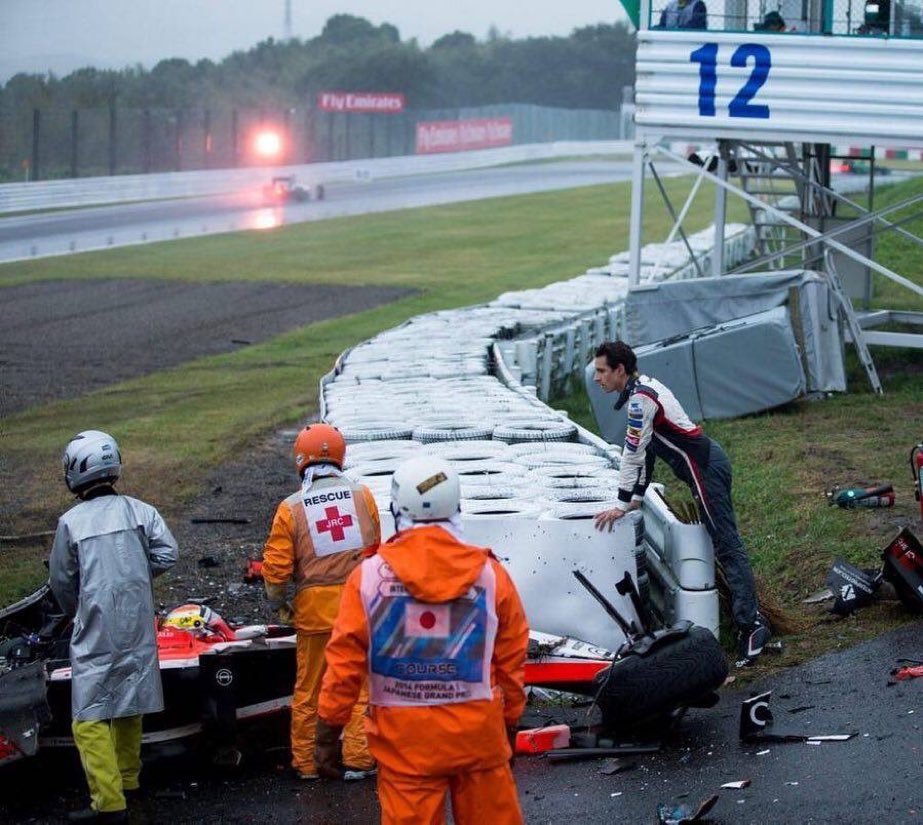
Probablemente la imagen más desgarradora de los últimos años en F1, hoy hace 12 años del accidente de Bianchi en Japón, ante la atenta mirada de Adrián Sutil.
Lap 18 from #93 should have Martin, at least for the Japanese Grand Prix! But Martin pulls four tenths back in the next 2 laps - still mentally there….