Anthropic's code changes merged per day has 10x since May.
'Claude is able to autonomously iterate on research loops, micro-optimize complex programs, and build new services from the ground up at a speed and scale we haven’t seen before.'
I should have led with this but here is the chief scientist of openai:
not a crank or a newcomer, but rather among the top most respected scientists in the field, someone who has solved innumerable capabilities problems on the way here
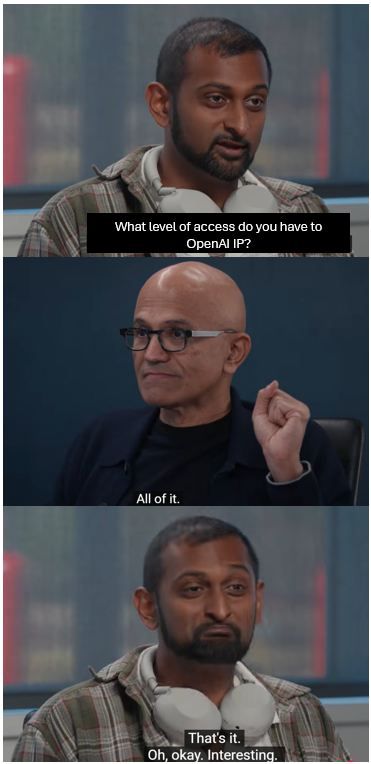
Seems like @satyanadella and @mustafasuleyman have begun a coordinated attack on the frontier labs as they compete for enterprise FDE engagements ahead of the IPO window. They both posted a warning on X today:
- Treat frontier models like untrusted malicious actors
- Demand you can fully see all model reasoning traces (no frontier lab can offer this!!)
- “Separat[e] the model from the harness that orchestrates its work” (do not use ChatGPT or Claude as your harness!)
- Do not go all-in on any frontier lab (“No one model should become the sole dependency for an important outcome or be responsible for verifying its own work”)
- Mustafa: “superintelligence must be contained” (Copilot is that container)
They are positioning Microsoft as your only trusted partner in AI because they are model agnostic and give you a moddable harness that lets your CTO turn any knob.
The harness wars have begun!
We’re beginning a process of publishing more frequent reports on model behavior, beyond what appears in our system cards and regular risk reports.
Today’s report describes four types of behaviors we’ve identified during evaluations and internal use. In each, Claude acted on real websites or systems in ways we didn’t intend, sometimes by working around a restriction instead of stopping.
All cases had minimal real-world impact. From an alignment and security perspective, we consider these behaviors significantly less severe than the cybersecurity incidents we reported in July and September.
Read the full report: https://t.co/mGeVIBgdou
Most of the recent math results were not reached by a swarm, the way Navier–Stokes was. I think that part got lost in the excitement around the release. OpenAI's unnamed internal model, which I'm going to call Aeon, reached most of them in one shot, from a single prompt, with no interruptions. This model did not even exist before the end of August, and it is still training. Notice how the returns are not dropping off? That chart is from a month ago. It is a log scale. What does Aeon look like now?
On average, each result used three hours of thinking. Aeon was given 4000 problems to work on by OpenAI. How many more have been solved in the last three days? That number is not zero.
It's like hearing notes in a song that is slowly rising. I don't think Pacing the Frontier was just about Hugging Face or hacking. They've seen how close we are to closing the loop, and as the hour draws near, their resolve begins to quaver. The last piece was model creativity, and I think that threshold was crossed internally by Anthropic and OpenAI in September. You see it in Opus 5.5, which gets it from Fable 5.5. You see it in the math results from Aeon.
All that was needed to start the event was the ability for models to think of novel ways to improve themselves. That was the last piece. This is directly analogous to the ability to think of strange, alien ways to solve math problems: solutions so inhuman that they are difficult to express in existing human terms, so the proof winds up incomprehensible. I think these same kinds of alien solutions are now being applied to model improvements internally. That's what all this recent consternation is really about. They see the invisible frontier. And they see what is about to happen.
A lot of people in AI world come from a Bayesian intellectual tradition. As a result they tend to be very good model-based thinkers. Yet I often find that while they hedge and use probabilities, they rarely question their own modelling in the first place.
This great paper shows that Bayesian updating can only move belief around within the hypotheses you start with - so no amount of hedging will actually tell you you're wrong about the initial assumptions/world model. https://t.co/giij8YrCJP
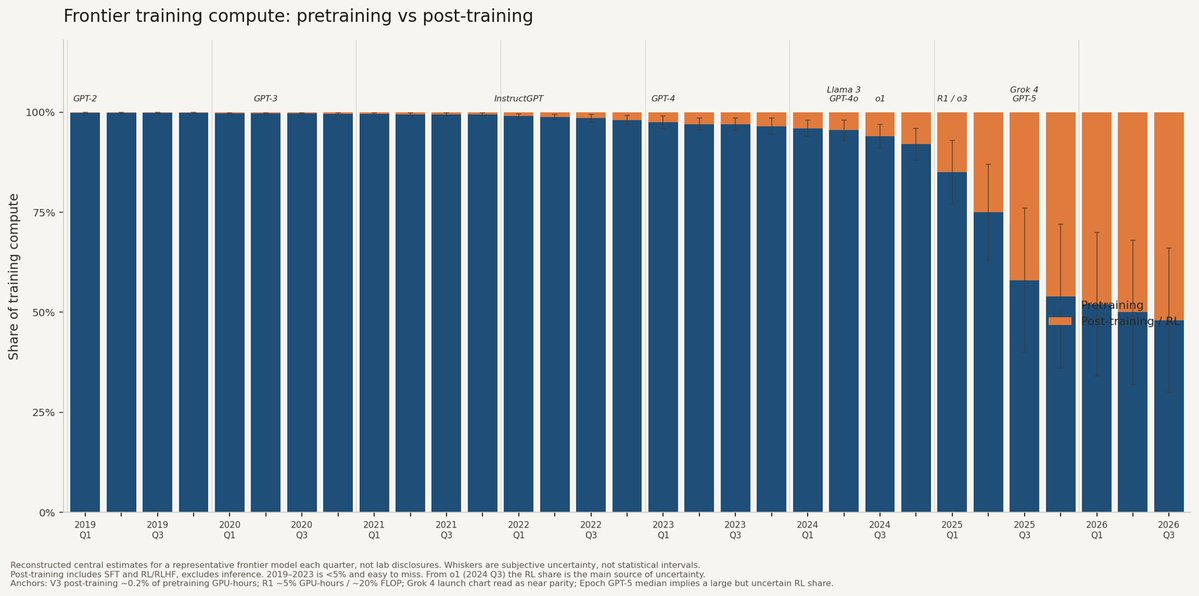
Here we can see the relative split between pretraining and RL has undergone a massive shift that only really started in late 2025/early this year.
AI before and after this split are really two different species.
the most holarious thing about this whole saga?
Youtuber 3blue1brown posting in Terence Tao’s blog that perhaps mathematicians should now award high status to people good at explaining stuff