Más sobre NeuroCovid
🔺🧠🔻LA AGRESIÓN INVISIBLE: NEUROTOXICIDAD INDEPENDIENTE DE LA REPLICACIÓN EN SÍNDROMES NEUROLÓGICOS POSTINFECCIOSOS
🧵1⃣Artículo de 5 investigadores de la Universidad de Hannover, Alemania
https://t.co/z8ElrGsQu2
🟫🟦🟨BASES MOLECULARES DE LOS CAMBIOS CONDUCTUALES Y COGNITIVOS INDUCIDOS POR VIRUS NEUROTRÓPICOS
🧵1⃣8 investigadores de Francia, EEUU y Alemania
https://t.co/ELjU2CAbBz
✴️🧠✴️VÍAS DE NEUROINVASIÓN DE DIFERENTES VIRUS NEUROTRÓPICOS (incluido Sars2)
Los virus neurotrópicos emplean distintos mecanismos para invadir el sistema nervioso central.
🧵1⃣Artículo de 8 investigadores de centros de Francia, EEUU y Alemania
https://t.co/ELjU2CAJr7
This new study is particularly interesting because it connects with something I’ve been reflecting on recently.
What if people with Long COVID and ME/CFS have a persistently altered inflammatory baseline?
The fact that immune biomarkers don’t correlate with symptom severity doesn’t necessarily mean these alterations are irrelevant. Perhaps measuring inflammation at a single point in time isn’t enough.
What if the key lies in how an already activated immune system responds to additional stimuli, and what happens when that response subsides?
In my recent Substack article, I explored this possibility by drawing parallels with autoinflammatory diseases such as familial Mediterranean fever.
My hypothesis is that persistent immune activation could make relatively small triggers more likely to cause severe exacerbations. And when the flare ends, patients may simply return to their chronically altered inflammatory baseline rather than normal physiological homeostasis.
Perhaps we need to study not only baseline inflammation, but also how immune activity changes before, during, and after symptom flares.
I explore this idea in more detail here:
https://t.co/ZKVwViM1Hk
El virus de Covid ha evolucionado a un punto en que ahora es 3 veces menos reconocible por los linfocitos.
https://t.co/SuYEpvz7TN
Al ser menos reconocible, puede “despertar” con más facilidad a otros virus que estaban en el cuerpo en estado de latencia.
https://t.co/1Kh1vdNRPk
👁️ Scientists have unlocked the secret to natural eye repair by removing a single protein that blocks the retina from regenerating.
For decades, medical science operated on the assumption that mammalian eyes could not repair themselves once vision loss occurred. Unlike zebrafish or amphibians, human retinas lack the innate ability to regrow damaged cells, rendering conditions like macular degeneration and glaucoma largely irreversible.
However, researchers have identified a key biological obstacle preventing this natural repair process: a protein named PROX1 that acts as a strict molecular stop sign inside retinal support cells.
By developing a targeted therapy to neutralize this protein, scientists successfully prompted mouse retinas to reprogram their own cells and naturally rebuild light-sensing tissue.
The intervention led to long-term vision recovery, proving that the cellular machinery for eye regeneration was merely dormant rather than lost. This breakthrough marks a monumental shift in ophthalmology, offering real hope that future treatments could actively restore sight rather than simply slowing down its decay.
source: Kim, M., Lee, E. J., & Kim, J. W. PROX1 inhibition restores vision through retinal neural regeneration. Nature Communications.
📊 Un informe de expertos integra las perspectivas de la investigación, la atención sanitaria y las personas afectadas por #COVIDpersistente para analizar las principales carencias y establecer prioridades de actuación
https://t.co/qSoHKhNvF5
#PostCOVID19#SARSCoV2
Does COVID-19 Vaccination Protect Against Post-COVID Cardiovascular Conditions?
🚨COVID vaccines don’t just stop severe infection, they appear to cut the risk of post-COVID heart damage (heart failure, arrhythmias, MI) by up to 65% in observational data. Four of nine Bradford Hill criteria for causality are met. Full immunisation + avoiding reinfection are your cornerstones!
➡️This interesting qualitative Brazilian review evaluates whether COVID-19 vaccination causally reduces the risk of post-COVID cardiovascular conditions (e.g., myocardial infarction, heart failure, arrhythmias as part of post-COVID condition/PCC).
➡️Using Bradford Hill criteria (BHC) and the sufficient-component cause (SCC) model, the authors synthesised literature from 2020–2025 (10 studies, including cohorts and meta-analyses).
➡️Results:
→Vaccination met four of nine BHC as a protective factor:
- Strength of association (e.g, U.S. data: RR 0.49 at 28 days and 0.35 at 90 days for post-COVID heart disease, Hong Kong: up to 66% reduction with three doses),
- Consistency (across U.S., China, Argentina cohorts of ~1 million people),
- Temporality, and
- Biological gradient (greater protection with more doses or more recent vaccination),
- Plausibility, coherence, and analogy were partially met (via reduced viral load, lower inflammation, and parallels with influenza vaccine),
- Specificity and experimental evidence (no dedicated RCTs on post-COVID CV outcomes) were not met,
➡️The SCC model positions vaccination as a preventive component that can interrupt pathways starting from prior infection,
➡️Reinfection remains a risk factor even in vaccinated individuals,
➡️Overall, vaccination’s benefits extend beyond the acute phase to lower post-COVID cardiovascular morbidity.
‼️So, COVID-19 vaccination meets key epidemiological criteria as a causal protective factor that reduces the risk of post-COVID cardiovascular conditions, making complete immunisation and reinfection prevention essential to cut long-term morbidity.
‼️This further supports practical decisions: staying up to date with COVID vaccination can lower not only acute severe disease but also longer-term cardiovascular complications after infection. It reinforces the value of layered prevention (vaccination + measures to reduce reinfection risk) for people WITH or WITHOUT preexisting heart conditions, as post-COVID CV issues contribute to ongoing morbidity and mortality.
Quote: “Comprehensive immunisation strategies and reinfection prevention are essential to mitigate the burden of post-COVID conditions”
#AvoidSars2 #AvoidReinfections #VaccineUpdates
https://t.co/CaW7Bj9ume
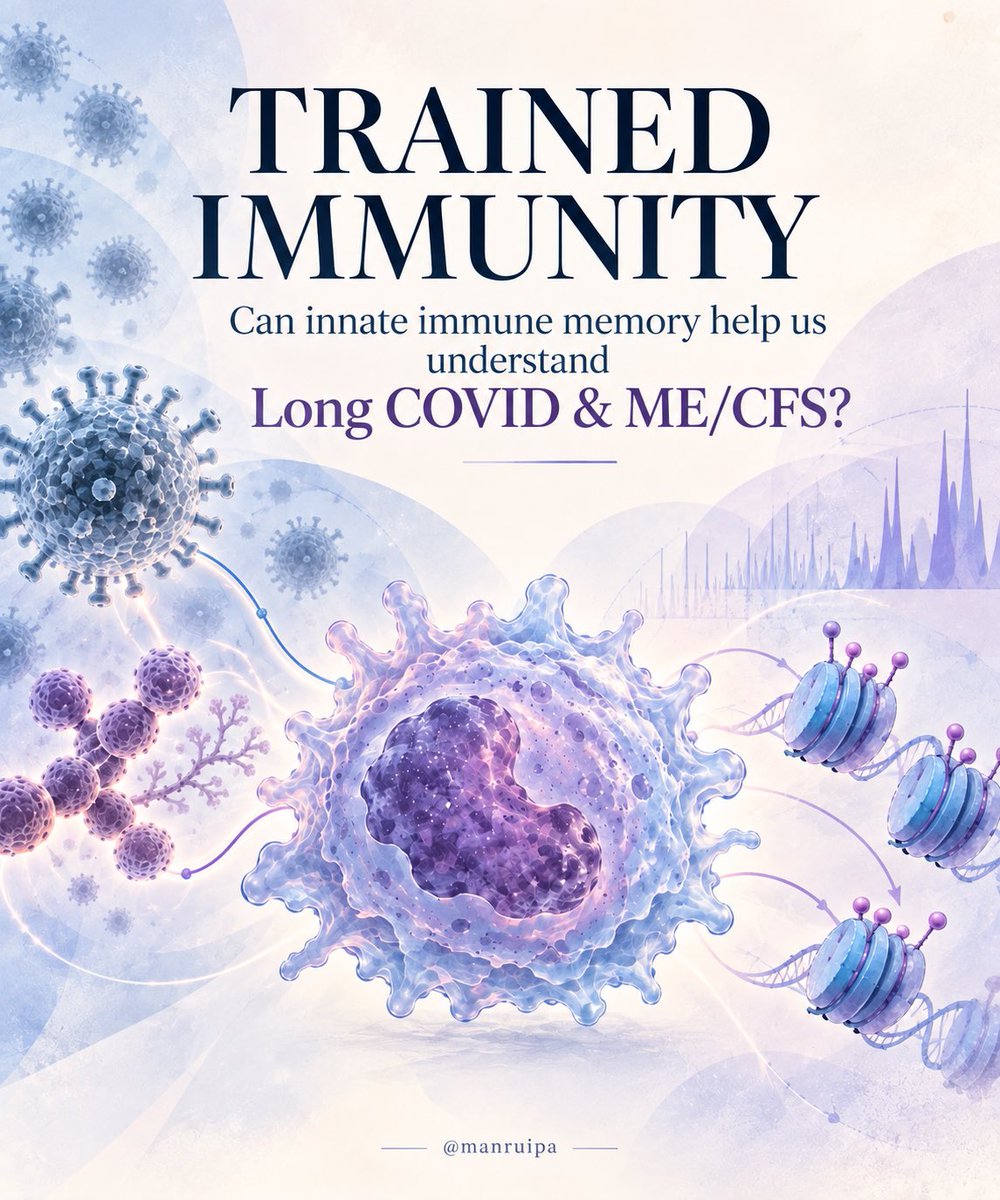
Can the innate immune system remember? How trained immunity could change the way we fight infections
1/
🔴 What if an infection you had in the past could change how your immune system responds to a completely different pathogen years later?
We usually associate immune memory with antibodies and T cells. You encounter a pathogen, adaptive immunity learns its antigens, and the next encounter triggers a faster response.
But innate immunity can also retain a kind of memory.
Not antigen-specific memory in the classical sense, but lasting metabolic and epigenetic changes that alter how strongly innate cells respond to a future challenge — sometimes even when that second pathogen is completely unrelated to the first.
This is called trained immunity, and I think it opens one of the most fascinating questions in modern immunology: could we eventually prepare the immune system for infections it has never encountered? 🧵
BREAKING: Our study revealing that spike protein drives PRION-LIKE protein misfolding has now been PEER-REVIEWED and PUBLISHED.
BILLIONS of people were exposed to LAB-MADE spike protein containing PRION-LIKE DOMAINS capable of promoting dangerous protein clumping.
This helps explain spike-associated CREUTZFELDT-JAKOB DISEASE, amyloid microclot formation, large WHITE FIBROUS CLOTS, and progressive multi-organ damage.
Those responsible must be held to account.
@Docjohnc@P_McCulloughMD
🔬 Con motivo del #DiaMundialdelAlzheimer, volvemos a unir fuerzas con @caixabank para impulsar una nueva edición de la campaña «La investigación en Alzheimer tiene nombre y apellido» y contribuir al avance de la investigación de esta enfermedad.
🔗: https://t.co/ay21iY6mU7
🏥🇺🇸"Overall, 11.3% of HCP reported persistent Long COVID symptoms. These findings underscore the ongoing impact of Long COVID on HCP, highlighting its potential to place a substantial burden on this essential workforce long after the initial infection".
🏥🇺🇸🏥PERSONAL SANITARIO DE EEUU: COVID PERSISTENTE EN INFECTADOS 2022-2024
🧵1⃣Artículo de numerosos investigadores de múltiples centros
https://t.co/3tcRfrPe5z
One respiratory virus may temporarily “lock the door” against another.
➡️ A new study reports that prior RSV infection significantly suppresses subsequent SARS-CoV-2 replication in human airway epithelial-cell models.
The effect appears to involve innate immune priming, particularly induction of the interferon-stimulated antiviral protein PLSCR1. 1/
🔬 La fatiga cognitiva del Long COVID podría estar relacionada con cambios medibles en el flujo sanguíneo cerebral.
Un nuevo estudio con fMRI aporta otra pieza al rompecabezas 🧵👇