@JamesOConnorTD for speed / cost & to circumvent planning & other legal issues - might it make sense for Ireland / a semi-State to explore building a second SMR on the Welsh site and run an inter-connecter ? Like we import nuclear from France, except we try own the asset too.
The UK have been open to selling / using capital from 3rd parties for its nuclear industry in the past - a hybrid public / private model. Rolls-Royce estimating the cost of a reactor unit at £2-3bn.
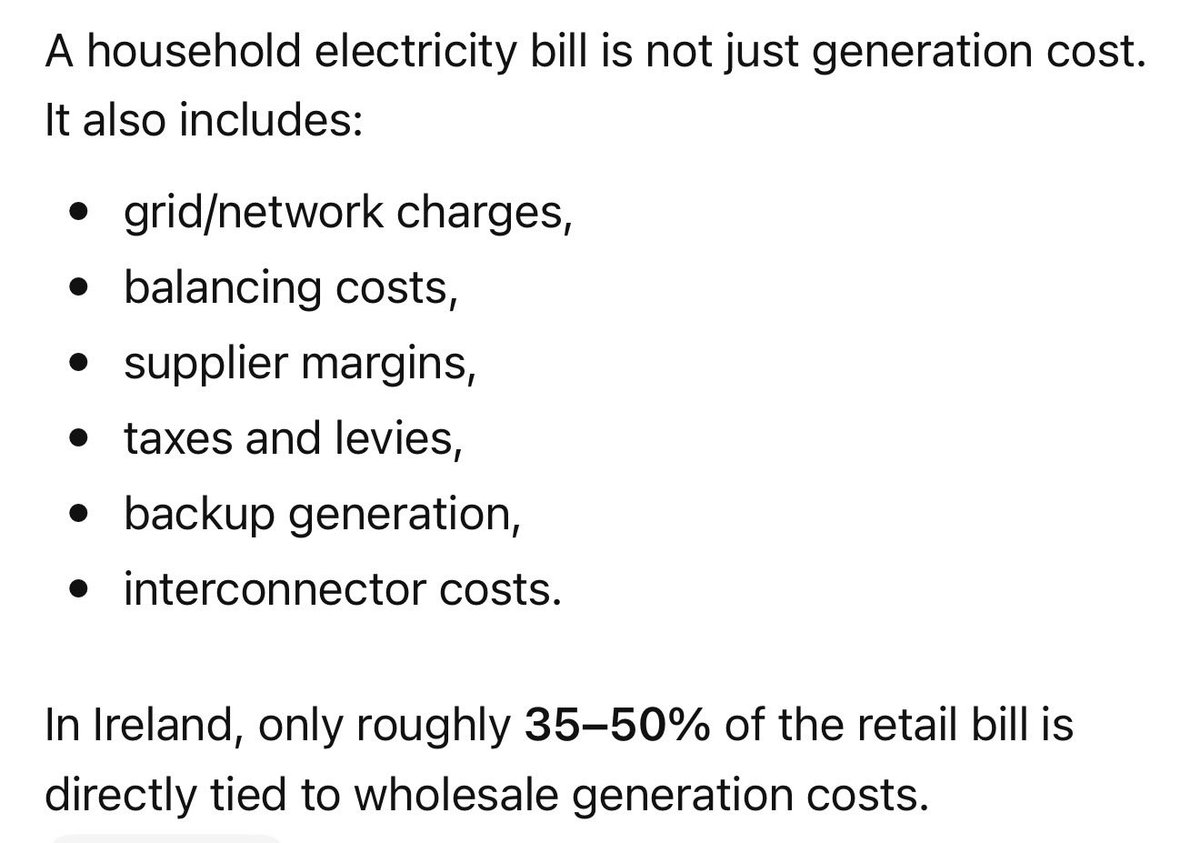
There’s a potential path here for households having the cheapest electricity in Europe & diversified energy security. It seems like we have ~2m households.
Some AI calculations here :
@karldeeter And Aontu are Left economically and will support a SF led Left coalition next time - which will mean more taxes for working families presented as wealth / asset taxes
This is a v. smart observation on spending cuts. Presumably the Government is modelling where & how to cut 10-20% in spending fast if needed ? All elected reps should be asked this question - “if you had to cut spending, what’s your plan..”. I’d wager nearly all would land on borrowing & tax increases to cover the gap. A bunch of smart business folks are saying the economy has the feel of ‘06.
As a country, we need to decide where the future of our economy lies, we can’t trust it to the lads who can’t build a shed for less than €450000
We need to consider our strengths and play to them, and build our economy around that.
As a minimum we need real conversations on:
- Mass producing all the food we can and becoming a breadbasket
- Complete energy security through oil, gas and nuclear
- Attracting tourism
- Can we really compete on AI or has the ship sailed
- What tertiary services will AI require and can we corner one of those markets
- If we’re going to lost lots of jobs, we need to look at reversing tax individualisation
- How can we reduce spending by 40%
Why is Government information still so fragmented across reports, PDFs, portals and departments and almost inaccessible to taxpayers..?
We should build an open-source Irish public-sector LLM so taxpayers can query / access government information in one place
Presumably something that could be advanced by the OGCIO - Office of the Government Chief Information Officer - given its role within the Department of Public Expenditure
I’ve been analysing purchase order and payment flows linked to MetroLink.
Published data shows the “client partner” consortium for the MetroLink project involves a substantial workforce. I asked how many people are involved in that contract and how the scale of that activity is being managed.
The response indicated that, at peak, up to 1,000 people may be engaged across planning, design and tender preparation.
Major infrastructure projects require specialist expertise. But at this level of activity, clear oversight, resource management and coordination are essential.
This line of questioning was only possible because TII is now publishing detailed purchase order data which strengthens scrutiny of large-scale public projects. The Q3 and Q4 data for 2025 is out and can be found on the tracker.
New Data:
Q3 2025: 17.51 million
Q4 2025: 38.77 million
This now bring the total to 86.6 million for 2025 and now totaling over 111.6 million for the whole period.
This is actually true on the ground - if you’re raising from angels you’re competing with other less risky asset classes. I know an investor who’s put millions to work in startup bets over +10 years and hasn’t had a power law winner and underwater across his portfolio. You could say he’s a bad picker, but the chances of returning a decent compounding return of say 5% - like an investment property or ETF - are massively against you. Here’s how the power law maths work across a portfolio assuming 1m over 10 years - 20 x 50k bets :
I used to vote & donate to the Party - no more under this leadership. These promises ring hollow - successive budgets and Ministerial inaction have made clear that the Party talks about helping working families but simply taxes them more. Name the Top 3 policies implemented by Government in recent years that has benefited homegrown businesses & starter job creation for the young people of Ireland - please share data supporting any purported benefits ?
“Make no mistake, this is one of the largest sustained transfers of wealth from a general population to a concentrated asset-holding class anywhere in the developed world. And if you’re not angry about this, then you should be!”
My follow up essay: Ireland's Failure Premium. To answer the question a lot of people have asked me: So where the hell does all of our money go, if it's not into creating infrastructure and a high living standard?!
[The short answer is: someone's pockets. Just not yours...]
Such a brilliant thread - the same can be said for Ireland and its support of homegrown talent & startups :
“There are two ways to reduce inequalities. Leveling up, and leveling down. These are two opposing philosophies, and the choice between them determines a country's trajectory…”
Bravo @brivael 👏
C'est exactement la phrase qui résume tout le débat. Et elle mérite d'être développée parce qu'elle pose le bon cadre, celui que la France a oublié depuis 40 ans.
Il y a deux façons de réduire les inégalités. Le nivellement par le haut, et le nivellement par le bas. Ce sont deux philosophies opposées, et le choix entre les deux détermine la trajectoire d'un pays sur un siècle.
Le nivellement par le haut, c'est tirer les pauvres vers le haut. On accepte que des gens deviennent très riches, parce que leur richesse est créée, pas extraite. Et en créant cette richesse, ils créent des emplois, des produits, des infrastructures, des innovations qui élèvent le niveau de vie de tout le monde. Le pauvre d'aujourd'hui vit mieux que le bourgeois de 1900. Il a un smartphone, l'eau courante, l'électricité, l'accès aux soins, l'espérance de vie de 82 ans. Tout ça a été produit par des entrepreneurs qui sont devenus riches en le produisant.
Le nivellement par le bas, c'est l'inverse. On refuse que des gens deviennent très riches, par principe moral. Donc on taxe, on régule, on confisque. Le résultat n'est jamais que les pauvres deviennent riches. Le résultat est toujours que les riches partent ou ne se créent pas, et les pauvres restent pauvres. Mais l'écart se réduit, donc politiquement on peut dire qu'on a "réduit les inégalités". L'égalité dans la médiocrité partagée.
Le test empirique est imparable. Les États-Unis ont produit Bezos, Musk, Zuckerberg, Gates. Ils ont aussi un SMIC effectif, une fois converti en pouvoir d'achat, supérieur au nôtre. Le pauvre américain a une voiture, un grand frigo, et accès à des biens qu'un cadre français ne peut plus se payer. La Suisse, qui a refusé de taxer ses riches, a un salaire médian deux fois supérieur au nôtre. La France, qui a méthodiquement chassé ses riches depuis Mitterrand, a vu son pouvoir d'achat médian stagner pendant que celui de l'Allemagne, de la Suisse et des US explosait.
C'est ça le drame français. On ne s'est pas appauvri en chassant les riches. On a appauvri les pauvres en chassant les riches. Parce que les riches ne sont pas des oisifs assis sur un tas d'or. Ce sont des gens qui dirigent des entreprises, créent des emplois, paient des salaires, lèvent des capitaux, prennent des risques. Quand ils partent ou ne se créent pas, ce sont les emplois, les salaires et les capitaux qui partent avec eux.
Il faut vraiment intégrer ça : la richesse n'est pas un gâteau fixe qu'on se partage. C'est un gâteau qui grossit ou qui rétrécit selon les règles du jeu qu'on impose. En France on a passé 40 ans à punir ceux qui font grossir le gâteau, en se disant que ça ferait des plus grosses parts pour les autres. Résultat, le gâteau a rétréci pour tout le monde, sauf pour la classe des fonctionnaires d'État protégés du marché.
Et la dernière chose, qui devrait être enseignée à l'école. Pour qu'il y ait des moins pauvres, il faut qu'il y ait des plus riches. Ce n'est pas un slogan, c'est une identité comptable. Si vous voulez que le SMIC monte, il faut que la productivité monte. Si vous voulez que la productivité monte, il faut des entreprises qui investissent. Si vous voulez des entreprises qui investissent, il faut du capital. Si vous voulez du capital, il faut des gens qui ont accumulé des fortunes et qui acceptent de les risquer plutôt que de les planquer.
Tous les pays qui ont sorti leurs populations de la misère, sans exception, ont d'abord laissé émerger des riches. Coréens, Taïwanais, Singapouriens, Polonais, Chinois post-1978. Aucun pays n'a jamais enrichi ses pauvres en empêchant l'enrichissement de ses entrepreneurs. Aucun. Zéro. C'est l'expérience la plus massive de l'histoire des sciences sociales, et elle est sans appel.
Donc oui, qu'il y ait des gens riches ne devrait poser de problème à personne. Ce qui devrait poser problème, c'est de vivre dans un pays où on n'arrive plus à en produire.
This is great lads ! In startup there’s a thing called “building in public” - where you take folks on the journey with you publicly, the good & the bad. Be specific. Name your Top 10 policy objectives / problems to solve - go after your Top 3 in the weeks / months ahead and show us how it all works in the Party & Coalition. Where and how you’re being blocked - what’s the process - full transparency. Folks will get behind you.
@declanganley@defenceforces This is a failure of Statescraft and wildly disproportionate - sending the army in against your own people, a new low for this Government.
This is an overreaction by you and reflects poor leadership - dial down the confrontational tone. These are Irish workers & taxpayers afraid and under pressure. They get the benefit of the doubt. Framing them as the villains here is not a vote winner. Lead and go help solve the problems - it’s always a talking solution.
In startup, this is moving from a transaction fee model to a recurring SaaS model - Government is growing more seats and revenue predictability. I expect once you model this out the unit economics are worse for the taxpayer - but more tax / profit over the “users” lifetime.
Can anybody name the Minister for Enterprise, Tourism and Employment - can anybody name the top 3 policy initiatives that this and previous Governments have successfully implemented to support Irish SMEs - where are representative organisations like ISME or SFA on any of this ? No plan, no vision - just blunt reactive policy like Vat cuts for hospitality or small % R&D credit increases (do SMEs ever claim these ?). Entrepreneurs relief should be radically reworked to incentivise reinvestment in startups. Are LEOs working - what does success look like for LEOs ? Has any startup used KEEP ? What are the top 10 regulations this Government have or will remove to support SMEs and in what industries ? Who in the Cabinet has ever run a business (being a landlord doesn’t count) ? AI is coming for starter jobs in corporates - how will young workers get a start, what’s the plan ? I know - let’s commission a report and set up a working group of stakeholders and do nothing. Celebrate & support the job creators - not just in words, but action ! Ps - it’s @peterburkefg
An honest response would’ve been acknowledging that the speed & scale of immigration - population increase of ~20% in 10/15 years - is causing very real challenges & demands on housing, public expenditure etc against the wishes, based on polling, of a large majority of the population who want immigration reform quickly - that he would try & sell these challenges as positives tell us all we need to know - it’s only going to get worse under this Government and current leadership. But to be fair - he did well again this year overall. Better him than Harris.



![SineadOS1's tweet photo. My follow up essay: Ireland's Failure Premium. To answer the question a lot of people have asked me: So where the hell does all of our money go, if it's not into creating infrastructure and a high living standard?!
[The short answer is: someone's pockets. Just not yours...] https://t.co/Q1W505TKfr](https://pbs.twimg.com/media/HG_i05kaAAIBGq1.jpg)