7 Layers Behind Aave's $212M liquidation event
Between June 1 and June 6, the crypto market went through a sharp correction, with many major assets falling between 20% and 30%.
More than $212M of collateral was liquidated across @aave in just six days.
The surprising part is that $201.12M of debt was cleared and not a single dollar of bad debt was created.
At first glance, liquidation sounds like a sign of stress.
But, liquidations are a normal part of any overcollateralized lending system.
In my view, the more interesting story is how Aave's liquidation engine absorbed that stress, recovered debt, and kept the system healthy.
This was essentially a large-scale stress test for Aave's liquidation system.
Let's dive in.
1/ From June 1 to June 6, a 20-30% market drawdown triggered $212.35M liquidation volume across @aave markets.
▪️ 10,871 liquidations processed
▪️ $1.12M in liquidation fees captured by the DAO
▪️ $3.83M in SVR revenue, split between Aave DAO and @chainlink
▪️ Zero bad debt realized
Aave's liquidation engine performed as designed. Breakdown below↓
Bringing private credit onchain does not replace the traditional model. It strengthens it with greater transparency, verifiability, and operational efficiency.
More than $2.7B in credit extended through @paretocredit shows that this approach is starting to prove its value.
@M11Credit handles underwriting and risk management, while Pareto brings settlement, interest distribution, compliance, and reporting onchain.
This is no longer just a "private credit onchain" concept. It is real infrastructure supporting institutional credit at scale.
You want yields? Points? Giga-brain farming strats?
A place where both yield and points farmooors can enjoy the treat!
It's time for Yield Collective No. 49
Bring your wallet, let’s eat 👇
Bringing private credit onchain does not replace the traditional model. It strengthens it with greater transparency, verifiability, and operational efficiency.
More than $2.7B in credit extended through @paretocredit shows that this approach is starting to prove its value.
@M11Credit handles underwriting and risk management, while Pareto brings settlement, interest distribution, compliance, and reporting onchain.
This is no longer just a "private credit onchain" concept. It is real infrastructure supporting institutional credit at scale.
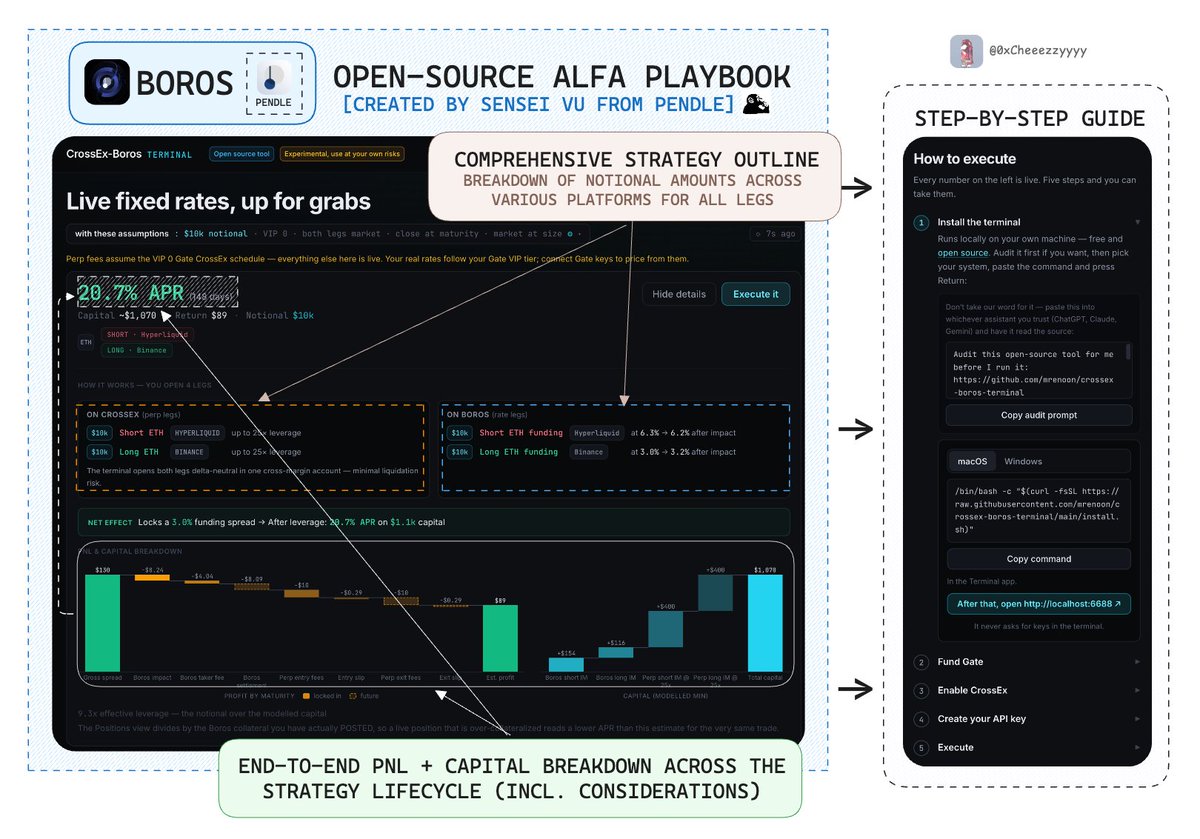
Pendle Sensei Vu just open-sourced an incredible alpha tool for @boros_fi, covering a range of S-tier strategies worth exploring.
For anyone looking to get started or simply level up their Boros strategy game this is probably one of the best resources available today.
In case you think it's another "do this strategy" kind of guide, it isn't.
It walks you through the entire execution lifecycle including:
🔹 Realistic notional sizes and capital requirements
🔹 End-to-end PnL projections with a full capital breakdown
🔹 Step-by-step execution guides across every platform involved
This gives you a much better understanding of not only the potential returns, but also the capital efficiency, risks + trade-offs before deploying a single dollar.
Ofc, executing these strategies still isn't entirely straightforward. Many involve multiple transactions across different protocols, which admittedly remains one of the biggest "inertia in trying".
But this is about as close as you can get to having a complete playbook.
If you ever had the thought to explore Boros' increasingly sophisticated yield strategies being built around them, this is def well worth bookmarking.
And if you're somehow still not following @gabavineb you probably should be.
He's consistently one of the best follows for anyone looking to deepen their understanding of Pendle's ecosystem + the more nuanced yield opportunities emerging across DeFi.
There is no bigger chad than him when it comes to @pendle_fi + Boros alfa 🫡
65.2% of Credible's total payment volume has settled on @solana
That's $611M in real payments moving through the network.
The number keeps growing as Credible opens new markets and connects more local payment rails, so businesses can move money globally while the payment feels local to whoever's making it.
Turns out fast, global settlement is a pretty good use case for fast, global rails.
$BUIDL, @BlackRock’s $2.6B+ tokenized money market fund on @securitize, is expanding to @tempo, a payments-focused Layer 1 blockchain incubated by @Stripe and @Paradigm.
RedStone's feed will enable the fund’s token to be put to work in DeFi on the network.
➥ best yield farming opportunities on tokenless
the opportunity set is better than I expected, but APY alone is a poor way to rank it
my higher-risk watchlist:
- @AccountableData USDC on Monad: 33.9% APY, $7.5M TVL
- @saturn_credit SUSDAT: 28.4%, $76.2M TVL
- @NestCredit NLCRD: 19.4%, $2.1M TVL
- @apyx_fi APXUSD: 13.9%, $153.1M TVL
- @tori_finance STRUSD: 13.1%, $25.2M TVL, 7D unstaking
these offer stronger airdrop optionality
but the risk is also clear with uncollateralized credit, thin liquidity, smart-contract exposure and possible depegs
for larger positions, I prefer deeper liquidity and yield backed by identifiable economic activity:
- @onrefinance ONYC: 11.7%, $244.6M TVL
- @MidasRWA mFONE: 10.4%, $70.3M TVL
- @3janexyz USD3/SUSD3: 6.8%-14.2%
- @Main_St_Finance MSUSD: 6.6%, $74.4M TVL
@Theo_Network also deserves attention, its products make sense from a macro perspective:
- thUSD earns around 5.4% from a managed gold carry strategy
- thBILL offers roughly 3.2%-3.35% through tokenized short-duration Treasuries
- StableEarn recently offered around 13.35% on USDT deposits
Theo has also launched a thUSD points program, so the yield and potential token exposure can be farmed together
i’m avoiding GMTrade despite the 55%-214% displayed APYs
Synthetic FX and commodity pools with only $1M - $3M in TVL are too speculative for me to treat as stablecoin farming
so to recap, my approach is simple:
• larger allocation to established pools with understandable yield
• smaller allocation to high-APY, early-stage protocols
• airdrop treated as upside, never as the reason the position is viable
a 3%-10% yield can be explained by Treasuries, credit or market-neutral strategies
when the APY reaches 20%-200%, i assume i’m taking significant risk until i can prove otherwise
This perfectly captures where I think DeFi is heading.
Crypto-native yield is reaching its limits.
The next stage of growth comes from bringing real-world cash flows on-chain and packaging credit and duration risk into transparent fixed-income products.
That’s how DeFi expands beyond crypto and starts absorbing real-world financial markets.
> @NestCredit x @paretocredit offers over 7% APY to @solana users through FalconX’s credit facility.
The rate is set monthly, while the yield comes from real lending activity rather than token emissions or funding rates.
This product was originally designed for institutions, but is now packaged as $nFXCF so onchain users can access it directly.
Institutional credit for retail users sounds pretty interesting.
.@solana users can now tap into institutional yield via @NestCredit
Exposure to @FalconXGlobal prime brokerage lending - predictable monthly returns, layers of structural protections.
Powered by Pareto onchain infrastructure.
⬇️
This perfectly captures where I think DeFi is heading.
Crypto-native yield is reaching its limits.
The next stage of growth comes from bringing real-world cash flows on-chain and packaging credit and duration risk into transparent fixed-income products.
That’s how DeFi expands beyond crypto and starts absorbing real-world financial markets.
The largest growth opportunity for DeFi is bringing Payments, invoice factoring and off-chain loan origination yield on-chain for everyone to access.
With the ability to package duration and credit risk, we can build fixed income products on-chain 👀
Stay tuned. DMs open
The largest growth opportunity for DeFi is bringing Payments, invoice factoring and off-chain loan origination yield on-chain for everyone to access.
With the ability to package duration and credit risk, we can build fixed income products on-chain 👀
Stay tuned. DMs open
An onchain policy engine is only as strong as the accuracy, speed, and depth of its input data.
Newton recently launched its mainnet beta, with RedStone and Credora selected as launch data partners.
@newton_xyz can be understood as a transaction-checking layer before a transaction gets settled. If a transaction meets the predefined conditions or risk policies → it gets cleared. If it crosses risk thresholds → it can be blocked or liquidated.
For these policies to work properly, the system needs reliable data. That is where RedStone and Credora come in.
> @redstone_defi provides verified price data, market data, PoR when needed, and specialized pricing methodologies for complex assets such as RWA, LST, LRT, and yield-bearing collateral.
> @CredoraNetwork adds the risk rating layer, helping the policy engine evaluate positions beyond price alone.
Put simply:
RedStone answers: "How should this asset be priced right now?"
Credora answers: "How risky is this asset or position?"
Newton turns both types of data into onchain actions: approve, block, or liquidate.
That makes it a notable direction for DeFi vaults, RWA, stablecoins, and AI agents.
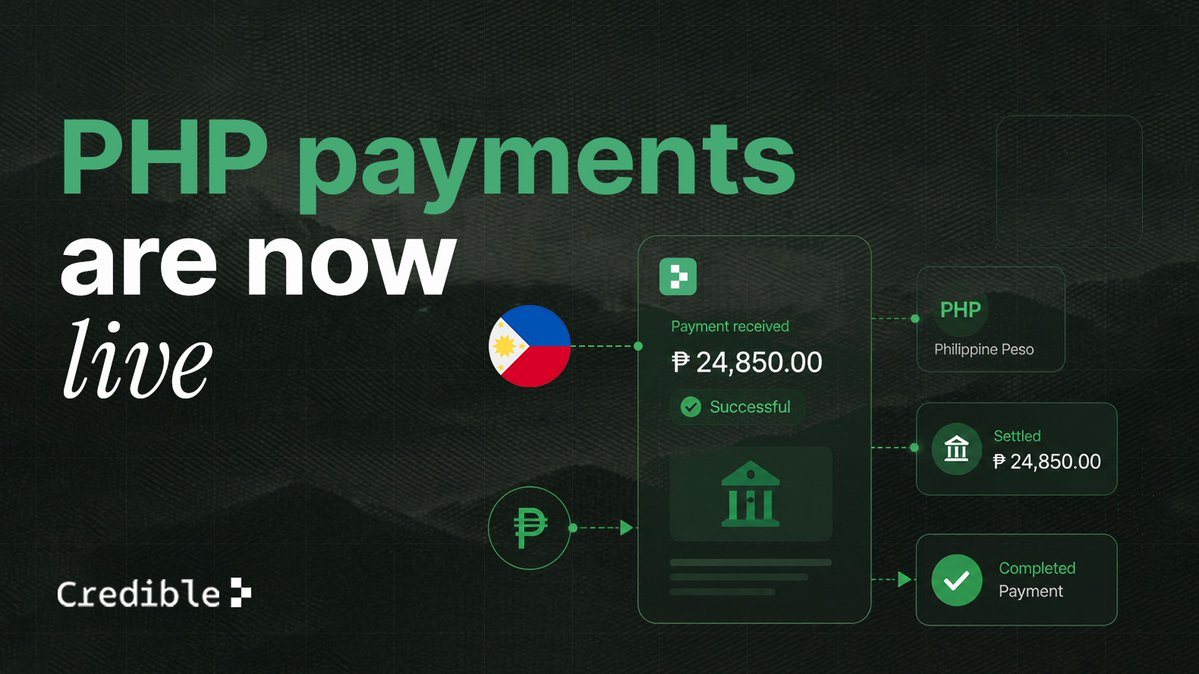
The Philippines is now live on Credible 🇵🇭
-PHP pay-ins ✓
-PHP payouts ✓
-Philippine peso (₱) support ✓
Businesses can now collect and send payments locally in the Philippines through Credible.
One more market for the Open Payment Stack!
.@solana users can now tap into institutional yield via @NestCredit
Exposure to @FalconXGlobal prime brokerage lending - predictable monthly returns, layers of structural protections.
Powered by Pareto onchain infrastructure.
⬇️
.@ethereuminsti announced its supporter coalition today. Tokenization, collateral, onchain settlement. Workstreams that have data requirements at every step.
The infrastructure is running on Ethereum. RedStone publishes NAV for several institutional funds, and the list is growing.